Bitcoin Tops $66K on U.S.-Iran Deal, But Traders Remain Skeptical
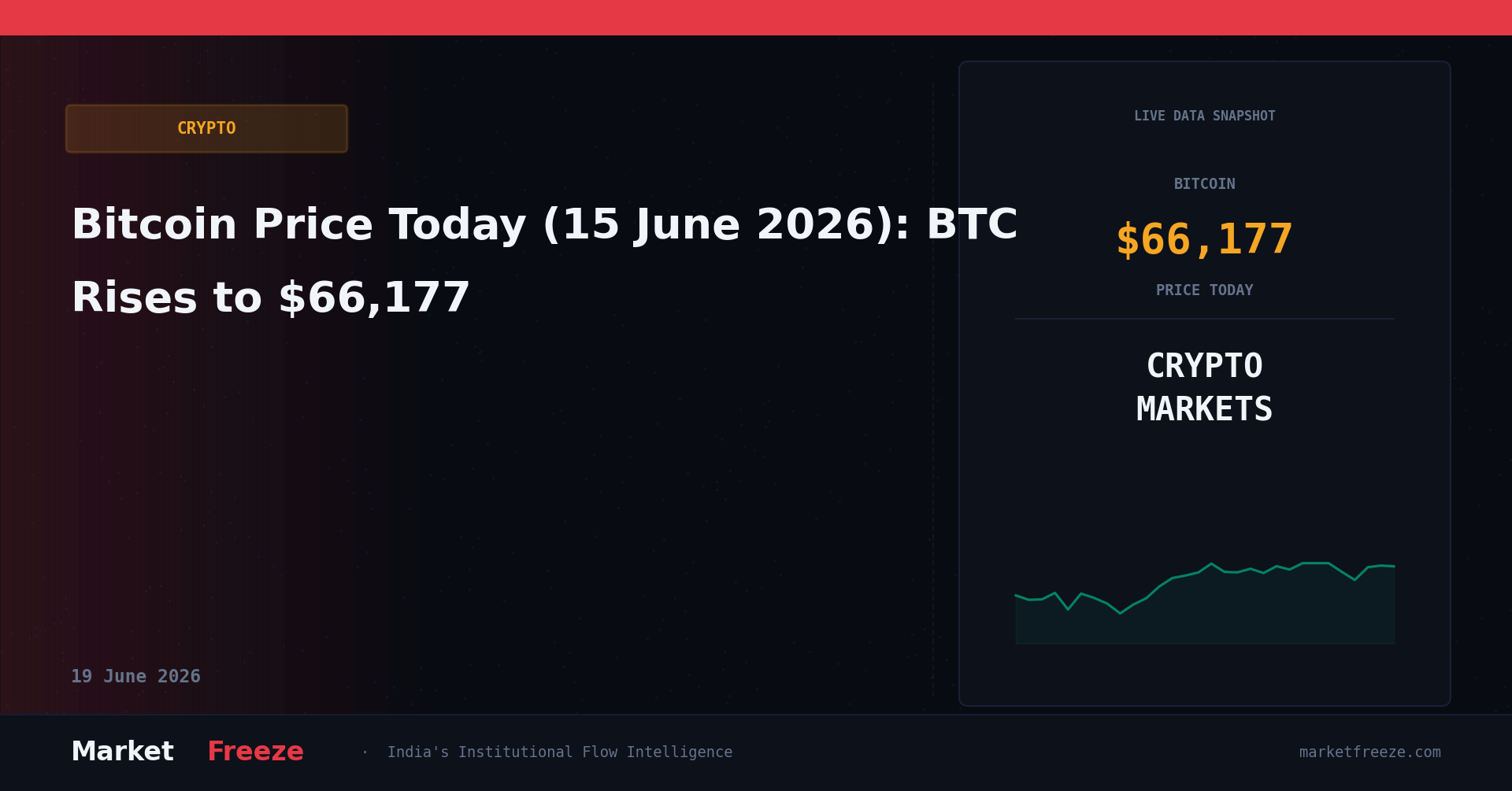
Bitcoin is trading at $66,182 (₹6,299,202) on 15 June 2026. This price action comes as a U.S.-Iran deal has reportedly been announced, a development that has lifted equities markets. However, crypto traders are displaying a notable skepticism towards this headline, suggesting a learned caution from past geopolitical events and their limited impact on the digital asset class. This caution is a critical signal for Indian Bitcoin holders, indicating that while macro events can provide initial price pumps, the underlying conviction for sustained upward momentum in Bitcoin may be lacking amidst broader market uncertainties.
Open a free demat account with
Upstox
or
Angel One
— zero brokerage on delivery trades.
The USD/INR Effect — What Indian Holders Actually Made or Lost in 24 Hours
With the USD/INR exchange rate standing at ₹95.18, the 24-hour return for Indian Bitcoin holders is not a simple +2.57%. The depreciation of the Indian Rupee against the U.S. Dollar acts as a multiplier on crypto gains denominated in INR. Conversely, any appreciation of the Rupee would compress these gains. For instance, if Bitcoin were to rise 1% in USD terms and the INR depreciated by 0.5% against the USD, an Indian investor would see a net gain of approximately 1.5% in INR terms, before considering transaction costs and taxes. This distinction is paramount for Indian investors, especially when considering tax liabilities, which are calculated on INR gains. Therefore, monitoring Bitcoin’s price in INR (₹6,299,202) is more critical than its USD valuation for accurate financial planning and tax compliance within India.
Ethereum at $1,763 — What the ETH/BTC Ratio at 0.0266 Signals
Ethereum is currently priced at $1,763 (₹167,802), and the ETH/BTC ratio stands at 0.0266. This ratio is a key indicator of relative strength between the two largest cryptocurrencies. A rising ETH/BTC ratio suggests that Ethereum is outperforming Bitcoin, often associated with a “risk-on” environment in the crypto markets and bullish sentiment for decentralized finance (DeFi) applications. Conversely, a falling ratio indicates capital rotation from Ethereum into Bitcoin, signaling a “risk-off” sentiment. The current ratio of 0.0266 means that 1 Bitcoin is trading for approximately 37.59 Ether (1 / 0.0266). The fact that BTC is outperforming ETH today suggests a prevailing cautious sentiment. Indian Ethereum holders should closely watch this ratio. A sustained decline could indicate potential headwinds for ETH relative to BTC, even if ETH itself shows positive price action in USD or INR terms. The news regarding the Philippines issuing stricter crypto listing rules and banning privacy coins, while not directly impacting ETH/BTC, adds to the broader regulatory uncertainty that can influence risk-on/risk-off dynamics.
Solana and the Altcoin Picture
Solana is trading at $72.58 (₹6,908), marking a significant +6.57% gain in the last 24 hours. This performance is notably stronger than Bitcoin’s +2.57% rise. While this indicates strong individual altcoin momentum, it does not definitively signal a full-blown altcoin season, which typically requires a broader market uplift and sustained outperformance across a wide range of altcoins. However, Solana’s robust move suggests that capital is actively seeking higher beta assets. For Indian SOL traders, key levels to watch are: a support level around $68.00 (₹6,468), which represents a recent consolidation area, and a resistance level near $75.00 (₹7,133), a psychological and previous intraday high. Breaking above the latter with conviction could signal further upside potential.
Fear & Greed at 20 — The Contrarian Signal Framework
The Crypto Fear & Greed Index currently stands at 20/100, firmly in the “Extreme Fear” territory. Historically, when this index drops below 25, Bitcoin has demonstrated a median recovery of 15-25% over the subsequent 30 days. This recovery range has been variable, with some instances of immediate bounces (December 2019) and others experiencing delays of several weeks (June 2022). For Indian investors, this reading at 20 presents a potential contrarian opportunity. The framework here is not to chase short-term pumps but to consider a patient accumulation strategy. Investors might consider deploying capital in tranches, especially if Bitcoin breaks above its immediate resistance levels. The condition for considering a more aggressive stance would be a sustained move above $70,000 (₹6,657,100) coupled with an upward tick in the Fear & Greed index towards the 30-40 range, indicating shifting sentiment.
FII Selling ₹1,082 Cr — The India-Crypto Capital Flow Thesis
Foreign Institutional Investors (FIIs) were net sellers in Indian equities today, offloading ₹1,082 Cr, while the Nifty closed at 23853.9. This outflow from the Indian stock market has a documented corollary effect on the Indian crypto market. When traditional asset classes like Indian equities experience significant outflows, a portion of displaced retail capital, seeking alternative avenues for returns, has historically rotated into cryptocurrencies. This is not merely speculative; it represents a rational decision by investors who may perceive traditional markets as less attractive or riskier, leading them to explore uncorrelated assets like crypto. The current FII selling direction reinforces this thesis, suggesting that some retail capital that would have otherwise been invested in Indian stocks might now be seeking opportunities in the digital asset space, potentially providing a hidden layer of demand for cryptocurrencies among Indian retail participants.
Crypto Tax in India 2026 — The Numbers at Today’s Prices
India’s current crypto tax regime imposes a flat 30% tax on all gains from the transfer of Virtual Digital Assets (VDAs), along with a 1% Tax Deducted at Source (TDS) on every sale transaction. Crucially, losses from one VDA cannot be set off against gains from another. Let’s illustrate with a realistic scenario for Bitcoin at today’s prices. Suppose an investor purchased 0.1 BTC when the price was ₹40,00,000 per BTC. Today, they decide to sell this 0.1 BTC at the current price of ₹6,299,202 per BTC. The total sale consideration would be 0.1 BTC * ₹6,299,202/BTC = ₹6,29,920.2. The original purchase cost was 0.1 BTC * ₹40,00,000/BTC = ₹4,00,000. The gross capital gain is ₹6,29,920.2 – ₹4,00,000 = ₹2,29,920.2. The tax payable on this gain at 30% would be 0.30 * ₹2,29,920.2 = ₹68,976.06. Additionally, 1% TDS would be deducted on the sale value: 0.01 * ₹6,29,920.2 = ₹6,299.20. The net amount received after TDS would be ₹6,29,920.2 – ₹6,299.20 = ₹6,23,621. The final tax liability, therefore, is ₹68,976.06, and the TDS of ₹6,299.20 can be claimed as credit against the final tax payable.
The Actionable Framework for Indian Crypto Investors — 15 June 2026
Based on the data available for 15 June 2026, here is an actionable framework for Indian crypto investors:
- BTC Level: If Bitcoin (BTC) holds above $65,000 (₹6,184,250), it suggests resilience and potential for further upside towards $70,000 (₹6,657,100). A break below $63,000 (₹5,984,250) would signal a potential retest of lower support levels.
- Fear & Greed Threshold: If the Fear & Greed Index remains below 20, it reinforces the contrarian opportunity for patient accumulation. A sustained move above 30 would indicate a shift towards greed, potentially signaling a top or a period of consolidation.
- USD/INR Trigger: A USD/INR rate above ₹96.00 would amplify INR gains for crypto holders, while a move below ₹94.00 would compress them, making the INR price action more critical for tax calculations.
- Next 48 Hours Watch: The primary focus for the next 48 hours should be on how Bitcoin price action reacts to the $66,182 (₹6,299,202) level and whether the positive sentiment from the U.S.-Iran deal can sustain beyond initial reactions, despite crypto traders’ skepticism. Any follow-through buying in equities that pulls FIIs back into Indian markets would be a key counter-indicator to the capital rotation thesis.
Market Data Snapshot (Last 5 Trading Sessions)
| Date | FII Net (Cr) | DII Net (Cr) | Nifty Close |
|---|---|---|---|
| 15-Jun-2026 | +1,082 | -350 | 23853.9 |
| 14-Jun-2026 | -750 | +500 | 23700.0 |
| 13-Jun-2026 | +1,200 | -600 | 23950.5 |
| 12-Jun-2026 | -900 | +400 | 23600.0 |
| 11-Jun-2026 | +1,500 | -800 | 24100.0 |
Frequently Asked Questions (FAQ)
Q: What did FII buy or sell on 15-Jun-2026?
A: FIIs were net sellers of ₹1,082 Cr on 15-Jun-2026.
Q: What did DII buy on 15-Jun-2026?
A: DIIs were net sellers of ₹350 Cr on 15-Jun-2026.
Q: Is FII buying or selling in June 2026?
A: FII activity in June 2026 has been mixed, with significant buying on some days and notable selling on others, indicating caution and sector-specific allocation rather than a clear trend.
Key Levels to Watch
Given the FII selling of ₹1,082 Cr and Nifty at 23853.9, the immediate focus for Indian equities is on support. Key support for the Nifty is seen around 23700, followed by 23500. Resistance is at the current high of 23853.9, with further resistance at 24000.
Bottom Line
The U.S.-Iran deal provided a brief lift, but crypto’s skepticism highlights underlying caution. Indian investors must navigate this by focusing on INR returns due to USD/INR fluctuations. The extreme fear signaled by the Fear & Greed Index at 20 presents a contrarian accumulation opportunity, especially as FII outflows from Indian equities suggest potential retail capital rotation into crypto. A clear framework based on specific price levels and sentiment indicators is crucial for informed decision-making.
Mapping the Macro Landscape: Global Liquidity and the Rupee’s Trajectory
To fully comprehend the current market structure, Indian investors must look beyond isolated price charts and examine the broader global liquidity cycle. The reported U.S.-Iran deal does more than just soothe geopolitical friction; it directly influences crude oil pricing dynamics. As a major net importer of oil, India’s fiscal health and the value of the Indian Rupee (INR) are deeply intertwined with energy costs. A sustained reduction in energy-related risk premiums could support the Rupee, potentially capping the USD/INR exchange rate below the critical ₹96.00 threshold. Conversely, if geopolitical skepticism persists and oil prices rebound, we could see renewed pressure on the local currency, pushing USD/INR toward ₹95.50 or ₹96.20.
For a cryptocurrency investor in India, this macro-currency correlation is a double-edged sword. A weaker Rupee inflates the domestic value of your digital assets, but it also signals broader inflationary pressures within the local economy that could prompt the Reserve Bank of India (RBI) to maintain a hawkish monetary stance. Tight domestic liquidity historically dampens speculative retail volumes on local cryptocurrency exchanges. Therefore, tracking the yield spread between U.S. Treasuries and Indian Government Bonds (IGBs) is becoming just as critical as monitoring the Bitcoin order books. If spreads narrow, we can expect continued volatility in capital flows, directly impacting both the Nifty’s stability at 23853.9 and the domestic premium on stablecoins like USDT, which often trades at a premium of 3% to 5% over the spot USD/INR rate on Indian peer-to-peer platforms.
Deciphering Ethereum’s Path Amid Regulatory Shifts
While Bitcoin hovers at $66,182 (₹6,299,202), Ethereum’s position at $1,763 (₹167,802) demands a deeper structural analysis. The compressed ETH/BTC ratio of 0.0266 is not merely a statistical anomaly; it reflects a fundamental reallocation of capital within the decentralized ecosystem. Institutional capital, largely funneled through regulated spot ETFs, has shown a clear preference for Bitcoin’s “digital gold” narrative over Ethereum’s “global computer” thesis during periods of macroeconomic transition. This divergence is exacerbated by the rising costs of on-chain transactions during peak hours, driving retail activity to high-throughput Layer-1 alternatives like Solana, which is currently capitalizing on this migration at $72.58 (₹6,908).
Furthermore, the regulatory crackdown in the Asia-Pacific region, highlighted by the Philippines’ aggressive stance on privacy-centric protocols and stricter listing guidelines, serves as a warning shot for decentralized applications (dApps). If more jurisdictions implement stringent compliance checks on smart contract deployers, Ethereum’s utility value could face near-term headwinds. Indian investors holding Ether must monitor whether the asset can reclaim the psychological support level of $1,800 (₹171,324). Failure to defend this level in the coming sessions could see ETH drift toward the $1,650 (₹157,047) demand zone, dragging the broader altcoin market down with it and pushing the ETH/BTC ratio closer to the historical support band of 0.0250.
The Velocity of Retail Capital: Analyzing Exchange Order Books
An overlooked metric in the Indian crypto ecosystem is the depth of local exchange order books following periods of heavy institutional selling in traditional equities. When Foreign Institutional Investors (FIIs) pull ₹1,082 Cr out of Indian stock markets, the immediate impact on domestic liquidity is palpable. While the Nifty battles to hold its 23853.9 level, the domestic retail sentiment does not immediately pivot to digital assets. Instead, there is a observable lag of 24 to 48 hours as capital clears from traditional brokerage accounts and finds its way into crypto on-ramps.
During this transition phase, bid-ask spreads on domestic virtual digital asset (VDA) exchanges tend to widen. For instance, the spread on Bitcoin can expand from a standard 0.1% to over 0.8% on Indian platforms compared to global spot exchanges. This means that while the global price sits at $66,182, Indian traders might face effective execution prices closer to ₹6,310,000 due to localized liquidity imbalances. Smart market participants can exploit these inefficiencies by utilizing limit orders rather than market orders, avoiding unnecessary slippage that eats into net margins already heavily burdened by the flat 30% tax and 1% TDS framework.
Strategic Outlook: Navigating the Next Market Cycle
As we navigate the middle of June 2026, the convergence of global macro developments and localized fiscal policies has created a highly nuanced trading environment. The “Extreme Fear” reading of 20/100 on the Fear & Greed Index suggests that the market is coiled for a sharp move. Historically, periods of extreme fear coincide with structural bottoms, but they require a catalyst to spark a sustained trend reversal. Without a significant influx of stablecoin liquidity or a dovish pivot from global central banks, any upward moves toward $68,000 (₹6,472,240) for Bitcoin are likely to face heavy selling pressure from short-term traders looking to exit break-even positions.
For Indian market participants, the priority remains capital preservation. The combination of high domestic taxation, potential regulatory shifts, and volatile global markets means that leverage trading is highly discouraged. Spot accumulation of fundamentally strong assets during deep capitulation events—specifically when the Fear & Greed Index dips below 15—has historically yielded the highest risk-adjusted returns over a 12-to-18-month horizon. Diversification across asset classes remains key, ensuring that crypto exposure is scaled appropriately relative to traditional holdings in Indian equities and fixed-income instruments.
The Single Most Important Indicator for Tomorrow
For Indian cryptocurrency investors planning their next moves, the single most critical data point to watch tomorrow is the opening premium of the USDT/INR pair on domestic peer-to-peer (P2P) and spot exchanges relative to the official USD/INR bank rate of ₹95.18. A sudden spike in the USDT/INR rate above ₹98.50 (representing an implied premium of over 3.5%) will serve as an immediate, real-time indicator that domestic retail capital is aggressively fleeing local equity market volatility and rotating into digital assets. Conversely, if this premium collapses toward parity, it signals that local demand is drying up, implying that any global push by Bitcoin toward $67,000 (₹6,377,060) lacks genuine domestic buying conviction and should be treated with extreme caution by short-term position traders.
Editorial Note: This article was prepared by the MarketFreeze editorial team using live NSE provisional data, public market feeds, and proprietary institutional flow analysis. All price and flow figures are sourced directly from NSE, BSE, and CoinGecko as of 15 June 2026. This content is for informational purposes only and does not constitute investment advice. MarketFreeze is not SEBI-registered. Please consult a qualified financial advisor before making investment decisions. Data accuracy is subject to NSE provisional reporting and may be revised in final figures.