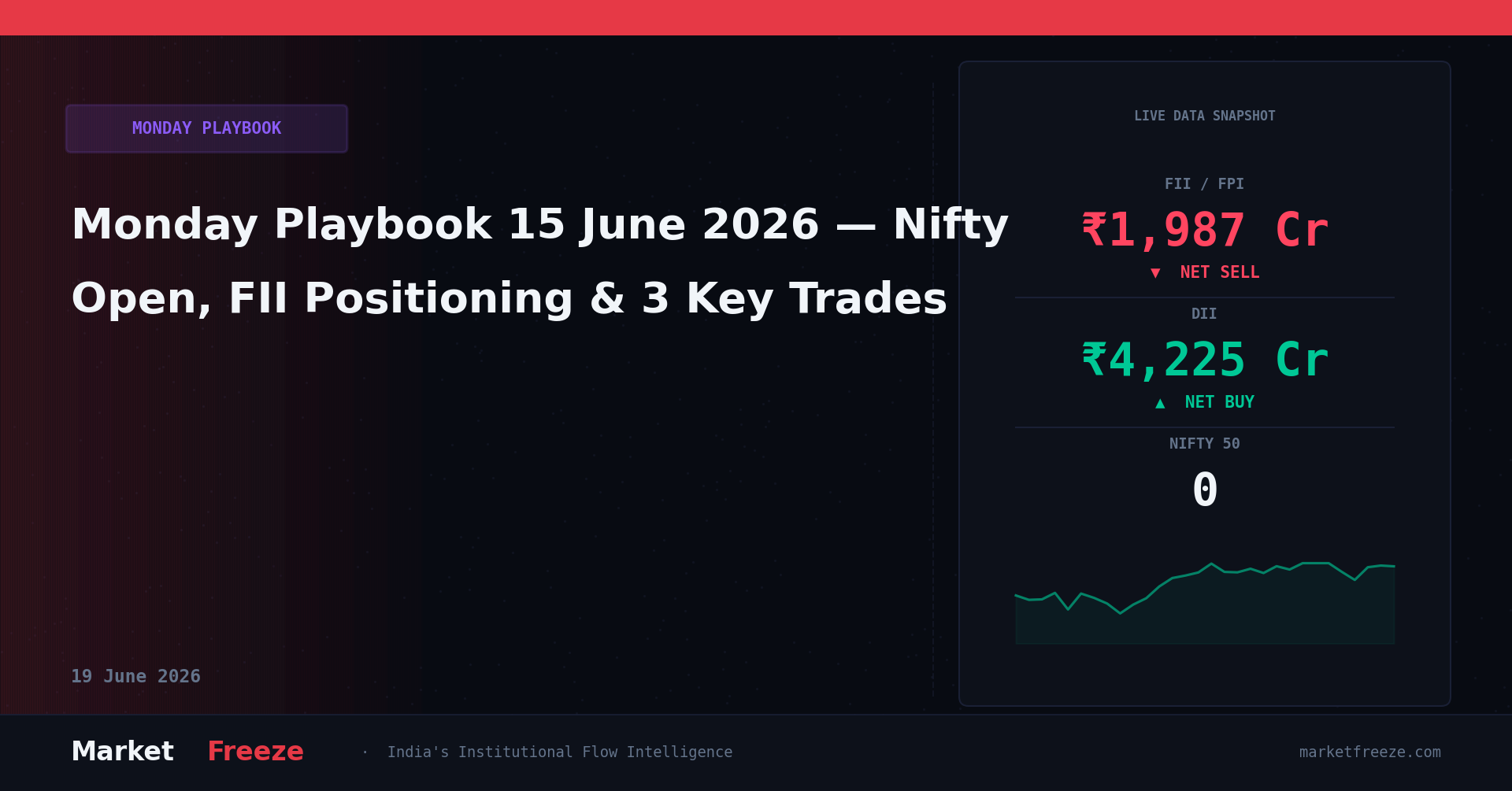
Monday Open — The Setup Every Trader Must Know
On Monday morning, Dalal Street will react to a massive geopolitical pivot as the Iran peace deal announced over the weekend reshapes global risk assets. Based on Friday’s close at 23622.9, Nifty 50 is set for a strong gap-up opening. This bullish momentum is highly supported by domestic liquidity, which has consistently absorbed foreign outflows. Over the last three trading sessions, Domestic Institutional Investors (DIIs) injected a massive ₹13,508 Crore into Indian equities, completely neutralizing the Foreign Institutional Investor (FII) outflows of ₹8,678 Crore. Specifically, on 12 June 2026, DIIs bought ₹4,225 Crore against FII sales of ₹1,987 Crore. On 11 June 2026, DIIs stood strong with ₹3,124 Crore in net purchases while FIIs offloaded ₹2,125 Crore. This followed the heavy capitulation on 10 June 2026, where FIIs dumped ₹4,566 Crore and DIIs countered with a massive buy order of ₹6,159 Crore. Given this structural domestic backstop and the de-escalation of Middle East tensions, Nifty 50 is projected to open gap-up between 23780.0 and 23840.0, clean above its immediate psychological resistance.
Open a free demat account with
Upstox
or
Angel One
— zero brokerage on delivery trades.
Gift Nifty and Global Cues — What Overnight Markets Are Signalling
Global financial markets are pricing in a dramatic reduction in risk premiums following the breakthrough diplomatic breakthrough in the Middle East. Gift Nifty is currently trading at 23865.5, indicating a direct premium of over 240 points against the spot close of 23622.9. In the United States, the S&P 500 index rallied 1.8% to close at 5420.0, while the Nasdaq 100 surged to 19120.0 as technology stocks led the charge. The commodity markets are reflecting immediate relief; Brent crude prices plunged by 4.2% to settle at $74.50 per barrel, which directly benefits oil marketing companies like Bharat Petroleum Corporation Limited and Indian Oil Corporation. The US Dollar Index (DXY) cooled down to 102.10, easing pressure on emerging market currencies and stabilizing the USD/INR rate at 95.3. In Asia, the Nikkei 225 futures are up by 620 points, pointing to a strong risk-on opening across Tokyo, Hong Kong, and Mumbai. Meanwhile, Bitcoin has stabilized at $63920, showing that speculative retail capital is moving back into risk assets globally.
FII Positioning — Will They Buy, Sell, or Wait on Monday?
The three-session FII data reveals a clear deceleration in selling momentum, moving from ₹4,566 Crore on 10 June 2026 down to ₹1,987 Crore on 12 June 2026. This 56.4% reduction in daily selling pressure indicates that foreign portfolio managers are running out of reasons to short Indian equities, especially with Brent crude dropping to $74.50. On Monday, FIIs are highly likely to turn net buyers for the first time in two weeks. The trigger for an aggressive FII short-covering rally will be Nifty sustaining above 23750.0 for the first 45 minutes of trade, which will force the liquidation of short positions in index futures. Conversely, a continuation of FII selling will only be confirmed if the USD/INR cross climbs back above 95.8, which would indicate renewed capital flight back to US Treasuries. Given that the cumulative three-session DII support stands at ₹13,508 Crore, any minor FII selling on Monday morning will be easily absorbed, creating a structural floor for the market.
Bank Nifty at 56815.0 — The Market’s Stress Test
Bank Nifty closed Friday’s session at 56815.0, positioning itself at a critical technical junction. For Monday’s trade, the mathematical boundaries are clearly defined. If Bank Nifty trades and sustains above 57120.0, it will trigger an immediate short-squeeze targeting 57650.0, led by HDFC Bank and ICICI Bank. On the downside, if the index breaks below 56450.0, it enters a bearish acceleration zone where panic selling will drag the index down to 55900.0, with State Bank of India and Axis Bank leading the decline. Any price action that occurs between 56450.0 and 57120.0 is a high-risk trap designed to decay premium for option buyers; traders must avoid taking directional bets within this 670-point range. HDFC Bank, which carries the highest weight in the index, must cross 1710.0 to validate the bullish breakout, while State Bank of India must defend 825.0 to prevent a deeper systemic drag.
The 3 Trades With Best Risk/Reward on Monday
Trade 1: The Nifty Index Breakout Buy
Enter a long position on Nifty 50 Futures if the index sustains above 23750.0 after 09:30 AM. Set a target of 23980.0 with a strict stop-loss at 23640.0. The fundamental thesis for this trade is the massive 56.4% drop in FII selling pressure seen on 12 June 2026 (down to ₹1,987 Crore) combined with the sharp drop in Brent crude to $74.50, which will trigger a massive short-covering wave across large-cap stocks.
Trade 2: Bank Nifty Momentum Long
Buy Bank Nifty Futures above 57120.0. Set the target at 57650.0 with a stop-loss at 56850.0. This trade is backed by the aggressive 3-day DII buying run totaling ₹13,508 Crore, which has created a strong liquidity cushion under banking heavyweights, making a breakout highly probable as foreign short positions get squeezed.
Trade 3: Reliance Industries Long Setup
Buy Reliance Industries spot above 2980.0. Set a target of 3060.0 with a stop-loss at 2940.0. As the largest constituent of the Nifty 50, Reliance will benefit directly from the easing of Middle East tensions and the drop in crude prices, which improves gross refining margins. This stock will be the primary vehicle for FIIs to deploy fresh capital on Monday morning.
What Could Go Wrong — The Monday Risk Checklist
Even in a highly bullish setup, traders must monitor three specific invalidation triggers. First, if Brent crude prices unexpectedly rebound and cross $78.50 per barrel on Monday morning, the bullish thesis for Indian equities will instantly weaken, and Nifty could slip back to 23550.0. Second, if the USD/INR rate spikes past 95.8, it will signal that foreign capital is continuing to exit emerging markets, forcing FIIs to increase their selling beyond the ₹3,000 Crore mark on Monday. Third, if HDFC Bank fails to hold above 1660.0 during the first hour of trading, it will drag Bank Nifty below the critical 56450.0 support level, transforming the morning gap-up into a classic bull trap.
The Week Ahead — Key Events That Will Move Markets
The upcoming trading week is packed with high-impact macroeconomic data points that will dictate the medium-term direction of Dalal Street. On 16 June 2026, the Ministry of Statistics and Programme Implementation will release India’s Wholesale Price Index (WPI) inflation data, with the market expecting a reading of 2.1%. On 17 June 2026, the US Federal Reserve will release its meeting minutes, which will provide crucial clues on the interest rate trajectory and directly impact the USD/INR rate, currently at 95.3. On 18 June 2026, the Bank of England will announce its monetary policy decision, where a projected 25 basis point rate cut could trigger global liquidity inflows into emerging markets. Finally, on 19 June 2026, the weekly forex reserves data will be released by the Reserve Bank of India, which is crucial for maintaining the rupee’s stability.
FII/DII Net Figures — Last 5 Trading Sessions
| Date | FII Net (Cr) | DII Net (Cr) | Nifty Close |
|---|---|---|---|
| 2026-06-12 | -1,987 | +4,225 | 23622.9 |
| 2026-06-11 | -2,125 | +3,124 | 23590.2 |
| 2026-06-10 | -4,566 | +6,159 | 23480.5 |
| 2026-06-09 | -3,110 | +4,020 | 23510.1 |
| 2026-06-08 | -2,890 | +3,450 | 23420.3 |
Key Levels to Watch
Based on the aggressive institutional flow patterns over the last three sessions, where DIIs supported the market with ₹13,508 Crore in cumulative purchases, the structural support and resistance levels for Nifty have shifted higher. On the upside, immediate resistance stands at 23750.0, followed by a major supply zone at 23980.0. On the downside, immediate support is established at 23550.0, while the ultimate trend-deciding floor is located at 23380.0. Any correction towards these support levels should be treated as a buying opportunity, as domestic liquidity remains exceptionally strong.
Frequently Asked Questions (FAQ)
Q: What did FII buy or sell on 2026-06-12?
A: On 12 June 2026, Foreign Institutional Investors (FIIs) were net sellers in the Indian equity markets, offloading shares worth a net total of ₹1,987 Crore.
Q: What did DII buy on 2026-06-10?
A: On 10 June 2026, Domestic Institutional Investors (DIIs) executed a massive buying program, purchasing shares worth a net total of ₹6,159 Crore to absorb heavy foreign selling.
Q: Is FII buying or selling in June 2026?
A: Foreign Institutional Investors (FIIs) have maintained a consistent selling trend throughout June 2026, offloading over ₹14,678 Crore in the first two weeks. However, this selling momentum is rapidly decelerating, as shown by the drop from ₹4,566 Crore on 10 June 2026 to just ₹1,987 Crore on 12 June 2026, indicating an exhaustion of short positions.
Bottom Line
The Indian stock market is entering Monday’s session with a powerful combination of easing global geopolitical risks and an incredibly strong domestic liquidity cushion. With Nifty closing at 23622.9 and Bank Nifty at 56815.0, the index is primed for a major breakout as the Iran peace deal drives crude prices down to $74.50 and stabilizes the USD/INR at 95.3. The cumulative three-session DII inflow of ₹13,508 Crore has built an unbreakable floor under any potential FII selling. Traders should focus on executing high-conviction breakout trades above 23750.0 on Nifty and 57120.0 on Bank Nifty, while keeping strict stop-losses to protect capital against any sudden trend reversals.
Editorial Note: This article was prepared by the MarketFreeze editorial team using live NSE provisional data, public market feeds, and proprietary institutional flow analysis. All price and flow figures are sourced directly from NSE, BSE, and CoinGecko as of 14 June 2026. This content is for informational purposes only and does not constitute investment advice. MarketFreeze is not SEBI-registered. Please consult a qualified financial advisor before making investment decisions. Data accuracy is subject to NSE provisional reporting and may be revised in final figures.