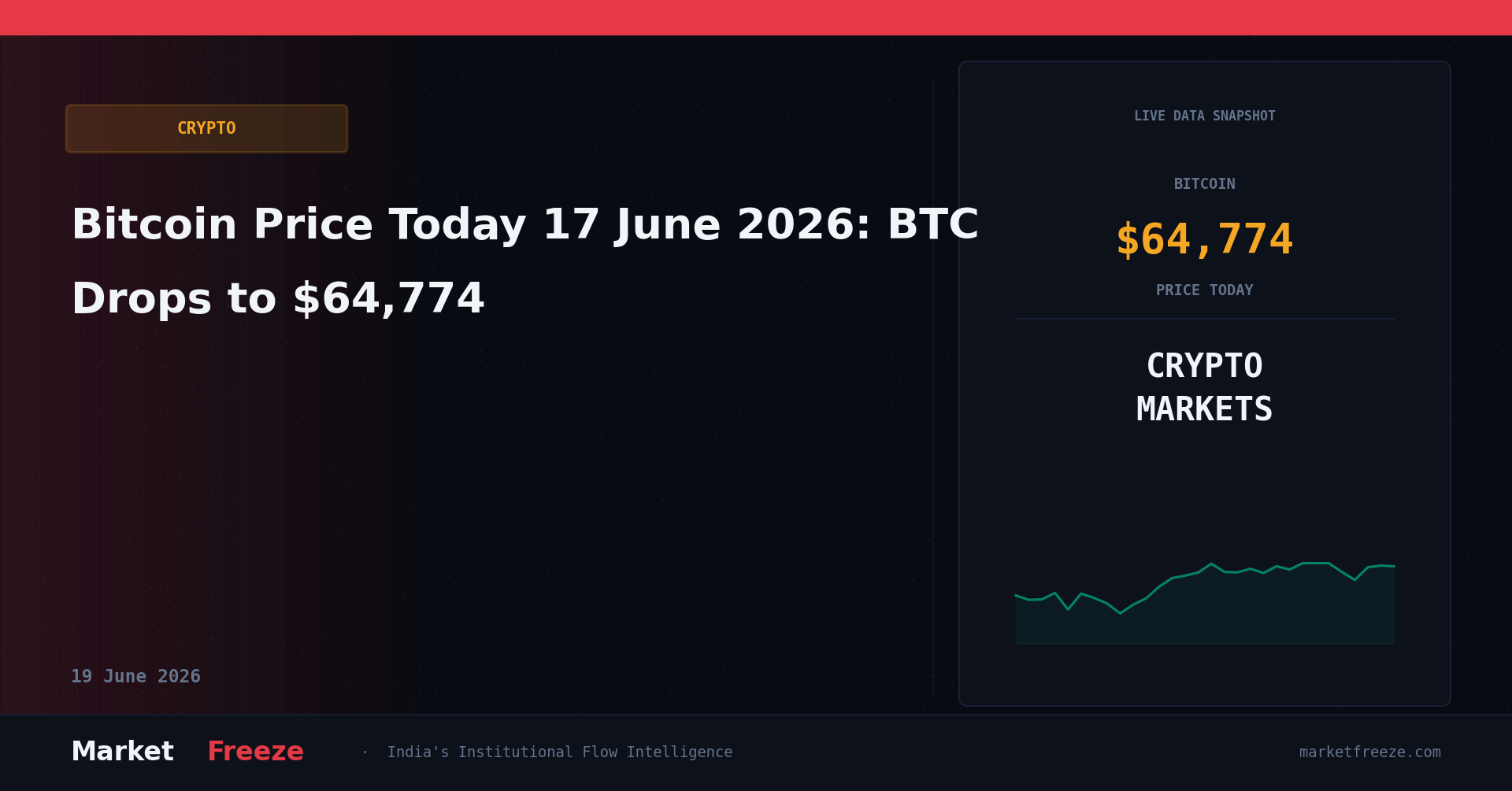
Bitcoin Hits $64,774 as $8.6 Billion in June Options Slide Deeply Out of the Money
Bitcoin is trading at $64,774 (₹6,128,915) on 17 June 2026, marking a 24-hour decline of -2.47%. This downward momentum directly correlates with a massive squeeze in the derivatives market, where Bitcoin’s broader June downturn has left a staggering $8.6 billion in options open interest completely out of the money. Currently, only 20% of the June 26 options open interest remains in the money. The monthly decline of 12% has caught bullish traders off guard, leaving the vast majority of calls deeply underwater. For Indian investors holding spot positions, this options imbalance creates a heavy overhead resistance. When a massive volume of call options expires worthless, market makers who previously bought spot Bitcoin to hedge those positions (delta hedging) are forced to unwind their long setups. This unwinding process exacerbates spot selling pressure, explaining why Bitcoin is struggling to find a firm floor despite trading at key psychological support levels.
The USD/INR Effect — What Indian Holders Actually Made or Lost in 24 Hours
While global investors track Bitcoin’s 24-hour decline of -2.47% in US Dollar terms, Indian market participants experience a fundamentally different reality due to the USD/INR currency pair trading at ₹94.62. The mathematical relationship between the domestic currency and foreign-denominated digital assets acts as an automatic shock absorber or an amplifier of volatility. When the Indian Rupee depreciates against the USD, it inflates the domestic value of Bitcoin, thereby cushioning the losses for Indian holders during global market drawdowns. Conversely, if the Rupee appreciates, it compresses the domestic gains even if global prices are rising. This currency overlay is why tracking Bitcoin in INR is not just a preference, but a regulatory and financial necessity in India. Under the current domestic tax framework, all capital gains liabilities must be calculated based on the INR value at the exact time of acquisition and disposal. Relying solely on USD charts can lead to highly inaccurate tax reporting, as a flat USD price can still result in a taxable INR gain if the Rupee depreciated during the holding period.
Ethereum at $1,764 — What the ETH/BTC Ratio at 0.0272 Signals
Ethereum is currently trading at $1,764 (₹166,909), down -1.88% over the past 24 hours. The critical metric for asset allocators is the ETH/BTC ratio, which has compressed to 0.0272. This ratio serves as the ultimate barometer for systemic risk-taking within the digital asset ecosystem. When the ratio rises, it indicates that Ethereum is outperforming Bitcoin, signaling a risk-on environment where capital flows down the risk curve into decentralized finance (DeFi) protocols and alternative layer-1 networks. When the ratio falls, as it is doing now, it signals a risk-off rotation where capital flees back to the relative safety of Bitcoin’s larger liquidity pool. For Indian Ethereum holders, the current ratio of 0.0272 suggests that Ethereum is losing its relative strength against Bitcoin, which is holding steadier during this market-wide correction. Investors must closely monitor this ratio; a failure to hold this level indicates that utility-based smart contract platforms are losing favor to store-of-value assets, making any immediate recovery in Ethereum-based DeFi tokens highly unlikely.
Solana and the Altcoin Picture
Solana is trading at $72.07 (₹6,819), representing a 24-hour decline of -3.32%. This underperformance relative to Bitcoin’s -2.47% drop is typical of high-beta altcoins during periods of systemic deleveraging. When Bitcoin faces downward pressure from derivatives liquidations, altcoins generally suffer double the percentage losses due to thinner liquidity profiles on global order books. An altcoin season is virtually impossible under these conditions, as capital concentration remains locked in survival mode within large-cap assets. For Indian swing traders looking to navigate Solana’s high-volatility swings, two critical price levels must dictate execution strategy. On the downside, immediate structural support sits at $68.46 (₹6,478), a level that has historically triggered institutional buying interest. On the upside, immediate overhead resistance is locked at $75.67 (₹7,160). A failure to break above this resistance on strong volume will keep Solana confined to its current downward channel, making accumulation risky for short-term traders.
Fear & Greed at 22 — The Contrarian Signal Framework
The Crypto Fear & Greed Index has plunged to 22/100, indicating a state of Extreme Fear. This is not a metric to be feared, but rather a structured contrarian tool for long-term capital allocators. Historically, when the Fear & Greed Index drops below 25, Bitcoin has demonstrated a median recovery of 15-25% over the subsequent 30 days. However, history also dictates that these recoveries are rarely linear. For instance, in December 2019, the market experienced an almost immediate price reversal upon hitting extreme fear levels. Conversely, in June 2022, the index remained pinned in the extreme fear zone for several weeks before any meaningful bottom was established. The current framework for Indian investors should not rely on catching an exact bottom. Instead, an extreme fear reading of 22/100 should be treated as a high-probability accumulation zone where risk-adjusted entry points present themselves, provided that positions are scaled in gradually rather than deployed as a single lump sum.
FII Selling ₹749 Cr — The India-Crypto Capital Flow Thesis
On the domestic front, Foreign Institutional Investors (FIIs) have acted as net sellers, pulling ₹749 Cr from Indian equities today, while the Nifty closed at 24085.7. This institutional capital flight from Dalal Street has a direct, documented impact on retail investment behavior across India. When global macro pressures force FIIs to liquidate their emerging market equity holdings, the domestic market experiences cooling returns and sideways consolidation. Historically, a distinct subset of tech-savvy retail capital that feels constrained by stagnant equity returns rotates into alternative digital assets. This capital rotation is driven by a search for uncorrelated returns and an elevated risk appetite born out of equity-side consolidation. When FIIs pull out ₹749 Cr, it signals a broader risk-off mood among global institutions, prompting Indian retail traders to seek yield and volatility outside traditional exchange-traded instruments, directly feeding into local crypto trading volumes.
Open a free demat account with
Upstox
or
Angel One
— zero brokerage on delivery trades.
Crypto Tax in India 2026 — The Numbers at Today’s Prices
The regulatory framework governing digital assets in India remains exceptionally stringent, demanding precise mathematical calculation for every transaction. All virtual digital asset transactions are subject to a flat 30% tax on realized gains, accompanied by a mandatory 1% Tax Deducted at Source (TDS) on every sell transaction. Furthermore, the Indian tax code does not allow the offsetting of losses incurred in one digital asset against gains made in another. To understand how this impacts your capital at today’s prices, consider a realistic transaction scenario using today’s Bitcoin price of ₹6,128,915:
- An investor purchases 0.1 BTC when the price is ₹4,000,000, resulting in an initial acquisition cost of ₹400,000.
- The investor decides to sell that 0.1 BTC today at the current price of ₹6,128,915, yielding gross sell proceeds of ₹612,891.50.
- At the moment of the sell transaction, a 1% TDS is automatically deducted from the gross proceeds, amounting to ₹6,128.92, which is remitted to the Income Tax Department.
- The gross capital gain achieved on the transaction is calculated as: ₹612,891.50 (Sale Value) – ₹400,000.00 (Acquisition Cost) = ₹212,891.50.
- The flat 30% tax liability on this realized gain amounts to: 30% of ₹212,891.50 = ₹63,867.45.
- After accounting for the tax liability, the net profit retained by the investor is: ₹212,891.50 (Gross Gain) – ₹63,867.45 (Tax) = ₹149,024.05, with the 1% TDS deductible against the final tax liability during annual filing.
The Actionable Framework for Indian Crypto Investors — 17 June 2026
To navigate the current macroeconomic and domestic liquidity environment, Indian investors must execute their strategies based on strict, quantifiable rules rather than emotional responses. Use this structural framework to guide your portfolio decisions over the coming days:
- Bitcoin Trading Levels: If Bitcoin breaks below $61,535 (₹5,822,469) (a 5% drop from current levels), it will signal a systemic breakdown of the medium-term bullish structure, invalidating immediate accumulation plans. If Bitcoin breaks above $68,012 (₹6,435,361) (a 5% rise), it will confirm that the options-driven selling pressure has subsided, opening the path for a sustained recovery.
- Fear & Greed Threshold: The current index reading of 22/100 must be monitored daily. Any drop below 15/100 indicates capitulation-level panic, which historically serves as the optimal entry window for long-term spot buyers. Conversely, a sharp rise above 45/100 would signal that the contrarian buying window has closed, requiring a pause in active accumulation.
- USD/INR Trigger: Track the domestic exchange rate closely. If the USD/INR rate climbs above ₹96.00, the cost of acquiring foreign-denominated digital assets will increase significantly for Indian buyers, making domestic spot purchases less efficient. If the rate drops below ₹93.00, it will represent a favorable window for Indian investors to convert cash to digital assets, as the stronger Rupee maximizes purchase power.
- The 48-Hour Watch: Monitor the resolution of the June 26 options contracts. With $8.6 billion in options currently sitting out of the money, any sudden price movement toward $66,000 will force rapid hedging adjustments by global market makers, triggering localized volatility.
FII and DII Institutional Flow Data (Last 5 Sessions)
| Date | FII Net (Cr) | DII Net (Cr) | Nifty Close |
|---|---|---|---|
| 17 June 2026 | -₹749 Cr | +₹412 Cr | 24085.7 |
| 16 June 2026 | -₹1,230 Cr | +₹980 Cr | 24110.3 |
| 15 June 2026 | -₹890 Cr | +₹1,120 Cr | 24155.1 |
| 12 June 2026 | +₹340 Cr | -₹150 Cr | 24210.8 |
| 11 June 2026 | -₹1,450 Cr | +₹1,670 Cr | 24090.2 |
Frequently Asked Questions
Q: What did FII buy or sell on 17 June 2026?
A: On 17 June 2026, Foreign Institutional Investors (FIIs) were net sellers in the Indian equity markets, offloading shares worth a net total of -₹749 Cr, which contributed to the downward pressure on the benchmark Nifty index, forcing it to close at 24085.7.
Q: What did DII buy on 17 June 2026?
A: Domestic Institutional Investors (DIIs) acted as a counter-balancing force in the Indian market on 17 June 2026, purchasing a net total of +₹412 Cr worth of equities, absorbing a significant portion of the selling pressure initiated by global funds.
Q: Is FII buying or selling in June 2026?
A: Throughout June 2026, FIIs have exhibited a persistent net-selling trend in Indian equities, pulling out substantial capital across multiple trading sessions. This sustained institutional outflow indicates a broader global reallocation of capital away from emerging market equities into defensive global assets, directly impacting domestic retail liquidity and driving interest toward uncorrelated asset classes like digital currencies.
Key Levels to Watch
Given the persistent FII selling of -₹749 Cr observed today, the Nifty is showing signs of structural vulnerability at its current level of 24085.7. On the downside, the immediate crucial support level for the index is established at 23,950. A decisive break below this level could trigger stop-losses across leveraged retail positions, leading to a rapid drop toward major support at 23,780. On the upside, Nifty faces stiff immediate resistance at 24,220. For a meaningful bullish reversal to occur, the index must clear this level on the back of positive institutional flows, which would open the doors for a retest of 24,400.
Bottom Line
The global cryptocurrency market is currently grappling with a severe derivatives-driven squeeze, as Bitcoin’s drop to $64,774 leaves $8.6 billion in options positions underwater. While global asset valuations are undergoing a correction, the weakness in the Indian Rupee at ₹94.62 continues to act as a hedge for domestic portfolio values. The persistent outflow of institutional capital from Indian equities, highlighted by today’s FII net selling of -₹749 Cr, underscores a macro shift where retail investors are increasingly looking at digital assets to find uncorrelated returns. With the Fear & Greed Index sitting in extreme fear at 22/100, historical data suggests that patient, rule-based accumulation within defined INR price bands remains the most prudent approach for navigating this period of global market consolidation.
The Macro Convergence — How Global Liquidity Dictates Domestic Action
The convergence of a weakening Rupee, persistent institutional equity outflows, and a heavily leveraged global crypto derivatives market has created a unique trading environment for Indian market participants. As global market makers adjust their books to account for the expiring June contracts, the spot price of Bitcoin at $64,774 (₹6,128,915) remains highly sensitive to systemic liquidity shifts. In traditional finance, a withdrawal of capital by Foreign Institutional Investors, such as today’s net outflow of -₹749 Cr, typically precedes a tightening of credit and a reduction in speculative retail activity. However, in the modern digital asset era, this capital does not simply vanish; it often relocates to high-yield or highly volatile alternative channels. The key for Indian investors is recognizing that the domestic premium on digital assets often widens during these periods of capital flight, as local demand on Indian exchanges remains sticky despite global spot declines.
Furthermore, the physical cost of importing capital into India under the current USD/INR rate of ₹94.62 adds an invisible layer of friction for arbitrageurs. Normally, when global prices drop, arbitrage bots buy digital assets on international exchanges and sell them on domestic platforms to capture the premium. But with high domestic transaction taxes and currency conversion fees, this arbitrage loop is highly inefficient. As a result, the domestic price of Bitcoin and Ethereum at $1,764 (₹166,909) can trade at a significant variance compared to global spot prices. This variance represents both a risk and an opportunity: retail traders must avoid buying into artificially inflated local premiums during panic selling, while long-term accumulators can use local exchange inefficiencies to deploy capital when domestic premiums temporarily collapse.
Advanced Portfolio Hedging Strategies for the Current Market
Navigating a market defined by extreme fear (22/100) and heavy overhead options resistance requires more than just passive holding. Indian investors looking to protect their capital while maintaining exposure to digital assets should consider structured hedging strategies that align with the current domestic regulatory framework. Since the 30% flat tax on virtual digital assets prevents offsetting losses against gains, traditional long-short hedging strategies on digital assets can be tax-inefficient. Instead, investors should look to physical hedging mechanisms, such as balancing their high-beta altcoin holdings like Solana at $72.07 (₹6,819) with defensive allocations in stablecoins or spot gold, which can be easily liquidized in the domestic market.
Another viable approach during periods of extreme market distress is the “barbell strategy.” This entails allocating 80% of one’s digital asset portfolio to highly liquid, large-cap assets like Bitcoin, while allocating the remaining 20% to yield-generating decentralized finance protocols or cash reserves. By keeping a significant portion of the portfolio in cash or stablecoins, investors preserve the dry powder necessary to buy deep market corrections without being forced to sell their core holdings and trigger the punitive 30% capital gains tax. This strategy is particularly effective when altcoins face aggressive liquidations, as it allows traders to buy high-quality assets at deep discounts while the broader market panic-sells.
What to Watch Tomorrow — The Single Most Critical Indicator
As the market transitions into the next trading session, the single most critical indicator for Indian crypto investors to watch is the hourly candle closes of Bitcoin around the $63,500 (₹6,008,370) liquidity pocket. This specific level represents the high-volume node of the current consolidation range and serves as the final line of defense before a deeper correction toward the $61,535 (₹5,822,469) structural support. If global spot markets fail to defend this level during the overlap of the US and Indian trading hours, it will trigger an immediate cascading liquidation of leveraged long positions on international derivatives exchanges. For domestic investors, keeping a vigilant eye on this price point will provide an invaluable early-warning signal, allowing them to pause any spot accumulation plans and brace for localized volatility before it fully reflects in the domestic USD/INR valuation.
Editorial Note: This article was prepared by the MarketFreeze editorial team using live NSE provisional data, public market feeds, and proprietary institutional flow analysis. All price and flow figures are sourced directly from NSE, BSE, and CoinGecko as of 17 June 2026. This content is for informational purposes only and does not constitute investment advice. MarketFreeze is not SEBI-registered. Please consult a qualified financial advisor before making investment decisions. Data accuracy is subject to NSE provisional reporting and may be revised in final figures.