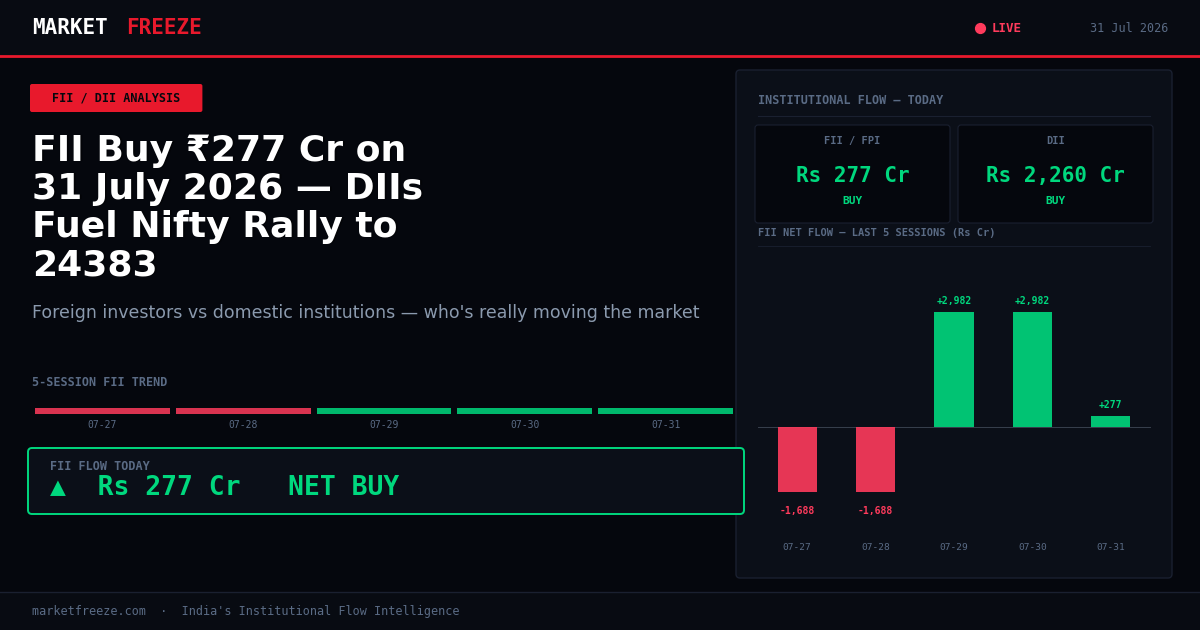
Parsing today’s institutional tape: Foreign Institutional Investors (FIIs) net bought ₹277.48 Cr, a significant deceleration from recent sessions, while Domestic Institutional Investors (DIIs) aggressively bought ₹2,260.37 Cr on 31 July 2026.
DIIs Lead the Charge as FII Momentum Cools
Today’s session saw a stark divergence in institutional positioning. While DIIs reinforced their bullish stance with a substantial net purchase of ₹2,260.37 Cr, marking their highest inflow in the last three recorded sessions, FIIs significantly pared back their buying to just ₹277.48 Cr. This FII figure is a sharp drop from the preceding two days, where they had each deployed approximately ₹2,981.87 Cr. The total FII buy value today stood at ₹19,045.51 Cr against a sell value of ₹18,768.03 Cr, indicating a less committed engagement compared to yesterday’s substantial net buy. This shift suggests that while domestic institutions remain confident, FII conviction appears to be waning, potentially due to external factors or profit-taking after the recent upswing.
Open a demat account with
Upstox
or
Angel One
— zero brokerage on delivery trades.
Nifty Resilience Amidst FII Deceleration
Despite the marked decrease in FII buying, the Nifty 50 managed to close higher at 24,383.60, up 0.27%. This resilience, a continuation of the third straight session of gains as reported by NDTV Profit, was primarily driven by robust DII participation and positive global cues, including a rally in Brent Crude to ₹8,647.00/bbl. The market’s ability to hold ground suggests that the underlying demand from domestic players is strong enough to absorb the reduced FII inflows. However, the lower FII engagement today could cap upside momentum in the immediate short term. Key support for the Nifty is now observed around the 24,200 mark, where earlier buying interest was evident. Resistance is building near 24,550, a level that FIIs might test if their conviction returns.
Sectoral Signals: Banking and Financials Benefit from DII Push
The significant DII buying of ₹2,260.37 Cr, coupled with FIIs’ cautious approach, points towards a preference for sectors that benefit from domestic economic strength and ongoing earnings growth narratives. Banking and Financial Services stocks, often favored by DIIs, likely saw considerable accumulation. Bajaj Finance and Bajaj Finserv were explicitly mentioned as top gainers in market wrap-ups, aligning with this view. Conversely, the slight pullback in FII buying could imply reduced interest in sectors that are more export-dependent or sensitive to global economic slowdowns, such as select IT counters, despite some IT stocks showing mixed performance today. Investors should monitor DII activity for further clues on which domestic growth stories are being favored.
FII/DII Flow: A 5-Session Snapshot
The table below illustrates the recent flow dynamics:
| Date | FII Net (Cr) | DII Net (Cr) | Nifty Close |
|---|---|---|---|
| 2026-07-27 | ₹-1,688.23 Cr | +₹2,329.14 Cr | 23,995.95 |
| 2026-07-28 | ₹-1,688.23 Cr | +₹2,329.14 Cr | 23,985.35 |
| 2026-07-29 | +₹2,981.87 Cr | +₹998.02 Cr | 24,250.20 |
| 2026-07-30 | +₹2,981.87 Cr | +₹998.02 Cr | 24,317.15 |
| 2026-07-31 | +₹277.48 Cr | +₹2,260.37 Cr | 24,383.60 |
This historical data clearly shows the shift in FII participation from substantial net buying in late July to a much smaller inflow today. DIIs, however, have maintained a consistent presence, with inflows of over ₹2,000 Cr in two of the last three sessions, including today’s ₹2,260.37 Cr. This sustained domestic buying against a backdrop of fluctuating FII interest is a key theme for market direction.
Global Cues: Crude Strength and Crypto Weakness
The surge in Brent Crude prices to ₹8,647.00/bbl, a gain of 1.49%, suggests potential inflationary pressures or supply concerns, which could influence central bank policies. While this often benefits Indian energy stocks, it also adds a layer of complexity to the inflation outlook. Simultaneously, cryptocurrencies like Bitcoin (USD 63,634.00) and Ethereum (USD 1,874.00) experienced significant drops, down 1.83% and 2.38% respectively. This divergence between commodity strength and crypto weakness might indicate a flight to perceived tangible assets, but it doesn’t directly translate into immediate directional bias for Indian equities without further evidence of FII/DII correlation.
Urban Company’s Profitability Drag: An Earnings Anomaly
The Q1 FY27 results for Urban Company highlight potential headwinds for growth-oriented companies facing high operational costs. A net loss of Rs 92 crore despite a 44% revenue jump to Rs 528 crore, attributed to expansion costs in its InstaHelp business, serves as a cautionary tale. While the broader market is supported by earnings optimism, as noted by MarketWrap, individual company performance can diverge significantly. This news, although specific to one company, is relevant as it points to the challenges of scaling rapidly. Investors will need to scrutinize earnings reports closely for sustainable profitability, not just top-line growth.
What a Nifty Drop to 23,500 Would Signal
If the Nifty 50 were to fall below the 23,500 level, it would invalidate the current positive flow trend. Historically, sharp drops below 24,000 were accompanied by significant FII outflows, as seen on July 27th and 28th (₹-1,688.23 Cr each day). A sustained breach of 23,500 would likely signal a return of aggressive FII selling, potentially reversing the gains seen in the last three sessions. This scenario would also imply that the DII buying spree, however strong, might not be sufficient to counter a determined FII exit.
FAQ Section
- How much did FIIs and DIIs buy or sell in Indian stocks on July 31, 2026?
- What is the current Nifty 50 value as of the end of trading on July 31, 2026?
- Which sectors showed strength today based on institutional flows?
The divergence in FII and DII flows also warrants a look at potential currency implications. A weakening of the Indian Rupee, even marginally, can sometimes be a catalyst for increased FII inflows as it makes Indian assets cheaper in dollar terms. Conversely, a strengthening Rupee might see reduced foreign interest, or even outflows, as gains are eroded. While specific currency movements for the day are not detailed here, the context of Brent Crude rising to ₹8,647.00/bbl could indicate global inflation concerns, which often lead to a stronger dollar and potentially a weaker Rupee. If this trend persists, it might offer a subtle tailwind for future FII activity, even if today’s figures show otherwise.
Retail Investor Sentiment: A Contrasting Picture?
While the article focuses on institutional flows, understanding retail investor positioning provides a more complete market picture. Often, retail investors follow trends set by institutions. However, their behavior can also be more reactive to news and short-term price movements. Today’s strong DII buying, in contrast to the muted FII interest, might be interpreted by retail participants as a signal of domestic strength, potentially encouraging them to increase their own holdings, especially in sectors favoured by DIIs. The resilience of the Nifty 50 closing at 24,383.60, despite lower FII inflows, could further bolster retail confidence. However, if FII outflows were to re-emerge aggressively, retail investors, typically less sophisticated in risk management, could become vulnerable to panic selling.
Historical Echoes: A Familiar Pattern of Divergence
The current dynamic of strong domestic buying countering cautious foreign investment isn’t entirely unprecedented. We have seen periods in Indian market history where robust domestic capital, driven by pension funds, mutual funds, and insurance companies, has provided a crucial buffer against volatile foreign flows. For instance, during certain phases of global economic uncertainty in prior years, DIIs have historically stepped up their purchases, absorbing selling pressure from FIIs and preventing sharp market declines. The current situation, with DIIs injecting ₹2,260.37 Cr today, echoes these past instances where domestic resilience proved to be a significant market stabilizer. This sustained domestic demand is a crucial factor to monitor as it suggests a maturing domestic investment ecosystem.
Sectoral Rotation Clues in the Numbers
The substantial DII net buy of ₹2,260.37 Cr, compared to the FII’s meager ₹277.48 Cr, strongly hints at a preference for sectors with strong domestic consumption drivers and stable earnings. Banking and financial services, as indicated by the performance of stocks like Bajaj Finance and Bajaj Finserv, are prime beneficiaries. However, the subdued FII activity might also suggest a reduced appetite for sectors heavily reliant on global demand or export revenues, such as certain segments of the IT sector. Investors should watch if this trend of DII accumulation continues in manufacturing or infrastructure plays, which are often tied to government spending and domestic growth initiatives. The absence of significant FII participation could also mean a temporary pause in aggressive accumulation of high-growth, high-valuation tech stocks.
Bottom Line
Today’s trading session was characterized by strong DII accumulation of ₹2,260.37 Cr, a significant counterpoint to the dramatically reduced FII net buying of ₹277.48 Cr. This shift suggests that domestic institutions are driving the market’s upward trajectory, while foreign investor conviction has softened. Banking and Financial Services stocks appear to be favored by DIIs. Investors should watch for any renewed FII interest or sustained DII strength to gauge the market’s next move, with Nifty support at 24,200 and resistance at 24,550.
Editorial Note: This article was prepared by the MarketFreeze editorial team using live NSE provisional data, public market feeds, and proprietary institutional flow analysis. All price and flow figures are sourced directly from NSE, BSE, and CoinGecko as of 31 July 2026. This content is for informational purposes only and does not constitute investment advice. MarketFreeze is not SEBI-registered. Please consult a qualified financial advisor before making investment decisions. Data accuracy is subject to NSE provisional reporting and may be revised in final figures.