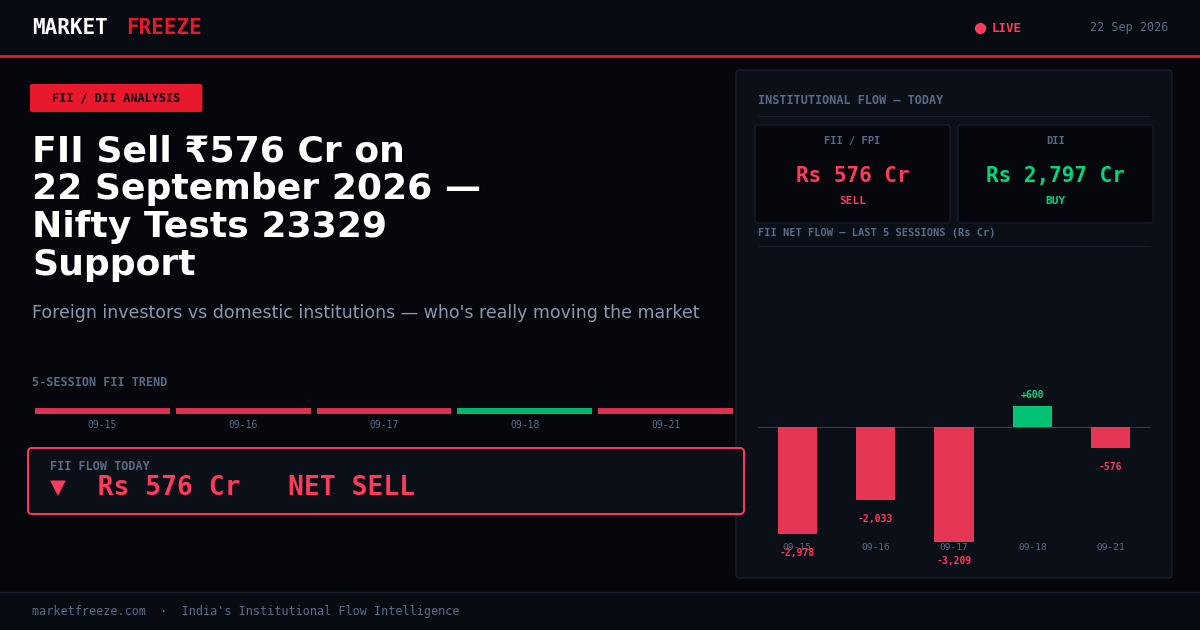
Foreign institutional investors offloaded ₹576.20 Cr worth of Indian equities today, 22 September 2026, reversing the buying trend seen on 18 September. Domestic institutional investors, however, continued their buying spree, adding ₹2,797.27 Cr to their portfolios. This divergence highlights a cautious stance from foreign capital despite domestic buying support.
FII Selling Continues as Nifty Tests Lower Bands
The Nifty 50 closed at 23,329.00, down 0.36% for the day. This decline occurred as FIIs registered a net sell of ₹576.20 Cr. Their total selling activity amounted to ₹10,637.17 Cr, underscoring a significant outflow. The broader market also succumbed to selling pressure, with the Sensex closing down 0.44% at 74,529.00. The decline in Nifty was amplified by a closing auction swing, as reported in the CAS chaos news, indicating pressure at the end of the trading session. This selling by FIIs suggests a potential downside target for the Nifty. Based on today’s flow and the prevailing Nifty close of 23,329.00, immediate support is seen at 23,150, a level tested during the CAS event. Resistance is pegged at 23,500, where FII selling pressure could intensify if the index approaches this band.
Open a free demat account with
Upstox
or
Angel One
— zero brokerage on delivery trades.
Actionable Insight: With FII selling today and Nifty hovering near the 23,329 mark, traders should monitor the 23,150 support level closely. A sustained breach below this could signal further downside, driven by foreign capital outflows.
DIIs Continue Robust Buying, Cushioning the Fall
Domestic institutional investors were net buyers of ₹2,797.27 Cr today, extending their consistent buying trend seen over the last three sessions. This inflow of domestic capital has been instrumental in absorbing FII selling pressure. On 21 September, DIIs bought ₹2,797.27 Cr, and on 18 September, their net purchase was ₹1,019.69 Cr. This sustained domestic buying indicates a strong belief in Indian equities at current valuations from local fund managers. The contrast with FII selling suggests a potential rotation or divergence in investment strategies between foreign and domestic institutions.
Actionable Insight: The strong DII buying provides a floor to the market. Retail investors can consider accumulating quality stocks on dips, especially those favoured by DIIs, anticipating that this domestic demand will continue to support the market even amidst FII outflows.
Sectoral Implications: IT Under Pressure, FMCG Shows Resilience
The IT sector was notably weak today, dragged down by concerns around demand and earnings, as mentioned in the news context. This aligns with the broader FII selling pressure, as IT stocks are often a significant component of foreign portfolios. Conversely, FMCG stocks like Nestle India were mentioned as laggards, but the overall sector may see continued domestic interest due to its defensive characteristics. Banking stocks, which form a substantial part of DII portfolios, likely benefited from their buying. Metals and Auto sectors could also see demand if FIIs reallocate capital from IT to other cyclical segments.
Actionable Insight: Retail investors should consider reducing exposure to IT stocks given the headwinds and FII selling. Focus on defensive sectors like FMCG or select banking counters where DII interest remains strong.
Currency and Commodity Cues: Weakening Rupee, Falling Crude
The USD/INR pair depreciated to Rs95.87, down 0.45%. This weakening of the rupee against the dollar is a typical consequence of capital outflows, as foreign investors sell rupees to buy dollars. Simultaneously, Crude MCX prices fell by 1.92% to Rs9,435.00/bbl. This drop in crude prices, ahead of potential US-Iran talks, is a positive development for India, a major oil importer, as it eases inflationary pressures. Gold MCX also saw a slight dip of 0.67% to Rs155,566.00/10g.
Actionable Insight: The weakening rupee could pose a challenge for importers but may benefit exporters. The fall in crude prices is a net positive for the Indian economy, potentially supporting DII buying in sectors sensitive to commodity costs.
Historical Flow Context: FII Selling Peaks
Today’s FII net sell of ₹576.20 Cr is a modest figure compared to the significant outflows seen earlier this month. On 17 September, FIIs were net sellers to the tune of ₹3,208.76 Cr, and on 15 September, the outflow was ₹2,977.86 Cr. The current selling is less aggressive, but the reversal from the buying seen on 18 September (₹599.54 Cr net buy) is noteworthy. The Nifty closed at 23,329.00 today, similar to its close of 23,329.00 on 21 September when FIIs also sold ₹576.20 Cr. This suggests a pattern where FII selling often accompanies a sideways to downward movement in the index.
Actionable Insight: While today’s FII selling is not an extreme event, it’s a continuation of a pattern of caution seen in the broader trend. Retail investors should remain vigilant to any acceleration in FII outflows, which historically have led to sharper market corrections.
IPO Market Momentum: SEBI Eyes ₹2 Lakh Crore Fundraising
The news regarding SEBI’s projection of up to ₹2 lakh crore in IPO fundraising reflects a robust primary market. This indicates strong underlying investor interest in Indian equities, with substantial capital expected to flow into companies. The DRHP filing by Abakkus Asset Manager for an IPO also points to continued activity in the asset management space. While this indicates a healthy capital market ecosystem, it also means significant liquidity could be absorbed by upcoming IPOs, potentially impacting secondary market liquidity if not managed effectively.
Actionable Insight: Investors should evaluate the IPO pipeline. While new listings can offer opportunities, a large influx of capital into the primary market could temporarily reduce liquidity in existing stocks, impacting trading volumes and price discovery in the secondary market.
Nifty Positioning: Watching the 23,150 Mark
The Nifty 50 closed at 23,329.00 today. Following today’s FII selling and the mentioned CAS chaos that saw the indicative price drop below 23,150, this level becomes critical. A close below 23,150 on significant FII selling would indicate a bearish bias. Conversely, if the Nifty can hold above 23,150 and FII flows turn positive in the next session, it could signal a short-term bottom. The immediate resistance remains at 23,500.
Actionable Insight: For short-term traders, 23,150 is the level to watch. A breakdown below this could trigger stop-losses, while holding above it might offer a chance for a modest bounce, contingent on FII sentiment changing.
FII/DII Flow Table: Last 5 Sessions
| Date | FII Net (Cr) | DII Net (Cr) | Nifty Close |
|---|---|---|---|
| 2026-09-15 | ₹-2,977.86 Cr | +₹2,686.05 Cr | 23,217.60 |
| 2026-09-16 | ₹-2,032.61 Cr | +₹3,908.23 Cr | 23,270.60 |
| 2026-09-17 | ₹-3,208.76 Cr | +₹3,617.75 Cr | 23,346.40 |
| 2026-09-18 | +₹599.54 Cr | +₹1,019.69 Cr | 23,414.30 |
| 2026-09-21 | ₹-576.20 Cr | +₹2,797.27 Cr | 23,329.00 |
FAQ
Why did FIIs sell ₹576.20 Cr worth of shares today?
FIIs sold ₹576.20 Cr today, potentially due to concerns over global economic outlook and sector-specific headwinds, particularly in IT, as indicated by market news. This outflow reversed the buying trend seen on 18 September.
What is the immediate support level for Nifty after today’s trading?
Following today’s close at 23,329.00 and FII selling, the immediate support level for the Nifty 50 is 23,150, a level that experienced pressure during the day’s trading. The resistance is at 23,500.
How much did DIIs buy in the last 5 sessions, and what does it mean?
In the last 5 sessions, DIIs were net buyers ranging from approximately ₹1,019.69 Cr on 18 September to a high of ₹3,908.23 Cr on 16 September. Today, they bought ₹2,797.27 Cr. This consistent buying provides a strong domestic support base for the market, counterbalancing FII outflows.
Global Sentiment and Emerging Market Correlation
The selling pressure observed from Foreign Institutional Investors (FIIs) today, amounting to ₹576.20 Cr, can also be viewed through the lens of broader global market sentiment. Emerging markets often move in tandem, and any significant downturn or heightened risk aversion in major global economies can trigger outflows from perceived riskier assets like Indian equities. For instance, if major indices in the US or Europe were to experience significant drops, it would not be unusual for FIIs to pare down their exposure in India, irrespective of domestic fundamentals. The Nifty closing at 23,329.00, a level not far from its recent highs, might be seen by some foreign investors as a point where global macro concerns outweigh India’s growth story, prompting a reduction in positions. This correlation is crucial for understanding FII behaviour beyond just daily Indian market dynamics.
Deep Dive into Sectoral Rotation: Beyond IT and FMCG
While IT has been highlighted as a weak sector due to demand concerns, and FMCG noted for its defensive appeal, a closer look at the DII buying patterns might reveal a more nuanced sectoral rotation. With DIIs investing a substantial ₹2,797.27 Cr, their focus could be on sectors poised for domestic growth or those that benefit from government infrastructure spending. For example, banking stocks, a perennial favourite for DIIs, would likely see continued accumulation. Furthermore, sectors like pharmaceuticals or even select manufacturing companies that are less correlated with global IT demand cycles might be benefiting from this domestic capital infusion. The resilience of Auto stocks, especially in segments catering to the domestic market, could also be a beneficiary of this sustained DII appetite, especially if crude prices remain subdued, as seen with the MCX fall of 1.92%.
Historical Context: FII Capitulation vs. Profit-Taking
The FII selling of ₹576.20 Cr today, while a reversal, is significantly less aggressive than the outflows seen on 17 September (₹3,208.76 Cr) or 15 September (₹2,977.86 Cr). This distinction is important. The earlier, larger sell-offs might have indicated capitulation or a more pronounced de-risking strategy. Today’s figure, however, could represent more of a profit-taking or a tactical reduction in exposure as the Nifty nears certain resistance levels, like the 23,500 mark. The fact that FIIs bought ₹599.54 Cr on 18 September further supports the idea of a fluctuating strategy rather than a wholesale exit. Understanding this nuance helps in gauging the potential duration and intensity of the current FII caution.
Currency Impact on FII Decisions: The Rupee’s Role
The depreciation of the Indian Rupee to Rs95.87 against the US Dollar is a significant factor influencing FII decisions, and not always negatively. While a weaker rupee increases the cost of imported goods for Indian companies, it can also enhance the returns for foreign investors when they eventually convert their earnings back into their home currency. Today’s FII selling, despite the rupee weakening, suggests that other factors like global risk sentiment or sector-specific concerns are currently overriding the potential currency advantage. However, if the rupee were to continue its slide more aggressively, it could, in the medium term, become a deterrent for FIIs, especially if they perceive it as a sign of broader economic instability rather than a temporary fluctuation.
Bottom Line
Today’s trading session saw a clear divergence between FIIs and DIIs, with foreign investors offloading ₹576.20 Cr while domestic institutions actively bought ₹2,797.27 Cr. The Nifty 50 closed lower at 23,329.00, with IT stocks facing headwinds. The 23,150 level is now a critical support for the index. Despite FII caution, sustained DII buying and positive macroeconomic cues from falling crude prices offer some stability. Retail investors should monitor FII flows closely and consider sector rotation towards defensives.
Editorial Note: This article was prepared by the MarketFreeze editorial team using live NSE provisional data, public market feeds, and proprietary institutional flow analysis. All price and flow figures are sourced directly from NSE, BSE, and CoinGecko as of 22 September 2026. This content is for informational purposes only and does not constitute investment advice. MarketFreeze is not SEBI-registered. Please consult a qualified financial advisor before making investment decisions. Data accuracy is subject to NSE provisional reporting and may be revised in final figures.