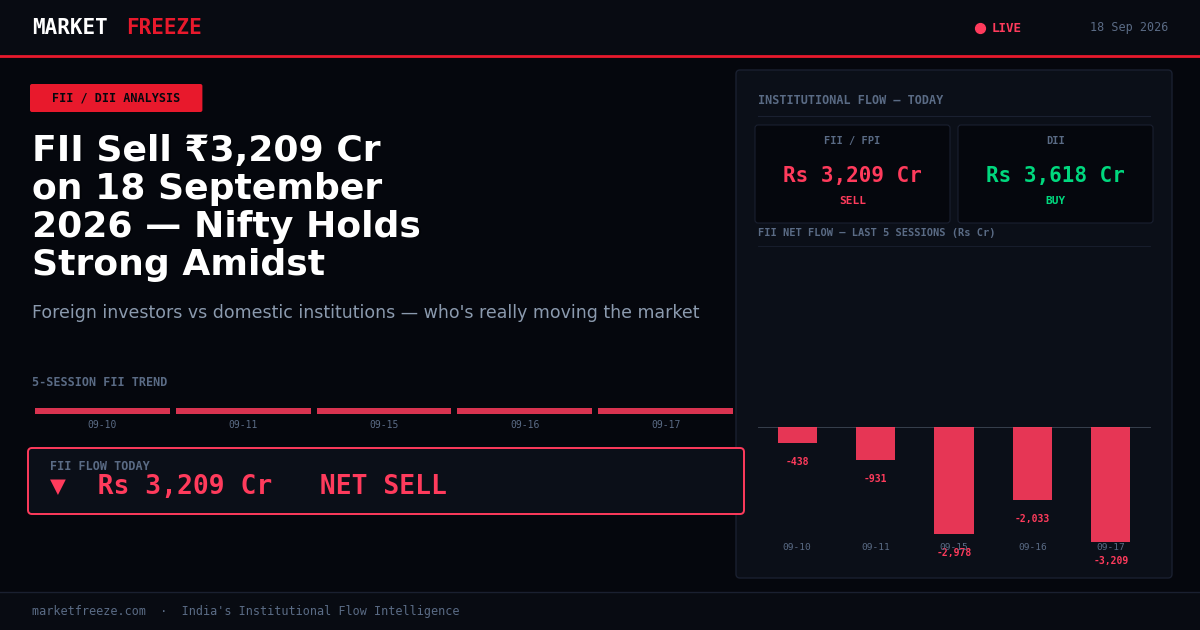
India’s equity markets absorbed ₹-3,208.76 Cr in net FII selling today, a continuation of the selling pressure seen across the last three sessions, while Domestic Institutional Investors (DIIs) countered with a net buy of ₹3,617.75 Cr.
FII Selling Accelerates, DIIs Maintain Defense
Foreign Portfolio Investors (FPIs) offloaded a substantial ₹3,208.76 Cr on a net basis today. This outflow represents an acceleration from the ₹2,032.61 Cr net sell recorded on September 16th and the ₹2,977.86 Cr net sell on September 15th. The gross buying by FIIs today stood at ₹8,761.71 Cr, indicating the scale of their selling operations. In contrast, DIIs demonstrated robust buying support, netting ₹3,617.75 Cr. This DII buying has been a consistent feature over the past three sessions, absorbing a significant portion of FII selling and preventing sharper declines in the indices.
Open a free demat account with
Upstox
or
Angel One
— zero brokerage on delivery trades.
The sustained DII buying provides a critical floor, especially given the current FII selling trajectory. The trend of DII net buying exceeding FII net selling has persisted for at least the last five sessions, suggesting a structural support mechanism in place for Indian equities from domestic funds.
Nifty’s Resilience Above Key Support
The Nifty 50 closed at 23,346.40, marking a gain of 0.33%. This upward move occurred despite significant FII selling, underscoring the impact of DII purchases and a potential shift in broader market dynamics. Based on today’s flow data and the Nifty’s closing price, the immediate support for the Nifty 50 can be pegged at 23,200. This level represents the approximate point where FII selling pressure was absorbed by DII buying, preventing a breach below the 23,217.60 closing level seen on September 15th. Resistance is now building around 23,450, a level tested during intraday trading today. A decisive breach above this could signal further upside potential, driven by continued DII strength.
For retail investors, the ability of the Nifty to close higher despite FII selling is a positive signal. Focus on stocks that are exhibiting DII accumulation or are less impacted by FII outflows.
Sectoral Shifts Implied by Flow Dynamics
The consistent DII buying, especially when FIIs are net sellers, often indicates a preference for domestic-facing sectors. While today’s data does not provide granular sector-level FII/DII breakdowns, the overall trend suggests DIIs are actively supporting large-cap stocks, potentially in sectors like Banking and select Auto manufacturers, which are typically favored by domestic funds for their stability and dividend yields. The Nifty Bank index closing up 0.54% to 56,359.00 corroborates this. FII selling, conversely, could be concentrated in sectors perceived as more sensitive to global liquidity conditions or geopolitical risks, such as IT and potentially some Metals. The moderation in crude oil prices, as noted in market reports, likely offered some relief, preventing a steeper decline in the broader market and possibly influencing buying in energy-intensive sectors indirectly through reduced cost pressures.
Retail traders should monitor banking stocks closely for continued DII accumulation, as this sector appears to be a primary beneficiary of domestic fund inflows in the current environment.
USD/INR Stability Amidst Global Factors
The Indian Rupee (USD/INR) closed at Rs95.96, down 0.27% today. Despite the FII outflows, the rupee showed relative resilience. Reports indicate traders expect losses to be capped near Rs96 against the USD, supported by central bank interventions. This suggests that while FII selling can exert downward pressure on the currency, domestic factors and official actions are providing a buffer. The stabilization of crude oil prices, a major import item for India, also plays a role in supporting the rupee by reducing the import bill. The slight depreciation today, however, warrants attention as it indicates that the rupee is sensitive to foreign capital movements and global interest rate expectations, as highlighted in market commentary.
Retail investors should be aware that a depreciating rupee can have mixed effects; it benefits exporters but increases the cost of imports and can be a drag on companies with significant foreign currency debt obligations.
Crude Oil Downturn and Market Reaction
Crude oil prices on MCX saw a significant decline of 5.93%, closing at Rs9,462.00/bbl. This sharp fall in crude prices aligns with market reports indicating easing oil prices offering relief to equities. The broad market indices closed mixed, with the Nifty 50 gaining 0.33% and the Sensex slipping 0.03%. The moderation in crude prices is a key factor that likely mitigated the impact of FII selling. Lower energy costs translate to reduced inflationary pressures and improved margins for many companies, particularly in the consumer discretionary and manufacturing sectors. This price action could be a significant driver for DII buying, as they position for a potentially more favorable inflation and cost environment.
For retail investors, the sharp fall in crude prices can be seen as a positive development for domestic consumption-oriented stocks, which may see improved operating margins.
Historical Flow Context: FII Selling Streak Continues
Today’s ₹-3,208.76 Cr FII net sell marks the third consecutive session of outflows exceeding ₹2,000 Cr. This sustained selling by foreign investors is a significant trend. Looking at the historical data for the last five sessions:
| Date | FII Net (Cr) | DII Net (Cr) | Nifty Close |
|---|---|---|---|
| 2026-09-10 | ₹-438.20 Cr | +₹1,025.80 Cr | 23,477.80 |
| 2026-09-11 | ₹-930.90 Cr | +₹1,968.20 Cr | 23,118.60 |
| 2026-09-15 | ₹-2,977.86 Cr | +₹2,686.05 Cr | 23,217.60 |
| 2026-09-16 | ₹-2,032.61 Cr | +₹3,908.23 Cr | 23,270.60 |
| 2026-09-17 | ₹-3,208.76 Cr | +₹3,617.75 Cr | 23,346.40 |
The pattern over the last three sessions shows FII selling intensifying while DII buying has also increased to meet it. This suggests that while foreign investors are consistently reducing their positions, domestic institutions are providing a strong counter-balance, keeping the market afloat. The Nifty’s ability to hold its ground and even gain slightly in the face of such sustained FII selling highlights the increasing importance of DII flows in the current market structure.
Retail investors should note that prolonged FII selling, even with DII support, can eventually lead to broader market fatigue if not accompanied by improved global liquidity or a change in FII risk perception.
Crypto Crossover: Bitcoin and Ethereum Strength
In a contrasting move to traditional equity flows, cryptocurrencies showed significant strength today. Bitcoin surged 2.38% to USD 77,987.00, and Ethereum rose 3.18% to USD 2,507.00. While there is no direct correlation between FII/DII flows in Indian equities and cryptocurrency movements, the broader trend of global capital seeking returns, coupled with increased risk appetite in alternative assets, could indirectly influence liquidity available for emerging markets like India. The strength in crypto could signal a general ‘risk-on’ sentiment in global financial markets, which might eventually benefit Indian equities if this trend persists and FIIs return.
Retail investors might consider that while equities are facing FII outflows, other asset classes are experiencing inflows, suggesting a potential redirection of capital or a broader market liquidity increase.
FAQ
What was the total amount FIIs sold in Indian equities today?
FIIs sold a net amount of ₹3,208.76 Cr in Indian equities today.
How much did DIIs buy to offset FII selling on September 18, 2026?
DIIs bought a net of ₹3,617.75 Cr today, effectively absorbing the FII selling pressure.
What was the closing price of the Nifty 50 on September 18, 2026?
The Nifty 50 closed at 23,346.40 on September 18, 2026.
The sustained net selling by FIIs, amounting to ₹3,208.76 Cr today, warrants a deeper look into potential sector rotation. While DIIs are actively buying, their focus might be shifting towards defensive sectors or companies with strong domestic fundamentals. Banks, for instance, have seen continued DII interest, and the Nifty Bank’s positive close of 0.54% to 56,359.00 further supports this. Conversely, FIIs might be reducing exposure to sectors heavily reliant on export demand or global cyclical trends. The IT sector, which has been a favorite for FIIs in the past, could be a potential area of reduced FII holding if global IT spending shows signs of cooling. Investors should watch for any subtle shifts in DII buying patterns across sectors, as these can provide early indicators of where domestic capital is finding value amidst foreign outflows.
Global Sentiment and Emerging Market Context
The current FII selling in India, while significant at ₹3,208.76 Cr, needs to be viewed within the broader emerging market (EM) context. Globally, there are mixed signals. While cryptocurrencies like Bitcoin are up 2.38% and Ethereum up 3.18%, suggesting a ‘risk-on’ sentiment in certain asset classes, other major economies are grappling with inflation and potential interest rate hikes. This dichotomy can lead to capital reallocation. If global inflation fears intensify, FIIs might pull back from riskier assets, including emerging markets. However, if the current strength in risk assets like crypto signals a broader liquidity surge, some of that capital could eventually find its way back into markets like India, especially if domestic economic indicators remain robust. The Nifty 50’s ability to close up 0.33% to 23,346.40 despite the outflows suggests that domestic factors are currently outweighing global bearish sentiment for Indian equities.
For retail investors, understanding this global interplay is crucial. While ₹3,208.76 Cr in FII selling is a headline number, the global liquidity environment and risk appetite can be more potent drivers of sustained foreign investment. If global conditions turn more favorable, we could see a reversal in FII flows, potentially leading to a significant rally in Indian equities, especially if DII buying continues its pace of ₹3,617.75 Cr.
Retail Investor Positioning Amidst Volatility
In the face of substantial FII selling (₹3,208.76 Cr today) and robust DII buying (₹3,617.75 Cr), retail investors often find themselves at a crossroads. Some may be tempted to exit positions fearing further declines, while others see this as an opportunity to accumulate quality stocks at lower prices, supported by DIIs. The Nifty 50’s resilience, closing at 23,346.40, might embolden the latter group. However, the historical context of sustained FII outflows, as seen over the last three sessions, suggests caution. Retail investors who are long-term oriented might focus on the fundamental strength of companies and the sectors DIIs are accumulating, such as banking, rather than reacting to short-term FII movements. The stability in USD/INR at Rs95.96 also offers a degree of reassurance against excessive currency depreciation, which could otherwise impact import-heavy sectors and increase costs for businesses with foreign debt.
Bottom Line
Foreign portfolio investors continued their selling spree today, offloading ₹3,208.76 Cr. However, domestic institutional investors provided a strong counter, buying ₹3,617.75 Cr, which helped the Nifty 50 close higher at 23,346.40. The easing of crude oil prices to Rs9,462.00/bbl offered some relief to the broader market, while the Indian Rupee showed resilience, trading near Rs95.96. The sustained DII buying suggests a robust domestic support system is in place for Indian equities amidst ongoing foreign outflows.
Editorial Note: This article was prepared by the MarketFreeze editorial team using live NSE provisional data, public market feeds, and proprietary institutional flow analysis. All price and flow figures are sourced directly from NSE, BSE, and CoinGecko as of 18 September 2026. This content is for informational purposes only and does not constitute investment advice. MarketFreeze is not SEBI-registered. Please consult a qualified financial advisor before making investment decisions. Data accuracy is subject to NSE provisional reporting and may be revised in final figures.