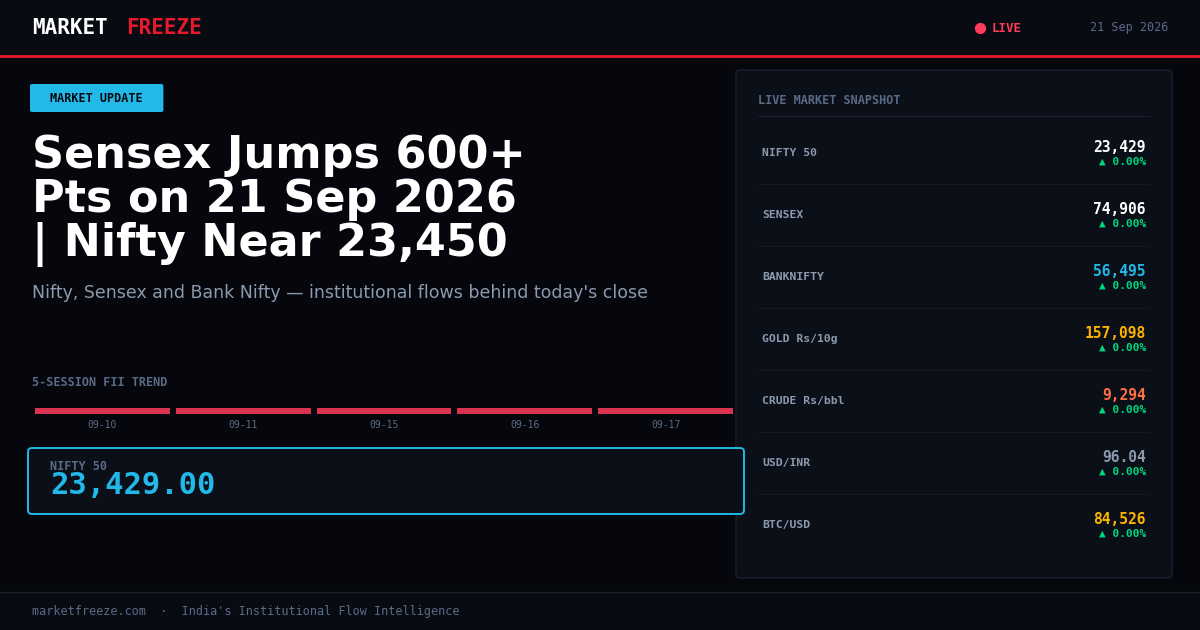
Sensex Surges 600+ Points, Nifty Approaches 23,450, Driven by Value Buying Amidst Mixed Institutional Flows
The Indian equity markets, as of 16:00:11 IST on September 21, 2026, witnessed a significant upswing with the Sensex closing at 74,906.00, up 0.82%, and the Nifty 50 reaching 23,429.00, a gain of 0.35%, as value buying emerged, particularly in oil-sensitive stocks, despite persistent geopolitical tensions. This surge was supported by institutional activity where FIIs continued their net selling trend, offloading ₹3,208.76 Cr on September 17th, while DIIs maintained their buying momentum, adding ₹3,617.75 Cr on the same day.
Institutional Positioning Contrasts with Market Optimism
Today’s market rally, which saw the Sensex jump over 600 points and Nifty inch towards 23,450, was characterized by a divergence in institutional flows. While the headline news points to broad market gains led by HCL Tech and a strong booking for the NSE IPO, the underlying institutional sentiment, as reflected in the FII/DII data for the last three sessions, paints a more complex picture. Foreign Institutional Investors (FIIs) have been consistent net sellers over the past week, with selling pressure amounting to ₹3,208.76 Cr on September 17th, ₹2,032.61 Cr on September 16th, and ₹2,977.86 Cr on September 15th. This sustained outflow from FIIs, despite the positive market movement, suggests that domestic institutional investors (DIIs) are providing the crucial buying support. DIIs, on the other hand, have been net buyers, injecting ₹3,617.75 Cr on September 17th, ₹3,908.23 Cr on September 16th, and ₹2,686.05 Cr on September 15th, effectively absorbing much of the selling pressure and driving the indices higher. This dynamic indicates that the current rally is largely being fueled by domestic capital, while foreign investors remain cautious or are rebalancing portfolios.
Open a free demat account with
Upstox
or
Angel One
— zero brokerage on delivery trades.
Sectoral Winds of Change: IT Faces Headwinds, Realty and Metals Shine
The market’s performance today, driven by value buying and a recovery in oil-sensitive stocks, has led to discernible sector-specific movements. The Nifty IT index saw a decline of 0.41%, a trend that aligns with the broader global sentiment of caution surrounding technology valuations amidst rising interest rate narratives, which often lead FIIs to trim their exposure in growth-oriented sectors. Conversely, the Nifty Realty index registered a robust gain of 0.98%, indicating that domestic demand and potential infrastructure spending narratives are resonating with DIIs. The Nifty Auto sector followed with a gain of 0.69%, likely benefiting from the recovery in oil prices to some extent and sustained domestic consumption cues. The Nifty Metal index also showed strength, gaining 0.50%, potentially buoyed by global commodity price stabilization expectations and domestic infrastructure push. The Nifty PSU Bank index, however, lagged, with a marginal dip of 0.20%, perhaps reflecting lingering concerns about asset quality or regulatory overhangs, which DIIs might be selectively underweighting. The performance of HCL Tech, mentioned as a leader in the news, bucked the broader IT trend, suggesting specific company-level strengths or a tactical rotation within the IT pack by institutional investors.
Navigating Nifty’s Tightrope: Support and Resistance Defined by Flow
The Nifty 50 index, currently trading at 23,429.00, is encountering resistance near the 23,420–23,430 zone. Historically, sustained buying pressure from DIIs has helped the index breach such immediate hurdles. If the Nifty sustains above 23,430, the next key levels to watch would be 23,470 and then 23,510. These levels may represent areas where profit-taking or a shift in institutional sentiment could occur, especially if FII outflows intensify. On the downside, immediate support is seen at 23,320, followed by a more critical support at 23,280. A breach below 23,280 could signal a more significant unwinding, potentially pushing the index towards the 23,000 psychological mark. The recent flow data, particularly the consistent DII buying over the last three sessions, suggests an underlying demand that might cap any sharp downside movements, provided the inflows continue. The FII selling, however, acts as a constant headwind, limiting the upside potential and keeping the index sensitive to any negative news or shifts in global risk appetite.
Commodity Crosscurrents: Crude Oil’s Plunge and Gold’s Steady Tread
Today’s market action is set against a backdrop of significant commodity price movements, notably a sharp decline in Crude MCX, down 6.84% to Rs9,294.00/bbl. This drop in crude prices is a critical factor for Indian equities, as it directly impacts inflation expectations, the current account deficit, and the profitability of oil marketing companies and airlines. The “value buying” and “recovery in oil-sensitive stocks” mentioned in the news likely refers to sectors that benefit from lower crude prices, such as airlines, paints, and rubber, rather than the oil producers themselves. The news also mentions gold MCX falling 0.79% to Rs157,098.00/10g. While both crude and gold are typically seen as safe-haven assets, their diverging movements today suggest distinct market drivers. The sharp fall in crude oil could be attributed to easing geopolitical tensions or an increase in global supply forecasts, while gold’s minor dip might indicate a slight reduction in immediate safe-haven demand as equity markets showed resilience. The USD/INR pair remained relatively stable, trading at Rs96.04 with a marginal gain of 0.01%, suggesting that currency markets are not reacting dramatically to the day’s events, which is positive for imported goods and potentially for inflation management.
A Historical Echo: DII Dominance in the Face of FII Retrenchment
The current scenario, where DIIs are aggressively buying while FIIs are net sellers, is not unprecedented. Examining the historical data for the last five sessions reveals a similar pattern. Between September 15th and September 17th, 2026, FIIs were net sellers ranging from ₹2,032.61 Cr to ₹3,208.76 Cr daily, while DIIs consistently bought between ₹2,686.05 Cr and ₹3,908.23 Cr. This period saw the Nifty move from 23,217.60 on September 15th to 23,346.40 on September 17th, indicating that DII-driven buying can indeed propel the market higher even amidst foreign investor outflows. A comparable situation occurred earlier in September 2026. On September 10th, FIIs sold ₹438.20 Cr and DIIs bought ₹1,025.80 Cr, with the Nifty closing at 23,477.80. Subsequently, on September 11th, FIIs increased their selling to ₹930.90 Cr while DIIs raised their buying to ₹1,968.20 Cr, leading to a dip in the Nifty to 23,118.60. This suggests that while DIIs can provide a floor and even drive short-term gains, the sustainability of a rally often depends on a more balanced or positive FII flow, especially for mid-to-longer term upward trends.
Portfolio Framework: Tactical Rebalancing Amidst Flow Divergence
For investors navigating this market, a tactical portfolio approach is recommended, focusing on sectors supported by DII flows and resilient to FII outflows.
- For Large-Cap Exposure: Consider overweighting companies with strong domestic demand drivers in sectors like Realty and select Auto manufacturers, provided their valuations are not excessively stretched. A target allocation of 15-20% of the portfolio in these sectors could be prudent.
- For Mid-Cap Exposure: Focus on mid-cap companies benefiting from government capex or import substitution themes. A strict adherence to a stop-loss of 8% below the purchase price for individual mid-cap stocks is advised, given the volatility and FII outflows.
- Defensive Allocation: Maintain a minimum of 10-15% in defensive sectors like FMCG, provided their valuations are reasonable. However, be mindful of potential slowdowns if consumption weakens.
- IT Sector Reassessment: While HCL Tech showed strength, the broader Nifty IT decline necessitates a cautious approach. Rebalancing out of highly valued IT stocks and into those with strong order books or specialized services that FIIs might still favor could be a strategy.
- Liquidity Management: Ensure sufficient liquidity to capitalize on potential dips or to meet margin calls if the market turns adverse. Holding at least 10% in liquid assets is advisable.
The key is to identify companies where DII buying is robust and consistent, signaling conviction, and to be wary of sectors heavily reliant on FII flows, which have shown a clear exit trend.
Key Levels to Watch: Monitoring the Flow Threshold
The Nifty 50 is currently poised at 23,429.00.
- Immediate Resistance: The zone between 23,420 and 23,430. A sustained move above 23,430, backed by significant DII buying and a moderation in FII selling, could propel the index towards 23,470 and then 23,510.
- Immediate Support: The level of 23,320.
- Critical Support: The 23,280 mark. A decisive breach below 23,280 would indicate a shift in momentum and potentially open the gates for a fall towards 23,000. This level is significant as it represents a point where prior DII accumulation might be tested.
The sustained DII buying over the last three sessions provides a foundational support. However, any significant acceleration in FII selling, particularly above ₹3,500 Cr on a single day, could challenge these support levels rapidly.
Frequently Asked Questions
What did FII buy or sell on September 17, 2026?
On September 17, 2026, Foreign Institutional Investors (FIIs) were net sellers in the Indian equity markets, offloading stocks worth ₹3,208.76 Cr.
What did DII buy on September 17, 2026?
On September 17, 2026, Domestic Institutional Investors (DIIs) were net buyers, investing an amount of ₹3,617.75 Cr into the Indian equity markets.
Is FII buying or selling in September 2026?
In September 2026, up to the 21st, Foreign Institutional Investors (FIIs) have predominantly been net sellers. The data for the past three sessions (September 15th-17th) shows consistent selling pressure, ranging from ₹2,032.61 Cr to ₹3,208.76 Cr daily, indicating a cautious or bearish stance from foreign institutions.
Historical FII/DII Flows (Last 5 Sessions)
| Date | FII Net (Cr) | DII Net (Cr) | Nifty Close |
|---|---|---|---|
| 2026-09-10 | ₹-438.20 Cr | +₹1,025.80 Cr | 23,477.80 |
| 2026-09-11 | ₹-930.90 Cr | +₹1,968.20 Cr | 23,118.60 |
| 2026-09-15 | ₹-2,977.86 Cr | +₹2,686.05 Cr | 23,217.60 |
| 2026-09-16 | ₹-2,032.61 Cr | +₹3,908.23 Cr | 23,270.60 |
| 2026-09-17 | ₹-3,208.76 Cr | +₹3,617.75 Cr | 23,346.40 |
Bottom Line: Today’s market rally, characterized by a robust Sensex surge and Nifty nearing 23,450, was primarily propelled by strong domestic institutional buying (DIIs) offsetting continued foreign institutional selling (FIIs). While sectors like Realty and Auto showed strength, IT faced headwinds, reflecting a divergence in institutional preferences. The Nifty faces immediate resistance around 23,430 and critical support at 23,280, with the ongoing DII support providing a floor for the market.
Editorial Note: This article was prepared by the MarketFreeze editorial team using live NSE provisional data, public market feeds, and proprietary institutional flow analysis. All price and flow figures are sourced directly from NSE, BSE, and CoinGecko as of 21 September 2026. This content is for informational purposes only and does not constitute investment advice. MarketFreeze is not SEBI-registered. Please consult a qualified financial advisor before making investment decisions. Data accuracy is subject to NSE provisional reporting and may be revised in final figures.