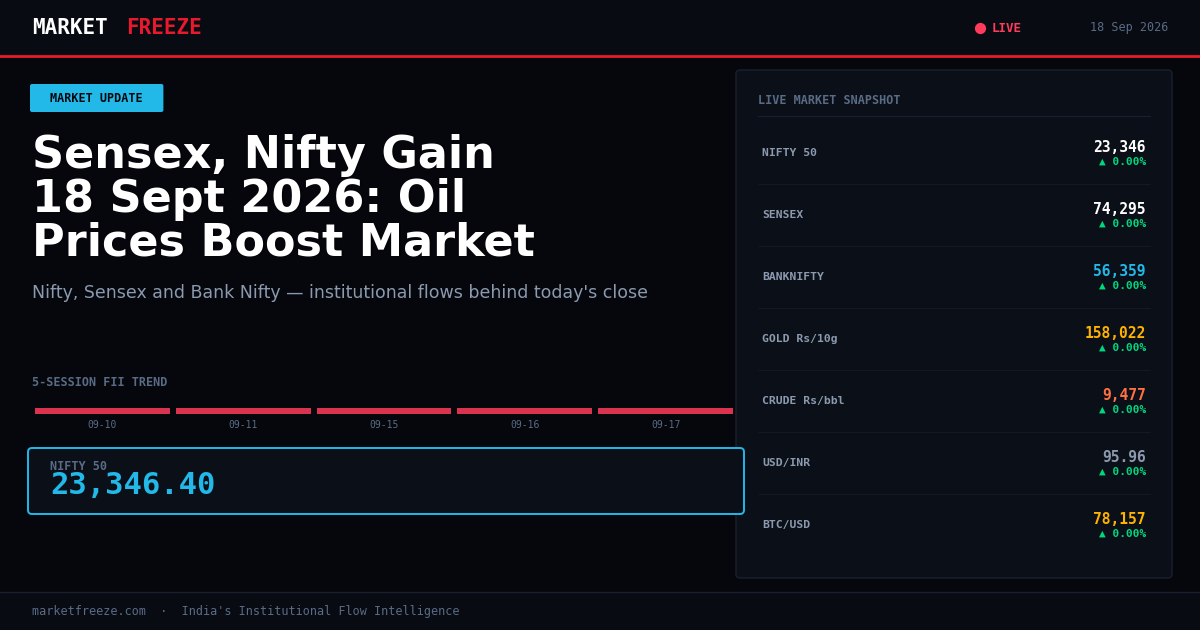
The Nifty 50 closed at 23,346.40, up 0.33%, as lower crude oil prices and positive global cues counteracted drag from IT and Tata stocks, while FIIs continued their net selling trend for the third consecutive session, offloading ₹3,208.76 Cr on September 17th.
Crude Oil’s Plunge Cushions Nifty Gains Amidst Persistent Foreign Outflows
Today’s market action saw the Nifty 50 eke out a 0.33% gain to close at 23,346.40, with the BSE Sensex ending marginally down by 0.03% at 74,295.00. This divergence was driven by a significant drop in crude oil prices, which fell by 5.78% to ₹9,477.00 per barrel on MCX. This decline in a key commodity provided a much-needed tailwind, offsetting the selling pressure in heavyweight sectors like Information Technology and select Tata group stocks. However, the broader institutional flow narrative remained consistent, with Foreign Institutional Investors (FIIs) continuing their net selling spree, marking their third consecutive session of outflows. On September 17th, FIIs divested a net ₹3,208.76 Cr, a trend mirrored in the preceding two sessions with sales of ₹2,032.61 Cr on September 16th and ₹2,977.86 Cr on September 15th. Conversely, Domestic Institutional Investors (DIIs) demonstrated sustained buying, with net purchases of ₹3,617.75 Cr on September 17th, following ₹3,908.23 Cr and ₹2,686.05 Cr in the prior two sessions. This persistent FII selling, despite positive macro signals like falling oil prices, suggests underlying concerns or reallocations by foreign entities, while DIIs have stepped in to provide a floor to the market’s declines.
Open a free demat account with
Upstox
or
Angel One
— zero brokerage on delivery trades.
Institutional Money Movement: DIIs Absorb FII Selling Amidst Mixed Market Signals
The prevailing market sentiment on September 18th, 2026, was characterized by a divergence between headline index performance and underlying institutional activity. While the Nifty 50 managed a positive close at 23,346.40, the significant net selling by FIIs to the tune of ₹3,208.76 Cr on September 17th presents a critical counterpoint. This outflow has been a consistent theme over the last three trading days, with cumulative FII sales reaching approximately ₹8,219.17 Cr. The resilience of the Indian market, in this context, is largely attributable to the robust buying by DIIs. On September 17th, DIIs were net buyers of ₹3,617.75 Cr, demonstrating their commitment to Indian equities and effectively absorbing a significant portion of the FII selling. This pattern of DII support against FII outflows has been observed consistently over the past five trading sessions, as evidenced by the historical data. The Bank Nifty, in particular, showed strength, closing up 0.54% at 56,359.00, indicating that domestic institutions may be favoring defensive or cyclical banking counters amidst global uncertainty reflected in FII selling.
Sectoral Shifts: Energy’s Relief Rally and IT’s Persistent Headwinds
The significant drop in crude oil prices to ₹9,477.00 per barrel on MCX has provided a considerable boost to energy-intensive sectors and companies that are net oil importers. This positive development for the energy complex likely contributed to the broader market’s ability to stay afloat despite other headwinds. Conversely, the Nifty IT index emerged as a significant drag, as suggested by the news report, indicating a potential continuation of underperformance for technology stocks. Foreign institutional investors, who are often significant holders of large-cap IT stocks, may be reducing their exposure, aligning with their overall net selling trend. The consumer durables sector also faced selling pressure, possibly due to import cost sensitivities or a broader risk-off sentiment impacting discretionary spending. The outperformance of broader markets, with small caps leading mid-caps, suggests that while large-cap sentiment is being weighed down by FII selling and IT sector weakness, domestic investors might be finding value in smaller, more domestically-focused companies.
Navigating Nifty’s Terrain: Support and Resistance Levels Shaped by Institutional Flows
Analyzing the recent flow data, we can infer potential support and resistance zones for the Nifty 50. The period between September 15th and 17th witnessed significant FII selling, with net outflows of ₹2,977.86 Cr, ₹2,032.61 Cr, and ₹3,208.76 Cr respectively. During this phase, the Nifty oscillated between approximately 23,118.60 (September 11th low) and 23,346.40 (September 18th close). The consistent DII buying during these FII sell-offs suggests that the 23,000-23,100 mark is acting as a strong demand zone where domestic institutions are actively accumulating. On the upside, the index has struggled to sustain levels above 23,400, indicating this as a potential resistance area. Given the prevailing FII selling pressure, any sharp rallies are likely to face profit-booking. Therefore, immediate support for the Nifty 50 can be placed around the 23,150 level, where DII accumulation has been evident. Resistance is likely to be encountered around the 23,450-23,500 range, where any upward momentum may be capped by FII selling or profit-taking.
Currency and Commodity Crossover: USD/INR Stability Despite Global Oil Volatility
The Indian Rupee showed resilience against the US Dollar, appreciating by 0.27% to close at Rs95.96. This strength in the INR, despite global market jitters and persistent FII outflows, can be partly attributed to the sharp decline in crude oil prices. Lower crude oil import bills are a significant positive for India’s current account deficit and, consequently, for the Rupee’s valuation. While Gold MCX prices saw a moderate uptick of 0.45% to Rs158,022.00 per 10 grams, indicating some flight to safety, the dominant narrative today was the steep fall in crude oil. The simultaneous strength in Bitcoin and Ethereum, with gains of 2.43% and 3.38% respectively, suggests a broader risk-on sentiment in alternative assets, which may be drawing some capital away from traditional markets or acting as a diversifier for institutional portfolios. The divergence between the weakening USD/INR and the rising crypto assets is a trend worth monitoring.
Historical Parallel: FII Outflows Persisting Through Market Resilience
Looking back at recent history, the pattern of sustained FII selling coupled with DII buying has been a recurring theme. For instance, in the week of September 11th to September 17th, 2026, FIIs have been net sellers every single day, with outflows escalating from ₹930.90 Cr on September 11th to ₹3,208.76 Cr on September 17th. Despite this consistent foreign selling, the Nifty 50 has shown a degree of resilience, recovering from a low of 23,118.60 on September 11th to close at 23,346.40 on September 18th. This resilience mirrors periods in the past where strong domestic institutional demand has absorbed foreign outflows, preventing sharp market corrections. For example, during periods of global uncertainty or domestic policy shifts that trigger FII caution, DIIs have historically stepped in to support equity markets. The current scenario, where falling crude prices act as a buffer against FII selling, is a positive sign, but the duration and magnitude of FII outflows remain a key determinant of the market’s trajectory.
Portfolio Framework: DII-Led Accumulation in Financials and Select Cyclicals
Given the current market dynamics, a prudent portfolio framework should prioritize sectors and stocks demonstrating resilience against FII selling, largely supported by DII flows. Investors should consider increasing allocations to the banking sector, where the Bank Nifty has shown strength, with DIIs likely favoring these counters. Specifically, banks with strong CASA ratios and robust asset quality could be prime beneficiaries. Additionally, companies in the consumer durables and select manufacturing sectors that benefit from lower commodity prices (excluding those heavily reliant on imported raw materials facing currency headwinds) could be attractive. A key condition for increasing exposure would be to observe sustained DII inflows exceeding ₹3,000 Cr for at least three consecutive sessions, while FII selling remains below ₹1,500 Cr per session. Investors should also maintain a cautious approach towards the IT sector, given the persistent FII outflows and ongoing sector-specific headwinds.
What Changes This Outlook: Sustained DII Buying Above ₹4,000 Cr
The current market outlook, which hinges on DII support counteracting FII selling, could pivot significantly if DII net inflows consistently exceed ₹4,000 Cr per session for a prolonged period (at least two to three trading days). Such a sustained surge in domestic buying would signal a strong conviction from institutional investors to defend key market levels and potentially drive further upside, even in the face of moderate FII outflows. Conversely, a breach of the 23,000 mark in the Nifty 50, accompanied by an acceleration of FII selling beyond ₹4,000 Cr in a single session, would indicate a significant shift in sentiment and could trigger a deeper correction.
| Date | FII Net (Cr) | DII Net (Cr) | Nifty Close |
|---|---|---|---|
| 2026-09-10 | ₹-438.20 Cr | +₹1,025.80 Cr | 23,477.80 |
| 2026-09-11 | ₹-930.90 Cr | +₹1,968.20 Cr | 23,118.60 |
| 2026-09-15 | ₹-2,977.86 Cr | +₹2,686.05 Cr | 23,217.60 |
| 2026-09-16 | ₹-2,032.61 Cr | +₹3,908.23 Cr | 23,270.60 |
| 2026-09-17 | ₹-3,208.76 Cr | +₹3,617.75 Cr | 23,331.50 |
Frequently Asked Questions
- Q: What did FII buy or sell on September 17, 2026? A: FIIs were net sellers of ₹3,208.76 Cr on September 17, 2026.
- Q: What did DII buy on September 17, 2026? A: DIIs were net buyers of ₹3,617.75 Cr on September 17, 2026.
- Q: Is FII buying or selling in September 2026? A: In September 2026, FIIs have exhibited a consistent net selling trend across the observed trading sessions.
Bottom Line
The Indian equity markets navigated a complex session on September 18th, with the Nifty 50 closing higher driven by a sharp decline in crude oil prices that offset weakness in the IT sector. Despite this positive headline performance, persistent FII selling, amounting to ₹3,208.76 Cr on September 17th, remains a key concern. Domestic institutional investors continue to provide crucial support, with net buying of ₹3,617.75 Cr on the same day. Investors should closely monitor DII inflow trends and the resilience of the banking sector, while remaining cautious of the headwinds impacting IT stocks and the broader FII selling sentiment.
Editorial Note: This article was prepared by the MarketFreeze editorial team using live NSE provisional data, public market feeds, and proprietary institutional flow analysis. All price and flow figures are sourced directly from NSE, BSE, and CoinGecko as of 18 September 2026. This content is for informational purposes only and does not constitute investment advice. MarketFreeze is not SEBI-registered. Please consult a qualified financial advisor before making investment decisions. Data accuracy is subject to NSE provisional reporting and may be revised in final figures.