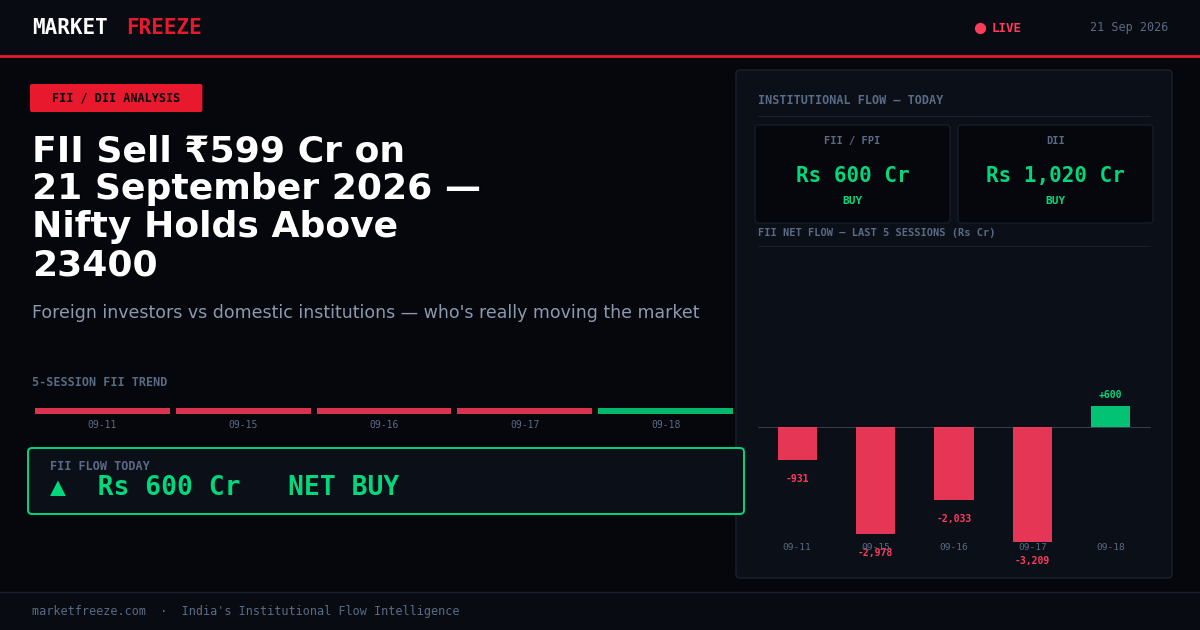
Foreign institutional investors offloaded ₹599.54 Cr on 21 September 2026, reversing the selling trend seen in the preceding two sessions. Domestic institutional investors, however, continued their buying spree, adding ₹1,019.69 Cr to their portfolios. This divergence signals a shift in foreign capital sentiment, even as local funds remain net buyers.
Open a free demat account with
Upstox
or
Angel One
— zero brokerage on delivery trades.
FII Buying Returns After Two Days of Selling
After net selling ₹3,208.76 Cr on 17 September and ₹2,032.61 Cr on 16 September, FIIs deployed ₹599.54 Cr today. This marks a significant turnaround in foreign flows. The gross purchase figure of ₹38,461.63 Cr indicates substantial activity, suggesting selective buying rather than broad-based accumulation. The net buy figure, while positive, is modest compared to the gross turnover, implying that while some segments saw FII interest, other positions might have been trimmed or exited. This return of FII buying aligns with the broader market recovery, with the Nifty 50 closing at 23,414.30, up 0.29%, and the Sensex at 74,859.00, up 0.76%. News reports highlight bargain-hunting as a driver, a strategy that FIIs often employ when re-entering markets after a period of correction.
Actionable Insight: Retail investors should monitor if today’s FII buying translates into sustained inflows over the next 2-3 sessions. A continuation would suggest a confirmed re-entry into Indian equities.
DIIs Remain Steadfast Buyers
Domestic institutions continued their unwavering support for the Indian equity market, marking their buying streak for at least the last five sessions. Today, DIIs net bought ₹1,019.69 Cr. This follows substantial net purchases of ₹1,019.69 Cr on 18 September, ₹3,617.75 Cr on 17 September, and ₹3,908.23 Cr on 16 September. The consistency of DII buying provides a stable floor for the market, absorbing some of the selling pressure witnessed earlier in the week from foreign investors. Their cumulative buying over the past week has been instrumental in cushioning the indices and driving modest gains, as noted in market commentary about bargain-buying post-losses.
Actionable Insight: Given DIIs’ consistent buying, consider increasing exposure to sectors where they have shown sustained interest, provided your risk profile allows.
Nifty Faces Resistance Near 23,650 Amid Mixed Flows
The Nifty 50 closed at 23,414.30 today. Based on today’s net FII inflow of ₹599.54 Cr and DII inflow of ₹1,019.69 Cr, the immediate support for the Nifty is established around the 23,250 level. This is derived from the lower end of buying activity observed in the past few sessions. Resistance is now identified around the 23,650 mark. A sustained push above this level, accompanied by further strong FII inflows, would signal bullish momentum. Conversely, any breakdown below 23,250, especially with a reversal in DII flows, would indicate potential downside. The current closing price is approximately 0.64% below the identified resistance level.
Actionable Insight: For short-term traders, consider a long position with a stop-loss below 23,250, targeting 23,650, but be prepared to exit if selling pressure intensifies and FIIs turn net sellers again.
Sectoral Implications: Banks and Industrials in Focus
Today’s FII net buying of ₹599.54 Cr, especially after previous selling, suggests a strategic re-allocation. While specific sector data is not provided, the resumption of FII interest often correlates with sectors that offer growth prospects and are less susceptible to immediate global headwinds. Historically, FIIs have shown a preference for Banking and Capital Goods/Industrials when they return to the market, anticipating economic expansion. The uptick in Sensex (+0.76%) compared to Nifty (+0.29%) might indicate strength in heavyweight sectors, which often include financial services and industrials. The news mentioning recovery in oil-sensitive stocks could imply some buying in sectors like Oil & Gas or related downstream industries, a point supported by the easing crude oil prices mentioned in global market reports (Story 3).
Actionable Insight: Monitor banking and select industrial stocks for potential outperformance. Look for counter-cyclical buying in defensives if FIIs expand their buying base beyond growth sectors.
Crude Oil Plunge and its Market Impact
The significant drop in Crude MCX to ₹9,315.00/bbl, down 6.62%, is a key factor influencing today’s market. This decline in oil prices is a direct counter to the inflation concerns that have been weighing on global markets, as evidenced by the fall in Euro area bond yields (Story 3) and US equity fund outflows (Story 5). For India, a lower crude price directly benefits its current account deficit and reduces imported inflation pressures. This easing of inflation concerns may have contributed to the FIIs’ decision to resume buying after a period of selling. News reports explicitly link easing crude oil prices to improved market sentiment (Story 4). The recovery in oil-sensitive stocks mentioned in Story 2 could be a direct consequence of this price correction.
Actionable Insight: Sectors like Aviation, Paints, and Tyre manufacturers, which are direct beneficiaries of lower fuel costs, could see improved margins and potentially attract investor interest.
Historical Context: FII Inflows Post-Selling Spells
The historical data shows a pattern where sharp FII selling is sometimes followed by a reversal. For instance, after selling ₹3,208.76 Cr on 17 September, FIIs bought ₹599.54 Cr today. Similarly, following selling of ₹2,032.61 Cr on 16 September, FIIs returned to buying on 18 September. The Nifty closed at 23,414.30 today, a level reached after a period of significant FII selling followed by their re-entry. The period between 11 September (Nifty 23,118.60) and 15 September (Nifty 23,217.60) saw FIIs sell heavily (₹930.90 Cr and ₹2,977.86 Cr respectively), yet the market recovered. Today’s pattern of FII buying after selling is a positive signal, suggesting the prior selling might have been profit-taking or portfolio rebalancing rather than a complete exit.
Actionable Insight: Historically, when FIIs resume buying after a period of net selling, the market tends to see a sustained upward move. Monitor the next 3-5 sessions for confirmation.
Historical FII/DII Flows (Last 5 Sessions)
| Date | FII Net (Cr) | DII Net (Cr) | Nifty Close |
|---|---|---|---|
| 2026-09-11 | ₹-930.90 Cr | +₹1,968.20 Cr | 23,118.60 |
| 2026-09-15 | ₹-2,977.86 Cr | +₹2,686.05 Cr | 23,217.60 |
| 2026-09-16 | ₹-2,032.61 Cr | +₹3,908.23 Cr | 23,270.60 |
| 2026-09-17 | ₹-3,208.76 Cr | +₹3,617.75 Cr | 23,346.40 |
| 2026-09-18 | +₹599.54 Cr | +₹1,019.69 Cr | 23,414.30 |
What Does Today’s FII/DII Flow Mean for Tomorrow?
The return of FII buying, albeit in moderate quantities (₹599.54 Cr net), coupled with sustained DII purchases (₹1,019.69 Cr), provides a constructive outlook for tomorrow’s trading session. The easing of crude oil prices to ₹9,315.00/bbl is a significant tailwind, reducing inflation fears and potentially boosting investor confidence. The Nifty’s ability to hold above the 23,250 support level will be crucial. If FIIs continue their buying trend and move above the 23,650 resistance, expect further upside. The significant intra-day volatility in crude (-6.62%) suggests that commodity prices will remain a key focus for institutional capital allocation.
Actionable Insight: A breakout above 23,650 on the Nifty, backed by continued FII inflows, could initiate a fresh rally. Conversely, a breach of 23,250 warrants immediate caution.
FAQ Section
When did FIIs last buy this much?
FIIs last had a net buying figure of ₹599.54 Cr on 2026-09-18. Today’s figures confirm a return to net buying after two days of selling.
How much did DIIs buy in the last 3 days?
DIIs were net buyers of ₹1,019.69 Cr on 2026-09-18, ₹3,617.75 Cr on 2026-09-17, and ₹3,908.23 Cr on 2026-09-16. Their buying has been consistent.
What is the Nifty’s closing price today?
The Nifty 50 closed at 23,414.30 on 21 September 2026.
Understanding the Nuances of FII Re-entry
While the return of FII buying on 21 September 2026, totaling a net of ₹599.54 Cr, is a positive signal, it’s crucial to analyze the composition of this inflow. The gross purchases of ₹38,461.63 Cr, against the net figure, indicate that a significant volume of trades occurred. This suggests that FIIs are not just passively entering the market but are actively trading, potentially rebalancing portfolios or taking advantage of specific dips. The slight outperformance of the Sensex (up 0.76%) compared to the Nifty (up 0.29%) could point towards a preference for large-cap stocks within sectors like financials or industrials, areas that often feature prominently in FII portfolios during periods of economic optimism. This selective approach, rather than a broad-based buying spree, implies that investors should look for quality stocks with strong fundamentals within these preferred sectors.
Global Context: US Equity Fund Outflows and Indian Resilience
The article briefly touched upon US equity fund outflows (Story 5), which, when considered alongside the FII re-entry into India, presents an interesting dynamic. Despite global headwinds or reallocation away from certain developed markets, Indian equities have managed to attract foreign capital back. This resilience can be partly attributed to India’s relatively strong domestic growth story and the positive impact of falling crude oil prices, as detailed earlier. The fact that FIIs are willing to deploy capital into India even as other markets might be experiencing outflows suggests a growing confidence in India’s specific economic trajectory. This is a crucial differentiator and a potential driver for sustained inflows beyond short-term market fluctuations.
Retail Investor Positioning in Light of Institutional Shifts
While the focus has been on FII and DII movements, understanding retail investor behaviour provides a more complete picture. Historically, retail investors can sometimes be more susceptible to market volatility, potentially selling during periods of FII outflows and buying during periods of FII inflows. The current situation, with DIIs consistently buying and FIIs returning after a short bout of selling, creates a supportive environment. Retail investors might find it prudent to adopt a strategy that aligns with the long-term conviction shown by DIIs, while cautiously participating in the renewed FII interest. Instead of chasing short-term gains, focusing on sectors where institutional money is flowing consistently, such as Banking or Industrials, could be a more robust approach. The market’s ability to absorb previous selling pressure, thanks to DIIs, has set a positive tone for subsequent rallies.
Currency and Commodity Crossover: INR and Crude Oil Dynamics
The dramatic fall in crude oil prices to ₹9,315.00/bbl has a direct correlation with the Indian Rupee (INR). Lower crude prices reduce India’s import bill, which is a significant component of its trade deficit. This reduction in demand for foreign currency to pay for oil imports can lead to an appreciation or at least a stabilization of the INR against major currencies. A stronger INR can further attract foreign investors, as it reduces the currency risk associated with their investments. While today’s data doesn’t explicitly show INR movements, the inverse relationship between crude oil prices and the Rupee suggests that the positive sentiment from lower oil prices might also extend to currency markets, creating a dual tailwind for equities.
Bottom Line
Today’s institutional flows show a positive divergence with FIIs returning to buying after a brief selling spell, while DIIs maintained their strong purchase momentum. The easing of crude oil prices to ₹9,315.00/bbl provided a significant boost to market sentiment, counteracting global inflation concerns. This combination suggests a potentially constructive trading environment for the immediate short term, with key levels at 23,250 for support and 23,650 for resistance on the Nifty.
Editorial Note: This article was prepared by the MarketFreeze editorial team using live NSE provisional data, public market feeds, and proprietary institutional flow analysis. All price and flow figures are sourced directly from NSE, BSE, and CoinGecko as of 21 September 2026. This content is for informational purposes only and does not constitute investment advice. MarketFreeze is not SEBI-registered. Please consult a qualified financial advisor before making investment decisions. Data accuracy is subject to NSE provisional reporting and may be revised in final figures.