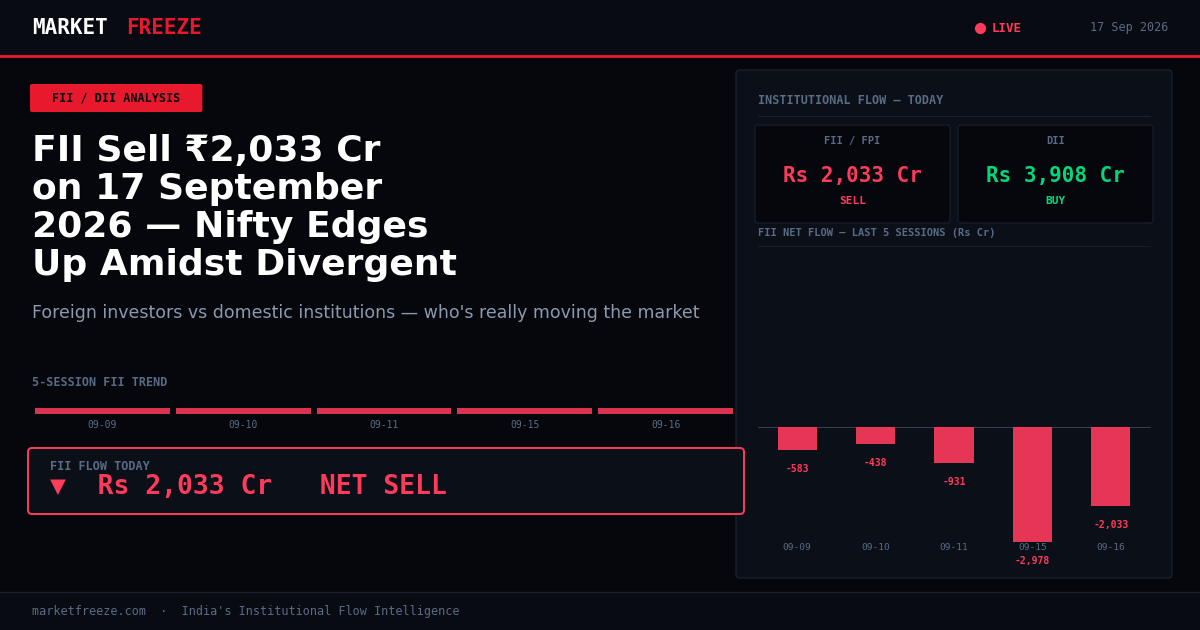
FII desks turned net sellers today, offloading ₹2,032.61 Cr in Indian equities. This outflow contrasts sharply with the sustained buying interest observed from Domestic Institutional Investors (DIIs), who recorded a net purchase of ₹3,908.23 Cr. The Nifty 50 closed marginally higher at 23,270.60, up 0.23%, while the Sensex shed 0.03% to 74,315.00. This divergence signals a potential short-term disconnect between foreign and domestic capital allocation strategies, as highlighted by the last three sessions’ data.
Open a free demat account with
Upstox
or
Angel One
— zero brokerage on delivery trades.
FII Selling Accelerates Against DII Buying Spree
The foreign institutional investor (FII) net selling figure of ₹2,032.61 Cr today represents an acceleration of their selling activity compared to the previous session (₹930.90 Cr net sell on 11 Sept) but is less than the ₹2,977.86 Cr outflow recorded on 15 September. Their gross buying stood at ₹12,959.04 Cr, indicating a substantial turnover but a net negative position. Conversely, DIIs have maintained a robust buying trend for at least the last five sessions, with today’s ₹3,908.23 Cr buy being the highest in this period. This sustained DII accumulation, particularly the significant jump today, suggests domestic funds are actively absorbing FII selling pressure, potentially identifying value in the current market structure.
Nifty Positioned Between Key Flow Levels
Based on today’s flow data, the Nifty 50 is currently trading at 23,270.60. The significant selling by FIIs today suggests immediate resistance may form around the 23,450 mark, a level where selling pressure could intensify if tested. Conversely, the strong DII buying indicates robust support. Historically, FII selling often pushes the index lower, but DII accumulation can cap downside. Support could emerge around the 23,000–23,100 range, where prior buying interest might have materialized. A decisive break below 23,000 would signal a weakening of DII support and a capitulation of FII selling, while a sustained move above 23,450 would imply FII selling is being completely absorbed and potentially reversed.
Sectoral Implications: Banking and PSU Under Pressure, Select Industrials Supported
The broad-based selling by FIIs today, coupled with the consistent buying from DIIs, points towards a sector rotation. The decline in Bank Nifty by 0.42% suggests that FIIs may be reducing their exposure to the banking sector, a typical move when reducing overall risk. DIIs, however, might be selectively accumulating beaten-down banking stocks or focusing on other pockets. The positive performance of select Nifty gainers like HDFC Life and SBI Life, as mentioned in market wrap stories, indicates a potential preference for insurance and financial services within the DII buying. Energy stocks, like ONGC, saw declines, possibly due to concerns over elevated crude prices (down 6.10% today), which FIIs might be exiting. The resilience in broader markets (midcaps and smallcaps up to 1%) suggests DIIs are also chasing growth beyond large-caps, potentially in manufacturing or infrastructure-linked counters.
USD/INR Stability Masks Underlying Global Pressures
The USD/INR pair closed at Rs96.02, showing a marginal decline of 0.07%. This stability, as noted in news reports, is attributed to Reserve Bank of India (RBI) interventions and portfolio flows, which blunted the impact of the US Federal Reserve’s rate hike. The elevated dollar index above 100 and a downturn in most Asian currencies highlight the global strength of the US dollar. Today’s FII selling, while significant in rupee terms, has not led to a sharp depreciation of the INR. This suggests that the DII inflows and likely corporate flows are providing a cushion, preventing the rupee from succumbing to broader dollar strength and FII outflows. For retail investors, this implies that currency-induced inflation might remain subdued in the short term, assuming the RBI maintains its stance.
Recent FII/DII Flow Trend Analysis
The following table details the net FII and DII flows over the last five trading sessions:
| Date | FII Net (Cr) | DII Net (Cr) | Nifty Close |
|---|---|---|---|
| 2026-09-09 | ₹-583.00 Cr | +₹1,509.00 Cr | 23,431.50 |
| 2026-09-10 | ₹-438.20 Cr | +₹1,025.80 Cr | 23,477.80 |
| 2026-09-11 | ₹-930.90 Cr | +₹1,968.20 Cr | 23,118.60 |
| 2026-09-15 | ₹-2,977.86 Cr | +₹2,686.05 Cr | 23,217.60 |
| 2026-09-16 | ₹-2,032.61 Cr | +₹3,908.23 Cr | 23,270.60 |
The trend of FII selling and DII buying has been consistent over this period, with today’s figures fitting this pattern. However, the magnitude of DII buying today is notably higher than in previous sessions, indicating an increased commitment from domestic institutions to absorb foreign selling. The Nifty’s movement over these sessions shows a gradual recovery from the lows of 23,118.60 on 11 September, despite the persistent FII outflows. This resilience underscores the absorbing power of DII inflows, which have managed to keep the index from significant declines.
Actionable Insight for Retail Investors
Given the ongoing FII selling pressure and strong DII accumulation, retail investors should consider a strategy of selective buying on dips, focusing on sectors where DIIs show sustained interest. Avoid chasing momentum stocks that are heavily reliant on FII flows. Monitor the Bank Nifty for signs of stabilization or renewed FII interest, as its performance often dictates broader market direction.
Frequently Asked Questions
What was the net FII and DII flow in Indian equities today?
Today, Foreign Institutional Investors (FIIs) were net sellers to the tune of ₹2,032.61 Cr, while Domestic Institutional Investors (DIIs) were net buyers of ₹3,908.23 Cr.
What is the immediate support level for the Nifty 50 based on today’s institutional flows?
Based on today’s strong DII buying against FII selling, immediate support for the Nifty 50 is expected around the 23,000–23,100 zone.
How has the FII DII data trended over the last week and what does it mean for the Nifty?
Over the last five sessions, FIIs have consistently sold Indian equities, with net outflows totaling over ₹7,000 Cr. DIIs have been consistent buyers, accumulating over ₹10,000 Cr in the same period. This sustained DII absorption has prevented significant downside in the Nifty, which has recovered from lows seen on 11 September.
The current market dynamic, characterized by foreign selling and domestic buying, bears resemblance to periods in late 2023 where FIIs had also exhibited significant net outflows. During those phases, DIIs consistently absorbed this selling pressure, particularly in sectors like banking and financials, preventing a sharp correction in the broader indices. The current situation echoes this pattern, with DIIs demonstrating a strong commitment to bolstering market sentiment. The total DII accumulation over the last five sessions, exceeding ₹10,000 Cr, suggests a strategic deployment of capital, possibly anticipating a rebound or capitalizing on perceived undervaluation in specific segments.
Divergent Sectoral Plays: A Deeper Dive
While the broad strokes indicate FII caution in banking and energy, a closer look at individual stock movements and sector indices reveals more nuanced positioning. The Bank Nifty’s 0.42% dip, for instance, might not represent a wholesale exit but rather profit-taking or a shift within the financial space. DIIs, meanwhile, could be reallocating from beaten-down large-cap banks towards high-growth NBFCs or specialized financial services that offer higher margins. The resilience in select PSU banks, which may have seen some DII accumulation, could be a counter-trend play against FII pessimism. Similarly, the decline in ONGC (down 6.10%) hints at FIIs trimming exposure to commodity-linked companies amidst global supply uncertainties, while DIIs might be selectively picking up infrastructure or capital goods stocks that stand to benefit from domestic growth narratives, irrespective of short-term commodity price volatility.
Retail Investor Positioning Amidst Institutional Flux
For retail investors, observing the sustained DII buying, which has now persisted for at least five sessions, offers a crucial signal. While FII selling, today amounting to over ₹2,000 Cr, can induce short-term volatility, the consistent domestic buying provides a structural support. Retail participants might find opportunities in the mid-cap and small-cap segments, which have shown relative strength, up to 1% in today’s session. These segments are often less influenced by FII flows and more by domestic economic expansion and corporate earnings. However, caution is advised; chasing stocks purely on DII inflow momentum without fundamental backing can be risky. A strategy of accumulating quality stocks at reasonable valuations during market dips, supported by strong DII interest, appears prudent.
Bottom Line
Today’s trading session saw a continuation of the FII selling versus DII buying trend, with DIIs stepping up their accumulation significantly. The Nifty managed to close higher despite FII outflows, a testament to the domestic institutional buying power. Sectorally, banking and energy appear to be areas of FII caution, while financials and potentially manufacturing are attracting DII interest. The stability in USD/INR suggests that currency pressures are being managed effectively, allowing domestic capital flows to dictate market direction in the near term.
Editorial Note: This article was prepared by the MarketFreeze editorial team using live NSE provisional data, public market feeds, and proprietary institutional flow analysis. All price and flow figures are sourced directly from NSE, BSE, and CoinGecko as of 17 September 2026. This content is for informational purposes only and does not constitute investment advice. MarketFreeze is not SEBI-registered. Please consult a qualified financial advisor before making investment decisions. Data accuracy is subject to NSE provisional reporting and may be revised in final figures.