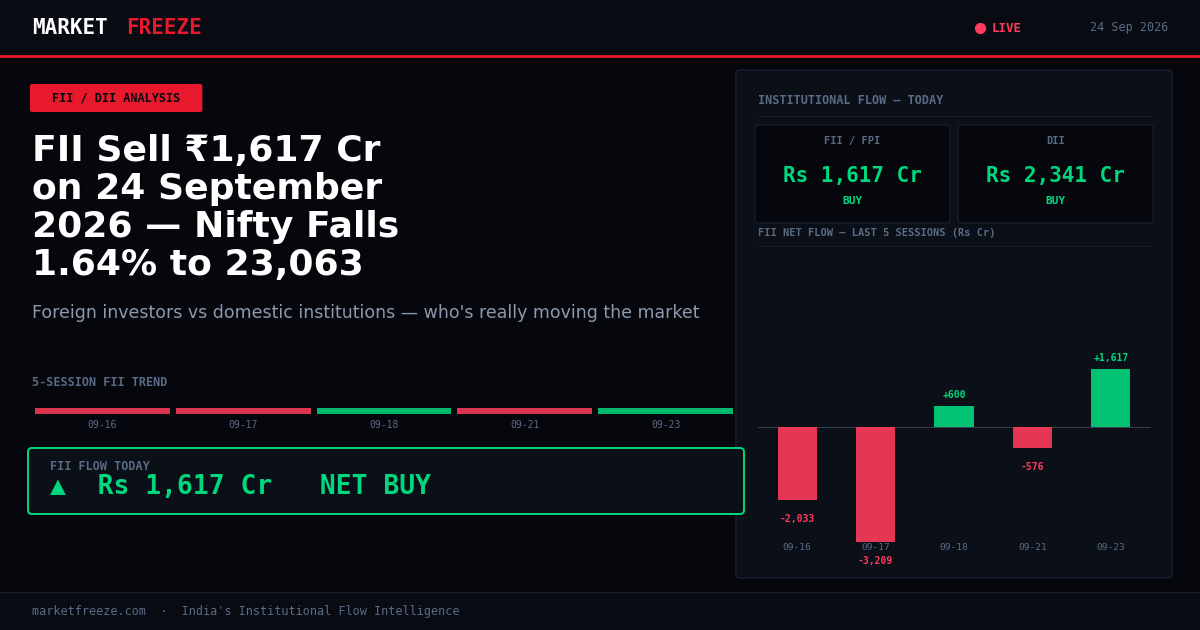
FII desks turned net sellers today, reversing two sessions of net buying, with a net outflow of ₹1,617.45 Cr from Indian equities. This move coincided with a sharp decline in key Indian indices, with the Nifty 50 dropping 1.64% to close at 23,063.10.
FII Reversal on Nifty’s Decline: A Closer Look at Today’s Flows
Today marks a significant shift in foreign institutional activity. After two consecutive sessions of net buying, FIIs executed a net sell of ₹1,617.45 Cr. While the total FII buy side was substantial at ₹13,580.40 Cr, the corresponding sell figure, though not explicitly provided, indicates a strong liquidation pressure that outweighed fresh allocations. This net outflow comes on a day when the Nifty 50 shed 383.70 points, hitting 23,063.10, and the Sensex plunged 1,247.71 points to 73,580.54. The magnitude of today’s FII selling, following Wednesday’s net buy of ₹1,617.45 Cr, demonstrates a rapid change in conviction, likely reacting to broader macro pressures.
DIIs, conversely, maintained their supportive stance, recording a net buy of ₹2,341.46 Cr. This sustained domestic purchasing has been a consistent feature, cushioning the impact of foreign selling pressure. For a retail investor, this divergence highlights that while foreign money is reacting to global cues, domestic capital continues to see value, creating a crucial floor for the market. Observe how DII buying interacts with any further FII liquidation.
Open a free demat account with
Upstox
or
Angel One
— zero brokerage on delivery trades.
Crude Surge and US Yields Fueling FII Exit
The FII selling today aligns directly with the broader market narrative driven by rising crude oil prices and surging US bond yields, as highlighted in today’s market reports. Crude MCX witnessed a substantial jump of +2.06% to Rs10,079.00/bbl, which directly impacts India’s import bill and inflation outlook. Concurrently, the USD/INR appreciated by +0.27% to Rs95.81, marking a one-week low for the rupee, further indicating capital flight pressure. The report referencing “US yield surge” and “renewed strength in crude oil prices” directly explains the institutional exit. Higher crude implies inflationary pressure, which in turn reinforces expectations of a more hawkish Federal Reserve, making emerging markets less attractive.
This macro backdrop, specifically the US Treasury yields hitting multi-year peaks, makes dollar-denominated assets more appealing relative to higher-beta emerging market equities like India. This dynamic creates a challenging environment for FIIs to allocate capital to Indian markets. Retail investors should monitor crude oil price movements and the USD/INR pair as key indicators for FII behaviour.
Nifty’s Critical Support at 23,000 Tested
The Nifty 50 closed at 23,063.10 today, a sharp drop of 1.64%. The FII selling pressure directly contributed to this decline, pushing the index perilously close to the 23,000 psychological support level. Historically, significant FII outflows often precede or accompany breaches of key technical levels. Given today’s net sell of ₹1,617.45 Cr, a potential break below 23,000 on sustained foreign selling could open up a downside towards 22,500-22,700. Conversely, if DII buying continues to absorb this selling, a strong bounce from 23,000 could indicate resilience.
On the upside, immediate resistance for the Nifty 50 is now at 23,300-23,400, the levels seen prior to today’s fall. Any significant FII re-entry would be required to reclaim these levels. For retail participants, maintaining positions above 23,000 is crucial; a definitive close below this level would warrant reassessment of short-term exposure.
Sectoral Implications: Banking Under Pressure, Tech Outlook
The “Thursday Tank” market event, driven by proposed changes to insurance rules, specifically hit Banking and Financial stocks hard, leading to a broad selloff. This aligns with the Bank Nifty’s significant drop of -1.96% to 55,438.00. FIIs, typically large holders in financial sector stocks, likely contributed to this selling pressure. A net outflow of ₹1,617.45 Cr suggests broad-based selling, but financials would have been a primary target given the news context.
Conversely, sectors less exposed to domestic regulatory changes or directly benefiting from currency depreciation, such as certain segments of IT or Pharma, might have seen relatively lower selling pressure or even selective buying. The rising USD/INR to Rs95.81 could theoretically benefit export-oriented sectors, but the overall market negativity and FII outflow suggest a lack of conviction for aggressive buying there today. Retail investors should monitor if FIIs use such dips to accumulate in defensive or export-oriented pockets in the coming sessions.
Historical Context of Institutional Flows
Today’s FII net sell of ₹1,617.45 Cr is a sharp reversal from yesterday’s identical net buy figure. Looking at the last five sessions, FII activity has been erratic: a net sell of ₹2,032.61 Cr on 2026-09-16, followed by a deeper sell of ₹3,208.76 Cr on 2026-09-17, then a modest buy of ₹599.54 Cr on 2026-09-18, and another sell of ₹576.20 Cr on 2026-09-21, before yesterday’s buy. This pattern indicates that foreign capital is highly reactive to daily global and domestic news flows, lacking a sustained directional conviction over the past week. DIIs, however, have consistently been net buyers, with figures like ₹3,908.23 Cr on 2026-09-16 and ₹2,797.27 Cr on 2026-09-21, providing consistent support.
The divergence is clear: FIIs are using rallies to exit or taking profits, while DIIs are deploying capital on dips. This suggests that domestic institutions perceive current valuations as attractive or are driven by steady SIP inflows. For retail investors, understanding this divergence is key: DII support provides a base, but FII selling can limit upside and increase downside velocity. Observe for any sustained FII buying or selling streak that lasts more than 3 sessions to gauge a change in longer-term directional bias.
Global Market Contagion and its Local Impact
The global market landscape, particularly the US stock market, is contributing significantly to the FII outflow from India. Reports indicate US stock futures are down, with the Nasdaq falling 1%, largely due to rising Treasury yields and heightened expectations for another Federal Reserve rate hike. This interconnectedness means that FIIs are not just reacting to Indian-specific news but are reallocating capital based on global macroeconomic shifts. The “fear index shoots up 23%” headline further underscores the risk-off mood globally, impacting all emerging markets.
When US bond yields rise, the “risk-free” return on offer in the world’s largest economy becomes more attractive, drawing capital away from higher-risk assets in countries like India. This pressure is amplified by the weakening rupee and rising crude. Retail participants must recognise that local market movements are increasingly influenced by these global capital flows. Look for stabilisation in US bond yields and global equity futures as a prerequisite for sustained FII re-entry into India.
FII/DII Flow: Last 5 Sessions
| Date | FII Net (Cr) | DII Net (Cr) | Nifty Close |
|---|---|---|---|
| 2026-09-16 | ₹-2,032.61 Cr | +₹3,908.23 Cr | 23,270.60 |
| 2026-09-17 | ₹-3,208.76 Cr | +₹3,617.75 Cr | 23,346.40 |
| 2026-09-18 | +₹599.54 Cr | +₹1,019.69 Cr | 23,414.30 |
| 2026-09-21 | ₹-576.20 Cr | +₹2,797.27 Cr | 23,329.00 |
| 2026-09-23 | +₹1,617.45 Cr | +₹2,341.46 Cr | 23,063.10 |
FAQ
-
What was the FII DII data for today, 24 September 2026?
FIIs were net sellers today with an outflow of ₹1,617.45 Cr, while DIIs were net buyers with an inflow of ₹2,341.46 Cr.
-
How much did the Nifty 50 fall today and what caused it?
The Nifty 50 fell 1.64% to close at 23,063.10, primarily due to rising crude oil prices (Crude MCX up +2.06% to Rs10,079.00/bbl), surging US bond yields, and concerns over proposed changes to insurance rules impacting banking stocks.
-
What does the FII selling today mean for the Nifty’s immediate future?
The FII net sell of ₹1,617.45 Cr, pushing the Nifty 50 to 23,063.10, indicates increased downside pressure, with the critical support level of 23,000 being tested. Sustained selling could lead to further declines towards 22,500-22,700, while DII buying offers some cushioning.
Divergence in Institutional Strategy: A Deeper Dive
The stark contrast between FII selling and DII buying today offers a window into differing investment philosophies and risk appetites. While FIIs, often guided by global mandates and short-to-medium term tactical shifts, reacted to macro headwinds, DIIs demonstrated a more strategic, long-term view. The persistent DII buying, totalling ₹2,341.46 Cr today and averaging over ₹2,000 Cr in the last five sessions, suggests a confidence in India’s fundamental growth story. This domestic capital is likely being deployed from sources like Systematic Investment Plans (SIPs) and pension funds, which are less susceptible to immediate market volatility. For retail investors, this indicates a potential opportunity: can they emulate the DII strategy of buying on dips, or should they follow the FII caution? Observing the underlying composition of DII buys – whether they are in large-cap defensives or growth-oriented mid-caps – would provide further clues.
Currency and Commodity Nexus: A Closer Look at USD/INR and Crude
The interplay between the rising USD/INR to Rs95.81 and the surge in crude oil prices to Rs10,079.00/bbl is a critical feedback loop impacting FII sentiment. A stronger dollar globally increases the cost of dollar-denominated debt for Indian companies and makes imports more expensive, directly feeding into inflationary pressures. The fact that crude oil, a major component of India’s import bill, climbed by +2.06% exacerbates this. This dual pressure point – a weaker rupee and higher commodity prices – is a classic trigger for foreign outflows, as it erodes the real return on investment. The FIIs’ net sell of ₹1,617.45 Cr today can be viewed as a direct response to this worsening currency and commodity outlook, which can also signal potential margin compression for many Indian businesses.
Historical Echoes: Resemblance to Past Risk-Off Phases
Today’s sharp market decline and FII net selling of ₹1,617.45 Cr bear a resemblance to periods where global risk aversion led to significant capital flight from emerging markets. While the specific dates in the table show recent fluctuations, one can recall past episodes, such as the taper tantrum of 2013 or the COVID-19 crash of 2020, where similar macro triggers – rising US yields, inflation fears, and geopolitical uncertainty – prompted substantial FII outflows. In those instances, domestic institutional buying played a crucial role in stabilizing markets, but the path to recovery often involved a period of consolidation and a clear shift in global risk sentiment. The current situation, with the Nifty closing at 23,063.10, highlights the sensitivity of Indian equities to these global macro shifts, even when domestic fundamentals appear relatively robust.
Retail Investor Positioning: Navigating the Volatility
In the face of such pronounced FII selling, particularly after a recent period of inflows, retail investors often find themselves at an inflection point. The question is whether to panic sell, book profits on existing positions, or see this as a buying opportunity, mirroring the DIIs. The market’s reaction to the 23,000 Nifty level will be a key determinant. If 23,000 holds, it suggests underlying retail and DII strength. However, a decisive breach, fueled by continued FII liquidation, could trigger stop-losses and broader retail capitulation. The advice to monitor crude and USD/INR movements is particularly pertinent for retail investors, as these are tangible indicators of the external pressures impacting the market, pressures that led to today’s 1.64% drop in the Nifty.
Bottom Line
Today’s FII net sell of ₹1,617.45 Cr marks a critical reversal, contributing to the Nifty’s 1.64% decline to 23,063.10. This institutional outflow is directly linked to rising crude prices and surging US bond yields, making global assets more attractive. While DIIs continue to provide a floor with ₹2,341.46 Cr in net buying, the immediate outlook for the Nifty remains challenged, with 23,000 serving as a crucial support level to monitor for stability.
Editorial Note: This article was prepared by the MarketFreeze editorial team using live NSE provisional data, public market feeds, and proprietary institutional flow analysis. All price and flow figures are sourced directly from NSE, BSE, and CoinGecko as of 24 September 2026. This content is for informational purposes only and does not constitute investment advice. MarketFreeze is not SEBI-registered. Please consult a qualified financial advisor before making investment decisions. Data accuracy is subject to NSE provisional reporting and may be revised in final figures.