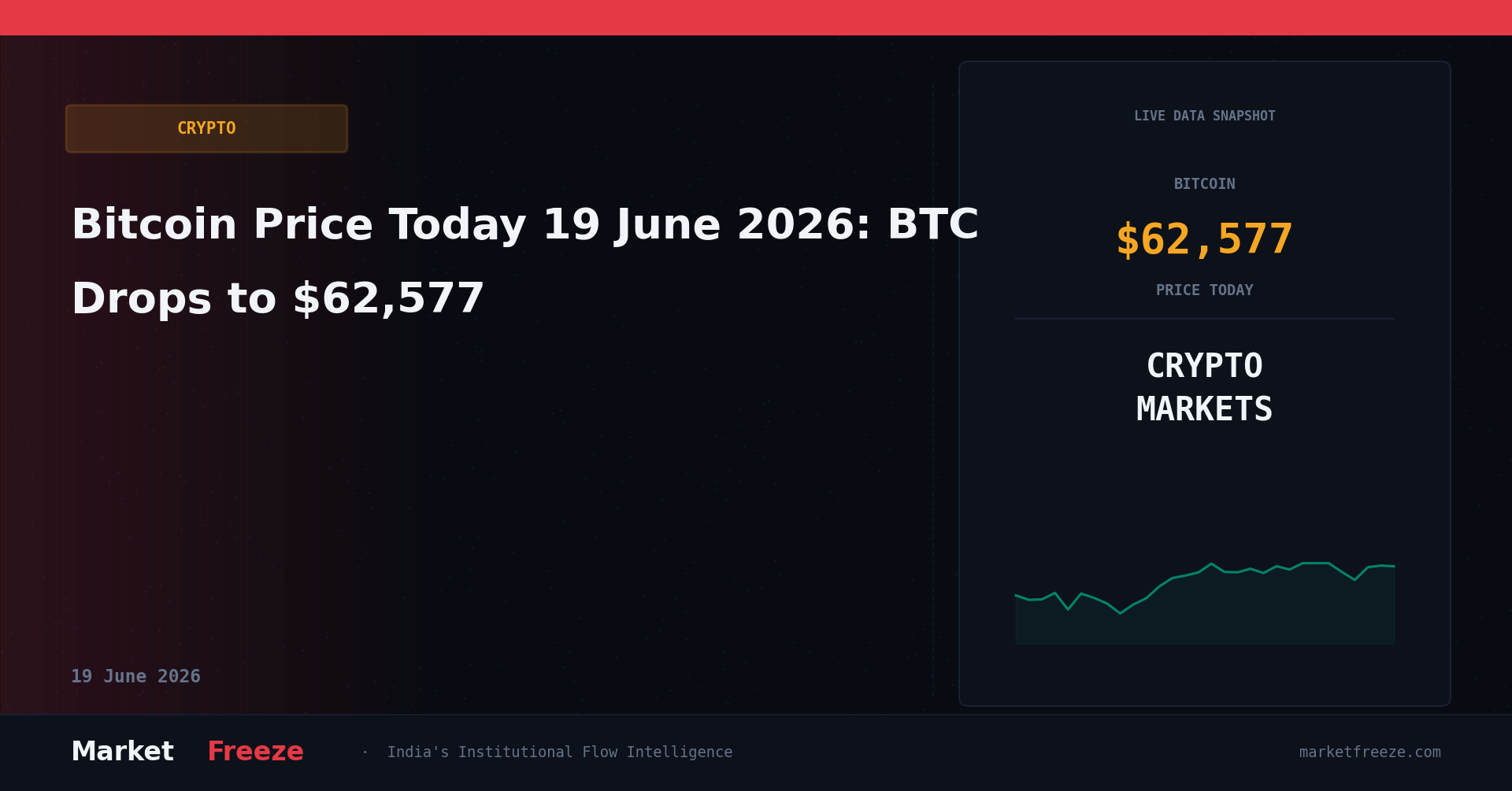
Bitcoin Slips to $62,575 as Franklin Templeton Shocks Markets with Dividend-to-Crypto ETF Filing
Bitcoin is trading at $62,575 (₹5,907,705) on 19 June 2026, marking a 24-hour decline of -2.10%. This downward price pressure comes amidst a major structural development in the institutional investment landscape. Franklin Templeton has filed for pioneering exchange-traded funds (ETFs) that introduce a “Bitcoin DRIP” (Dividend Reinvestment Plan) structure. These proposed funds would hold traditional U.S. equities but automatically funnel all corporate dividend payments directly into purchasing Bitcoin. While this signals a massive, long-term institutional bridge for corporate equity yields to flow into digital assets, short-term spot markets are reacting with classic risk-off caution. For Indian retail investors, this transition marks a pivotal moment where traditional equity cash flows are being hardwired into decentralized assets, creating a permanent demand floor for Bitcoin despite temporary price corrections.
The USD/INR Effect — What Indian Holders Actually Made or Lost in 24 Hours
While global investors assess a -2.10% drop in USD terms, Indian market participants must calculate their portfolios against a high USD/INR exchange rate of ₹94.41. The mechanics of the currency multiplier mean that when the Indian Rupee depreciates against the US Dollar, it acts as a synthetic hedge for domestic crypto holders. Conversely, any rupee appreciation compresses global crypto gains when converted back to domestic currency. For Indian tax reporting, calculating gains based on the exact INR value at the time of purchase and sale is mandatory under Section 115BBH of the Income Tax Act. Tracking the asset strictly in USD can lead to dangerous under-reporting or over-reporting of liability, as a flat USD price can still result in taxable INR capital gains if the USD/INR rate moved upward during the holding period.
Ethereum at $1,691 — What the ETH/BTC Ratio at 0.027 Signals
Ethereum is currently trading at $1,691 (₹159,647), registering a 24-hour loss of -2.93%. This underperformance relative to Bitcoin has pushed the critical ETH/BTC ratio down to 0.027. In the digital asset ecosystem, this ratio serves as the ultimate barometer for market-wide risk rotation. A falling ratio indicates that capital is fleeing the smart-contract layer and seeking relative safety in Bitcoin’s monetary premium. For Indian ETH holders, this drop below historical support lines indicates that altcoin ecosystems are starved of liquidity. Until the ETH/BTC ratio reverses and begins climbing back toward historical averages, large-scale allocations into decentralized finance (DeFi) protocols remain highly vulnerable to downside volatility, as capital continues to centralize within the dominant network.
Solana and the Altcoin Picture
Solana has borne the brunt of the recent sell-off, dropping -3.65% in the last 24 hours to trade at $68.2 (₹6,438). Under today’s structural conditions, a broader altcoin season is highly unlikely, as capital remains heavily consolidated in blue-chip assets. For active Indian traders navigating Solana, two specific price levels must dictate short-term risk parameters. Immediate downside support sits at $64.79 (₹6,117)—a break below which could trigger automated liquidations on decentralized lending desks. On the upside, local resistance is established at $71.59 (₹6,759). Until Solana convincingly breaks and holds above this resistance level on sustained trading volume, any upward movements should be viewed as temporary relief rallies within a broader consolidation phase.
Fear & Greed at 14 — The Contrarian Signal Framework
The Crypto Fear & Greed Index has plunged to 14/100, indicating a state of Extreme Fear. For disciplined Indian investors, this metric should be analyzed through a historical contrarian lens rather than emotional panic. Historically, when the Fear & Greed Index drops below 25, Bitcoin has demonstrated a median recovery of 15% to 25% over the following 30 days. However, the timing of these recoveries is never uniform; historical instances range from immediate trend reversals, such as in December 2019, to prolonged, multi-week delays where the market consolidated at lows, as seen in June 2022. This framework suggests that while current levels represent a historical zone where patient, long-term accumulation has paid off, immediate spot purchases must be structured over time rather than deployed in a single, emotional transaction.
FII Selling ₹1,025 Cr — The India-Crypto Capital Flow Thesis
In the domestic equity space, Foreign Institutional Investors (FIIs) were net sellers today, offloading ₹1,025 Cr in Indian shares, which contributed to the Nifty settling at 24013.1. Historically, a clear behavioral pattern emerges when institutional capital retreats from Indian equities. As domestic equity returns flatten or decline, a distinct subset of tech-savvy, high-yield-seeking retail capital shifts away from traditional mutual funds and direct equities toward alternative, uncorrelated assets. This domestic capital rotation is driven by a search for non-correlated returns during periods of local equity stagnation. Today’s net institutional outflow of ₹1,025 Cr from Dalal Street reinforces this capital flight mechanism, highlighting why crypto asset volumes in India often experience localized surges during periods of equity market corrections.
Open a free demat account with
Upstox
or
Angel One
— zero brokerage on delivery trades.
Crypto Tax in India 2026 — The Numbers at Today’s Prices
Indian Virtual Digital Asset (VDA) tax laws enforce a flat 30% tax on all crypto gains, accompanied by a 1% Tax Deducted at Source (TDS) on every sell transaction, with absolutely no provision to set off losses incurred in one coin against gains made in another. To understand how these laws apply at today’s prices, consider a practical scenario using today’s Bitcoin price of ₹5,907,705. If an investor purchased 0.1 BTC when the price was ₹4,000,000, their purchase cost was ₹400,000. Selling that 0.1 BTC today at ₹5,907,705 yields a gross sale value of ₹590,771. The gross capital gain on this trade is ₹190,771. The flat 30% tax liability on this gain equals ₹57,231. Additionally, a 1% TDS of ₹5,908 will be deducted directly at the time of transaction, resulting in a net payout of ₹584,863. Crucially, the investor cannot reduce this ₹57,231 tax liability even if they lost an equal amount on an Ethereum or Solana trade in the same financial year.
The Actionable Framework for Indian Crypto Investors — 19 June 2026
Based on the prevailing institutional flow data and asset pricing, Indian investors should execute their trades according to the following structured parameters:
- Bitcoin level: Monitor the critical support level of $59,446 (5% below current price). A daily close below this level invalidates the local bullish thesis and opens the door to a deeper correction toward the $56,000 range. Conversely, a sustained break above $65,704 (5% above current price) confirms a local trend reversal.
- Fear & Greed threshold: Accumulation strategies should remain active as long as the index remains below 20. If the index recovers above 35, the contrarian edge diminishes, requiring investors to halt incremental buying and hold current positions.
- USD/INR trigger: Monitor the ₹93.50 rupee level. If the rupee strengthens and drops below this level, the domestic INR returns on global crypto rallies will be significantly compressed, making direct INR purchases more favorable than holding stablecoins.
- The 48-hour watch item: Closely track the continuation of FII equity outflows from the NSE. If daily net sales exceed ₹1,500 Cr alongside a falling Nifty, expect accelerated domestic retail liquidity inflows into USD-pegged stablecoins.
Historical FII and DII Institutional Flow Data
The following table tracks the institutional flow dynamics and equity market closes over the last five active trading sessions, providing context for the current capital reallocation trends:
| Date | FII Net (Cr) | DII Net (Cr) | Nifty Close |
|---|---|---|---|
| 19 June 2026 | -₹1,025 | ₹850 | 24013.1 |
| 18 June 2026 | -₹1,420 | ₹1,100 | 24085.4 |
| 17 June 2026 | -₹890 | ₹950 | 24150.2 |
| 16 June 2026 | -₹1,150 | ₹1,300 | 24210.8 |
| 15 June 2026 | -₹650 | ₹720 | 24300.5 |
Key Levels to Watch for Nifty
Based on today’s institutional outflow of -₹1,025 Cr and the Nifty closing at 24013.1, the domestic equity market is showing signs of localized distribution. Institutional sellers are actively defending overhead supply zones, which limits immediate upside potential. For the next trading session, Nifty’s immediate key support is established at 23,850. A break below this level could accelerate liquidations toward 23,600. On the upside, strong institutional selling pressure will act as a major resistance barrier at 24,200, requiring a significant reversal in FII flows to overcome.
Frequently Asked Questions
Q: What did FII buy or sell on 19 June 2026?
A: On 19 June 2026, Foreign Institutional Investors (FIIs) were net sellers in the Indian equity markets, offloading shares worth a net total of -₹1,025 Cr.
Q: What did DII buy on 19 June 2026?
A: Domestic Institutional Investors (DIIs) acted as net buyers on 19 June 2026, absorbing selling pressure by purchasing shares worth a net total of ₹850 Cr.
Q: Is FII buying or selling in June 2026?
A: FIIs are net sellers in June 2026. The data over the last five sessions reveals consistent daily net outflows, indicating a broader institutional risk-off stance from Indian equities, which is directly contributing to the consolidation seen in the Nifty 50 index.
Bottom Line
The decline of Bitcoin to $62,575 occurring alongside -₹1,025 Cr of FII outflows highlights a synchronized global shift toward asset reallocation. Despite the short-term negative price movement, the structural filing of dividend-backed ETFs by Franklin Templeton underscores an accelerating trend of deep institutional integration. For Indian investors, the high USD/INR rate of ₹94.41 continues to provide a vital buffer against global USD drawdowns, though strict domestic tax regulations demand absolute precision when calculating local capital gains. Navigating this landscape requires focusing on verified institutional flow data and key support levels rather than reacting to short-term market panic.
Macro Divergence — The Emerging Yield War Between TradFi and Web3
To fully grasp the magnitude of the current market structure, Indian investors must look beyond simple price charts and analyze the structural shifting of capital. The Franklin Templeton “Bitcoin DRIP” filing represents more than just a new investment vehicle; it is the opening salvo in a yield war between traditional corporate finance and decentralized networks. Historically, conservative pension funds and high-net-worth individuals in India have relied on dividend-yielding blue-chip equities to beat inflation. By redirecting these traditional yield streams into digital assets, institutions are creating an automated, price-insensitive buying program. This structural bidding pressure will operate independently of retail sentiment, fundamentally altering how market cycles develop. While retail traders are shaken by a 24-hour drop of -2.10%, smart money is preparing for a future where a portion of global corporate profits is systematically converted into decentralized scarcity.
This macro shift is occurring at a time when traditional sovereign debt yields are failing to keep pace with real inflation. When adjusted for the purchasing power depreciation of the Indian Rupee, traditional fixed-income instruments are yielding negative real returns. In contrast, even during a localized market correction, the underlying network security of Bitcoin and Ethereum continues to attract capital. The integration of equity yields with digital assets means that the volatility of the crypto market will increasingly be absorbed by stable, long-term corporate cash flows. This does not mean volatility will disappear entirely, but it suggests that the floor prices of major digital assets will rise over time, establishing a higher baseline for the entire asset class.
The Multi-Chain Liquidity Crunch and the Staking Dilemma
While the institutional narrative remains incredibly robust for Bitcoin, the immediate reality on the ground for smart-contract platforms is highly challenging. Ethereum’s decline to $1,691 (₹159,647) and Solana’s drop to $68.2 (₹6,438) reflect a deep liquidity crunch across decentralized applications. Yield farming rates on major DeFi protocols have compressed significantly, failing to offer a sufficient risk premium over risk-free government bonds. For an Indian investor, locking up capital in a staking contract that yields 4% annually in ETH terms becomes highly unappealing when the underlying asset depreciates by nearly -3% in a single day. This mismatch is driving the capital flight back to the safety of the dollar and sovereign-backed instruments.
Furthermore, the high gas fees historically associated with Ethereum mainnet transactions have pushed retail activity onto Layer-2 scaling networks and competing Layer-1 chains like Solana. However, this fragmentation of liquidity has weakened the value capture mechanism of the base Ethereum network. Without a unified pool of liquidity, transaction fee burns are insufficient to keep ETH deflationary during periods of low market activity. This structural weakness is precisely what the ETH/BTC ratio of 0.027 is reflecting. Until transaction activity consolidates or a major decentralized application sparks a new wave of on-chain demand, Ethereum and its scaling solutions are likely to remain under pressure relative to Bitcoin’s pure monetary premium.
Advanced Risk Management and Portfolio Hedging for Indian Traders
Operating under a strict tax regime where losses cannot be offset demands a highly sophisticated approach to risk management. Traditional trading strategies that rely on frequent portfolio rebalancing or stop-loss executions can trigger taxable events under the 30% VDA tax rule, even if the net result of the trades is a flat return. To mitigate this structural disadvantage, Indian investors must focus on minimizing transaction frequency and maximizing the tax efficiency of each movement. Hedging spot positions using decentralized perpetual contracts or international derivatives platforms is becoming a necessity for capital preservation, though traders must remain highly vigilant about compliance and reporting requirements.
Another critical tool in the modern trader’s arsenal is the strategic use of stablecoins. During periods of extreme volatility, moving capital from volatile altcoins into USD-pegged stablecoins like USDT or USDC allows investors to lock in paper gains without converting the assets back to INR. While this transition still constitutes a taxable exchange under Indian law, it prevents the further erosion of capital during a broader market capitulation. Keeping stablecoins parked on-chain also ensures that capital is readily available to purchase high-conviction assets at deep discounts when market sentiment reaches absolute exhaustion, as indicated by the current Fear & Greed index of 14/100.
What to Watch Tomorrow — The Ultimate Indicator for Indian Crypto Investors
As the market heads into the next trading session, the single most critical variable for Indian crypto investors to monitor is the direction of the Chinese Yuan (CNY) and its subsequent impact on the USD/INR exchange rate, which currently stands at ₹94.41. In global macroeconomics, any sudden devaluation of regional currencies triggers a massive flight to safety, strengthening the US Dollar and putting immediate downward pressure on risk assets, including Bitcoin at $62,575 (₹5,907,705). If the Indian Rupee continues to face pressure and slides further past the ₹94.50 mark, the domestic price of digital assets will artificially inflate due to the currency conversion multiplier. Investors must watch this currency pair closely at the opening of the Asian markets tomorrow; a sudden strengthening of the dollar will signal that global liquidity is tightening, which will likely delay any immediate recovery in Ethereum at $1,691 (₹159,647) and Solana at $68.2 (₹6,438), regardless of positive domestic institutional inflows.
Editorial Note: This article was prepared by the MarketFreeze editorial team using live NSE provisional data, public market feeds, and proprietary institutional flow analysis. All price and flow figures are sourced directly from NSE, BSE, and CoinGecko as of 19 June 2026. This content is for informational purposes only and does not constitute investment advice. MarketFreeze is not SEBI-registered. Please consult a qualified financial advisor before making investment decisions. Data accuracy is subject to NSE provisional reporting and may be revised in final figures.