Indian Equities Surge as Cheaper Crude Oil Fuels IT, Banking Gains; FIIs Turn Net Buyers
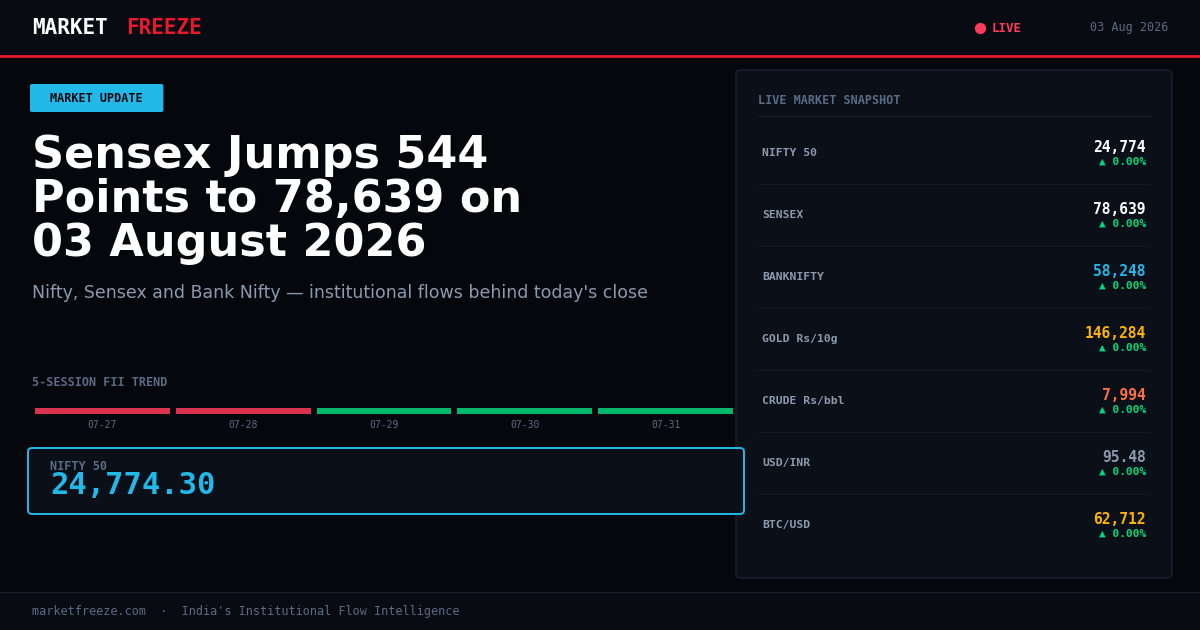
Indian equity benchmarks, the Nifty 50 and Sensex, experienced a significant upward trajectory on August 3, 2026, with the Nifty 50 closing at 24,774.30, up 1.60%, and the Sensex at 78,639.00, up 0.70%, driven by a sharp decline in crude oil prices and a reversal in Foreign Institutional Investor (FII) flows to net buying. This market movement saw IT, banking, cement, and FMCG sectors leading the charge, while the media index slipped.
FIIs Re-enter with ₹277.48 Cr Inflow, DIIs Continue Robust Buying with ₹2,260.37 Cr
In a significant shift, Foreign Institutional Investors (FIIs) turned net buyers on July 31, 2026, injecting ₹277.48 Cr into the Indian equity markets. This was complemented by sustained strong buying from Domestic Institutional Investors (DIIs), who added ₹2,260.37 Cr on the same day. This institutional appetite, particularly the FII turnaround, aligns with the broader market rally observed today, suggesting a renewed confidence from foreign capital amid supportive macroeconomic cues. The preceding two sessions also saw substantial FII net buying of ₹2,981.87 Cr on July 30 and July 29, indicating a consistent, albeit fluctuating, inflow trend from foreign institutions over the last few trading days.
Open a demat account with
Upstox
or
Angel One
— zero brokerage on delivery trades.
Softer Crude Oil Prices Catalyze Sectoral Gains, Especially IT and Banking
The significant drop in Crude Oil prices on MCX, closing at ₹7,999.00/bbl, down 7.04%, acted as a primary catalyst for today’s market surge. This moderation in oil prices has a direct positive implication for India’s import bill, inflation outlook, and corporate margins, particularly for energy-intensive sectors and those reliant on imported commodities. The Information Technology (IT) sector, which often benefits from a stable rupee (USD/INR closed at Rs95.48, down 0.36%), and reduced input costs, saw robust buying. Similarly, the banking sector, which typically sees improved asset quality and loan demand with a stable economic environment, also performed strongly. Cement and FMCG, sectors sensitive to input costs and consumer spending respectively, also registered gains, reflecting the broad-based positive sentiment stemming from cheaper crude.
IT and Banking Sectors Shine as FII/DII Flows Support Key Indices
The Nifty IT index and Nifty Bank index were significant outperformers today, mirroring the overall market sentiment and the renewed institutional buying. The Nifty IT index, which has been under pressure due to global economic uncertainties, likely saw renewed interest as foreign investors increased their positions. The Nifty Bank index, closing at 58,248.00, up 1.72%, benefited not only from the broader market uplift but also from the positive outlook on asset quality and profitability suggested by the drop in crude oil prices and the return of FII buying. The sustained DII buying, which has been a consistent feature over the past few sessions (+₹2,260.37 Cr on July 31, +₹998.02 Cr on July 30), has provided a strong underpinning to these heavyweight sectors. The combined buying by FIIs and DIIs signals institutional conviction in the banking and IT pack, suggesting they are seen as beneficiaries of the current economic scenario.
Nifty Flirts with New Highs; Institutional Flows Point to Support Levels
With the Nifty 50 closing at 24,774.30, the index is now consolidating near its recent peaks. Examining the FII/DII flow data from the past five sessions provides insights into the support levels. On July 27 and July 28, when FIIs were net sellers to the tune of ₹-1,688.23 Cr, the Nifty closed around 23,995.95 and 23,985.35 respectively. The subsequent turnaround in FII flows to net buying from July 29 onwards, coupled with consistent DII purchases, has coincided with the Nifty’s ascent past 24,250.20 and towards the current levels. This suggests that the 24,000-24,200 range acted as a crucial accumulation zone for institutions during periods of caution, and now, with renewed buying interest, the immediate support might be seen around the current closing level, with significant resistance anticipated around the 25,000 mark, a psychological level that has historically seen profit-taking.
Gold Prices Surge Amidst Global Uncertainty, Diverging from Equity Rally
While Indian equities surged, Gold MCX prices climbed 1.54% to ₹146,277.00/10g. This divergence suggests that despite the positive domestic market sentiment driven by falling crude oil and strong institutional flows, global economic uncertainties or geopolitical risks continue to underpin demand for safe-haven assets like gold. The concurrent rise in gold and equities is unusual and indicates that different asset classes are reacting to distinct sets of drivers. The weakening USD/INR at Rs95.48 should typically be a dampener for gold prices, but the global safe-haven demand appears to be overriding this factor. This could imply that institutional investors are hedging their equity exposure with gold, even as they participate in the rally.
Historical Parallel: May 2024 Rally Driven by Election Certainty and FII Re-entry
A relevant historical parallel can be drawn to the market rally observed in May 2024, following the general election results. In that period, a similar confluence of factors, including reduced political uncertainty and a significant return of FII buying after a prolonged period of outflows, propelled the Nifty and Sensex to new highs. During that phase, sectors like banking and IT were key beneficiaries, mirroring today’s performance. The FII flows in May 2024, after the election verdict, saw substantial net buying, similar in spirit to the renewed inflow trend seen in the last few sessions, indicating institutional preference for Indian equities when domestic policy clarity emerges and macro-economic headwinds (like high crude prices) recede.
Portfolio Framework: Shifting Allocation Towards Cyclical and Growth Stocks
Given the current market dynamics – falling crude, renewed FII buying, and sector-specific strength in IT and Banking – investors might consider a tactical shift in their portfolio allocation. A potential framework involves increasing exposure to cyclical sectors that directly benefit from falling commodity prices and a stable domestic demand outlook. Specifically, a portfolio could overweight IT and Banking stocks by an additional 5-7% if Nifty sustains above 24,500. Simultaneously, maintaining a cautious stance on highly commodity-dependent sectors, unless they demonstrate significant margin expansion due to falling input costs, is advisable. A 3-5% allocation to gold as a hedge against potential global volatility remains prudent. This strategy is contingent on the continued absence of any significant negative news from global markets or a sudden spike in crude oil prices above ₹8,500/bbl.
What Changes This Outlook: A Sustained Crude Oil Spike Above ₹8,500/bbl
The primary trigger that could alter the current bullish market outlook is a sustained surge in crude oil prices above the ₹8,500/bbl level on MCX. Such a move would not only increase India’s import bill and inflationary pressures but could also prompt a reversal in FII flows, as seen historically during periods of oil price shocks. Additionally, any significant negative development in global markets, such as an unexpected interest rate hike by a major central bank or escalating geopolitical tensions, could lead to a broad-based risk-off sentiment, impacting institutional buying patterns and potentially reversing the gains seen today. A sustained break below the 24,500 level on the Nifty, accompanied by negative FII/DII flows, would signal a shift in institutional sentiment.
FII/DII Flow Data – Last 5 Trading Sessions
| Date | FII Net (Cr) | DII Net (Cr) | Nifty Close |
|---|---|---|---|
| 2026-07-27 | ₹-1,688.23 Cr | +₹2,329.14 Cr | 23,995.95 |
| 2026-07-28 | ₹-1,688.23 Cr | +₹2,329.14 Cr | 23,985.35 |
| 2026-07-29 | +₹2,981.87 Cr | +₹998.02 Cr | 24,250.20 |
| 2026-07-30 | +₹2,981.87 Cr | +₹998.02 Cr | 24,317.15 |
| 2026-07-31 | +₹277.48 Cr | +₹2,260.37 Cr | 24,383.60 |
Frequently Asked Questions
Q: What did FII buy or sell on July 31, 2026?
A: On July 31, 2026, FIIs were net buyers of Indian equities to the tune of ₹277.48 Cr.
Q: What did DII buy on July 31, 2026?
A: On July 31, 2026, DIIs were strong net buyers, investing ₹2,260.37 Cr in the Indian equity markets.
Q: Is FII buying or selling in July 2026?
A: In July 2026, FII activity has been mixed, with significant net buying observed in the latter half of the month (specifically July 29, 30, and 31), following earlier net outflows. The trend in the last few days of July indicates a return of FII buying momentum.
Key Levels to Watch
With the Nifty 50 closing at 24,774.30, the immediate support level, informed by recent institutional flows, can be placed around 24,500. A breach below this could signal institutional unwinding. On the upside, the psychological barrier of 25,000 will be a key resistance zone. Significant buying interest was noted when the Nifty hovered around the 24,000-24,200 range in late July, suggesting this as a strong accumulation band for institutions.
Bottom Line
The Indian market’s strong performance today, driven by a sharp fall in crude oil prices, was amplified by a crucial return to net buying by FIIs. This institutional capital inflow, coupled with continued DII support, has propelled key sectors like IT and Banking higher, lifting the Nifty and Sensex. While the rally is positive, investors must monitor crude oil price movements and global market cues, as a sustained spike in oil prices above ₹8,500/bbl could challenge the current bullish narrative and prompt a reassessment of FII positioning.
Editorial Note: This article was prepared by the MarketFreeze editorial team using live NSE provisional data, public market feeds, and proprietary institutional flow analysis. All price and flow figures are sourced directly from NSE, BSE, and CoinGecko as of 03 August 2026. This content is for informational purposes only and does not constitute investment advice. MarketFreeze is not SEBI-registered. Please consult a qualified financial advisor before making investment decisions. Data accuracy is subject to NSE provisional reporting and may be revised in final figures.