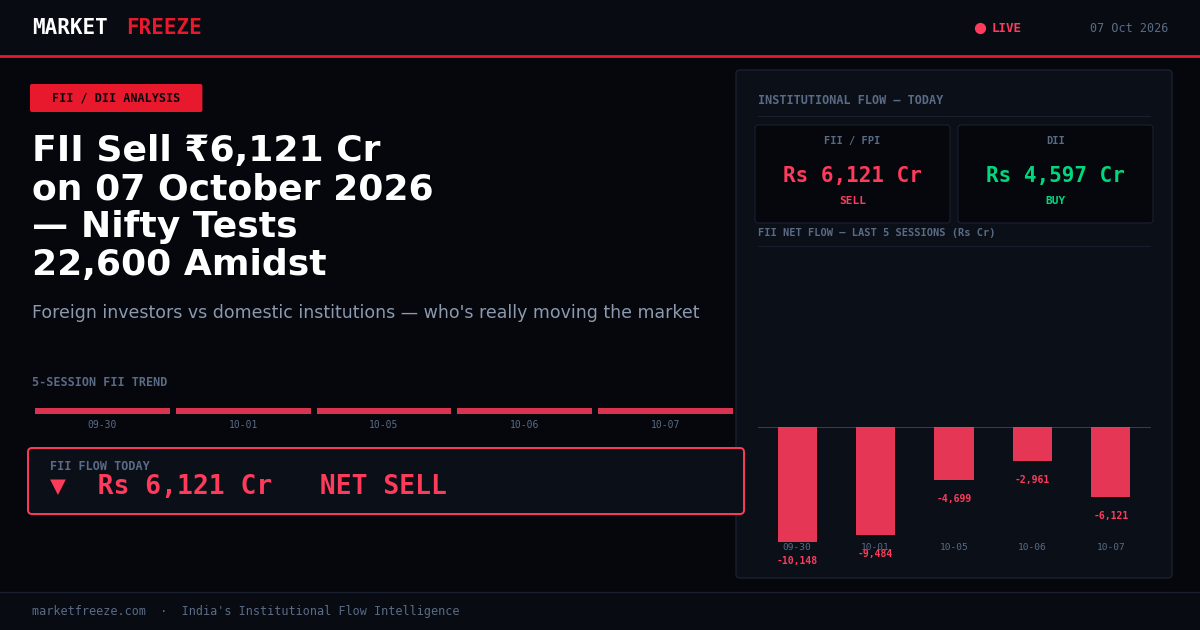
Institutional flow data released after market close shows Foreign Institutional Investors (FIIs) were significant net sellers on 07 October 2026, offloading equities worth ₹6,121.37 Cr. This heavy selling by FIIs contrasts with sustained buying from Domestic Institutional Investors (DIIs), who recorded a net buy of ₹4,596.57 Cr. The Nifty 50 closed down 0.76% at 22,603.05, while the Sensex fell 0.59% to 72,639.00.
Open a free demat account with
Upstox
or
Angel One
— zero brokerage on delivery trades.
FII Selling Accelerates Post-RBI Decision
The ₹6,121.37 Cr outflow from FIIs on 07 October 2026 represents a significant acceleration of their selling trend. This follows net sales of ₹2,961.30 Cr on 06 October and ₹4,699.14 Cr on 05 October. The Reserve Bank of India’s (RBI) decision to hike the repo rate by 25 basis points to 5.5%, as reported, appears to be a direct catalyst for this increased FII divestment. The market’s immediate reaction was negative, with the Nifty shedding 0.76%. This suggests FIIs are repricing Indian assets in a higher interest rate environment, potentially anticipating slower economic growth or reduced corporate earnings. The total FII buy turnover for the day was ₹12,577.96 Cr, indicating that while selling was aggressive, there was also underlying trading activity. However, the net figure clearly shows a decisive reduction in their long positions.
The consistent DII buying, totaling ₹4,596.57 Cr today and ₹5,088.92 Cr yesterday, provides a crucial buffer against the FII selling pressure. This suggests domestic institutions are absorbing the shares being offloaded by foreign players, perhaps based on a different growth outlook or valuation perspective within the Indian economy. Retail investors should note that this divergence in flows, with FIIs exiting and DIIs entering, can lead to choppy market movements in the short term.
Actionable Insight: Monitor the sustained DII buying to gauge immediate support levels for key indices and stocks. A continued DII buy above ₹4,000 Cr daily might signal underlying domestic confidence.
Nifty Levels Under Pressure from FII Exit
Given today’s ₹6,121.37 Cr FII net sell, the Nifty 50’s current position at 22,603.05 is now facing downward pressure. The sharp selling suggests that immediate support for the Nifty would be around the 22,400 mark. This level represents a potential absorption zone where DII buying might intensify or where bargain hunters could step in, especially if the selling pressure from FIIs eases. Conversely, any sustained breach below 22,400, coupled with continued FII outflows, could quickly drag the index towards the 22,200 region. Resistance, however, is likely to build up around the 22,800 mark, a level that would require significant renewed buying interest to overcome, particularly from FIIs.
The Bank Nifty closed relatively flat at 55,056.00, down only 0.13%, suggesting that while financials might be impacted by the RBI rate hike, the selling pressure is not as acute as in broader markets. This resilience in the banking index could be a function of DII accumulation in financial stocks, which often form a significant part of their portfolios.
Actionable Insight: Retail traders should consider the 22,400 Nifty level as a critical short-term support. A decisive close below this level on higher volumes, especially with FII selling persisting, would signal a potential further downside towards 22,200.
Sectoral Implications: Metals and Industrials Bear the Brunt
The substantial FII selling of ₹6,121.37 Cr today, particularly in the context of a rate hike and a strengthening USD/INR (now at Rs96.47), points towards potential outflows from rate-sensitive sectors and those heavily reliant on global demand. Metals, which often react negatively to global slowdown fears and a stronger dollar, are likely candidates for FII divestment. Similarly, industrial and capital goods sectors that typically see demand surge during economic expansion phases could be under pressure. The sharp 1.14% drop in Gold MCX to ₹148,800.00/10g, despite the equity market fall, could indicate a shift away from safe-haven assets by some institutional players, or simply a reaction to the strengthening dollar and rising bond yields post-RBI move. However, the Crude MCX price rising 0.89% to ₹9,790.00/bbl suggests that global commodity price strength is not entirely absent, making specific sector calls crucial.
Conversely, the consistent DII buying could be concentrated in sectors perceived as defensive or having strong domestic growth drivers. Banking stocks, despite the rate hike, might be accumulating by DIIs on the expectation of improved net interest margins in a higher rate regime. FMCG and Pharmaceuticals, typically defensive plays, could also be beneficiaries of DII inflows.
Actionable Insight: Focus on sectors that FIIs are exiting (likely Metals, Industrials) for potential shorting opportunities if the downtrend continues. Simultaneously, observe if DIIs continue to accumulate Banking and FMCG stocks for defensive positioning.
Flow Analysis: Sustained Selling Across Multiple Sessions
The FII net sell figure of ₹6,121.37 Cr today marks the third consecutive session of significant outflows. Over the last three trading days, FIIs have sold a cumulative ₹13,781.81 Cr. This sustained selling trend is a key data point that retail investors must track. The Nifty’s movement over these days, from 22,776.10 on 05 October to 22,603.05 today, shows a clear correlation with FII selling. However, the DII’s consistent buying, totaling ₹14,867.11 Cr over the same three days, has prevented a more severe market decline. This DII absorption is a critical factor preventing a steeper correction, as seen in the relatively stable Nifty close on 06 October at 22,776.10 before today’s fall.
The historical data from September shows a much larger FII sell-off, with ₹10,148.41 Cr sold on 30 September and ₹9,484.22 Cr on 01 October. While today’s selling is significant, it has not yet reached those extreme levels. This comparison suggests that while FIIs are actively reducing their exposure, the scale of selling has been somewhat managed compared to late September. The current trend highlights the importance of tracking the daily DII net buy figure; if it falters below ₹3,000 Cr while FIIs continue to sell, the market could experience a sharper correction.
Actionable Insight: Consider the 5-session trend as a primary indicator. If FII selling continues above ₹5,000 Cr daily for another two sessions, and DII buying falls below ₹4,000 Cr, expect increased downside risk for the Nifty.
Historical Context: Rate Hikes and Market Reactions
The RBI’s rate hike on 07 October 2026 has once again brought the historical relationship between monetary policy tightening and equity market performance into focus. As noted in the news context, market responses to rate hikes have historically varied. The immediate reaction today was a decline in both Sensex and Nifty, a common occurrence when interest rates rise, as it increases borrowing costs for companies and can reduce consumer spending. The Nifty’s fall of 0.76% and Sensex’s 0.59% decline are indicative of this sensitivity. However, the news also points out that the impact depends on underlying economic conditions. If inflation is a significant concern and the economy is robust, markets can often absorb rate hikes without prolonged downturns. The fact that the USD/INR has moved up to Rs96.47, a 5-month low for the rupee, adds another layer of complexity, potentially increasing imported inflation and further pressuring the RBI.
Looking at the past five sessions, the Nifty moved from 22,421.95 to 22,603.05. Despite significant FII selling on 30 September (₹10,148.41 Cr) and 01 October (₹9,484.22 Cr), the Nifty saw a recovery towards the end of that week, closing at 22,555.75 on 01 October, and further up to 22,776.10 by 05 October. This suggests that domestic buying power (DIIs and retail) can indeed counter FII selling pressure over short periods, especially if economic fundamentals remain perceived as strong.
Actionable Insight: Evaluate the RBI’s commentary following the rate hike for forward guidance on future monetary policy. If the RBI signals a pause or a data-dependent approach, it could cushion the impact of today’s FII selling.
Currency and Commodities: USD/INR Strength and Gold Weakness
The significant move in the USD/INR pair, strengthening to Rs96.47, is a critical factor to consider alongside equity flows. A rising dollar against the rupee is typically negative for FIIs as it erodes their returns when converted back to their base currency. This 0.44% jump in USD/INR today is likely a contributing factor to the ₹6,121.37 Cr FII sell-off, as it makes Indian equities less attractive. The simultaneous 1.14% drop in Gold MCX to ₹148,800.00/10g, while Bitcoin and Ethereum also saw significant declines (-3.11% and -4.98% respectively), suggests a broad risk-off move away from traditional safe havens and speculative assets, potentially driven by a stronger dollar and higher US bond yields, which are not directly provided but implied by global market movements.
The resilience of Crude MCX, which rose 0.89% to ₹9,790.00/bbl, indicates that global energy prices remain elevated. This can be a double-edged sword for India: a positive for energy producers but a negative for importers and inflationary pressures. The combination of a weaker Rupee and higher crude prices directly impacts India’s current account deficit and inflation outlook, factors that FIIs closely monitor.
Actionable Insight: Keep a close watch on the USD/INR. If it continues to strengthen above Rs97.00, expect sustained pressure on FII flows and potentially further downside in Indian equities.
Table: FII/DII Net Flow Over Last 5 Trading Sessions
| Date | FII Net (Cr) | DII Net (Cr) | Nifty Close |
|---|---|---|---|
| 2026-09-30 | ₹-10,148.41 Cr | +₹11,271.73 Cr | 22,421.95 |
| 2026-10-01 | ₹-9,484.22 Cr | +₹10,041.84 Cr | 22,555.75 |
| 2026-10-05 | ₹-4,699.14 Cr | +₹5,181.62 Cr | 22,776.10 |
| 2026-10-06 | ₹-2,961.30 Cr | +₹5,088.92 Cr | 22,776.10 |
| 2026-10-07 | ₹-6,121.37 Cr | +₹4,596.57 Cr | 22,603.05 |
Frequently Asked Questions
What was the total amount FIIs sold on October 7, 2026?
FIIs were net sellers of ₹6,121.37 Cr on 07 October 2026.
How much did DIIs buy today, October 7, 2026?
Domestic Institutional Investors (DIIs) were net buyers of ₹4,596.57 Cr on 07 October 2026.
What is the Nifty 50’s current support level based on today’s FII activity?
Based on today’s substantial FII selling of ₹6,121.37 Cr, the Nifty 50’s immediate support is estimated around 22,400.
Bottom Line
Foreign Institutional Investors significantly increased their selling pressure on 07 October 2026, offloading equities worth ₹6,121.37 Cr, a move directly correlated with the RBI’s repo rate hike. This heavy outflow was partially absorbed by consistent domestic buying, with DIIs purchasing ₹4,596.57 Cr. The Nifty 50 closed lower at 22,603.05, indicating immediate downside risk with 22,400 as a critical support level. Sectors like Metals and Industrials are likely under pressure due to FII selling, while financials and FMCG may see DII accumulation. The strengthening USD/INR to Rs96.47 exacerbates FII concerns, suggesting continued vigilance on currency movements alongside equity flows.
Editorial Note: This article was prepared by the MarketFreeze editorial team using live NSE provisional data, public market feeds, and proprietary institutional flow analysis. All price and flow figures are sourced directly from NSE, BSE, and CoinGecko as of 07 October 2026. This content is for informational purposes only and does not constitute investment advice. MarketFreeze is not SEBI-registered. Please consult a qualified financial advisor before making investment decisions. Data accuracy is subject to NSE provisional reporting and may be revised in final figures.