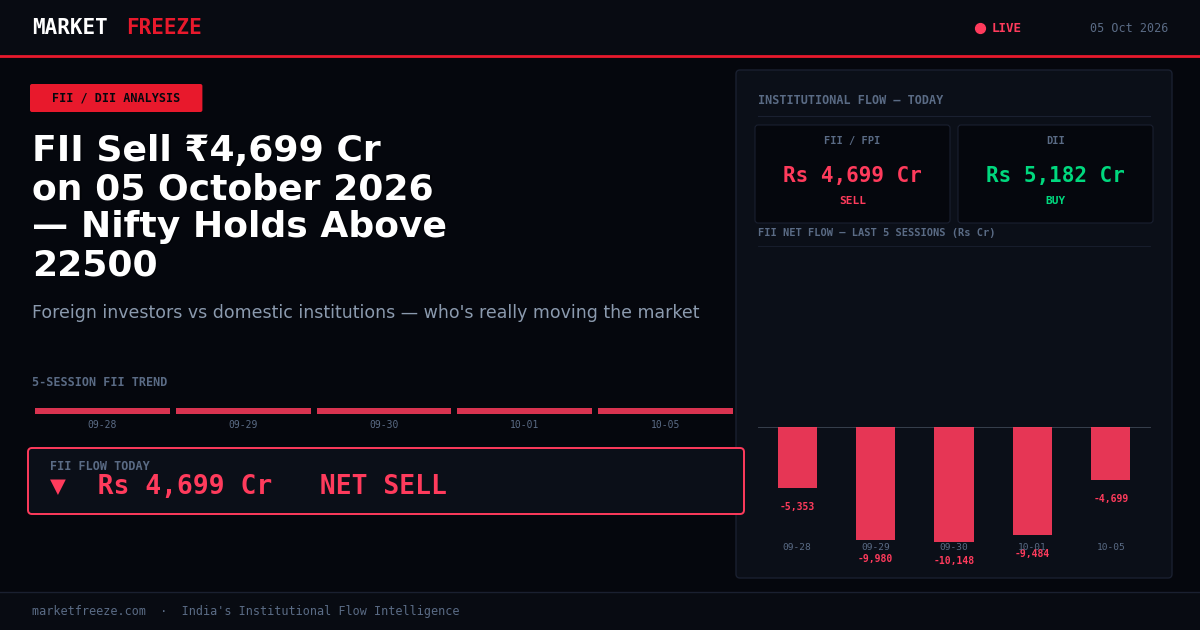
NSE provisional data confirms that on 05 October 2026, Foreign Institutional Investors (FIIs) offloaded ₹4,699.14 Cr worth of Indian equities, while Domestic Institutional Investors (DIIs) injected a net ₹5,181.62 Cr. This marks a significant divergence, with DIIs absorbing the bulk of FII selling, a trend observed for the last three sessions.
FII Selling Persists, DIIs Absorb ₹5,181 Cr
Today’s FII net selling figure of ₹4,699.14 Cr, while substantial, represents a moderation compared to the preceding two sessions. On 01 October 2026, FIIs were net sellers of ₹9,484.22 Cr, and on 30 September 2026, the outflow was even larger at ₹10,148.41 Cr. DIIs, conversely, have consistently stepped in, buying ₹10,041.84 Cr on 01 October and ₹11,271.73 Cr on 30 September. This sustained DII buying has provided a crucial floor to the market, preventing sharper declines despite significant FII liquidation.
Open a free demat account with
Upstox
or
Angel One
— zero brokerage on delivery trades.
FII Daily Turnover Shows Limited Conviction
The gross FII buy figure today stood at ₹15,674.61 Cr against their sell figure. While the net outflow was ₹4,699.14 Cr, the significant buy-side activity suggests that FIIs are not entirely exiting positions but are likely rebalancing portfolios or taking profits in certain segments while redeploying capital elsewhere. The ratio of gross buys to net sells (approximately 3.3x) is lower than in previous sessions, indicating a potential reduction in aggressive selling conviction compared to the steep outflows seen earlier this week. This suggests their focus might be shifting from broad-based selling to more selective profit-taking.
Nifty Movement Reflects DII Strength
The Nifty 50 closed at 22,555.75, up 0.60%, and the Sensex at 72,382.00, up 0.66%. Despite the FII selling pressure, the indices managed to end in positive territory, largely due to DII buying. This indicates that DII capital is effectively countering FII outflows, particularly in large-cap stocks. The current Nifty closing level of 22,555.75 suggests immediate support at 22,300, a level where FII selling has historically seen resistance in terms of overall market impact due to DII intervention. A break below this could see selling pressure intensify, with the next support at 21,900. On the upside, a sustained push beyond 22,800 would likely require a significant shift in FII positioning.
Sectoral Implication: FMCG and Consumer Durables Shine
Reports indicate that ITC, a prominent FMCG stock, led the gainers on the Nifty and Sensex. This aligns with the market narrative that FMCG and consumer durables are outperforming. The sustained DII buying, which often favors stable, consumer-facing businesses, likely supported these sectors. Conversely, reports mention HCL Tech and Asian Paints falling sharply, with healthcare and pharma stocks also declining. This suggests FII selling might be concentrated in IT and select defensives, while DIIs are actively supporting consumption-driven sectors and large-cap index heavyweights.
Global Cues: US Tech Strength Contrasts Indian Flows
Globally, US markets saw the Nasdaq hit a record high, driven by megacap technology stocks like Nvidia and Meta Platforms. This is in stark contrast to the FII selling observed in Indian IT stocks today. While US equities are buoyed by strong corporate earnings expectations, Indian markets are grappling with elevated Treasury yields and geopolitical uncertainties, as noted in US market wrap-ups. The differing performance drivers highlight a potential disconnect between global tech optimism and FII risk aversion in emerging markets like India.
Rupee Stability Amid RBI Policy Watch
The USD/INR pair closed at Rs96.4, a marginal increase of 0.06%. The rupee showed resilience, trading slightly stronger earlier in the day, supported by lower crude oil prices and improved broader sentiment. However, traders are awaiting the Reserve Bank of India’s (RBI) monetary policy decision, with a 25-basis-point rate hike widely anticipated. Indian bonds also held in a tight range ahead of this policy announcement, reflecting a cautious stance across financial markets. The tight range of the rupee suggests that while FII outflows are present, they are not yet causing significant currency depreciation, partly due to DII inflows and stable commodity prices like Gold MCX trading flat at Rs149,533.00/10g.
Historical Context: Sustained DII Buying Against FII Outflows
The current pattern of significant FII selling met by robust DII buying has been consistent over the last five sessions. On 28 September 2026, FIIs sold ₹5,353.22 Cr while DIIs bought ₹5,189.02 Cr. A similar dynamic played out on 29 September with FII selling of ₹9,980.22 Cr countered by DII buying of ₹6,952.71 Cr. This sustained DII absorption indicates a structural shift where domestic funds are accumulating assets at lower levels, potentially positioning for a medium-term recovery. Retail investors typically react to such sustained institutional divergence by either following DIIs or waiting for FIIs to turn buyers, creating a period of price discovery.
Key Data Points: Last 5 Sessions
| Date | FII Net (Cr) | DII Net (Cr) | Nifty Close |
|---|---|---|---|
| 2026-09-28 | ₹-5,353.22 Cr | +₹5,189.02 Cr | 22,716.20 |
| 2026-09-29 | ₹-9,980.22 Cr | +₹6,952.71 Cr | 22,620.45 |
| 2026-09-30 | ₹-10,148.41 Cr | +₹11,271.73 Cr | 22,421.95 |
| 2026-10-01 | ₹-9,484.22 Cr | +₹10,041.84 Cr | 22,555.75 |
| 2026-10-05 | ₹-4,699.14 Cr | +₹5,181.62 Cr | 22,555.75 |
What changed the outlook today?
The primary shift today was the moderation in FII selling volume compared to the preceding week. While still a net outflow, the reduced intensity, coupled with continued strong DII buying, allowed the Nifty to recover from potential intraday lows. The market’s ability to hold gains, as evidenced by the Nifty closing above 22,555, suggests that the DII support mechanism is currently robust enough to absorb FII selling at these price levels. The key level to watch is the Nifty’s ability to break through 22,800; failing to do so while FII selling persists could signal a retest of support levels.
FAQ Section
How much did FIIs sell in Indian stocks on October 5th, 2026?
FIIs were net sellers of ₹4,699.14 Cr in the Indian equity market on 05 October 2026, according to provisional NSE data.
What was the DII net buy figure on October 5th, 2026?
Domestic Institutional Investors (DIIs) were net buyers of ₹5,181.62 Cr on 05 October 2026.
What was the Nifty 50 closing level on October 5th, 2026?
The Nifty 50 index closed at 22,555.75 on 05 October 2026.
The sustained DII buying, consistently outstripping FII outflows over the past five sessions, suggests a strategic accumulation by domestic entities at current valuations. This is particularly evident when considering the sheer volume of DII purchases, which have ranged from ₹5,189.02 Cr on September 28th to over ₹11,000 Cr on September 30th. This implies that domestic fund managers perceive underlying value in the Indian market, even amidst global headwinds and FII reticence. Retail investors, often followers of institutional trends, are likely observing this divergence closely. Their participation level, while not directly measurable from FII/DII data, often becomes more pronounced when DIIs show sustained confidence, potentially leading to a ‘bottoming out’ effect once FII selling pressure abates.
Sector Rotation and Underlying Strength
The current market dynamics suggest a subtle but important sector rotation. The outperformance of FMCG and consumer durables, as highlighted by ITC’s gains, aligns with DII’s preference for defensive, consumption-oriented stocks that offer stability. Conversely, the weakness in IT and select healthcare stocks points towards potential FII reallocations away from growth-oriented or globally sensitive sectors. This divergence is crucial; while headline indices might be range-bound due to FII selling, underlying domestic demand is supporting specific sectors, creating pockets of opportunity. The ability of consumer staples to hold firm, even with significant foreign outflows, indicates resilience in domestic demand drivers, which is a positive sign for the broader economy.
Global Currency Dynamics and Gold’s Role
The relative stability of the USD/INR pair, trading around Rs96.4, is another significant factor. Despite the substantial FII outflows amounting to billions over recent weeks, the rupee has not depreciated sharply. This resilience can be attributed to several factors, including the RBI’s proactive currency management, lower crude oil prices (a major import cost for India), and consistent DII inflows acting as a buffer. Furthermore, the flat movement in Gold MCX prices at Rs149,533.00/10g suggests that safe-haven demand, often seen during periods of market uncertainty or currency weakness, is not significantly elevated. This indicates that while FIIs might be trimming equity exposure, the broader financial system and investor sentiment are not signalling extreme risk aversion, thus preventing a sharp currency slide that could exacerbate FII outflows.
Lessons from Previous FII Sell-Offs
History offers a perspective on such FII selling spells. Periods of significant foreign outflows have often been followed by market corrections, but also by periods of consolidation and eventual recovery fueled by domestic demand. For instance, in late 2023, a similar pattern of FII selling was met by strong DII buying, and the market eventually found its footing as domestic institutions absorbed the selling pressure. The current situation, with DIIs consistently stepping in, mirrors these past instances, suggesting that the market may be building a strong base. The magnitude of FII selling in the preceding sessions, exceeding ₹9,000 Cr on multiple days, highlights the scale of foreign investor caution, but the sustained DII counter-moves suggest a belief in India’s long-term growth story among domestic asset managers.
Bottom Line
Today’s session saw a notable reduction in FII selling pressure, with DIIs continuing their robust buying to absorb the outflows. This divergence allowed the Nifty to close higher at 22,555.75, indicating that domestic capital is currently a strong counterforce to foreign selling. While FII selling persists, its reduced intensity and DII support suggest stability in the near term, with sectors like FMCG showing relative strength. The immediate focus remains on whether FII selling will re-accelerate or if this moderation signals a potential shift in their positioning.
Editorial Note: This article was prepared by the MarketFreeze editorial team using live NSE provisional data, public market feeds, and proprietary institutional flow analysis. All price and flow figures are sourced directly from NSE, BSE, and CoinGecko as of 05 October 2026. This content is for informational purposes only and does not constitute investment advice. MarketFreeze is not SEBI-registered. Please consult a qualified financial advisor before making investment decisions. Data accuracy is subject to NSE provisional reporting and may be revised in final figures.