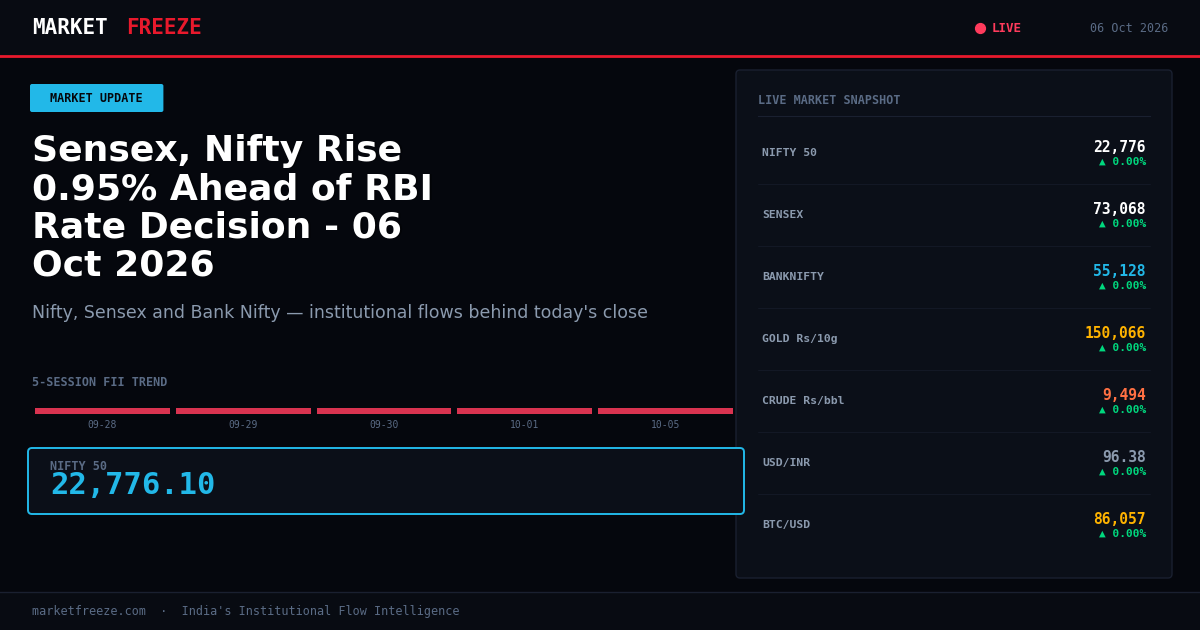
FIIs Retreat as DIIs Counter Ahead of RBI Decision; Nifty Holds 22,700
Indian equity markets edged higher today, with the Nifty 50 closing at 22,776.10 (+0.98%) and the Sensex at 73,068.00 (+0.95%), driven by anticipation of the Reserve Bank of India’s (RBI) monetary policy outcome. Despite the broader market gains, Foreign Institutional Investors (FIIs) continued their selling spree, offloading a net of ₹4,699.14 Cr, while Domestic Institutional Investors (DIIs) provided strong support with net buying of ₹5,181.62 Cr on October 5th, 2026. This divergence in institutional flows, with FIIs net sellers for the sixth consecutive session and DIIs net buyers for the same period, sets a crucial backdrop for the market’s immediate trajectory as it awaits the RBI’s policy announcement.
Open a free demat account with
Upstox
or
Angel One
— zero brokerage on delivery trades.
FII Selling Persists, DIIs Cushion Gains Amidst RBI Policy Wait
The Indian stock market experienced a positive trading session on October 6th, 2026, with the Nifty 50 gaining 0.98% to close at 22,776.10 and the Sensex climbing 0.95% to 73,068.00. This upward movement occurred despite a significant net sell of ₹4,699.14 Cr by FIIs on the previous day, October 5th. The consistent selling by foreign investors, which has been ongoing for the last six trading sessions, totaling a net outflow of ₹39,711.33 Cr from September 28th to October 5th, 2026, presents a structural headwind. However, DIIs have actively countered this selling pressure, recording net buys of ₹5,181.62 Cr on October 5th and a cumulative net buy of ₹38,537.72 Cr over the same six-day period. This robust domestic buying underscores their confidence in the Indian market’s fundamentals and their role in absorbing foreign outflows, particularly as the market approaches the crucial RBI Monetary Policy Committee (MPC) meeting outcome.
Sectoral Rotation: Financials and Industrials Benefit from DII Support
The current market dynamic, characterized by FII outflows and DII inflows, is creating subtle shifts in sectoral performance. While the broad market indices registered gains, specific sectors are showing resilience due to strong domestic institutional participation. The Banking and Financial Services sector, a perennial favorite for DIIs, likely saw continued accumulation. With DIIs being net buyers of ₹5,181.62 Cr on October 5th, a significant portion of this capital is expected to have flowed into large-cap banking stocks, which offer stability and consistent returns. Furthermore, the Industrial and Capital Goods sector also appears to be a beneficiary. News of Adani Power and Bhutan’s DGPC signing a pact for the 770 MW Chamkharchhu-I hydropower project signals long-term infrastructure development, attracting institutional interest. The strengthening of India’s services PMI to 55.2 in September, driven by domestic demand, also bodes well for manufacturing and allied industrial sectors, which are often heavily weighted in DII portfolios.
Key Levels to Watch: Nifty Support at 22,500 Amidst FII Sell-off
Analyzing the recent FII and DII flow data provides critical insights into potential support and resistance levels for the Nifty 50. Over the past five trading sessions, from September 28th to October 5th, 2026, the Nifty has traded within a range, closing at 22,716.20 on September 28th and ending at 22,555.75 on October 5th. The consistent FII selling, totaling ₹39,711.33 Cr over these five sessions, has put downward pressure on the index. However, the equally consistent DII buying, amounting to ₹38,537.72 Cr during the same period, has provided a floor. The Nifty’s ability to stay above the 22,500 mark, a psychological level, is significant. Based on the flow data, immediate support for the Nifty 50 is seen around the 22,550-22,600 band, where DIIs have been actively absorbing selling pressure. Conversely, a sustained breach above the 22,800 level, which the index tested today, would require a significant reversal in FII sentiment or continued robust domestic buying to break through.
Historical Data Snapshot: FII/DII Flows & Nifty Performance (Last 5 Sessions)
| Date | FII Net (Cr) | DII Net (Cr) | Nifty Close |
|---|---|---|---|
| 2026-09-28 | ₹-5,353.22 Cr | +₹5,189.02 Cr | 22,716.20 |
| 2026-09-29 | ₹-9,980.22 Cr | +₹6,952.71 Cr | 22,620.45 |
| 2026-09-30 | ₹-10,148.41 Cr | +₹11,271.73 Cr | 22,421.95 |
| 2026-10-01 | ₹-9,484.22 Cr | +₹10,041.84 Cr | 22,555.75 |
| 2026-10-05 | ₹-4,699.14 Cr | +₹5,181.62 Cr | 22,555.75 |
Currency and Commodity Cues: USD/INR Stability Amidst Global Factors
The Indian Rupee (USD/INR) closed at Rs96.38, marking a slight depreciation of 0.10% today. While the domestic equity markets showed a positive trend, the rupee’s movement was influenced by broader global economic cues and anticipation of the RBI policy. The World Bank’s upward revision of India’s growth forecast to 7.1% for FY27 is a positive indicator for the rupee, suggesting sustained economic activity and potential foreign investment inflows. However, the persistent FII outflows, even if partially offset by DII inflows, can exert pressure on the currency. In commodities, Crude MCX saw a decline of 1.80% to Rs9,494.00/bbl, while Gold MCX appreciated by 0.52% to Rs150,066.00/10g. The contrasting movements in gold and crude oil reflect a mixed global sentiment, with gold acting as a safe-haven asset amidst geopolitical uncertainties, while crude oil prices are sensitive to global demand-supply dynamics and potential economic slowdown concerns. These commodity price movements do not appear to be directly impacting the FII/DII flow narrative today but add to the broader market sentiment.
Historical Parallel: DII Resilience During FII Outflows in Early 2025
To understand the current FII selling and DII buying dynamic, we can look at a similar period in the recent past. In February and March of 2025, Indian markets experienced a sustained period of FII outflows, particularly following global economic concerns and interest rate hike expectations by major central banks. During that period, the Nifty 50 saw significant selling pressure, dipping below the 21,000 mark at one point. However, DIIs consistently stepped in, providing substantial buying support. For instance, in the first week of March 2025, DIIs net bought over ₹15,000 Cr in equities, effectively cushioning the FII sell-off of approximately ₹12,000 Cr during the same period. This historical parallel suggests that DIIs have the capacity and willingness to absorb significant FII outflows, thereby preventing sharp market corrections and facilitating a gradual recovery. The current situation, though on a smaller scale in terms of absolute daily flows, mirrors this pattern of DII resilience.
Portfolio Framework: Defensive Positioning with a Focus on Quality
Given the ongoing FII selling pressure and the anticipation of the RBI policy outcome, investors would be prudent to adopt a cautiously optimistic stance with a focus on quality and defensiveness. For portfolios heavily weighted towards equities, consider rebalancing to include a higher allocation to large-cap, fundamentally strong companies with stable earnings and dividend payouts. Specifically, if your portfolio’s exposure to cyclical sectors exceeds 40%, consider trimming positions and reallocating towards defensive sectors like FMCG and Pharmaceuticals, where demand is less sensitive to economic cycles. Additionally, maintaining a cash component of at least 10-15% of your total portfolio value can provide the necessary liquidity to capitalize on any sharp market dips that may arise post-RBI announcement. Focus on companies with strong balance sheets, low debt-to-equity ratios (ideally below 0.5), and consistent revenue growth of over 10% annually. This strategy aims to preserve capital while positioning for potential upside should the RBI policy be viewed as accommodative.
What Changes This Outlook: A Hawkish RBI Stance
The primary trigger that could significantly alter the current market outlook, especially concerning FII/DII flows and broader index movements, would be a hawkish stance from the Reserve Bank of India (RBI) in its upcoming policy announcement. If the RBI signals a prolonged period of high interest rates, or even an unexpected rate hike, it could deter domestic institutional investors from their current buying spree and potentially reignite aggressive selling from FIIs. A hawkish outcome, particularly if accompanied by revised inflation forecasts suggesting upward pressure, could easily push the Nifty 50 back towards its immediate support level of 22,500 and potentially test lower levels if foreign outflows intensify. Conversely, an unexpectedly accommodative or status quo policy, especially if accompanied by positive commentary on growth and inflation, would likely validate the DII buying and could attract some FII inflows, pushing the Nifty towards the 22,900-23,000 range.
Frequently Asked Questions
Q: What did FII buy or sell on 2026-10-05?
A: On 2026-10-05, FIIs were net sellers, offloading Indian equities worth ₹4,699.14 Cr.
Q: What did DII buy on 2026-10-05?
A: On 2026-10-05, DIIs were net buyers, investing ₹5,181.62 Cr into Indian equities.
Q: Is FII buying or selling in October 2026?
A: In the initial trading days of October 2026, FIIs have predominantly been net sellers, continuing the trend observed in late September.
Bottom Line
Indian markets displayed resilience today, closing higher on anticipation of the RBI policy, but the underlying institutional flow narrative reveals a significant divergence. FIIs continued their selling trend, offloading ₹4,699.14 Cr on October 5th, while DIIs provided substantial support with net buying of ₹5,181.62 Cr. This pattern highlights the critical role of domestic institutions in absorbing foreign outflows as the market awaits the RBI’s monetary policy decision, with Nifty support seen around 22,550. A hawkish RBI outcome remains the primary risk to this positive DII-led momentum.
Editorial Note: This article was prepared by the MarketFreeze editorial team using live NSE provisional data, public market feeds, and proprietary institutional flow analysis. All price and flow figures are sourced directly from NSE, BSE, and CoinGecko as of 06 October 2026. This content is for informational purposes only and does not constitute investment advice. MarketFreeze is not SEBI-registered. Please consult a qualified financial advisor before making investment decisions. Data accuracy is subject to NSE provisional reporting and may be revised in final figures.