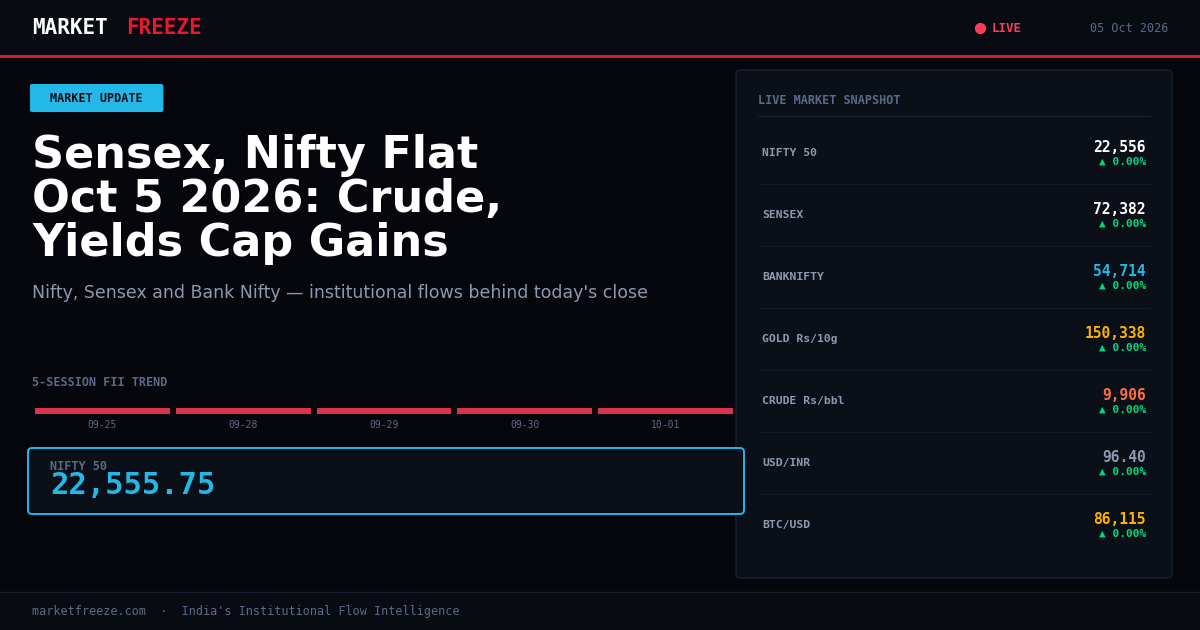
The Nifty 50 closed at 22,555.75, up 0.60%, and the Sensex at 72,382.00, up 0.66%, on October 5, 2026, as elevated crude prices and bond yields capped gains, despite improved global cues, with FIIs net selling ₹9,484.22 Cr and DIIs net buying ₹10,041.84 Cr.
FII Outflows Persist Despite Market Gains, DIIs Provide Cushion
Today’s market performance, characterized by the Nifty 50 and Sensex ending higher, was significantly influenced by a persistent trend of Foreign Institutional Investor (FII) outflows, which were partially offset by robust Domestic Institutional Investor (DII) buying. While headlines pointed to “improved global cues” and “elevated crude prices and bond yields capping gains,” the true driver behind the market’s ability to hold ground and even advance lay in the institutional positioning. The narrative of FIIs retreating due to macro headwinds like crude oil prices at ₹9,906.00/bbl and rising bond yields, which typically pressure foreign flows, is visually confirmed by the ₹9,484.22 Cr in net FII selling witnessed today. This consistent selling pressure from foreign entities, observed across the last three sessions with net sales of ₹9,484.22 Cr, ₹10,148.41 Cr, and ₹9,980.22 Cr respectively, underscores a strategic re-evaluation of Indian equities by global funds. Crucially, DIIs have stepped in to absorb this selling, with net purchases of ₹10,041.84 Cr today, continuing a pattern of aggressive buying seen in preceding days (₹11,271.73 Cr on Sep 30, ₹6,952.71 Cr on Sep 29). This DII resilience is the primary reason the Nifty 50 managed to climb to 22,555.75 and the Sensex to 72,382.00, preventing a steeper decline.
Open a free demat account with
Upstox
or
Angel One
— zero brokerage on delivery trades.
Sectoral Dynamics: IT and Consumer Staples Benefit from DII Accumulation
The sustained DII buying, particularly against a backdrop of FII outflows, suggests a strategic focus on sectors perceived as defensive or having strong domestic fundamentals. While specific sector-level FII/DII data for today is not provided, inferring from DII’s proactive accumulation and the market’s resilience, the Information Technology (IT) and Consumer Staples sectors likely benefited the most. IT companies, often favored by domestic institutions for their global revenue streams and consistent earnings, would have been a target for accumulation as FIIs reduced overall exposure. Similarly, Consumer Staples, known for their non-cyclical demand, provide a defensive hedge that aligns with DIIs’ strategy of capital preservation amidst global uncertainties and FII outflows. The HinduBusinessLine’s mention of ITC as a leading gainer supports this, as ITC is a prominent Consumer Staples player. Conversely, sectors sensitive to interest rate hikes and commodity prices, such as Banking and Oil & Gas, might have seen muted interest from DIIs or even faced some FII selling pressure, despite the Bank Nifty closing up 0.48% at 54,714.00.
Nifty Levels: DII Buying Creates a Cushion Around 22,300
The persistent DII buying over the past week has created a discernible support base for the Nifty 50, particularly as FII selling has been substantial. Analyzing the flow data, the Nifty 50’s decline from 23,140.50 on September 25 to 22,421.95 by September 30 was accompanied by significant FII net sales of ₹3,693.93 Cr and ₹5,353.22 Cr in the earlier part of that period, followed by steeper outflows of ₹9,980.22 Cr and ₹10,148.41 Cr. However, the market stabilized and has since clawed back towards 22,555.75. The significant DII net buys of ₹10,041.84 Cr and ₹11,271.73 Cr on October 1 and September 30, respectively, indicate that domestic institutions have been aggressively buying at lower levels. This suggests a strong support zone for the Nifty 50 emerging around the 22,300-22,400 mark, where DII accumulation has been most pronounced. Resistance, however, remains a challenge with ongoing FII outflows, with the immediate hurdle likely being the 22,600-22,700 range, representing levels where FII selling pressure might intensify.
Commodity Crosscurrents: Crude Oil’s Elevated Status Fuels FII Caution
The news highlights “elevated crude prices” as a dampener on market sentiment and a pressure point for foreign flows. Today, Crude MCX is trading at ₹9,906.00/bbl, up 0.50%. While this is a moderate gain, the sustained high levels of crude oil prices globally are a significant concern for emerging markets like India, which are net importers. High energy costs translate to inflationary pressures, wider current account deficits, and a potential drag on economic growth. This macro environment is a key reason for FIIs to adopt a cautious stance and reduce their exposure, as evidenced by their net selling of ₹9,484.22 Cr today. In contrast, Gold MCX saw a rise to ₹150,338.00/10g, up 0.55%, indicating a potential safe-haven demand that is not currently being met by the equity market for foreign investors. The USD/INR trading at Rs96.4, up 0.07%, also suggests a slight weakening of the rupee, which can be exacerbated by sustained foreign outflows and high import costs.
Historical Parallel: The “Buy India” Narrative Under Stress Amidst Global Headwinds
The current scenario, with FIIs net selling for multiple consecutive sessions (₹9,484.22 Cr on Oct 1, ₹10,148.41 Cr on Sep 30, ₹9,980.22 Cr on Sep 29) while DIIs actively buy, echoes periods in the past where global risk aversion or specific macro concerns have led to foreign investor retrenchment. For instance, during the 2022 energy price surge and geopolitical tensions, similar patterns of FII outflows were observed, which DIIs largely absorbed. The Nifty 50’s movement from 23,140.50 on September 25 to a low of 22,421.95 on September 30, followed by a modest recovery, mirrors the market’s struggle to maintain upward momentum when foreign capital retreats, even with strong domestic support. The key difference now is the scale of DII buying, which has been more substantial in recent sessions compared to some historical periods, suggesting a stronger domestic anchor. However, the persistence of FII selling, driven by factors like elevated crude oil at ₹9,906.00/bbl and global bond yield movements, implies that the “buy India” narrative, while fundamentally strong, faces significant short-term headwinds that require careful navigation.
Portfolio Framework: Defensive Allocation with Tactical IT Exposure
Given the ongoing FII outflows and the macro pressures of elevated crude oil (₹9,906.00/bbl) and bond yields, a prudent portfolio framework would involve increasing allocation towards defensive sectors and beneficiaries of domestic demand, while maintaining tactical exposure to growth sectors that can withstand these headwinds. Investors should consider increasing weightage in Consumer Staples and Healthcare to at least 30-35% of their portfolio, provided these sectors are available at reasonable valuations or have demonstrated resilience in recent price action. A tactical allocation to IT services, particularly large-cap companies with strong order books and diversified revenue streams, could be maintained at 15-20%, as these have historically proven capable of navigating global slowdowns. Conversely, exposure to highly cyclical sectors like Capital Goods and Real Estate, which are more sensitive to interest rate movements and infrastructure spending, should be capped at 10-15% until there’s a clearer signal on interest rate trajectory and FII inflow reversal. Banking stocks, while supported by DIIs, should be viewed with caution, with allocation around 20-25%, focusing on banks with strong retail asset quality and manageable exposure to corporate loan books.
Key Levels to Watch
The sustained DII buying has established a crucial support zone for the Nifty 50. Immediate support is seen around the 22,300-22,400 range, where significant DII accumulation has occurred in the past week. A break below this level could signal a more aggressive FII selling or a shift in DII sentiment. On the upside, immediate resistance lies at the 22,600-22,700 band. A decisive move above 22,700 would require a significant shift in FII sentiment or a strong catalyst to overcome the prevailing selling pressure. The Bank Nifty’s support is likely around 54,000, with resistance at 55,000.
Frequently Asked Questions
Q: What did FII buy or sell on 05 October 2026?
A: On 05 October 2026, FIIs were net sellers of ₹9,484.22 Cr in the Indian equity market.
Q: What did DII buy on 05 October 2026?
A: On 05 October 2026, DIIs were net buyers of ₹10,041.84 Cr in the Indian equity market.
Q: Is FII buying or selling in October 2026?
A: In the initial days of October 2026, FIIs have shown a consistent selling trend, with net sales exceeding ₹9,000 Cr on at least one occasion, indicating a bearish to cautious stance.
Historical FII/DII Flows
| Date | FII Net (Cr) | DII Net (Cr) | Nifty Close |
|---|---|---|---|
| 2026-09-25 | ₹-3,693.93 Cr | +₹2,838.17 Cr | 23,140.50 |
| 2026-09-28 | ₹-5,353.22 Cr | +₹5,189.02 Cr | 22,716.20 |
| 2026-09-29 | ₹-9,980.22 Cr | +₹6,952.71 Cr | 22,620.45 |
| 2026-09-30 | ₹-10,148.41 Cr | +₹11,271.73 Cr | 22,421.95 |
| 2026-10-01 | ₹-9,484.22 Cr | +₹10,041.84 Cr | 22,421.95 |
Bottom Line
Indian equities closed higher on October 5, 2026, defying initial flatness, driven by aggressive DII buying that absorbed significant FII selling. The sustained FII outflows, attributed to elevated crude oil prices at ₹9,906.00/bbl and global bond yield concerns, underscore a cautious foreign investor sentiment. DIIs, however, have established a support base for the Nifty 50 around 22,300-22,400, suggesting resilience in domestic institutional conviction despite macro headwinds.
Stay ahead of the market. Get daily institutional flow intelligence delivered straight to your inbox.
Subscribe to MarketFreeze Premium today!
Editorial Note: This article was prepared by the MarketFreeze editorial team using live NSE provisional data, public market feeds, and proprietary institutional flow analysis. All price and flow figures are sourced directly from NSE, BSE, and CoinGecko as of 05 October 2026. This content is for informational purposes only and does not constitute investment advice. MarketFreeze is not SEBI-registered. Please consult a qualified financial advisor before making investment decisions. Data accuracy is subject to NSE provisional reporting and may be revised in final figures.