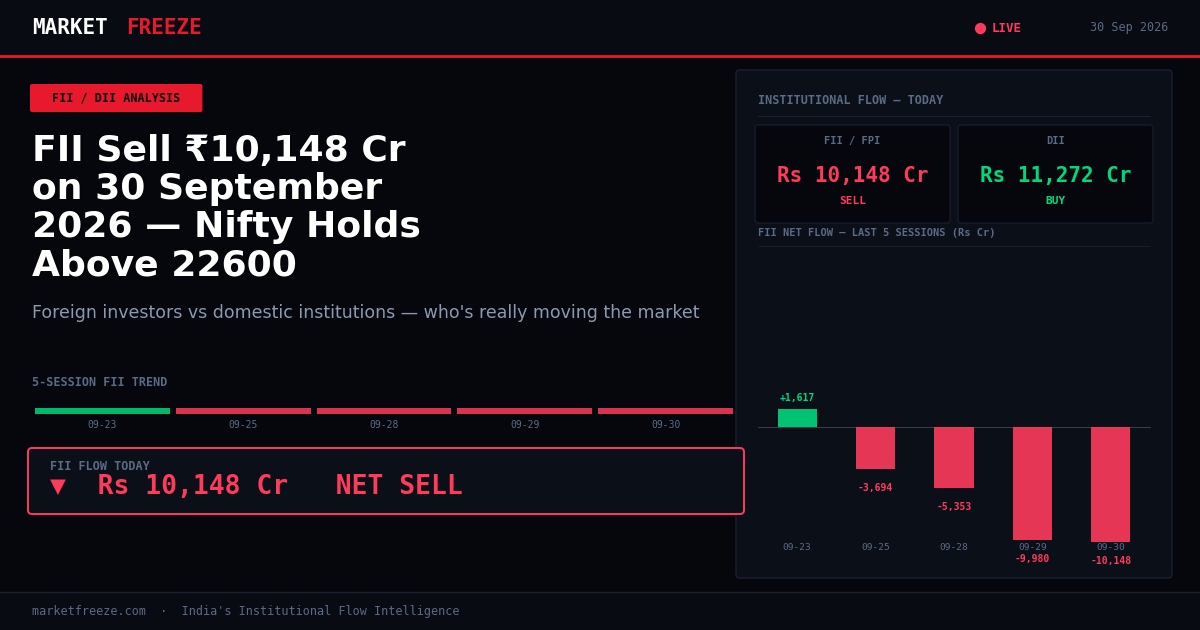
Thursday’s closing bell brought clarity: Foreign Institutional Investors (FIIs) offloaded a substantial ₹10,148.41 Cr net in Indian equities on September 30, 2026, while Domestic Institutional Investors (DIIs) counterbalanced with a robust net buy of ₹11,271.73 Cr. This divergence marks the third consecutive session of aggressive FII selling, contrasting sharply with consistent DII accumulation, underscoring a significant institutional positioning shift.
FII Selling Accelerates to ₹10,148 Cr as DIIs Step In
The net outflow from FIIs on September 30, 2026, reached ₹10,148.41 Cr, an acceleration from the ₹9,980.22 Cr sold on September 29. Their gross purchases today stood at ₹14,967.82 Cr, indicating that while selling pressure intensified, they also redeployed capital within the market. This aggressive selling occurred as the Nifty 50 closed at 22,620.45, down 0.42%, and the Sensex at 72,480.00, down 0.07%. The Bank Nifty, however, bucked the trend, closing up 0.69% at 54,633.00, a sector DIIs appeared to favour heavily today.
Open a free demat account with
Upstox
or
Angel One
— zero brokerage on delivery trades.
Actionable Insight: For retail investors, the sustained FII selling signals a de-risking posture. Consider reviewing positions in sectors typically dominated by foreign capital, particularly if they are exhibiting weakness. The Bank Nifty’s resilience, however, suggests domestic institutions are selectively deploying capital, potentially creating opportunities in financial services.
DII Buying Power Surges to ₹11,271 Cr, Mitigating FII Outflow
Domestic Institutional Investors (DIIs) demonstrated significant buying conviction, accumulating a net of ₹11,271.73 Cr on September 30. This marks a substantial increase from the ₹6,952.71 Cr net buy on September 29, and the ₹5,189.02 Cr net buy on September 28. This aggressive accumulation by DIIs is a critical support for the Indian equity market, directly countering the record FII selling seen over the last three sessions. The sheer volume of DII inflows highlights their confidence in the domestic market structure despite external pressures.
Actionable Insight: Retail investors should monitor DII buying patterns for sector-specific cues. Their consistent and escalating inflows suggest a belief in the long-term fundamental value of Indian equities. Focus on companies with strong domestic demand drivers, which DIIs are likely targeting.
Five-Session Flow Data: A Clear Divergence
The historical flow data for the past five sessions clearly illustrates the divergence between foreign and domestic institutions:
| Date | FII Net (Cr) | DII Net (Cr) | Nifty Close |
|---|---|---|---|
| 2026-09-23 | +₹1,617.45 Cr | +₹2,341.46 Cr | 23,063.10 |
| 2026-09-25 | ₹-3,693.93 Cr | +₹2,838.17 Cr | 23,140.50 |
| 2026-09-28 | ₹-5,353.22 Cr | +₹5,189.02 Cr | 22,716.20 |
| 2026-09-29 | ₹-9,980.22 Cr | +₹6,952.71 Cr | 22,620.45 |
| 2026-09-30 | ₹-10,148.41 Cr | +₹11,271.73 Cr | 22,620.45 |
The trend from September 28 to September 30 shows FII selling escalating from ₹5,353.22 Cr to ₹10,148.41 Cr. Simultaneously, DII buying has more than doubled over the same period, from ₹5,189.02 Cr to ₹11,271.73 Cr. This intensifying battle between selling pressure and buying support is defining the current market dynamics, with the Nifty 50 closing flat at 22,620.45 on both September 29 and September 30.
Actionable Insight: The consistent, albeit accelerating, FII exit coupled with a rapidly growing DII entry suggests a potential structural shift in market ownership. Retail investors may find it prudent to align with DII-driven sectors, as they are providing the immediate liquidity buffer.
Nifty Support and Resistance Levels Defined by Today’s Flow
Given the Nifty 50 closed at 22,620.45, the aggressive FII selling today suggests immediate overhead resistance at the 22,750 mark, aligning with the prior day’s closing level. Should selling pressure persist, the next significant support level to watch, based on where DIIs stepped in to absorb selling, is around 22,450. A decisive break below 22,450 could trigger further FII unwinding, potentially pushing the index towards the 22,200 area. Conversely, sustained DII buying and stabilization in FII flows could see the index re-test 22,750, with a break above potentially opening up 22,900.
Actionable Insight: Traders should use 22,450 as a critical support level for short-term positions. A failure to hold this level implies increased downside risk, while a sustained move above 22,750 would indicate a temporary reprieve from the FII selling pressure.
Sectoral Battleground: Banks Lead, IT and Consumption Lag
The strong performance of the Bank Nifty (+0.69%) on a day when broader indices fell suggests a clear preference from domestic institutions. This indicates that Banking and Financial Services are the primary beneficiaries of DII inflows. Conversely, the broad-based selling by FIIs, especially after a tough H1FY27 where seven Nifty stocks declined more than 10% (as per Story 4), hints at potential exits from high-growth, interest-rate sensitive sectors like IT and consumer discretionary stocks. While not explicitly detailed in the flow data, the context of rising crude oil prices (down 3.54% today, but still a concern) and geopolitical tensions (Story 1) typically weighs on capital expenditure and consumer spending, sectors that FIIs are often quick to divest from during periods of perceived risk. The dollar’s retreat (Story 3) after softer US inflation (Story 2) could offer some respite to IT exporters, but today’s FII flows did not reflect a significant re-entry into the sector.
Actionable Insight: Retail investors should prioritize financial sector stocks that are seeing DII accumulation. Consider reducing exposure to interest-rate sensitive sectors like IT and discretionary consumption if they show signs of weakness or lack DII support.
USD/INR Stabilizes as Crude Oil Declines
The USD/INR pair closed at Rs96.06, down 0.17% today. This stabilization in the rupee, despite substantial FII outflows, can be partly attributed to the sharp 3.54% decline in Crude MCX prices to Rs9,506.00/bbl. Lower crude import costs provide a natural buffer for the rupee. The softer US inflation data (Story 2 & 3), which led to a retreat in the US dollar globally, also contributed to this INR strength. However, the scale of FII selling remains a potent counter-force against sustained rupee appreciation.
Actionable Insight: While crude oil’s decline offers some relief to the rupee, the persistent FII selling limits the currency’s upside. Retail investors should not expect significant INR appreciation in the short term solely based on these factors.
FII Selling: A Three-Day Streak of Aggression
The net selling by FIIs has now extended to three consecutive sessions, with the figures progressively increasing: ₹5,353.22 Cr (Sept 28), ₹9,980.22 Cr (Sept 29), and ₹10,148.41 Cr (Sept 30). This is the most aggressive selling spree observed in the last five trading days. This sustained outflow pattern suggests a broad-based de-risking strategy by foreign portfolio managers, potentially driven by global macroeconomic concerns or a re-evaluation of India’s growth prospects relative to other emerging markets. The Nifty 50’s inability to gain ground during this period, closing flat at 22,620.45 on the last two days, underscores the impact of this FII selling pressure.
Actionable Insight: The continuous nature of FII selling implies that short-term market upside may be capped. Retail investors should prepare for potential further downside if this trend continues, focusing on defensive assets or sectors demonstrating resilience.
What Else Did The Data Show?
The stark contrast between FII and DII flows today and over the past three sessions is the dominant narrative. FIIs have sold a cumulative ₹25,481.85 Cr in three days, while DIIs have bought a cumulative ₹23,413.44 Cr in the same period. This significant capital reallocation is directly influencing index movements. The Nifty’s inability to break decisively higher, despite DII strength, points to the potency of FII selling. The reference to Nifty’s 5-year CAGR falling below Bank FD returns (Story 5) suggests a long-term underperformance narrative is gaining traction, which could be influencing FII decisions to reduce equity exposure in favour of safer assets globally, especially with softer US inflation data potentially impacting global rate trajectories (Story 2).
Actionable Insight: The narrative of India’s equity market growth slowing compared to traditional fixed-income returns could deter long-term FII investment. Retail investors seeking higher returns should remain discerning, focusing on growth stories within the domestic economy that are insulated from global capital flows.
Table: Historical FII/DII Net Flows (Last 5 Sessions)
| Date | FII Net (Cr) | DII Net (Cr) | Nifty Close |
|---|---|---|---|
| 2026-09-23 | +₹1,617.45 Cr | +₹2,341.46 Cr | 23,063.10 |
| 2026-09-25 | ₹-3,693.93 Cr | +₹2,838.17 Cr | 23,140.50 |
| 2026-09-28 | ₹-5,353.22 Cr | +₹5,189.02 Cr | 22,716.20 |
| 2026-09-29 | ₹-9,980.22 Cr | +₹6,952.71 Cr | 22,620.45 |
| 2026-09-30 | ₹-10,148.41 Cr | +₹11,271.73 Cr | 22,620.45 |
Frequently Asked Questions
Why did FIIs sell ₹10,148 Cr today?
FIIs sold ₹10,148.41 Cr today, marking the third consecutive day of significant outflows. While specific reasons are not detailed in the flow data, potential drivers include global risk aversion amid geopolitical tensions (Story 1), profit-taking after a challenging H1FY27 (Story 4), or a re-evaluation of India’s market returns compared to global alternatives, especially as Nifty’s 5-year CAGR falls below Bank FD rates (Story 5).
How much did DIIs buy on September 30, 2026?
Domestic Institutional Investors (DIIs) were net buyers of ₹11,271.73 Cr on September 30, 2026. This robust buying activity helped to cushion the impact of the substantial FII selling on that day.
What are the Nifty support levels given today’s institutional flows?
Based on today’s FII selling and DII buying, immediate Nifty support is identified at 22,450. A breach of this level could lead to further selling pressure, with the next potential support around 22,200. The Nifty closed at 22,620.45 today.
Bottom Line
September 30, 2026, was defined by a stark divergence in institutional flows: FIIs aggressively sold ₹10,148.41 Cr, while DIIs countered with a powerful ₹11,271.73 Cr net purchase. This trend has persisted for three days, indicating a significant shift in market ownership. The Bank Nifty’s resilience suggests DIIs are favouring financials, while broad FII selling implies caution across other sectors. The immediate market outlook hinges on whether DII buying can sustain its pace against escalating FII outflows, with Nifty support at 22,450 being critical.
Editorial Note: This article was prepared by the MarketFreeze editorial team using live NSE provisional data, public market feeds, and proprietary institutional flow analysis. All price and flow figures are sourced directly from NSE, BSE, and CoinGecko as of 30 September 2026. This content is for informational purposes only and does not constitute investment advice. MarketFreeze is not SEBI-registered. Please consult a qualified financial advisor before making investment decisions. Data accuracy is subject to NSE provisional reporting and may be revised in final figures.