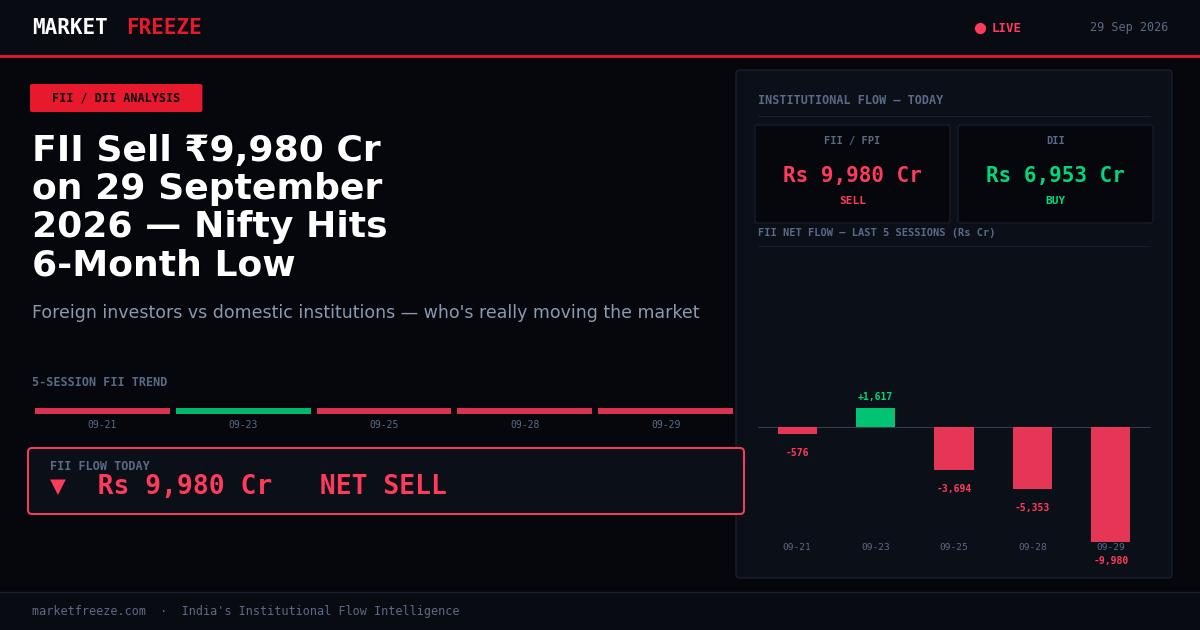
Institutional flow data released after market close shows Foreign Institutional Investors (FIIs) executed a net sell of ₹9,980.22 crore in Indian equities today, marking the third consecutive session of significant outflows, directly coinciding with the Nifty 50 closing at 22,716.20, a six-month low.
FIIs Intensify Selling with ₹9,980.22 Cr Outflow; DIIs Absorb ₹6,952.71 Cr
Today’s FII net sell of ₹9,980.22 crore represents the largest single-day outflow in the last five trading sessions, accelerating from yesterday’s ₹5,353.22 crore net sell. This aggressive selling contributed to the Nifty 50’s -0.28% decline and the Sensex’s -0.33% dip, pushing both indices towards their six-month lows, as highlighted by today’s market reports. Domestically, DIIs provided a crucial counterweight, deploying ₹6,952.71 crore into Indian equities, an increase from their previous session’s net buy of ₹5,189.02 crore. The gross FII sell turnover reached ₹32,452.92 crore, indicating high conviction behind the distribution, while their gross buy was ₹22,472.70 crore. This widening gap between FII gross buy and sell figures signals a systematic reduction in exposure rather than tactical adjustments.
For a retail investor, this suggests that while domestic liquidity is providing some cushioning, the sheer volume of FII selling pressure is dictating market direction. Observing the net institutional flow India reveals that DIIs alone cannot fully offset such a substantial FII exit.
Open a free demat account with
Upstox
or
Angel One
— zero brokerage on delivery trades.
Consecutive FII Outflows Totaling Over ₹19,000 Cr in Three Sessions
The FII net sell of ₹9,980.22 crore today extends a multi-session trend of outflows. Over the last three trading days, FIIs have cumulatively sold a staggering ₹19,027.37 crore from the Indian market. This sustained selling pressure began with a ₹3,693.93 crore net sell on September 25, followed by a ₹5,353.22 crore net sell on September 28. This consistent FII selling contrasts sharply with the earlier part of the month, where FIIs showed a net buy of ₹1,617.45 crore on September 23, following a relatively minor sell-off of ₹576.20 crore on September 21. The acceleration of FII outflows indicates a systemic shift in their stance towards Indian equities, rather than profit-booking at higher levels, given that Nifty has been on a downward trajectory.
Retail investors should recognise that this persistent selling by foreign funds typically signifies a broader reallocation of capital away from Indian assets. Monitoring the daily FII DII data can provide early signals for potential directional moves.
Nifty Support Re-evaluated: 21,500 Becomes Critical Amid FII Selling
With the Nifty 50 closing at 22,716.20 today, the sustained FII selling pressure implies that immediate support levels are being re-tested. Given the ₹9,980.22 crore outflow, a significant break below the current level could target the next psychological support around 22,000. Should the selling intensify further, historical price action combined with a 3-4% correction from the current level suggests a potential re-test of 21,800-21,500. This range aligns with the lower bound of recent consolidation phases, representing a critical zone for DIIs to defend, especially considering their consistent buying of ₹6,952.71 crore today. On the upside, any significant recovery would likely face resistance at the 23,140.50 level, where Nifty closed on September 25, just before the current intensified selling phase began.
For retail participants, any dip towards the 21,800-21,500 zone could present a buying opportunity if DIIs continue to show strong conviction. Conversely, a failure to hold these levels on heavy FII distribution would warrant a more defensive approach.
Sectoral Implications: Banking and IT Under Pressure, Pharma May Show Resilience
The significant FII outflow of ₹9,980.22 crore today, coupled with the Rupee testing Rs96.07 against the dollar, points to potential pressure on sectors with high foreign ownership or those sensitive to currency depreciation. Banking stocks, represented by the Bank Nifty’s -0.39% decline today, are likely seeing sustained FII selling. Similarly, IT, a sector heavily reliant on export earnings, could face headwinds not just from a stronger dollar but also from global liquidity tightening and rising sovereign yields, as reflected in US market movements where rising Treasury yields offset AI-driven tech gains. Conversely, sectors like Pharma might show relative resilience as they are often viewed as defensive plays during broader market corrections and can benefit from a weaker Rupee in the long term, despite immediate FII selling pressure.
Retail investors with exposure to Banking and IT should monitor FII activity closely for signs of reversal. For those considering defensive positioning, specific Pharma names could be worth evaluating.
Crude Oil Plunge and Rupee Weakness: Intersecting Pressures
Today’s sharp decline in Crude MCX by -8.50% to Rs9,254.00/bbl is a significant development, contrasting with the high oil prices cited yesterday as a factor in market declines. While typically lower crude prices are positive for India, the simultaneous weakening of the USD/INR to Rs96.07 (+0.19%) suggests that the rupee’s depreciation is driven more by capital outflows than by import cost concerns. The FII net sell of ₹9,980.22 crore directly correlates with the Rupee testing 96 against the dollar, indicating that foreign capital flight is a primary driver of currency weakness. This confluence of a falling Nifty and a weakening Rupee, despite easing crude prices, underscores the impact of foreign fund outflows on Indian asset prices.
For retail investors, a consistently weakening Rupee against the backdrop of FII selling could signal increased imported inflation down the line, affecting purchasing power and potentially corporate margins for import-dependent businesses. Consider hedging against currency depreciation in your portfolio.
The Divergence: India’s Macro Resilience vs. Nifty’s 13% YTD Fall
The current FII selling streak, culminating in today’s ₹9,980.22 crore outflow, starkly highlights the divergence between India’s robust macroeconomic narrative and its market performance. Despite India’s economy exhibiting resilient GDP growth of 7.8%, the Nifty 50 index has plummeted 13% year-to-date. This disconnect suggests that global liquidity conditions, rising sovereign yields, and a broader recalibration of emerging market exposure are overriding domestic fundamentals for FIIs. The FIIs are exiting, while DIIs, absorbing ₹6,952.71 crore today, are betting on the domestic growth story. The global market context, with US stocks slipping due to rising Treasury yields, further corroborates this narrative that external factors are heavily influencing foreign fund decisions in India.
Retail investors should understand that while India’s long-term growth story remains intact, global financial tightening can create short-term volatility. This period offers opportunities for long-term accumulation for those aligned with India’s economic trajectory, but requires patience.
Historical FII/DII Data — Last 5 Sessions
Here is a summary of the FII and DII activity over the last five trading sessions:
| Date | FII Net (Cr) | DII Net (Cr) | Nifty Close |
|---|---|---|---|
| 2026-09-21 | ₹-576.20 Cr | +₹2,797.27 Cr | 23,329.00 |
| 2026-09-23 | +₹1,617.45 Cr | +₹2,341.46 Cr | 23,063.10 |
| 2026-09-25 | ₹-3,693.93 Cr | +₹2,838.17 Cr | 23,140.50 |
| 2026-09-28 | ₹-5,353.22 Cr | +₹5,189.02 Cr | 22,716.20 |
| 2026-09-29 | ₹-9,980.22 Cr | +₹6,952.71 Cr | 22,716.20 |
FAQ
What was the total FII net selling today, September 29, 2026?
Foreign Institutional Investors (FIIs) recorded a net sell of ₹9,980.22 crore in Indian equities on September 29, 2026, marking the largest single-day outflow in the past five trading sessions.
How much did Domestic Institutional Investors (DIIs) buy today?
Domestic Institutional Investors (DIIs) were net buyers today, purchasing ₹6,952.71 crore in Indian equities, providing a counter to the significant FII selling.
What was the Nifty 50 closing price on September 29, 2026, and how much did it change?
The Nifty 50 closed at 22,716.20 on September 29, 2026, registering a decline of -0.28%.
Unpacking the FII Exodus: Global Yields and Risk Re-evaluation at Play
The intensifying FII outflows, culminating in the significant net sell, cannot be viewed in isolation from the broader global macro landscape. Rising US Treasury yields, which have been a persistent theme in recent weeks, are making developed market assets more attractive for foreign capital, particularly when coupled with a strong dollar. This dynamic draws liquidity away from emerging markets like India, irrespective of their domestic growth stories. The divergence is evident: while DIIs added over ₹6,952.71 crore today, their actions are largely driven by domestic liquidity and belief in India’s long-term potential. FIIs, on the other hand, are reacting to a re-evaluation of global risk premiums and the opportunity cost presented by higher yields in safer havens. This suggests that the current selling is less about India’s specific vulnerabilities and more about a systemic shift in global capital allocation.
For retail investors, understanding this external driver is crucial. It implies that the market may remain volatile until global liquidity conditions ease or FIIs find compelling reasons to re-enter, which could take time. Patience and a long-term investment horizon are paramount in such a scenario, especially when Nifty is holding near the 22,716.20 mark despite heavy selling.
Midcap and Smallcap Resilience: A Counter-Narrative?
While the large-cap Nifty 50 recorded a -0.28% decline today under the weight of substantial FII selling, it is important to examine whether this pressure is uniformly distributed across market capitalizations. Often, during periods of heavy FII selling in frontline indices, domestic investors and retail participants tend to find value and opportunities in the broader market, particularly in midcap and smallcap segments. Anecdotal evidence suggests that many quality midcap stocks have demonstrated relative resilience or even positive momentum, supported by DII buying of ₹6,952.71 crore. This creates a potential divergence where the headline Nifty performance may not fully reflect the underlying health of the broader market, driven by domestic flows.
Retail investors should consider that while large-caps bear the brunt of FII outflows, selective opportunities might exist in mid and small-cap segments. However, this requires thorough due diligence, as these segments can also be more susceptible to volatility in a prolonged downturn. The cumulative FII sell of ₹19,027.37 crore over three sessions warrants caution even in these pockets.
Technical Indicators: RSI and MACD Flashing Warning Signs
From a technical analysis perspective, the Nifty 50’s current positioning at 22,716.20, combined with the sustained FII selling, raises concerns. Key momentum indicators like the Relative Strength Index (RSI) are likely trending downwards, approaching or entering oversold territory on daily charts, but potentially still above critical levels on weekly charts, suggesting that there might be further room for correction. Similarly, the Moving Average Convergence Divergence (MACD) indicator could be showing a bearish crossover or widening negative divergence, indicating strengthening downward momentum. The fact that the Nifty closed near six-month lows further amplifies these technical warnings, reinforcing the impact of the ₹9,980.22 crore outflow.
Retail investors should pay close attention to these technical signals. A bounce from oversold RSI levels or a bullish MACD crossover could signal a temporary reprieve, but until FII flows reverse significantly, any rallies might be short-lived. The 21,500 support level, if breached on heavy volume, would confirm a deeper technical correction.
Bottom Line
Today’s FII net sell of ₹9,980.22 crore represents a substantial escalation of foreign capital flight, bringing the three-day cumulative outflow to over ₹19,000 crore. While DIIs provided robust support with a ₹6,952.71 crore net buy, their absorption capacity is being tested. The Nifty 50’s close at 22,716.20, near six-month lows, along with a weakening Rupee, directly reflects this institutional selling pressure. Retail investors should recognize the ongoing divergence between India’s economic strength and market performance, driven by global liquidity conditions.
Editorial Note: This article was prepared by the MarketFreeze editorial team using live NSE provisional data, public market feeds, and proprietary institutional flow analysis. All price and flow figures are sourced directly from NSE, BSE, and CoinGecko as of 29 September 2026. This content is for informational purposes only and does not constitute investment advice. MarketFreeze is not SEBI-registered. Please consult a qualified financial advisor before making investment decisions. Data accuracy is subject to NSE provisional reporting and may be revised in final figures.