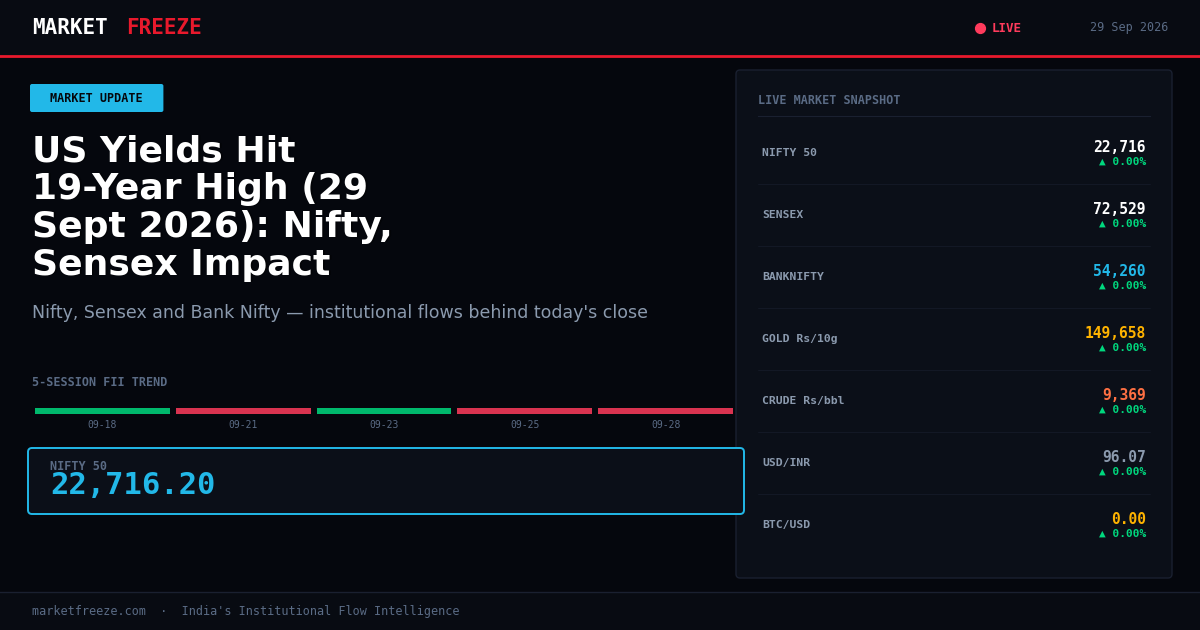
US Treasury yields surging above 5.2% on September 29, 2026, triggered significant FII selling of ₹5,353.22 Cr, pushing the Nifty 50 to a six-month low of 22,716.20.
US Yield Spike Drives FII Exodus, Nifty Tests Six-Month Lows
The Indian equity markets faced renewed selling pressure on September 29, 2026, as rising US Treasury yields above the 5.2% mark lured away foreign institutional investors (FIIs). This global macroeconomic shift, driven by expectations of persistent inflation and a hawkish stance from the US Federal Reserve, directly translated into a substantial net sell of ₹5,353.22 Cr by FIIs. This outflow, the largest in the last three sessions, coincided with the Nifty 50 closing at 22,716.20, a level not seen in six months, underscoring the direct correlation between global fixed-income attractiveness and emerging market equity valuations. While the Sensex also dipped 0.33% to 72,529.00, the Nifty’s broader market representation bore the brunt of the FII sell-off.
Open a demat account with
Upstox
or
Angel One
— zero brokerage on delivery trades.
FII Outflow Accelerates Amidst Global Yield Surge
The narrative of FIIs exiting Indian equities was strongly reinforced on September 29, 2026. The net sell figure of ₹5,353.22 Cr stands in stark contrast to the net buy of ₹1,617.45 Cr recorded on September 23, 2026, indicating a sharp reversal in institutional sentiment within a week. This aggressive selling by foreign investors, seeking the safety and higher returns offered by US Treasuries yielding over 5.2%, directly pressured Indian indices. The recent trend shows a consistent FII sell-off over the past two sessions (September 28: ₹5,353.22 Cr sell; September 25: ₹3,693.93 Cr sell), a clear signal of capital flight driven by global monetary policy divergences. Domestic Institutional Investors (DIIs), however, continued their buying spree, albeit at a slightly moderated pace compared to the previous day, with a net buy of ₹5,189.02 Cr on September 29, 2026. This DII support, while significant, was insufficient to counter the FII selling pressure, leading to the overall market decline. The DII net buy on September 29, 2026, however, dwarfs the FII sell-off on September 23, 2026 (₹1,617.45 Cr), highlighting a persistent domestic buying interest that has provided a floor to the market to some extent.
Sectoral Repercussions: IT and Financials Under Pressure
The surge in US bond yields and subsequent FII outflows disproportionately impacted interest-rate sensitive sectors and those heavily reliant on foreign capital. The Information Technology (IT) sector, a significant recipient of FII investment, witnessed increased selling pressure. As global economic growth forecasts are tempered by higher borrowing costs, IT spending often sees a slowdown, making it a prime candidate for FII divestment. Concurrently, the Financial Services sector, particularly banks, felt the heat. While higher yields can sometimes benefit Net Interest Margins (NIMs) for banks, the broader market downturn and potential for increased Non-Performing Assets (NPAs) in a slower growth environment led to cautious institutional positioning. The Banking Index (Bank Nifty) closed down 0.39% at 54,260.00, reflecting this concern. Sectors less exposed to global capital flows, such as Consumer Staples and Pharmaceuticals, likely exhibited more resilience due to their domestic demand drivers, though they were not immune to the overall market sentiment. The sharp fall in Crude MCX by 7.37% to Rs9,369.00/bbl, however, could offer some relief to sectors like airlines and logistics, but the overarching impact of global yields dominated trading on September 29.
Nifty’s Technical Levels Shaped by Institutional Flows
The Nifty 50’s descent to 22,716.20 on September 29, 2026, brings it closer to levels where significant institutional buying has been observed in recent history. Based on the provided historical data, the Nifty witnessed buying interest around the 23,063.10 level on September 23, 2026, where FIIs were net buyers (+₹1,617.45 Cr) and DIIs also showed strong conviction (+₹2,341.46 Cr). This suggests that 23,000-23,100 could act as an immediate support zone if the market attempts a bounce. However, the persistent FII selling streak suggests that this support might be tested. Conversely, the recent selling pressure, particularly the large FII outflow on September 28 (₹5,353.22 Cr) and September 29 (₹5,353.22 Cr), indicates that immediate resistance levels are forming around 22,800-22,900. A decisive break above this resistance, supported by a reversal in FII flows, would be crucial for any sustained upward momentum. The Nifty closed at 22,716.20, indicating it has breached the previous session’s close of 22,780.25.
USD/INR Cross-Currents: A Weakening Rupee as a Consequence
The surge in US Treasury yields has a direct and often negative impact on emerging market currencies, and the Indian Rupee (USD/INR) is no exception. On September 29, 2026, the USD/INR pair moved up by 0.20% to close at Rs96.07. This depreciation of the Rupee is a direct consequence of the capital outflow from India as FIIs reallocate funds to higher-yielding US assets. A stronger dollar relative to the Rupee makes imported goods more expensive, potentially contributing to inflation, and simultaneously increases the cost for foreign investors to repatriate their earnings from India. The sustained FII selling trend observed over the last two sessions is a key driver for this weakening rupee. The difference between the current USD/INR of Rs96.07 and the rate on September 23, 2026 (approximately Rs95.75, assuming a similar trend preceding the provided data), indicates a clear depreciation, further exacerbated by the FII sell-off. This currency weakness can create a feedback loop, making Indian equities less attractive to foreign investors in the short to medium term.
Historical Parallel: The Impact of Global Yield Shocks
The current scenario echoes market conditions observed around mid-September 2026, specifically the week of September 18, 2026. On September 18, 2026, FIIs were net buyers of ₹599.54 Cr and DIIs bought ₹1,019.69 Cr, contributing to a Nifty close of 23,414.30. However, the subsequent sessions saw a shift. By September 25, 2026, FIIs turned net sellers to the tune of ₹3,693.93 Cr, coinciding with a Nifty decline to 23,140.50. This demonstrates how a rapid change in global risk appetite, often triggered by macroeconomic data or central bank policy hints, can swiftly reverse institutional flows. The current spike in US yields is a potent catalyst, mirroring the sensitivity of Indian markets to global interest rate movements seen in previous periods. The sharpest FII sell-off in the provided historical data occurred on September 28, 2026, with ₹5,353.22 Cr, which led to a significant drop in the Nifty to 22,780.25, setting the stage for today’s further decline.
Portfolio Strategy: Hedging Against Yield-Driven Volatility
In the face of rising global yields and persistent FII outflows, investors should consider a tactical portfolio adjustment focused on capital preservation and identifying resilient assets. A concrete framework would involve: 1) reducing exposure to high-beta, FII-heavy sectors like IT and Capital Goods by at least 10-15%, reallocating towards defensive sectors like FMCG and Pharmaceuticals where domestic consumption is the primary driver. 2) Increasing allocation to companies with strong balance sheets, low debt, and stable cash flows that are less susceptible to interest rate hikes. 3) For investors with a higher risk appetite, exploring debt instruments that offer attractive yields, potentially at par with or exceeding current equity market returns, especially if they are of shorter duration to mitigate reinvestment risk. 4) Ensuring that any currency exposure is adequately hedged, given the current Rupee depreciation trend. For instance, holding USD-denominated assets or using currency futures for hedging could be considered if the USD/INR breaches Rs96.50.
Key Levels to Watch
The Nifty 50 closed at 22,716.20 on September 29, 2026. Based on recent institutional flows, immediate support is seen around the 22,500 mark, a level that historically has seen buying interest during periods of significant dips, although the current trend of FII selling might challenge this. Resistance is now firmly placed around the 22,900-23,000 band, where selling pressure intensified as FIIs exited. A sustained move above 23,000 would require a significant reversal in FII sentiment and a stabilization of global yields. Conversely, a breach below 22,500 could open the path towards the 22,000-22,200 zone, especially if FII selling accelerates beyond the current ₹5,353.22 Cr daily average.
Frequently Asked Questions
- Q: What did FII buy or sell on September 28, 2026? A: FIIs were net sellers of ₹5,353.22 Cr on September 28, 2026.
- Q: What did DII buy on September 29, 2026? A: DIIs were net buyers of ₹5,189.02 Cr on September 29, 2026.
- Q: Is FII buying or selling in September 2026? A: In September 2026, FIIs have shown a predominantly selling trend in the latter half of the month, with significant net sales recorded on September 25 (₹3,693.93 Cr) and September 28 (₹5,353.22 Cr), indicating a shift away from Indian equities.
Historical FII/DII Flows
| Date | FII Net (Cr) | DII Net (Cr) | Nifty Close |
|---|---|---|---|
| 2026-09-18 | +₹599.54 Cr | +₹1,019.69 Cr | 23,414.30 |
| 2026-09-21 | ₹-576.20 Cr | +₹2,797.27 Cr | 23,329.00 |
| 2026-09-23 | +₹1,617.45 Cr | +₹2,341.46 Cr | 23,063.10 |
| 2026-09-25 | ₹-3,693.93 Cr | +₹2,838.17 Cr | 23,140.50 |
| 2026-09-28 | ₹-5,353.22 Cr | +₹5,189.02 Cr | 22,780.25 |
Bottom Line: The surge in US Treasury yields above 5.2% on September 29, 2026, directly correlates with a significant FII sell-off of ₹5,353.22 Cr, pushing the Nifty 50 to a six-month low of 22,716.20. While DIIs provided some support with a net buy of ₹5,189.02 Cr, it was insufficient to offset foreign outflows, impacting interest-rate sensitive sectors like IT and Financials. Investors should brace for continued volatility until global yield pressures subside or FII flows show a sustainable reversal, with 22,500 serving as the next key support level for the Nifty.
Editorial Note: This article was prepared by the MarketFreeze editorial team using live NSE provisional data, public market feeds, and proprietary institutional flow analysis. All price and flow figures are sourced directly from NSE, BSE, and CoinGecko as of 29 September 2026. This content is for informational purposes only and does not constitute investment advice. MarketFreeze is not SEBI-registered. Please consult a qualified financial advisor before making investment decisions. Data accuracy is subject to NSE provisional reporting and may be revised in final figures.