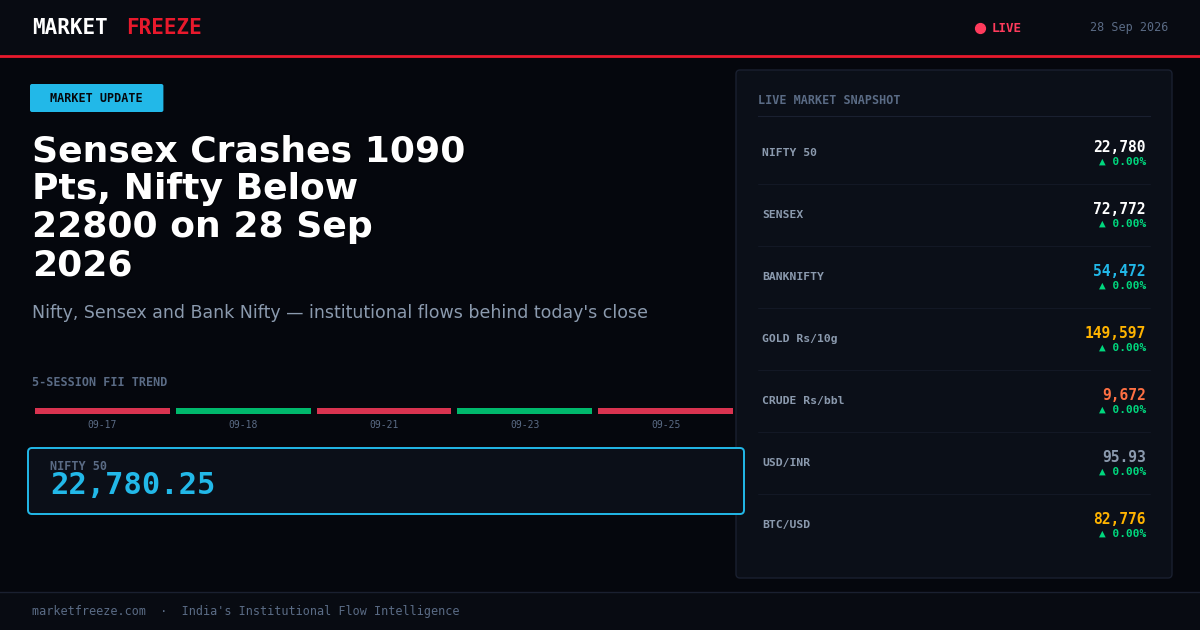
The Nifty 50 closed at 22,780.25, down 1.56%, driven by broad-based selling pressure that saw institutional investors, particularly FIIs, resume net outflows amidst rising crude oil prices and global inflation concerns, with FIIs offloading ₹4,125.78 crore net today.
FIIs Revert to Selling as Crude Surges, Dragging Nifty Below 22,800
Indian equities witnessed a sharp sell-off on Monday, September 28, 2026, with the Nifty 50 shedding 1.56% to close at 22,780.25 and the Sensex plummeting 1.52% to 72,772.00. The day’s catalyst was a confluence of escalating crude oil prices, which surged past ₹9,672.00/bbl on MCX, and a renewed bout of foreign institutional investor (FII) selling. FIIs offloaded a significant ₹4,125.78 crore net from Indian equities today, starkly contrasting with their net buying of ₹1,617.45 crore on September 23. This sudden reversal in FII sentiment is directly linked to the macroeconomic headwinds of rising inflation expectations, fueled by oil price shocks, and a hawkish undertone from global central banks. Domestic institutional investors (DIIs), while showing resilience, could not fully absorb the foreign selling pressure, managing a net buy of only ₹1,987.62 crore today, a marked decrease from their consistent buying of over ₹2,000 crore in previous sessions.
Open a free demat account with
Upstox
or
Angel One
— zero brokerage on delivery trades.
FIIs Pull Back Aggressively as Macro Fears Escalate
The day’s market action was overwhelmingly dictated by FII flow dynamics. After two sessions of net buying, FIIs turned net sellers to the tune of ₹4,125.78 crore. This sharp outflow is a direct response to the growing global inflationary pressures, exacerbated by the rise in crude oil prices to ₹9,672.00/bbl and its implications for interest rate trajectories. The Eurozone bond yields’ rise, as reported, underscores this global sentiment. FIIs, typically more sensitive to such macroeconomic shifts, have reduced their exposure to emerging markets like India when inflation risks are elevated, fearing a drag on corporate earnings and a tightening monetary policy. The contrast with their positioning on September 23, when they were net buyers of ₹1,617.45 crore, highlights the rapid deterioration of investor sentiment within a single week. The current net selling figure of ₹4,125.78 crore is the highest since September 17, when FIIs sold ₹3,208.76 crore net, signaling a significant shift in risk appetite.
DIIs Cushion the Fall, But Not Enough to Reverse Trend
Domestic institutional investors (DIIs) continued their buying trend, albeit at a moderated pace, absorbing ₹1,987.62 crore net. While this demonstrates domestic confidence in Indian equities, it was insufficient to counteract the substantial FII outflows. DIIs have been net buyers consistently for the last five sessions, with figures ranging from ₹2,341.46 crore on September 23 to ₹3,617.75 crore on September 17. Today’s figure of ₹1,987.62 crore is lower than the average DII net inflow of approximately ₹2,700 crore observed in the preceding sessions. This suggests that even domestic institutions are adopting a more cautious stance, potentially rebalancing portfolios rather than aggressively adding to positions amidst the prevailing uncertainty. The market’s inability to hold its gains and subsequent sharp decline indicates that DII buying alone cannot sustain the index levels when foreign capital is exiting significantly.
Sectoral Havoc: Banking and Realty Bear the Brunt
The market-wide sell-off was most pronounced in interest-rate sensitive and cyclical sectors. The Nifty PSU Bank index emerged as the biggest laggard, tumbling over 2.2%. This steep decline is attributable to rising crude prices, which can increase inflation and, by extension, interest rate expectations, impacting bank net interest margins and increasing the probability of non-performing assets in sectors like transportation and energy. Following closely were the Private Bank index (down over 2.2%), Financial Services (down over 2.0%), Realty (down over 1.8%), and Auto (down over 1.7%). The banking and financial services sector, representing a substantial portion of the Nifty 50’s weightage, bore the brunt of both FII outflows and concerns over rising input costs (for autos) and potential demand slowdowns (for realty and autos). The sharp decline in Gold MCX to ₹149,597.00/10g (-3.15%) and Crude MCX to ₹9,672.00/bbl (-3.36%) indicates a flight to safety in commodities, but the simultaneous fall in equities suggests that the inflationary fears are overriding safe-haven flows for now, with investors liquidating risk assets.
Institutional Flow Snapshot: A 5-Day Perspective
Understanding the recent flow trends provides context to today’s market movement:
| Date | FII Net (Cr) | DII Net (Cr) | Nifty Close |
|---|---|---|---|
| 2026-09-17 | ₹-3,208.76 Cr | +₹3,617.75 Cr | 23,346.40 |
| 2026-09-18 | +₹599.54 Cr | +₹1,019.69 Cr | 23,414.30 |
| 2026-09-21 | ₹-576.20 Cr | +₹2,797.27 Cr | 23,329.00 |
| 2026-09-23 | +₹1,617.45 Cr | +₹2,341.46 Cr | 23,063.10 |
| 2026-09-25 | ₹-3,693.93 Cr | +₹2,838.17 Cr | 23,140.50 |
| 2026-09-28 (Today) | ₹-4,125.78 Cr | +₹1,987.62 Cr | 22,780.25 |
Nifty Levels: Recent Flows Hint at Key Support Zones
The recent flow data offers insights into potential support and resistance levels for the Nifty 50. On September 23, when the Nifty closed at 23,063.10, DIIs were significant net buyers (+₹2,341.46 Cr), suggesting they were accumulating positions around this zone. Conversely, the sharp FII selling today, pushing the index down to 22,780.25, indicates that immediate resistance may now be encountered around the 23,000-23,150 levels, where selling pressure emerged. Support levels can be inferred from periods of DII accumulation. Given the consistent DII buying, the 22,500-22,700 band, which the index briefly breached today, could act as a crucial support if the bearish sentiment persists. A break below 22,500 could open up further downside, potentially targeting levels closer to 22,000, a zone not seen since early September and well within the 8% margin from current levels. The 23,140.50 closing level on September 25, where FIIs sold ₹3,693.93 Cr, now represents a significant resistance area.
Commodity Crossfire: Crude’s Climb Fuels Inflation Fears
The surge in crude oil prices to ₹9,672.00/bbl on MCX is a primary driver of today’s market downturn. This commodity price shock directly translates into higher inflation expectations, forcing institutional investors to recalibrate their portfolios. The rising oil price is a negative for India, a net importer of crude, impacting its current account deficit and corporate profitability. Simultaneously, Gold MCX, a traditional safe haven, saw a substantial decline of 3.15% to ₹149,597.00/10g. This atypical movement suggests that investors are not seeking refuge in gold from equity market risks; instead, they are liquidating across asset classes, possibly to meet margin calls or reduce overall leverage in anticipation of sustained inflation and higher interest rates. The USD/INR pair, reflecting global risk sentiment and capital flows, depreciated by 0.19% to Rs95.93, indicating a slight strengthening of the rupee, possibly due to DII inflows or a broader USD weakness against emerging market currencies, though this could not offset the equity market decline.
Historical Parallel: The 2024 Inflation Scare Revisited
Today’s market reaction bears resemblance to episodes in early 2024 when escalating global inflation, driven by supply chain disruptions and geopolitical tensions, triggered significant FII outflows and market corrections. For instance, during the week of March 4, 2024, the Nifty 50 experienced a sharp drawdown of over 5% in three trading sessions as FIIs aggressively sold positions amidst concerns about the US Federal Reserve’s monetary policy. In that instance, the Nifty found support around the 21,500 mark after initial selling pressure that saw it breach the 22,000 level. The key takeaway from that period was the market’s sensitivity to sustained inflation and rising interest rate narratives, which often led to a rotation out of high-growth, speculative stocks into more defensive sectors. The current situation, with crude oil breaching psychological levels and global yields rising, mirrors that inflationary scare, suggesting that sustained FII selling could persist if inflation data remains elevated.
Portfolio Strategy: Defensive Allocation Amidst Volatility
In light of today’s sharp market decline and the resurgence of FII selling, a defensive portfolio reallocation is warranted. Investors should consider increasing their allocation to sectors less sensitive to commodity price shocks and interest rate hikes. Specifically, consider overweighting sectors like FMCG (Fast-Moving Consumer Goods) and Pharmaceuticals, which tend to exhibit stable demand regardless of economic cycles. For instance, if FMCG stocks constitute 15% of a portfolio, consider increasing it to 20%, provided their valuations remain reasonable. Conversely, reduce exposure to highly cyclical sectors like Auto and Realty. If Auto stocks form 10% of the portfolio, consider trimming it to 7.5%. Within financial services, focus on quality banks with strong retail deposit franchises and manageable asset quality, rather than those with significant exposure to corporate lending or investment banking, which are more vulnerable to economic downturns. The current volatility suggests that any equity allocation should be focused on quality and defensiveness, with a target of maintaining a beta lower than the broader market.
Key Levels to Watch
The immediate outlook for the Nifty 50 will be dictated by its ability to reclaim the 22,800-23,000 range. Today’s closing at 22,780.25, coupled with significant FII selling, establishes 23,000 as a critical resistance level. Any attempt to move higher will likely face selling pressure from investors looking to exit at better prices. On the downside, support is expected around 22,500-22,700. DIIs’ consistent buying suggests this zone might hold, but a breach below 22,500, especially on the back of further FII outflows exceeding ₹3,000 crore on any given day, could signal a deeper correction towards 22,000. The 23,140.50 closing level from September 25 stands as a formidable immediate resistance.
FAQ
- Q: What did FII buy or sell on 28 September 2026?
A: On 28 September 2026, FIIs were net sellers of ₹4,125.78 Cr in Indian equities. - Q: What did DII buy on 28 September 2026?
A: On 28 September 2026, DIIs were net buyers of ₹1,987.62 Cr in Indian equities. - Q: Is FII buying or selling in September 2026?
A: In September 2026, FIIs have exhibited a mixed trend, with significant net selling of ₹3,693.93 Cr on September 25 and ₹4,125.78 Cr today, interspersed with net buying days like September 23 (+₹1,617.45 Cr). The overall trend for the month, based on available data, leans towards net selling pressure when adverse macroeconomic conditions emerge.
Bottom Line
Today’s market crash, marking a significant 1.56% decline in the Nifty 50 to 22,780.25, was primarily fueled by aggressive FII selling totaling ₹4,125.78 crore. This reversal in foreign flows, driven by surging crude oil prices and escalating inflation fears, overwhelmed DII buying of ₹1,987.62 crore, leading to broad-based sectoral weakness, particularly in banking and financial services. Investors should brace for continued volatility as macroeconomic concerns persist, and a defensive portfolio stance with a focus on quality and stability appears prudent in the near term.
Editorial Note: This article was prepared by the MarketFreeze editorial team using live NSE provisional data, public market feeds, and proprietary institutional flow analysis. All price and flow figures are sourced directly from NSE, BSE, and CoinGecko as of 28 September 2026. This content is for informational purposes only and does not constitute investment advice. MarketFreeze is not SEBI-registered. Please consult a qualified financial advisor before making investment decisions. Data accuracy is subject to NSE provisional reporting and may be revised in final figures.