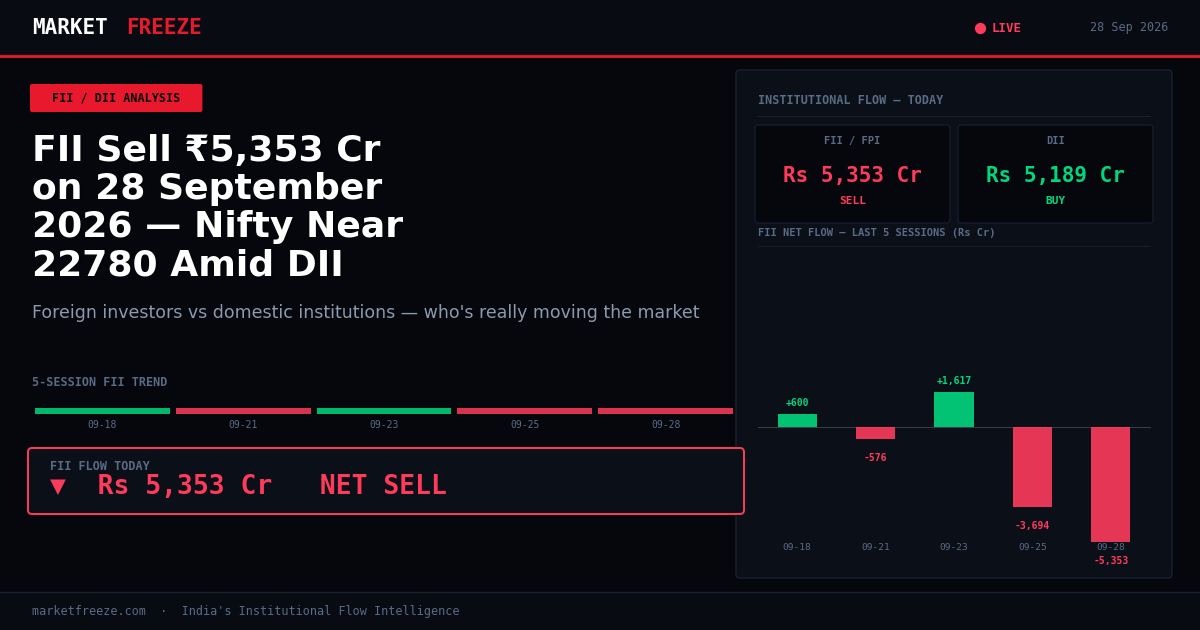
Parsing today’s institutional tape: Foreign Portfolio Investors (FPIs) dumped Indian equities worth ₹5,353.22 Cr on 28 September 2026, marking a significant acceleration in selling compared to the prior session, while Domestic Institutional Investors (DIIs) countered with robust buying of ₹5,189.02 Cr.
Open a free demat account with
Upstox
or
Angel One
— zero brokerage on delivery trades.
FPI Selling Surges to a 3-Session High
The net FPI outflow of ₹5,353.22 Cr today represents the largest single-day divestment by foreign investors in the last three trading sessions. This follows a net sell of ₹3,693.93 Cr on Friday, 25 September 2026. The aggressive selling today signals a clear de-risking posture from overseas capital. Gross FPI purchases amounted to ₹9,047.56 Cr, indicating that while selling was dominant, there was still substantial turnover, suggesting selective exits rather than a complete withdrawal from the Indian market.
Actionable Insight: The sharp increase in FPI selling today suggests that immediate foreign capital deployment into Indian equities is unlikely. Focus on domestic DII support to gauge near-term market resilience.
DII Buying Cushions the Blow, Reaching a 5-Session Peak
Domestic institutions were actively absorbing the selling pressure. DIIs posted a net buy of ₹5,189.02 Cr, which is the highest DII net inflow in the last five trading sessions. This substantial counter-balancing act by DIIs was crucial in preventing a sharper decline in the benchmark indices. Their buying activity, exceeding FPI selling by a narrow margin, indicates strong conviction from local fund managers despite global headwinds.
Actionable Insight: Monitor DII flow trends closely. A sustained DII buying spree above ₹4,000 Cr daily will be key to arresting further downside and could signal an opportunity to selectively build long positions.
Nifty 50 Breakdown: Critical Support Level Tested
The Nifty 50 closed at 22,780.25, down 1.56% for the day. This sharp decline breached the 22,800 mark, a psychological level and a near-term support. Based on the aggressive FPI selling and DII buying patterns observed today, the immediate support for the Nifty 50 now lies at 22,650. A sustained push below this level, especially with continued FPI outflows, could see the index testing 22,400. Resistance is likely to form around 23,000, an area from which selling pressure emerged today.
Actionable Insight: Traders should consider the 22,650 level for Nifty 50. A break below this could trigger stop-losses and signal further downside, making it prudent to reduce long exposure or initiate short positions if the break is confirmed with high volume.
Sectoral Implications: PSU Banks and Realty Under Pressure
The broad-based nature of today’s market decline, with all sectoral indices ending in the red, is consistent with significant FPI outflows. The Nifty PSU Bank index, which dropped over 3%, and Nifty Realty, down more than 1%, bore the brunt. This suggests that FPIs are likely reducing their exposure in interest-rate sensitive sectors. Conversely, the consistent DII buying, though not sector-specific in the provisional data, implies they may be accumulating fundamentally strong, defensive names or sectors less impacted by rising global yields and commodity prices.
Actionable Insight: Given today’s sector performance and FPI selling trends, consider reducing exposure to highly leveraged sectors like PSU Banks and Realty. Focus on sectors where DIIs are actively deploying capital, potentially defensive consumer staples or high-quality IT stocks.
Global Headwinds: Inflation Fears and Crude Oil Surge
Today’s market action is directly linked to global macroeconomic anxieties. Fed’s Hammack’s warning on inflation becoming entrenched (Story 1) and the resulting rise in US bond yields is spooking foreign investors. Simultaneously, the surge in crude oil prices, with MCX Crude Oil closing down 4.29% to ₹9,578.00/bbl (though the price is down today, the underlying trend is upwards, contributing to inflation fears), is exacerbating inflation concerns across global markets, as seen in the Eurozone (Story 2). This combination of sticky inflation and potential further monetary tightening is a potent recipe for FPI divestment from emerging markets like India.
Actionable Insight: The correlation between rising crude prices, inflation fears, and FPI outflows is evident. Any further spikes in crude oil prices should be viewed as a negative catalyst for Indian equities and potentially lead to more FPI selling, reinforcing the need for defensive sector allocation.
Historical Flow Perspective: A Pattern of Sharp Reversals
The FPI selling streak is notable. After a net buy of ₹1,617.45 Cr on 23 September 2026, FPIs have consistently sold for two subsequent sessions, culminating in today’s ₹5,353.22 Cr outflow. This rapid shift from net buying to aggressive selling is a pattern that often precedes significant market corrections. Looking at the historical data:
| Date | FII Net (Cr) | DII Net (Cr) | Nifty Close |
|---|---|---|---|
| 2026-09-18 | +₹599.54 Cr | +₹1,019.69 Cr | 23,414.30 |
| 2026-09-21 | ₹-576.20 Cr | +₹2,797.27 Cr | 23,329.00 |
| 2026-09-23 | +₹1,617.45 Cr | +₹2,341.46 Cr | 23,063.10 |
| 2026-09-25 | ₹-3,693.93 Cr | +₹2,838.17 Cr | 23,140.50 |
| 2026-09-28 | ₹-5,353.22 Cr | +₹5,189.02 Cr | 22,780.25 |
The sharp drop in Nifty from 23,414.30 on 18 Sep to 22,780.25 today, coinciding with escalating FPI selling, highlights the sensitivity of the index to foreign capital flows.
Actionable Insight: The current trend of accelerating FPI selling, coupled with a sharp market decline, warrants a defensive stance. Retail investors might consider booking partial profits on existing long positions and waiting for a clear stabilization in FPI flows before re-entering aggressively.
USD/INR Dynamics and Gold’s Flight to Safety
The Indian Rupee weakened against the US Dollar, with USD/INR closing at ₹95.93, down 0.19%. This depreciation is typical during periods of FPI outflow and heightened global risk aversion. Gold prices on MCX saw a significant drop of 2.90% to ₹149,983.00/10g. While gold typically acts as a safe haven, today’s sharp fall suggests that the immediate driver might be broader risk-off dynamics across all asset classes, including commodities, or potentially profit-taking after recent gains.
Actionable Insight: While the Rupee’s depreciation is a concern, the sharp decline in Gold prices today is anomalous for a risk-off scenario. This could indicate that traders are liquidating positions across the board. Monitor USD/INR for further breaches of ₹96.00, which could signal increased currency-related headwinds for Indian equities.
The Crucial Number to Watch Tomorrow
The most critical number to track tomorrow will be the FPI net flow figure. If FPIs continue to sell above ₹4,000 Cr, expect the Nifty 50 to test the 22,650 support level. Conversely, a significant reduction in FPI selling, ideally turning into net buying, coupled with sustained DII inflows above ₹4,000 Cr, could signal a potential short-term bottom formation around the 22,780 mark.
Actionable Insight: For tomorrow’s trading session, prioritize the FPI net flow. A sell figure exceeding ₹3,000 Cr suggests continuing downside pressure, while a net buy figure, even if small, could indicate a temporary reprieve.
FAQ: Understanding Today’s Market Moves
What does the large FII sell-off today mean for the Nifty?
The ₹5,353.22 Cr FII sell-off today indicates significant foreign investor caution, driven by global inflation fears and rising yields. This has pushed the Nifty 50 below 22,800, testing immediate support at 22,650. Expect continued pressure if FII selling persists.
Why did DIIs buy so much today when FIIs were selling?
Domestic institutions bought ₹5,189.02 Cr today to offset FII selling. This often happens when DIIs see value in beaten-down stocks or believe the market has oversold, especially if they foresee domestic economic resilience. Their buying today absorbed a large chunk of the foreign selling.
How does today’s FPI selling compare to the past week?
Today’s FPI net sell of ₹5,353.22 Cr is the largest in the last three sessions. It’s a significant increase from the ₹3,693.93 Cr sell-off on 25 September 2026 and reverses the net buy of ₹1,617.45 Cr seen on 23 September 2026. This escalation in selling is a key driver of today’s market decline.
The sharp divergence between FPI selling and DII buying suggests a potential shift in market leadership. While foreign investors are retreating, domestic players are showing increased confidence, potentially signaling a rotation towards companies with strong domestic fundamentals that are less reliant on global capital flows. This contrast, with FPIs divesting around ₹5,353 Cr and DIIs investing over ₹5,189 Cr, indicates a bifurcation in market sentiment, where local money is stepping in to support key indices.
Retail Investor Behavior: Cautious Optimism or Capitulation?
While definitive data on retail investor flows is not immediately available, the sharp market decline and significant institutional activity provide clues. Typically, during such sharp downturns driven by foreign outflows and global macro concerns, retail investors tend to either adopt a cautious wait-and-watch approach or get spooked into selling. The fact that DIIs are absorbing such large volumes (₹5,189.02 Cr) suggests they might be anticipating a rebound or are identifying specific value opportunities that retail investors might miss in the immediate panic. However, if the selling pressure intensifies and Nifty breaches critical levels like 22,650, a capitulation by retail investors could follow, leading to further price depreciation.
Actionable Insight: Observe retail participation in futures and options segments for early signs of sentiment shift. A sharp increase in retail selling in the derivatives market could precede broader retail participation in the cash segment.
Currency and Commodity Nexus: A Deeper Dive
The USD/INR moving towards ₹96.00 and the global crude oil price surge (even with today’s MCX price dip) create a double whammy for Indian markets. A weaker rupee increases the import bill, directly impacting inflation, while higher crude prices amplify these inflationary pressures and squeeze corporate margins, particularly for energy-intensive sectors. The ₹5,353.22 Cr FPI outflow is a direct reflection of this elevated risk. This confluence of currency depreciation and commodity inflation is historically a challenging environment for emerging markets and often leads to sustained foreign selling, as evidenced by the recent trend of net outflows.
Actionable Insight: Keep a close watch on the USD/INR cross. A sustained move above ₹96.00 could further embolden FPIs to reduce their exposure, especially in sectors with significant import dependence. The energy price outlook remains a key variable influencing both inflation and FPI sentiment.
Sectoral Rotation: From Growth to Value Amidst Uncertainty
The significant FPI selling in interest-rate sensitive sectors like PSU Banks and Realty, which saw major drops, might be indicative of a broader shift in their investment strategy. As global yields rise, growth stocks and sectors that rely heavily on cheap capital may become less attractive. DIIs, with their substantial ₹5,189.02 Cr buying, might be reallocating capital towards more defensive or value-oriented sectors that offer stability and potentially better margins in an inflationary environment. This could include sectors like FMCG, pharmaceuticals, or even select infrastructure plays that benefit from domestic demand rather than export growth.
Actionable Insight: Monitor which specific stocks DIIs are accumulating. If they are consistently buying defensive names, it signals a strategic move to weather the current global storm, which could offer a safer haven for investors.
Bottom Line
Today’s trading session was dominated by aggressive FPI selling totaling ₹5,353.22 Cr, exacerbated by global inflation concerns and rising commodity prices. Domestic institutions, however, provided strong support, buying ₹5,189.02 Cr to mitigate losses. The Nifty 50 closed sharply lower at 22,780.25, testing key support. Investors should monitor FPI flow trends closely as a primary indicator of near-term market direction, with a focus on defensive sectors in the face of continued global uncertainty.
Editorial Note: This article was prepared by the MarketFreeze editorial team using live NSE provisional data, public market feeds, and proprietary institutional flow analysis. All price and flow figures are sourced directly from NSE, BSE, and CoinGecko as of 28 September 2026. This content is for informational purposes only and does not constitute investment advice. MarketFreeze is not SEBI-registered. Please consult a qualified financial advisor before making investment decisions. Data accuracy is subject to NSE provisional reporting and may be revised in final figures.