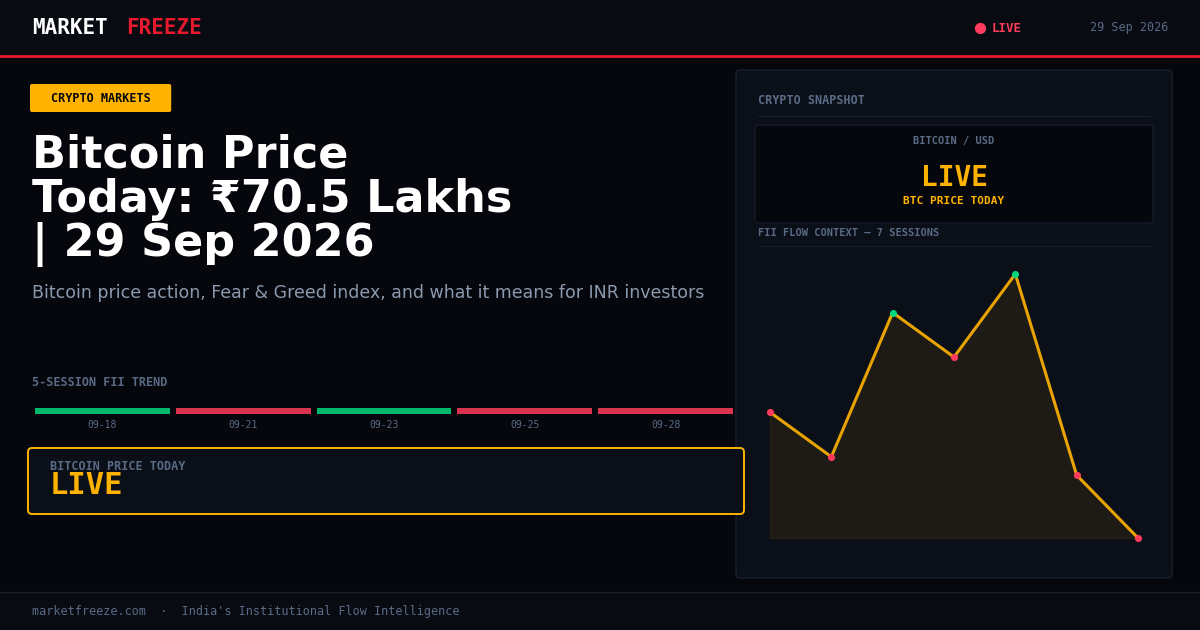
Bitcoin is trading at $84,230 USD, equivalent to ₹8,091,976 INR, with no significant price movement in the last 24 hours. This stability comes as headlines suggest a potential surge towards $100,000, underscoring a bullish outlook for the digital asset. The broader crypto market is experiencing a “Greed” sentiment, with the Fear & Greed index at 73/100, a level that historically precedes short-term corrections.
Open a free demat account with
Upstox
or
Angel One
— zero brokerage on delivery trades.
Bitcoin’s Ascent and the $100,000 Horizon
The latest narrative in the crypto sphere is the potential for Bitcoin to breach the $100,000 USD mark. Today’s steady price action at $84,230 USD (₹8,091,976 INR) provides a stable base for this ambitious target. This price point is significant as it represents a new high ground, and with the daily change at a flat 0.00%, it suggests consolidation rather than any immediate pullback. The news surrounding Bitcoin beating gold in recent performance further bolsters this bullish sentiment, indicating a structural shift in investor preference towards digital assets as a store of value. This narrative is particularly compelling for Indian retail investors who are increasingly seeking alternatives to traditional assets, especially in the face of a fluctuating INR. The current price level, while already high, is being interpreted by many as a launchpad for further gains, with anticipation building for the next major upward move. The sustained interest, coupled with positive analyst outlooks, suggests that the current $84,230 level is not a ceiling but a platform for future growth. The ETF inflows, reported at $30 million USD, also serve as a tangible indicator of institutional demand, reinforcing the belief that significant capital is flowing into Bitcoin, driving its value upwards.
The Impact of USD/INR on Indian Crypto Portfolios
For Indian investors, the movement of the USD/INR exchange rate is a critical factor influencing the actual returns on their crypto holdings. Today, the USD/INR is trading at ₹96.07. This means that while Bitcoin remains stable in USD terms, its INR value is directly tied to this exchange rate. If the INR depreciates against the USD, Indian investors would see their INR-denominated crypto values rise, even if the USD price remains unchanged. Conversely, an INR appreciation would lead to a decrease in the INR value of their crypto assets. Given Bitcoin’s current price of $84,230 USD (₹8,091,976 INR), even a minor fluctuation in the USD/INR can translate into significant gains or losses in absolute INR terms. For instance, a 1% depreciation in the INR would increase the INR value of Bitcoin by approximately ₹80,919 INR, assuming the USD price stays constant. This currency volatility underscores the importance of considering the USD/INR rate when evaluating the performance of crypto investments in India. It also highlights how a strong INR can act as a headwind for crypto returns, while a weakening INR can provide a tailwind, amplifying gains. The current INR 96.07 level is a key determinant for how much Indian investors truly gain or lose on their crypto, independent of global price action.
Ethereum’s Performance and Inter-Crypto Dynamics
Ethereum is currently priced at $2,731 USD, or ₹262,432 INR, mirroring Bitcoin’s 0.00% change over the past 24 hours. The ETH/BTC ratio stands at 0.0324, indicating that Bitcoin is holding its ground more firmly than Ethereum today. While this ratio is not experiencing a dramatic shift, it suggests a slight preference for Bitcoin’s stability within the top-tier cryptocurrencies. The broader DeFi sector, however, shows some independent strength, with Aave leading a significant rally, jumping 11%. This independent upward movement in specific DeFi tokens, even as yields on traditional bonds remain elevated at 5.234% for the 10-year Treasury, points to speculative interest driving certain segments of the crypto market. The news of Aave’s potential token burn is fueling this specific surge, demonstrating how token-specific catalysts can override general market trends. For Indian investors, understanding these nuances is crucial. While the headline figures for BTC and ETH might appear flat, pockets of significant activity exist within the altcoin and DeFi spaces. The ETH/BTC ratio, though stable today, remains a vital indicator of relative strength between the two largest cryptocurrencies, and any notable divergence would warrant closer attention.
Altcoin Activity and Solana’s Trajectory
Solana is currently trading at $121.02 USD, or ₹11,626 INR, and has shown relative strength with a +1.08% gain in the last 24 hours. This outperformance against Bitcoin and Ethereum, which are flat, highlights the potential for altcoins to lead the market during periods of consolidation or specific positive news. While there isn’t a prominent overarching news story for altcoins today, Solana’s upward move suggests underlying demand or positive sentiment for this specific blockchain. The broader altcoin market, as indicated by Aave’s strong performance, is demonstrating resilience and selective upward momentum. This is important for Indian investors who might be looking to diversify beyond Bitcoin and Ethereum. The ability of altcoins like Solana to gain ground when the majors are stagnant indicates that there are opportunities for higher returns, albeit with potentially higher risk. The continued development in the DeFi space, as evidenced by Aave’s gains, suggests that innovation and specific utility are driving value in these newer digital assets. Investors should monitor these individual altcoin narratives closely, as they can present distinct opportunities separate from the broader crypto trends.
Navigating Elevated ‘Greed’ and Potential Market Shifts
The crypto market is currently enveloped in a state of “Greed,” as indicated by the Fear & Greed index reading of 73/100. This level of exuberance has historical implications for short-term market movements. According to the provided context, readings above 60 have often preceded corrections ranging from 5% to 15% within a 2 to 4-week timeframe. While this is a cautionary signal, it’s important to note that during exceptionally strong bull cycles, such as the 2020-2021 period, greed levels have sustained above 75 for extended periods. The current reading suggests that the market may be becoming overheated, increasing the probability of a near-term pullback. For Indian retail investors, this presents a dual challenge: capitalizing on the ongoing bullish momentum while also preparing for a potential downturn. It is crucial to implement risk management strategies, such as setting stop-losses or gradually taking profits, rather than getting caught up in the euphoria. The sustained “Greed” reading, while indicating positive sentiment, also serves as a yellow flag, prompting a cautious approach to new entries and an evaluation of existing positions. The historical context suggests that such high greed levels are not sustainable indefinitely and are often followed by periods of price consolidation or decline.
FII Flows and the Capital Allocation Conundrum
Today’s Foreign Institutional Investor (FII) net flow in Indian equities stands at ₹0 Cr. This lack of significant net buying or selling activity from FIIs in the Indian equity market presents an interesting backdrop when considering capital allocation towards digital assets. Historically, when FIIs are net buyers in equities, it often signifies a broader risk-on sentiment that can spill over into other asset classes, including cryptocurrencies. Conversely, when FII flows are muted or negative, it can indicate a cautious approach from international institutions towards Indian markets. While there is no direct correlation, large-scale shifts in FII behavior can influence overall market liquidity and investor sentiment, which indirectly affects the crypto market. For Indian investors, understanding this dynamic is key. If FIIs are pulling back from Indian equities, it could suggest a more risk-averse global environment, which might also dampen enthusiasm for speculative assets like cryptocurrencies. Conversely, if FIIs were to turn into significant net buyers, it could signal a more optimistic outlook that might benefit riskier assets. Today’s flat ₹0 Cr flow means FII sentiment towards Indian equities is neutral, offering no clear directional signal for broader risk asset flows. This lack of clear FII direction implies that crypto market movements today are likely driven more by internal crypto market dynamics and global crypto-specific news rather than a strong push or pull from Indian equity FII flows.
Crypto Tax Mechanics: A Practical Illustration
Let’s illustrate the implications of India’s crypto tax regulations with a practical scenario. Suppose an Indian investor decided to sell a portion of their Bitcoin holdings today, at the current price of ₹8,091,976 INR per BTC. If this investor had purchased Bitcoin at ₹4,045,988 INR (assuming a purchase price of $42,115 USD when USD/INR was ₹96.07), the profit on this sale would be ₹4,045,988 INR. Under Indian tax law, this profit from the sale of Virtual Digital Assets (VDAs) is taxed at a flat rate of 30%, plus applicable surcharges and cess. Therefore, the tax liability on this single transaction would be 30% of ₹4,045,988 INR, which amounts to ₹1,213,796.4 INR. This tax is levied irrespective of whether the investor makes a profit or loss on other crypto assets or in other transactions during the financial year. Furthermore, losses from the sale of one VDA cannot be set off against the profit from another VDA, nor can they be carried forward to future years. This means that if the investor had sold another asset at a loss, that loss could not reduce the taxable profit from this Bitcoin sale. The tax is calculated on the gross profit from each transaction. This example highlights the significant tax burden associated with crypto trading in India and the importance of meticulous record-keeping and tax planning. For investors actively trading Bitcoin at $84,230 USD (₹8,091,976 INR), understanding these tax implications is paramount to avoid unforeseen liabilities.
Actionable Framework: Navigating the Greed Zone
Given the current “Greed” reading of 73/100 and Bitcoin’s steady price at $84,230 USD (₹8,091,976 INR), Indian retail investors should consider the following actionable framework:
- Profit-Taking Strategy: If holding Bitcoin acquired at significantly lower prices, consider booking partial profits. A 5-10% gain from current levels might trigger a sell order for a portion of the holdings. For example, if holding BTC bought at $75,000 USD (₹7,207,500 INR), a sell order could be placed at $82,500 USD (₹7,928,250 INR) to secure gains.
- Set Entry Points for New Capital: For those looking to deploy fresh capital, wait for minor pullbacks. A support level around $79,000 USD (₹7,592,000 INR) could be an attractive entry point, especially if accompanied by a decrease in the Fear & Greed index below 65.
- Monitor ETH/BTC Ratio for Rotation Signals: While currently stable at 0.0324, any significant shift in the ETH/BTC ratio to favor ETH could indicate a rotation towards more speculative altcoins. Conversely, a BTC dominance increase might signal a flight to safety within the crypto market.
- Review Altcoin Holdings: Evaluate altcoins like Solana ($121.02 USD | ₹11,626 INR) that are showing relative strength. Consider trimming positions if they have significantly outperformed recent gains, to reallocate to more stable assets or take profits.
- Dollar-Cost Averaging (DCA) for Long-Term:** For long-term investors, continue with DCA strategies, investing fixed amounts at regular intervals regardless of price. This method helps average out entry costs and mitigate the risk of buying at a market peak.
Key Levels to Watch
The Nifty closed at 22716.2. Based on the recent FII outflows and the overall market sentiment, key levels to watch are:
- Support: The immediate support for the Nifty is expected around the 22,500 mark. A breach below this level, especially with continued FII selling pressure, could signal further downside.
- Resistance: The 22,800-23,000 range is acting as a resistance zone. A decisive move above 23,000 would require a significant shift in institutional flows, likely turning FIIs back into net buyers.
Frequently Asked Questions
Q: What did FII buy or sell on 2026-09-28?
A: FIIs were net sellers of ₹-5,353.22 Cr in Indian equities on 2026-09-28.
Q: What did DII buy on 2026-09-28?
A: Domestic Institutional Investors (DIIs) were net buyers of ₹5,189.02 Cr in Indian equities on 2026-09-28.
Q: Is FII buying or selling in September 2026?
A: FII flows in September 2026 have shown volatility, with significant selling observed on certain days. The net flows for the last five recorded sessions indicate a mixed trend, with substantial selling on 2026-09-25 (₹-3,693.93 Cr) and 2026-09-28 (₹-5,353.22 Cr), interspersed with buying activity earlier in the month.
FII/DII Flows Table (Last 5 Sessions)
| Date | FII Net (Cr) | DII Net (Cr) | Nifty Close |
|---|---|---|---|
| 2026-09-18 | +₹599.54 Cr | +₹1,019.69 Cr | 23,414.30 |
| 2026-09-21 | ₹-576.20 Cr | +₹2,797.27 Cr | 23,329.00 |
| 2026-09-23 | +₹1,617.45 Cr | +₹2,341.46 Cr | 23,063.10 |
| 2026-09-25 | ₹-3,693.93 Cr | +₹2,838.17 Cr | 23,140.50 |
| 2026-09-28 | ₹-5,353.22 Cr | +₹5,189.02 Cr | 22,716.20 |
Bottom Line
Bitcoin holds steady at $84,230 USD (₹8,091,976 INR) amidst optimistic projections of reaching $100,000. The market’s “Greed” sentiment at 73/100 signals caution, with historical data suggesting potential short-term corrections. While FIIs show net neutrality in Indian equities today (₹0 Cr), their recent selling trends warrant attention for broader capital flow insights. Indian investors must remain vigilant of USD/INR fluctuations, which significantly impact their actual INR returns, and consider tax implications on crypto transactions, which are taxed at a flat 30%.
Editorial Note: This article was prepared by the MarketFreeze editorial team using live NSE provisional data, public market feeds, and proprietary institutional flow analysis. All price and flow figures are sourced directly from NSE, BSE, and CoinGecko as of 29 September 2026. This content is for informational purposes only and does not constitute investment advice. MarketFreeze is not SEBI-registered. Please consult a qualified financial advisor before making investment decisions. Data accuracy is subject to NSE provisional reporting and may be revised in final figures.