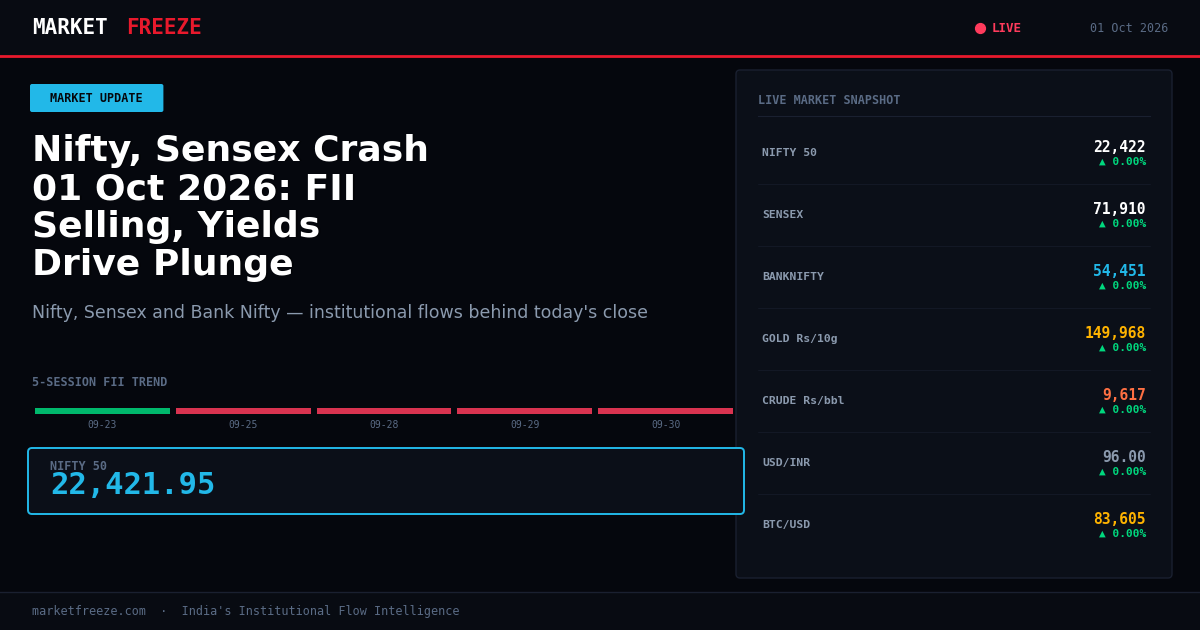
The persistent FII selling, which totaled ₹10,148.41 Cr on September 30th and contributed to the Nifty 50’s -0.88% decline today to 22,421.95, directly fueled the “stock market crash” narrative, extending India’s losing streak to four sessions.
FII Exodus Intensifies: A Direct Link to Today’s Market Plunge
Today’s significant market decline, with the Nifty 50 shedding -0.88% to close at 22,421.95 and the Sensex dropping -0.79% to 71,910.00, is unequivocally tied to the aggressive and sustained foreign institutional investor (FII) selling. The news headline explicitly cited “persistent FII selling” as a primary reason, a claim validated by the latest institutional flow data. For the third consecutive session, FIIs were net sellers, offloading a substantial ₹10,148.41 Cr on September 30th alone. This follows net sells of ₹9,980.22 Cr on September 29th and ₹5,353.22 Cr on September 28th. This cumulative outflow of over ₹25,000 Cr in just three trading sessions stands as the most direct and impactful catalyst for the current market downturn, overshadowing other factors like high bond yields and a weak rupee in terms of immediate market movement.
Domestic Institutional Investors (DIIs) have valiantly attempted to absorb this selling pressure, recording net buys of ₹11,271.73 Cr on September 30th, ₹6,952.71 Cr on September 29th, and ₹5,189.02 Cr on September 28th. Despite DIIs deploying over ₹23,000 Cr to counter the FII exit, the sheer magnitude of foreign selling has proven overwhelming, pushing the Nifty towards a potential eighth consecutive weekly decline, a phenomenon not witnessed since 2001. This imbalance in institutional firepower, with FIIs dominating the sell-side, confirms the news narrative that FII actions are indeed a leading cause of the current market fragility.
Open a free demat account with
Upstox
or
Angel One
— zero brokerage on delivery trades.
Bond Yields and Rupee Weakness: Magnifying FII Exit Pressure
While FII selling remains the primary driver, the confluence of rising US 10-year Treasury yields and a weakening Indian Rupee (USD/INR) has undeniably amplified the market’s negative reaction. The news highlights the US 10-year yield reaching a 24-year high, a critical factor making emerging markets like India less attractive for global capital. This yield surge pushes up the risk-free rate, compelling FIIs to reallocate funds from riskier assets in India to safer US government bonds, thus contributing to the ₹10,148.41 Cr FII outflow yesterday. Concurrently, the USD/INR exchange rate climbed to Rs96.0 today, marking a +0.28% increase. A weakening rupee erodes the returns for foreign investors when repatriating their capital, further incentivizing FIIs to exit Indian equities. This creates a negative feedback loop: FII selling weakens the rupee, which in turn makes further FII selling more probable.
The Bank Nifty, despite its relative resilience compared to broader indices, still shed -0.33% to close at 54,451.00. This underperformance, while less severe than the Nifty 50, reflects the broader financial sector’s sensitivity to rising bond yields and potential tightening monetary policy. Banks’ bond portfolios can face mark-to-market losses when yields rise, and higher interest rates can impact credit demand. The combination of FII selling, elevated US yields, and a depreciating rupee creates a formidable headwind for Indian equities, pushing the Nifty 50 to 22,421.95 and validating the multi-factor pressure outlined in today’s news.
Sectoral Vulnerability: IT and Financials Bear the Brunt of Outflows
The concentrated FII selling, particularly the ₹10,148.41 Cr recorded on September 30th, has exerted significant pressure across sectors, with Information Technology (IT) and Financials emerging as particularly vulnerable. IT stocks are highly sensitive to global risk-off sentiment and currency fluctuations. With the USD/INR at Rs96.0, while seemingly beneficial for export-oriented IT companies in the long run, the immediate impact of global capital flight often leads FIIs to liquidate their most liquid holdings first, which frequently includes large-cap IT counters. Furthermore, the rising US 10-year yield makes US-based investments more attractive, diverting capital that might otherwise flow into Indian IT firms.
The Financial Services sector, which includes major banking and non-banking financial companies, has also faced considerable pressure. Although the Bank Nifty saw a comparatively smaller decline of -0.33% to 54,451.00 today, the sector has been a consistent target for FII outflows during periods of rising bond yields and tightening monetary policy concerns. Higher interest rates increase borrowing costs for financial institutions and can lead to a rise in non-performing assets, impacting profitability. The substantial DII buying, including ₹11,271.73 Cr on September 30th, likely concentrated in these larger, more liquid sectors, has prevented an even steeper decline, but the underlying FII divestment signal remains strong for both IT and Financials.
Crude Oil Reversal: A Glimmer Amidst the Gloom?
In a rare divergence from the broad market pessimism, crude oil prices on MCX witnessed a significant decline today, dropping -3.24% to Rs9,617.00/bbl. The news catalyst specifically mentioned “rising crude oil prices” as a reason for the market plunge. However, today’s data presents a contrasting picture. This sudden dip in crude prices, if sustained, could offer a marginal reprieve for the Indian economy, which is a net importer of oil. Lower crude prices can alleviate inflationary pressures, reduce the import bill, and potentially ease the pressure on the Indian Rupee, which strengthened today to Rs96.0 despite the market downturn. While today’s market sell-off was driven by institutional outflows and global yield concerns, a continued softening in crude prices could somewhat mitigate the negative impact on corporate margins and consumer spending in the coming weeks. However, this alone is unlikely to reverse the current FII selling trend, which is more deeply rooted in global capital allocation shifts rather than commodity price movements. The FII net sell of ₹10,148.41 Cr on September 30th still heavily outweighs the positive implications of a single day’s crude price drop.
Historical Parallels: Echoes of 2001 and Sustained FII Selling
The market’s current trajectory, heading towards a potential eighth consecutive weekly decline, is a significant event, explicitly stated as the “first such streak since 2001.” This historical parallel is crucial for understanding the current FII behavior. During prolonged periods of global uncertainty or tightening monetary conditions, FIIs often undertake sustained exits from emerging markets. In 2001, global economic slowdowns and geopolitical events led to significant capital outflows from India. The current environment, characterized by a 24-year high in US 10-year yields, global monetary policy tightening, and a strong US Dollar, presents a similar backdrop where global liquidity seeks safer havens. The continuous FII net selling observed – ₹10,148.41 Cr on September 30th, ₹9,980.22 Cr on September 29th, and ₹5,353.22 Cr on September 28th – mirrors the kind of prolonged divestment seen in historical periods of extended market weakness. Unlike short-term profit booking, this sustained selling pattern suggests a structural shift in FII allocation away from Indian equities, driven by macro factors rather than isolated news events. DIIs, through their robust buying of ₹11,271.73 Cr yesterday, are attempting to cushion the fall, but the historical context suggests that such deep and consistent foreign outflows are difficult to counteract in the short term, leading to extended periods of consolidation or decline for the Nifty 50, which closed today at 22,421.95.
Key Levels to Watch: Nifty’s Immediate Support and Resistance
Given the persistent FII selling and the Nifty 50’s current close at 22,421.95, understanding critical support and resistance levels derived from recent institutional flow activity is paramount. The Nifty has seen significant institutional churn around the 22,620-22,700 zone. The Nifty closed at 22,620.45 on both September 29th and September 30th, despite FIIs selling ₹9,980.22 Cr and ₹10,148.41 Cr respectively, indicating strong DII support in this region (₹6,952.71 Cr and ₹11,271.73 Cr net buys). This suggests that the immediate resistance level for the Nifty 50 is around 22,700. A sustained break above this level, ideally on the back of FII buying reversing the trend, would signal a potential short-term recovery. Conversely, the significant selling pressure that pushed the Nifty from 23,140.50 on September 25th (when FIIs sold ₹3,693.93 Cr) down to today’s 22,421.95 indicates that the next critical support for the Nifty 50 lies around 22,300, a level where DIIs might step in more aggressively to defend. A decisive breach below 22,300, especially with continued FII outflows, could open the Nifty 50 to further declines towards 22,000, which would represent a -1.88% drop from current levels.
Portfolio Framework: Prioritizing Defensive and Value Plays
In the current environment of persistent FII selling (totaling over ₹25,000 Cr in the last three sessions) and a declining Nifty 50 (down to 22,421.95), investors should re-evaluate their portfolios with a focus on defensive sectors and value-oriented companies. A pragmatic portfolio framework would involve allocating a higher percentage (e.g., 30-40%) to sectors with stable earnings visibility and lower correlation to global macro headwinds. This includes sectors like Fast-Moving Consumer Goods (FMCG) and Pharmaceuticals, which tend to be more resilient during market downturns. These sectors are less impacted by fluctuating bond yields or the weakening rupee (currently at Rs96.0) compared to growth-oriented sectors. Furthermore, consider allocating 20-25% to high-dividend-yielding stocks, which provide a regular income stream and can cushion capital depreciation. For the remaining allocation, a selective approach to high-quality public sector undertakings (PSUs) or companies with strong domestic demand drivers could be beneficial. Avoid highly leveraged companies or those heavily reliant on foreign capital inflows for expansion. The current environment demands a shift from high-beta growth stocks that FIIs are liquidating to more stable, value-preserving assets. Any re-entry into riskier assets should only be considered if FII net flows reverse to consistent buying of at least ₹5,000 Cr over three consecutive sessions, and the Nifty 50 sustainably closes above 22,700.
| Date | FII Net (Cr) | DII Net (Cr) | Nifty Close |
|---|---|---|---|
| 2026-09-23 | +₹1,617.45 Cr | +₹2,341.46 Cr | 23,063.10 |
| 2026-09-25 | ₹-3,693.93 Cr | +₹2,838.17 Cr | 23,140.50 |
| 2026-09-28 | ₹-5,353.22 Cr | +₹5,189.02 Cr | 22,716.20 |
| 2026-09-29 | ₹-9,980.22 Cr | +₹6,952.71 Cr | 22,620.45 |
| 2026-09-30 | ₹-10,148.41 Cr | +₹11,271.73 Cr | 22,620.45 |
What Changes This Outlook: The FII Reversal Trigger
The current negative outlook, characterized by the Nifty 50’s fall to 22,421.95 and the persistent selling, will fundamentally change only with a sustained reversal in Foreign Institutional Investor (FII) flows. The critical trigger level to watch is a shift from net selling to consistent net buying of at least ₹5,000 Cr on a daily basis for a minimum of three consecutive trading sessions. While Domestic Institutional Investors (DIIs) have provided strong support, exemplified by their ₹11,271.73 Cr net buy on September 30th, their buying alone is insufficient to counteract the massive FII outflows that totaled over ₹25,000 Cr in the last three sessions. A significant reduction in the US 10-year Treasury yield from its 24-year high, or a clear signal from global central banks indicating a pause or dovish pivot in monetary tightening, would be necessary macro catalysts to encourage FIIs back into Indian equities. Until such a reversal in FII sentiment and flow patterns materializes, the Indian market is likely to remain under pressure, making a sustained Nifty 50 rally above 22,700 challenging.
FAQ
- Q: What did FII buy or sell on 2026-09-30? A: FIIs were net sellers of ₹10,148.41 Cr on 2026-09-30.
- Q: What did DII buy on 2026-09-30? A: DIIs were net buyers of ₹11,271.73 Cr on 2026-09-30.
- Q: Is FII buying or selling in September 2026? A: FIIs have been net sellers for the majority of September 2026, with significant outflows totaling over ₹25,000 Cr in the last three sessions alone, contributing to the Nifty’s decline to 22,421.95.
Bottom Line
The Indian equity market experienced a significant downturn today, with the Nifty 50 closing at 22,421.95, primarily driven by persistent FII selling, which amounted to ₹10,148.41 Cr on September 30th. This sustained foreign capital outflow, compounded by high US bond yields and a weak rupee at Rs96.0, is pushing the Nifty towards a rare eighth consecutive weekly decline. While DIIs have provided substantial counter-buying, their efforts have been insufficient to stem the tide, leaving the market highly vulnerable. Investors should monitor FII flow reversals and the 22,700 Nifty resistance level as key indicators for a potential shift in the current bearish sentiment.
Stay ahead with real-time institutional flow analysis. Subscribe to the MarketFreeze daily newsletter for exclusive insights delivered straight to your inbox.
Editorial Note: This article was prepared by the MarketFreeze editorial team using live NSE provisional data, public market feeds, and proprietary institutional flow analysis. All price and flow figures are sourced directly from NSE, BSE, and CoinGecko as of 01 October 2026. This content is for informational purposes only and does not constitute investment advice. MarketFreeze is not SEBI-registered. Please consult a qualified financial advisor before making investment decisions. Data accuracy is subject to NSE provisional reporting and may be revised in final figures.