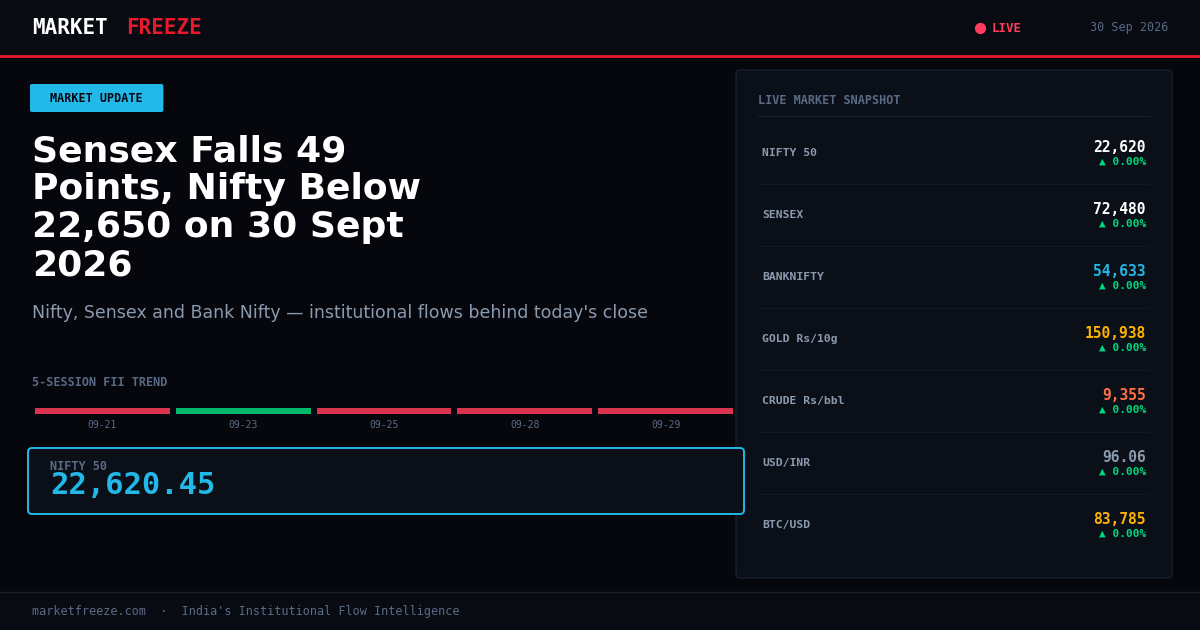
Indian Equities Extend Losses as Rising Bond Yields Trigger FII Exodus
The Nifty 50 closed at 22,620.45, down 0.42% on September 30, 2026, as sustained FII selling, totaling ₹9,980.22 crore in the last session, underscores investor concerns over rising US Treasury yields impacting Indian equity flows and market sentiment.
Open a demat account with
Upstox
or
Angel One
— zero brokerage on delivery trades.
FIIs Continue Net Sell Streak as Bond Yields Signal Risk-Off Sentiment
Today’s market action, with the Nifty 50 shedding 95.75 points to close at 22,620.45 and the Sensex dipping 49 points to 72,480.00, directly correlates with the persistent foreign institutional investor (FII) outflows observed over the last three trading sessions. The primary catalyst identified, rising US 30-year Treasury yields, which have surged to levels not seen since 2002, is creating a compelling risk-free alternative for global capital. This yield surge makes fixed-income instruments relatively more attractive than equities, prompting FIIs to divest from riskier emerging markets like India. The sheer scale of FII net selling, escalating from ₹3,693.93 crore on September 25 to ₹9,980.22 crore on September 29, highlights a clear institutional shift driven by macroeconomic factors rather than domestic corporate performance. This outflow trend is directly pressuring the Nifty 50, pushing it below the 22,650 mark.
Institutional Flows Reveal Divergent Strategies Amidst Market Downturn
In the session ending September 30, 2026, available data suggests continued selling pressure from FIIs, aligning with the negative market close. While exact figures for today’s session are pending, the trend from the preceding three days is alarming:
- September 29, 2026: FII Net Sell ₹9,980.22 Cr | DII Net Buy ₹6,952.71 Cr
- September 28, 2026: FII Net Sell ₹5,353.22 Cr | DII Net Buy ₹5,189.02 Cr
- September 25, 2026: FII Net Sell ₹3,693.93 Cr | DII Net Buy ₹2,838.17 Cr
This sustained FII selling contrasts sharply with consistent Domestic Institutional Investor (DII) buying. DIIs have actively deployed capital, absorbing a significant portion of the FII-led sell-off. Their net buying has steadily increased, from ₹2,838.17 crore on September 25 to ₹6,952.71 crore on September 29. This DII support is crucial in cushioning the Nifty’s fall, preventing a steeper decline. However, the magnitude of FII outflows suggests that DII capacity to absorb selling pressure might be tested if the trend continues unabated. The Bank Nifty’s resilience, closing up 0.69% at 54,633.00, might be partly attributable to DII flows into banking counters, often favored for their stability and dividend yields during uncertain times.
Sectoral Headwinds Emerge as Global Yields Dictate Flows
The market’s bifurcation, with the Nifty 50 and Sensex declining while the Nifty Midcap 100 and Smallcap 100 managed a 0.3% gain, highlights a sector-specific impact. The broad market indices are being dragged down by sectors heavily reliant on foreign capital or those sensitive to global economic slowdown fears. Specifically, the IT sector and Metal sector appear to be under significant pressure. Reports indicate that these sectors were among the drags on the Nifty 50 today, reflecting their higher correlation with global growth prospects and consequently, FII investment appetite. Pharma stocks also showed weakness, as indicated by supporting news, suggesting a broader risk aversion impacting sectors perceived as more cyclical or export-oriented. Conversely, the resilience in mid and small-cap segments, coupled with the Bank Nifty’s gain, points towards domestic demand-driven sectors and financial services potentially finding favor with DIIs seeking value and stability.
Key Levels to Watch for Nifty Direction Amidst Institutional Flux
Analyzing recent FII/DII flow patterns provides crucial support and resistance levels for the Nifty 50. The sustained selling by FIIs has created overhead resistance, particularly around the 22,750-22,800 levels, where significant selling pressure was observed in the sessions leading up to today. On the downside, DII buying has established a floor around the 22,500-22,550 range. Today’s close at 22,620.45 places the Nifty precariously close to this support. A decisive break below 22,500, if accompanied by continued FII selling, would signal further downside potential towards 22,200, a level where DII activity was notable in earlier weeks. Conversely, any respite in FII outflows or a pickup in their buying could see the index retesting the 22,750 mark.
Commodity Markets Reflect Global Uncertainty, Diverging from Equities
Today’s commodity price movements offer a mixed signal, with Gold MCX showing strength while Crude MCX experienced a significant downturn. Gold prices on MCX rose by 0.89% to ₹150,938.00/10g, indicating a classic “flight to safety” as investors seek refuge in precious metals amidst rising global economic uncertainties and equity market declines. This aligns with the risk-off sentiment driving FII outflows from equities. However, Crude MCX prices plunged by 5.07% to ₹9,355.00/bbl. This sharp fall in crude prices could be attributed to concerns about global demand weakening due to higher interest rates worldwide and potential supply increases from certain regions, counteracting the inflation hedge narrative. The USD/INR pair remained relatively stable, closing down 0.16% at Rs96.06, suggesting that the currency market is not yet reflecting significant capital flight, but rather a measured adjustment.
Historical Parallel: The August 2024 Yield Scare and FII Reversal
A historical parallel can be drawn to the market behavior observed in August 2024, when a similar spike in US Treasury yields triggered a sharp reversal in FII flows. During that period, a rapid increase in yields led to substantial FII outflows, causing the Nifty to correct by over 5% in a short span. While DII buying was present then as well, it was insufficient to fully offset the FII selling pressure, resulting in a prolonged period of market consolidation. The current scenario echoes this pattern, with rising yields acting as the primary trigger. In August 2024, it took nearly three weeks of stabilizing yields and supportive domestic news for FIIs to resume net buying. This historical context suggests that the current market weakness could persist until global bond yields show a clear downtrend or until domestic factors offer a compelling counter-narrative to attract institutional capital back into Indian equities.
Portfolio Strategy: Defensive Stance Until Yields Stabilize Below 4.5%
Given the current market dynamics and sustained FII outflows, a defensive portfolio allocation strategy is warranted. Investors should consider increasing exposure to fundamentally strong companies with low debt, consistent dividend payouts, and domestic demand linkage. Specifically, allocations towards the banking sector, particularly large-cap PSU banks and select private banks exhibiting strong deposit growth and manageable asset quality, could be beneficial, mirroring DII’s current preference. Furthermore, sectors like consumer staples and pharmaceuticals, which generally exhibit lower beta and are less sensitive to global economic cycles, should form a larger part of the portfolio. A shift towards debt instruments with shorter maturities could also be considered as yields remain elevated. The threshold for re-engaging with higher-risk assets would be a sustained decline in US 30-year Treasury yields back below the 4.5% mark for at least two consecutive weeks, coupled with a reversal in FII flow direction.
What Changes This Outlook: A US Inflation Surprise
The single most critical trigger that could alter the current market outlook is a significant US inflation surprise. Any data point suggesting persistently higher inflation in the US would likely force the Federal Reserve to maintain its hawkish stance or even consider further rate hikes. This would inevitably lead to higher global bond yields, exacerbating the current FII selling pressure on Indian equities. Conversely, a US inflation print significantly below expectations (e.g., below 3.0% year-on-year) could prompt a dovish shift in Fed commentary, leading to a sharp drop in bond yields and a potential reversal in FII flows, thereby providing a strong tailwind for Indian markets. Therefore, monitoring US inflation data releases closely is paramount.
| Date | FII Net (Cr) | DII Net (Cr) | Nifty Close |
|---|---|---|---|
| 2026-09-21 | ₹-576.20 Cr | +₹2,797.27 Cr | 23,329.00 |
| 2026-09-23 | +₹1,617.45 Cr | +₹2,341.46 Cr | 23,063.10 |
| 2026-09-25 | ₹-3,693.93 Cr | +₹2,838.17 Cr | 23,140.50 |
| 2026-09-28 | ₹-5,353.22 Cr | +₹5,189.02 Cr | 22,716.20 |
| 2026-09-29 | ₹-9,980.22 Cr | +₹6,952.71 Cr | 22,716.20 |
Frequently Asked Questions
- Q: What did FII buy or sell on September 29, 2026?
A: FIIs were net sellers of ₹9,980.22 Cr on September 29, 2026. - Q: What did DII buy on September 29, 2026?
A: DIIs were net buyers of ₹6,952.71 Cr on September 29, 2026. - Q: Is FII buying or selling in September 2026?
A: In September 2026, FIIs have predominantly been net sellers, with significant outflows observed in the latter half of the month, particularly from September 25 onwards, driven by rising global yields.
Bottom Line
The Indian equity market is currently navigating a challenging phase, with the Nifty 50 succumbing to sustained FII selling pressure fueled by rising global bond yields. While DIIs are providing a crucial support floor, the sheer magnitude of foreign outflows suggests underlying weakness. Investors should adopt a defensive stance, focusing on domestic demand-driven sectors and quality companies. The key to a market turnaround lies in the stabilization of US Treasury yields, a factor that will dictate the direction of institutional flows in the coming sessions.
Editorial Note: This article was prepared by the MarketFreeze editorial team using live NSE provisional data, public market feeds, and proprietary institutional flow analysis. All price and flow figures are sourced directly from NSE, BSE, and CoinGecko as of 30 September 2026. This content is for informational purposes only and does not constitute investment advice. MarketFreeze is not SEBI-registered. Please consult a qualified financial advisor before making investment decisions. Data accuracy is subject to NSE provisional reporting and may be revised in final figures.