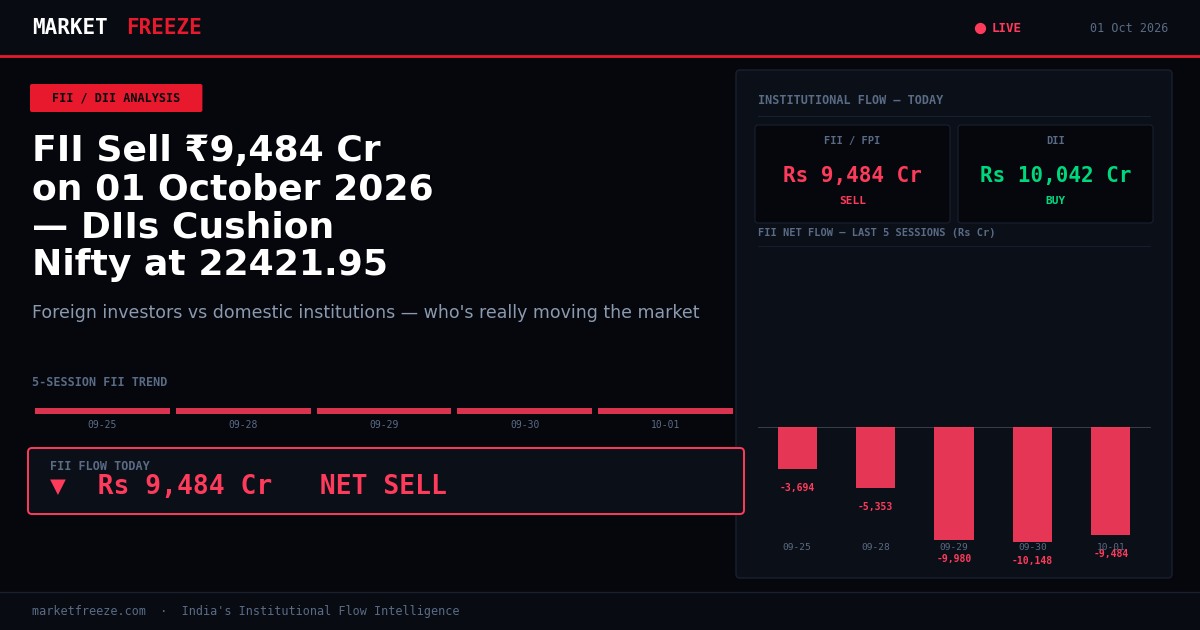
The numbers are in from NSE — Foreign Institutional Investors (FIIs) recorded a net sell of ₹9,484.22 Cr in Indian equities today, October 1, 2026, marking the fourth consecutive session of significant outflows, while Domestic Institutional Investors (DIIs) provided a counter-balance with a net buy of ₹10,041.84 Cr.
FII Selling Streak Extends: A ₹39,000 Crore Exodus in Four Sessions
Today’s FII net sell figure of ₹9,484.22 Cr represents a continuation of substantial capital withdrawal from Indian markets. Over the last four trading sessions, FIIs have offloaded a total of ₹39,611.05 Cr. This includes ₹10,148.41 Cr on September 30, ₹9,980.22 Cr on September 29, and ₹5,353.22 Cr on September 28. This sustained selling pressure has directly coincided with the Nifty 50 declining from 22,716.20 on September 28 to today’s close of 22,421.95, a 1.3% drop in three sessions. The gross FII buy value today stood at ₹12,260.26 Cr, indicating that while there was some selective accumulation, the selling conviction significantly outweighed fresh buying.
The consistent FII outflow at nearly ₹10,000 Cr per session for the past three days signals a strong negative bias. This is not merely profit-booking but a systematic reduction of exposure, impacting broader market breadth. Retail investors should monitor if DII buying continues to absorb this magnitude of selling, or if the buying capacity of domestic funds begins to wane, potentially leading to sharper corrections.
Open a free demat account with
Upstox
or
Angel One
— zero brokerage on delivery trades.
DIIs Absorb Selling: Countering ₹10,041.84 Cr with Domestic Capital
Domestic Institutional Investors (DIIs) have been the primary shock absorbers during this FII exodus. Today, DIIs injected ₹10,041.84 Cr into the market, marginally exceeding the FII selling. This trend of DII buying offsetting FII selling has been consistent, with DIIs buying ₹11,271.73 Cr on September 30 and ₹6,952.71 Cr on September 29. The DII buying today is a robust signal that domestic funds are finding value at current levels, or are mandated to deploy capital despite global headwinds.
The consistent DII support is critical in preventing a steeper market decline. For retail participants, this implies that while global factors are driving FIIs away, domestic money believes in the long-term India growth story. Watch for DII net buy figures below ₹5,000 Cr as a potential exhaustion signal, which could expose the market to greater downside risk.
Nifty’s Critical Juncture: 22,400 Holds Amid Persistent Selling
The Nifty 50 closed at 22,421.95 today, down 0.88%. This level is effectively unchanged from yesterday’s close of 22,421.95, despite significant institutional activity. The persistent FII selling, coupled with DII absorption, has created a narrow trading range around the 22,400 mark. This indicates that while bears are pushing, bulls are defending this immediate support zone with substantial domestic capital.
Given the FII selling pressure, immediate resistance for the Nifty 50 is located near 22,800, a level last seen on September 28. A break below 22,400, sustained by further FII selling not adequately countered by DIIs, could lead to a test of 22,000. Conversely, if DIIs continue to buy aggressively and FII selling abates, a rebound towards 22,600 is plausible. Retail investors should monitor the 22,400 level closely; a decisive breach below it on higher volumes would be a strong bearish confirmation.
Sectoral Implications: IT Under Pressure, Banking & Auto Resilience Tested
The Nifty IT index has seen a significant 11% crash in September, directly impacting FII allocations. With global growth fears and rising interest rates cited as reasons for this downturn (Story 3), FIIs are likely liquidating positions in this sector. This persistent FII selling pressure in IT stocks like TCS, Infosys, and Wipro suggests that any Q2 earnings rebound might be short-lived if global economic conditions do not improve.
Conversely, while the Nifty 50 and Sensex saw declines today, sectors like Banking and Auto, which often see DII resilience, might be where domestic money is finding opportunities. The Bank Nifty only fell 0.33% today, outperforming the broader indices. This suggests DIIs might be selectively accumulating in these defensives or value pockets. Retail investors should be cautious with IT exposure and evaluate if domestic-oriented sectors like certain Auto or Banking names align with DII buying patterns, especially those less exposed to global rate hikes.
Crude Oil and USD/INR: Macro Headwinds Intensify FII Exit
The macroeconomic backdrop contributes significantly to the FII selling. Crude MCX prices are at ₹9,766.00/bbl, an elevated level that puts pressure on India’s import bill and inflation. The US Dollar strengthening against the Rupee, with USD/INR trading at Rs96.0 today, makes Indian assets less attractive for dollar-denominated investors, providing an additional incentive for FIIs to repatriate funds. This dual pressure from rising crude and a depreciating rupee creates a challenging environment for foreign capital retention (Story 1).
The rising Treasury yields in the US, mentioned in the context of Wall Street’s dip (Story 2), further exacerbate this. Higher yields in safe-haven US bonds reduce the relative attractiveness of emerging market equities, particularly those facing currency depreciation and commodity price inflation. Retail investors should factor in these macro cross-currents; a strengthening dollar and high crude are structural negatives for FII flows into India.
The PB Fintech Crash and Broader Market Weakness
The drastic 48% crash in PB Fintech shares over seven sessions, bringing it back to its IPO price of ₹980, highlights the specific pressures some segments are facing (Story 4). Concerns over proposed insurance commission rule changes have triggered this sell-off, impacting mutual funds holding the stock. This specific event underscores a broader theme: regulatory uncertainty or sector-specific headwinds can amplify institutional selling, even if the overall market is supported by DIIs.
Such sharp declines in individual stocks, especially those with significant institutional holdings, can lead to forced selling by funds to manage redemptions or portfolio rebalancing. Retail investors should examine their holdings for similar regulatory or sector-specific risks, as FIIs are quick to exit positions when such uncertainties emerge, irrespective of the broader DII support.
What Would Shift This Outlook?
A fundamental shift in the current FII selling trend would require either a significant change in global macro conditions or specific policy actions. A sustained period of FII net buying, perhaps exceeding ₹5,000 Cr daily for several sessions, would signal a reversal. This would likely be triggered by a moderation in US Treasury yields or a stabilization in crude oil prices. Domestically, a strong, unexpected positive earnings surprise from a bellwether sector, or a significant policy announcement that boosts confidence, could also attract FIIs back. The current Nifty 50 level of 22,421.95 acts as a psychological battleground; a break above 22,800 on strong FII buying would indicate a change in trend.
Until such a reversal, the current pattern of FII selling and DII buying is likely to persist. Retail investors should look for FIIs to move from net selling to net buying, a shift that would provide a strong indication of renewed global capital confidence in Indian equities. Any FII net buy figure above ₹3,000 Cr for two consecutive days would be a preliminary signal of this change.
FII/DII Net Flow for Last 5 Sessions
| Date | FII Net (Cr) | DII Net (Cr) | Nifty Close |
|---|---|---|---|
| 2026-09-25 | ₹-3,693.93 Cr | +₹2,838.17 Cr | 23,140.50 |
| 2026-09-28 | ₹-5,353.22 Cr | +₹5,189.02 Cr | 22,716.20 |
| 2026-09-29 | ₹-9,980.22 Cr | +₹6,952.71 Cr | 22,620.45 |
| 2026-09-30 | ₹-10,148.41 Cr | +₹11,271.73 Cr | 22,421.95 |
| 2026-10-01 | ₹-9,484.22 Cr | +₹10,041.84 Cr | 22,421.95 |
FAQ
-
What was the total FII selling in Indian markets today, October 1, 2026?
Foreign Institutional Investors (FIIs) recorded a net sell of ₹9,484.22 Cr in Indian equities on October 1, 2026, with gross purchases of ₹12,260.26 Cr.
-
How much did Domestic Institutional Investors (DIIs) buy today, and how does it compare to FII selling?
Domestic Institutional Investors (DIIs) registered a net buy of ₹10,041.84 Cr today, effectively absorbing the majority of the FII selling pressure of ₹9,484.22 Cr.
-
What Nifty level is critical to watch given the current FII outflow trend?
With the Nifty 50 closing at 22,421.95 today, the 22,400 level is critical to monitor. Continued FII selling below this could indicate further downside towards 22,000, while DII support above it could defend this zone.
The sustained selling by FIIs, amounting to nearly ₹40,000 crore in just four sessions, raises questions about their long-term conviction in Indian equities, particularly when juxtaposed against the persistent domestic buying. While DIIs have heroically absorbed the outflows, their capacity is not infinite. Should global sentiment sour further, leading to a substantial increase in FII sell orders exceeding ₹10,000 crore for another session or two, the DII buying might falter. A scenario where DII net buys drop below ₹5,000 crore, as previously highlighted, would be a critical warning sign, potentially leading to a breakdown of the 22,400 support level.
Historical Parallels: Lessons from Past FII Sell-offs
While every market cycle is unique, the current pattern bears some resemblance to periods of significant FII capitulation witnessed in India. For instance, during the taper tantrum in 2013, FIIs pulled out substantial capital, and the Indian rupee depreciated sharply. The current depreciation of the USD/INR to 96.0, coupled with elevated crude prices, mirrors some of those earlier macro pressures. In those times, sustained DII buying was crucial in cushioning the market’s fall, but ultimately, a reversal in global risk appetite was needed to reignite foreign inflows. Investors might find it instructive to review how Indian equities performed and recovered in the aftermath of the 2013 sell-off, particularly the sectors that proved resilient and the duration of the FII outflow spell.
Currency and Commodity Interplay: A Vicious Cycle?
The interplay between the depreciating rupee and rising crude oil prices presents a self-reinforcing negative feedback loop for foreign investors. As the rupee weakens, the dollar-cost of oil imports rises, putting pressure on India’s current account deficit and inflationary expectations. This, in turn, can prompt the Reserve Bank of India to consider tighter monetary policy, which might not be ideal for equity markets. Furthermore, a weaker rupee erodes the returns for FIIs when they convert their profits back into dollars. The current USD/INR level of 96.0 is a significant hurdle, and any further appreciation towards 97.0 or above would likely intensify FII outflows, especially if crude prices remain stubbornly high above ₹9,700 per barrel.
Retail Investor Positioning: A Tale of Two Classes
While FIIs are pulling back and DIIs are absorbing, it’s crucial to consider where retail investors stand. Anecdotal evidence and equity savings scheme inflows suggest retail participation remains robust, though potentially more cautious. Many retail investors have benefited from the market’s earlier rally and might be hesitant to book profits amidst uncertainty, or they may be waiting for a better entry point. However, with the Nifty oscillating around 22,400 and facing headwinds, there’s a risk of a significant portion of retail investors being caught on the wrong side if the market experiences a sharp correction. The aggressive selling by FIIs, even if countered by DIIs, can lead to heightened volatility, which often triggers panic selling among less experienced retail participants.
Sectoral Rotation: A Harbinger of Change?
The stark underperformance of the Nifty IT index, down 11% in September, alongside the relative resilience of sectors like Banking, suggests a potential sectoral rotation driven by institutional flows. FIIs, often heavily invested in growth-oriented tech stocks, are likely trimming these positions due to global growth concerns and rising interest rates. Conversely, DIIs may be shifting towards more defensive or value-oriented sectors like Banking and Automobiles, which tend to perform better in a slower growth environment or when domestic demand is strong. Retail investors might consider aligning their portfolios with these perceived DII preferences, focusing on sectors less sensitive to global economic downturns and currency fluctuations.
Bottom Line
Today’s FII net selling of ₹9,484.22 Cr extends a sustained period of foreign capital withdrawal, bringing the four-day total FII outflow to nearly ₹40,000 Cr. DIIs, however, continue to act as a significant counter-force, injecting ₹10,041.84 Cr into the market, preventing a steeper decline for the Nifty 50, which closed at 22,421.95. This dynamic of FII exits driven by macro headwinds (high crude, strong USD, rising US yields) and DII absorption points to a market battling for direction, with immediate support at 22,400. Retail investors should prioritize domestic-focused sectors and monitor DII buying capacity for signs of exhaustion.
Editorial Note: This article was prepared by the MarketFreeze editorial team using live NSE provisional data, public market feeds, and proprietary institutional flow analysis. All price and flow figures are sourced directly from NSE, BSE, and CoinGecko as of 01 October 2026. This content is for informational purposes only and does not constitute investment advice. MarketFreeze is not SEBI-registered. Please consult a qualified financial advisor before making investment decisions. Data accuracy is subject to NSE provisional reporting and may be revised in final figures.