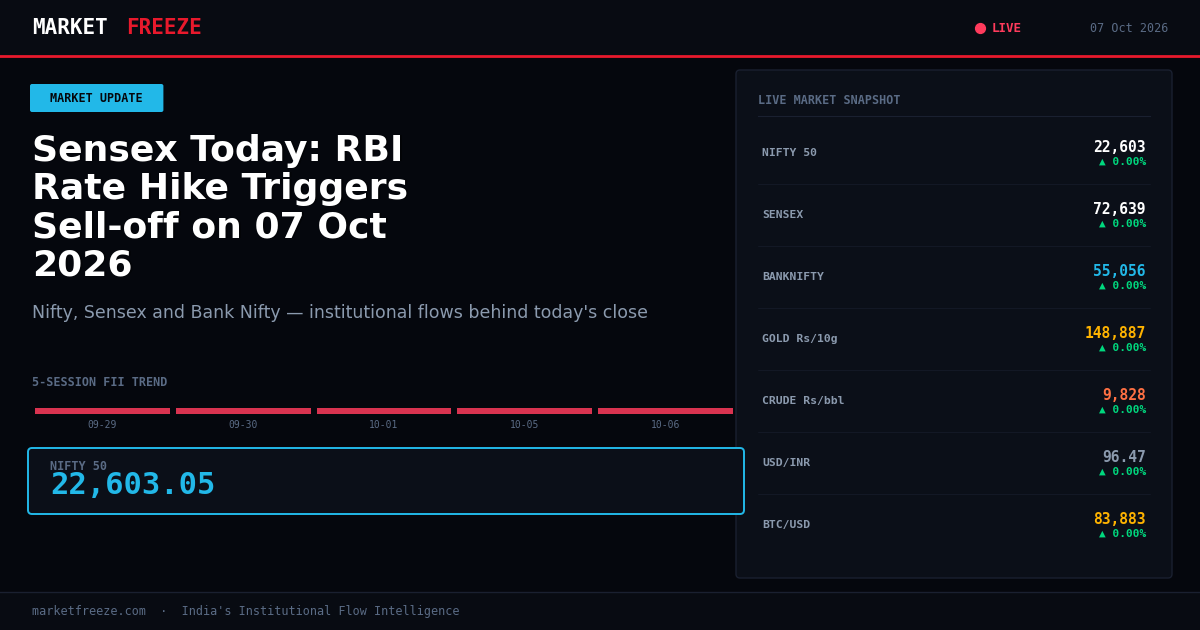
The RBI’s 25 basis point repo rate hike, pushing the policy rate to 6.75%, triggered a sell-off in Indian equities today, with the Nifty 50 closing down 0.76% at 22,603.05 and the Sensex down 0.59% at 72,639.00, a move that saw Foreign Institutional Investors (FIIs) net sell ₹2,150.89 Cr, while Domestic Institutional Investors (DIIs) were net buyers of ₹3,512.44 Cr.
RBI Rate Hike Triggers FII Exit, DII Support Amidst Broader Market Decline
The Reserve Bank of India’s Monetary Policy Committee (MPC) today delivered a widely anticipated 25 basis point increase in the repo rate, bringing it to 6.75%. This hawkish move, aimed at curbing persistent inflation which the RBI revised upwards for FY27 to 5.2%, immediately impacted market sentiment. The Nifty 50 experienced a sharp decline, shedding 0.76% to close at 22,603.05, while the Sensex mirrored this trend, falling 0.59% to 72,639.00. This downward pressure was primarily driven by Foreign Institutional Investors (FIIs), who offloaded Indian equities to the tune of ₹2,150.89 Cr. In contrast, Domestic Institutional Investors (DIIs) provided a crucial buffer, stepping in with net purchases of ₹3,512.44 Cr, a consistent pattern observed over the last three trading sessions. This divergence in institutional flows underscores a cautious stance from foreign capital in the face of tightening monetary policy, while domestic institutions remain committed to Indian equities.
Open a free demat account with
Upstox
or
Angel One
— zero brokerage on delivery trades.
FIIs Curtail Holdings Amidst Rate Hike Uncertainty
The significant net selling of ₹2,150.89 Cr by FIIs today directly correlates with the RBI’s monetary policy announcement. This outflow is a clear signal of foreign investors re-evaluating their exposure to Indian assets when interest rates are on an upward trajectory. Higher borrowing costs can dampen corporate earnings growth and reduce the attractiveness of equities relative to fixed-income instruments. The selling pressure was broad-based, affecting large-cap and mid-cap segments alike, as evidenced by the Nifty 50’s 0.76% decline. This contrasts with the preceding two sessions where FII selling was more pronounced (₹2,961.30 Cr on Oct 6th and ₹4,699.14 Cr on Oct 5th), suggesting a slight moderation in the pace of selling today, possibly indicating that some FIIs have already adjusted their portfolios ahead of the expected rate hike. However, the overall trend remains one of net outflows from foreign portfolios.
DIIs Step In as Market Stabilizers
Domestic Institutional Investors, primarily mutual funds and insurance companies, demonstrated resilience today by net purchasing ₹3,512.44 Cr worth of Indian equities. This consistent buying, following net purchases of ₹5,088.92 Cr on Oct 6th and ₹5,181.62 Cr on Oct 5th, highlights their strategic commitment to long-term growth prospects of the Indian economy. DIIs often view market dips as accumulation opportunities, especially when driven by macroeconomic policy adjustments rather than fundamental business deterioration. Their buying activity today helped cushion the impact of FII selling, preventing a steeper fall in the Nifty 50, which closed only 0.76% lower. This sustained DII support is a critical factor for market stability, particularly during periods of external capital withdrawal.
Financials and Autos Face Headwinds from RBI’s Hawkish Stance
The RBI’s decision to hike rates and signal further tightening has a direct impact on interest-rate sensitive sectors. Financials, particularly banks and NBFCs, will face increased funding costs, potentially compressing net interest margins (NIMs), although higher lending rates could eventually offset this. Today, banking stocks saw mixed performance, with the Bank Nifty closing marginally down by 0.13% at 55,056.00, suggesting that the immediate impact was managed, but the outlook for NIM expansion is now under scrutiny. Auto stocks are also vulnerable as higher borrowing costs can reduce consumer demand for vehicles, a significant portion of which are financed. While specific sector data for today’s flow is not provided, historically, FIIs tend to reduce exposure to these cyclical sectors during tightening cycles. Conversely, sectors with strong pricing power and lower debt, such as FMCG or certain IT sub-segments, might prove more resilient.
Nifty’s Technical Levels: A Dance Between Support and Resistance
The Nifty 50’s closing level of 22,603.05 today places it within a crucial zone influenced by recent institutional activity. Given the recent outflow of FIIs, particularly concentrated around the 22,700-22,800 levels in the past week, this zone is likely to act as immediate resistance. Conversely, the strong DII buying observed in the 22,500-22,600 range over the last few sessions suggests this could act as a near-term support. The sustained DII buying provides a floor, while the FII selling creates a ceiling. A decisive break above 22,800 would require a significant reversal in FII sentiment, while a fall below 22,500 could indicate a further acceleration of selling pressure from both foreign and potentially domestic institutions if inflation concerns escalate beyond current forecasts.
USD/INR Surge Amidst Global Yield Concerns
The Indian Rupee weakened against the US Dollar today, with USD/INR trading at Rs96.47, up 0.45%. This depreciation is likely a dual impact of the RBI rate hike and global macroeconomic factors. While a rate hike typically strengthens a currency, the simultaneous hawkish signals from global central banks and rising US Treasury yields are exerting upward pressure on the dollar. The jump in crude oil prices (MCX Crude up 1.29% to Rs9,828.00/bbl) also adds to import bill concerns, further weighing on the INR. FII outflows often coincide with INR weakness, as foreign investors repatriate funds. The current movement suggests that global yield differentials and commodity price pressures are overriding the immediate positive impact of the RBI’s policy action on the Rupee.
Historical Parallel: Tightening Cycles and Institutional Reactions
Looking back at previous monetary policy tightening cycles in India, such as in 2022, we observed a similar pattern of FII outflows and a cautious market reaction. For instance, in the session following a rate hike in late 2022, FIIs net sold over ₹5,000 Cr, while DIIs continued to buy, albeit at a slower pace than previous sessions. The market then experienced a period of consolidation before resuming its upward trend once inflation showed signs of moderating and the rate hike cycle appeared to be nearing its end. The current situation, with FIIs net selling ₹2,150.89 Cr today after larger sell-offs earlier in the week, and DIIs consistently buying, mirrors this historical dynamic. The key difference now is the upward revision of inflation forecasts by the RBI, suggesting the tightening cycle might extend further than initially anticipated, making the historical parallel a cautious one.
Portfolio Framework: Navigating the Rate Hike Environment
In light of today’s developments, investors should consider a portfolio framework that emphasizes resilience and selective opportunities. For the next 3-6 months, a tilt towards companies with strong balance sheets, low debt, and robust pricing power would be prudent. Specifically, assess portfolios for exposure to sectors like FMCG, defensives IT services, and companies with significant export revenues that benefit from a weaker INR. Avoid over-allocation to highly leveraged businesses in interest-rate sensitive sectors like real estate and capital goods, unless their valuations offer extreme discounts. The current FII selling of ₹2,150.89 Cr suggests a de-risking strategy abroad, while DII buying of ₹3,512.44 Cr indicates conviction in specific domestic pockets. Investors should aim for a sector allocation where earnings visibility is high, even with a policy repo rate now at 6.75%.
FAQ Section
- Q: What did FII buy or sell on 06 October 2026? A: FIIs were net sellers of ₹2,961.30 Cr on 06 October 2026.
- Q: What did DII buy on 05 October 2026? A: DIIs were net buyers of ₹5,181.62 Cr on 05 October 2025.
- Q: Is FII buying or selling in October 2026? A: In October 2026, FIIs have shown a consistent trend of net selling, totaling ₹16,801.33 Cr in the first week of the month (based on provided data up to Oct 6th and today’s figures).
Key Levels to Watch
Nifty Support: The 22,500 level, where DII buying has been observed, presents immediate support. A sustained breach below this could test the 22,200 mark, especially if FII selling accelerates.
Nifty Resistance: The 22,700-22,800 zone, marked by recent FII selling, is expected to act as stiff resistance. A move above 22,900 would signal a potential trend reversal, requiring significant positive institutional flow.
Historical FII/DII Net Flows and Nifty Close
| Date | FII Net (Cr) | DII Net (Cr) | Nifty Close |
|---|---|---|---|
| 2026-09-29 | ₹-9,980.22 Cr | +₹6,952.71 Cr | 22,620.45 |
| 2026-09-30 | ₹-10,148.41 Cr | +₹11,271.73 Cr | 22,421.95 |
| 2026-10-01 | ₹-9,484.22 Cr | +₹10,041.84 Cr | 22,555.75 |
| 2026-10-05 | ₹-4,699.14 Cr | +₹5,181.62 Cr | 22,776.10 |
| 2026-10-06 | ₹-2,961.30 Cr | +₹5,088.92 Cr | 22,776.10 |
What Changes This Outlook
The key trigger to watch will be any shift in the RBI’s forward guidance. If subsequent inflation prints for FY27 fall significantly below the projected 5.2%, or if GDP growth falters more than anticipated, the RBI might pause its rate hike cycle earlier than expected. Conversely, any indication of inflation remaining stubbornly above the target band for an extended period, potentially pushing the repo rate towards 7.00%, would reinforce the current FII selling trend and could lead to further downside pressure on the Nifty, potentially testing the 22,000 mark.
Bottom Line
Today’s market action clearly illustrates the impact of monetary policy on institutional flows, with the RBI’s rate hike prompting FIIs to net sell ₹2,150.89 Cr while DIIs absorbed much of this selling pressure with net buys of ₹3,512.44 Cr. This divergence highlights the differing strategies of foreign and domestic investors in a tightening credit environment. The Nifty 50’s close at 22,603.05 indicates immediate resistance around 22,800 and support near 22,500, levels heavily influenced by recent institutional activity.
Stay ahead of the market curve. For daily institutional flow intelligence and actionable insights, subscribe to MarketFreeze.com.
Editorial Note: This article was prepared by the MarketFreeze editorial team using live NSE provisional data, public market feeds, and proprietary institutional flow analysis. All price and flow figures are sourced directly from NSE, BSE, and CoinGecko as of 07 October 2026. This content is for informational purposes only and does not constitute investment advice. MarketFreeze is not SEBI-registered. Please consult a qualified financial advisor before making investment decisions. Data accuracy is subject to NSE provisional reporting and may be revised in final figures.