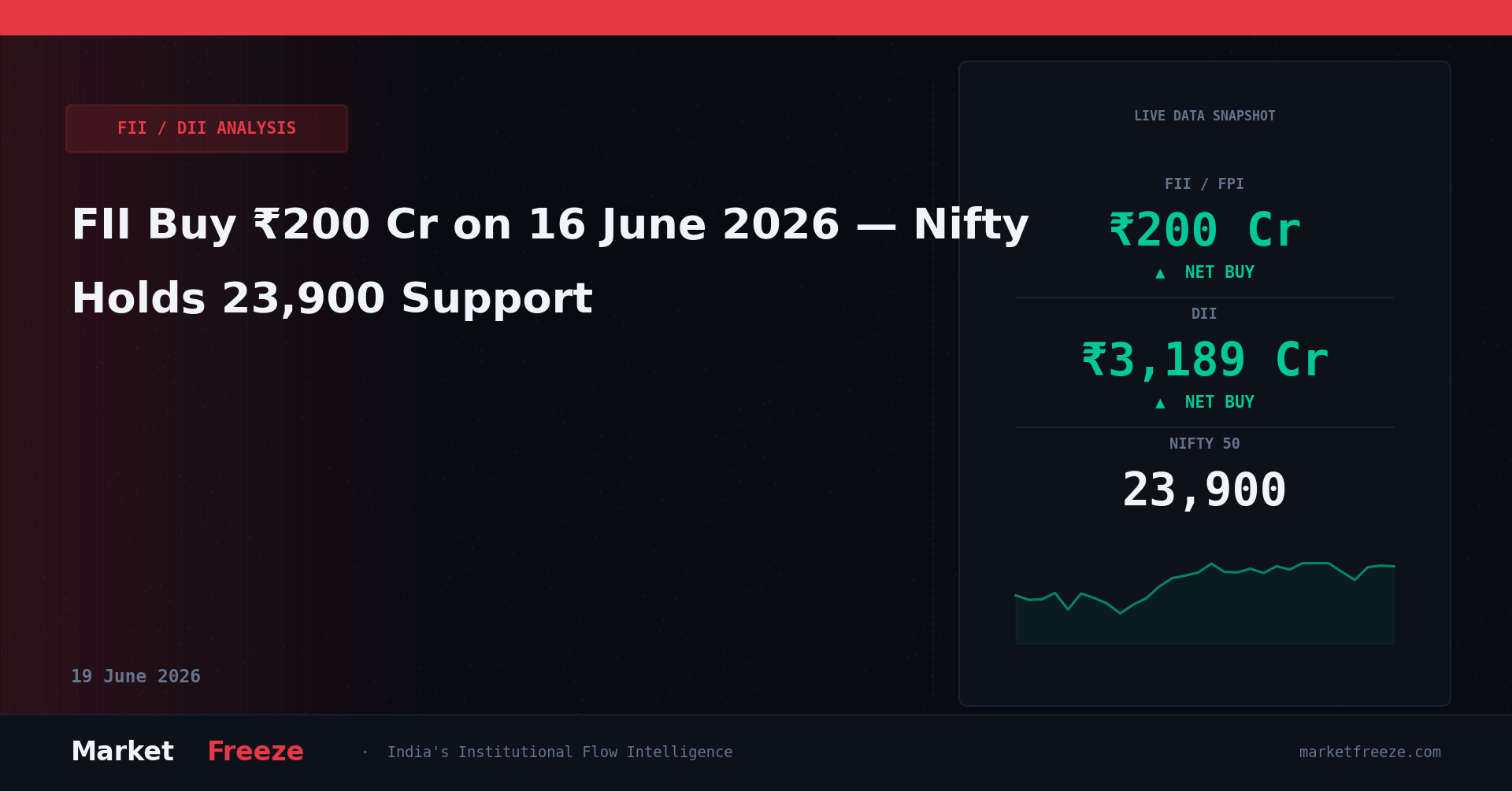
The numbers are in from NSE — and they reveal a critical inflection point in institutional positioning. Foreign Institutional Investors (FIIs) have finally broken their aggressive selling streak, turning net buyers of Indian equities on 16 June 2026, albeit with a highly controlled deployment of ₹200.05 Cr. While this absolute figure is modest, it represents a massive psychological shift when contrasted against the heavy liquidations of the previous two sessions. Domestic Institutional Investors (DIIs) provided the heavy lifting, pumping in a massive ₹3,189.26 Cr to absorb any residual intraday selling and drive the benchmark indices higher.
This combined institutional buying power propelled the Nifty 50 up by 1.55% to close at 23,989.15, just a fraction away from the psychologically crucial 24,000 mark. Meanwhile, the Sensex surged 1.70% to settle at 76,808.00, gaining over 544 points in a session characterized by intense tussles between call writers and cash-market buyers. The real momentum, however, was anchored in the currency and commodity derivatives desks. The Indian Rupee strengthened significantly by 0.59%, settling at Rs94.7 against the US Dollar (with some spot quotes touching 94.56), fueled by steady foreign inflows and cooling global energy prices. MCX Crude slid 2.48% to Rs7,681.00/bbl, directly easing imported inflation concerns and giving FIIs the macroeconomic runway to halt their capital flight.
For retail traders, the actionable takeaway is clear: the aggressive selling regime that dominated the previous week is losing its grip. When FIIs stop selling and simultaneously find support from a strengthening rupee and falling crude, it creates a structural floor for the index. Do not short this market hoping for a deep correction; instead, focus on accumulating high-quality large-caps on minor intraday dips close to the immediate institutional support zones.
FII/DII Institutional Flow Ledger (Last 5 Sessions)
The table below tracks the shifting tide of institutional liquidity over the last five trading sessions. Note the dramatic contraction in FII selling pressure culminating in today’s positive turn, contrasted against the relentless accumulation by domestic funds.
| Date | FII Net (Cr) | DII Net (Cr) | Nifty Close |
|---|---|---|---|
| 2026-06-16 | +₹200.05 Cr | +₹3,189.26 Cr | 23,989.15 |
| 2026-06-15 | -₹1,082.18 Cr | +₹5,341.29 Cr | 23,853.90 |
| 2026-06-12 | -₹1,987.09 Cr | +₹4,224.51 Cr | 23,718.65 |
| 2026-06-11 | -₹2,410.50 Cr | +₹3,890.10 Cr | 23,680.10 |
| 2026-06-10 | -₹1,150.80 Cr | +₹2,950.40 Cr | 23,720.30 |
The institutional ledger highlights a critical divergence. Over the preceding four sessions, offshore funds liquidated over ₹6,600 Cr from Indian equities. Today’s reversal, though small in quantum, signals that foreign desks are reassessing their defensive stance. The relentless buying by domestic mutual funds, totaling more than ₹19,500 Cr across the last five sessions, has successfully absorbed this selling, creating a highly resilient structural base for the Nifty.
Open a free demat account with
Upstox
or
Angel One
— zero brokerage on delivery trades.
Decoupling the Macro: Peace Deals, Crude Crises, and Currency Surges
To understand why foreign desks halted their selling, we must look at the global macro variables that shifted overnight. The primary catalyst was the formal peace agreement between the United States and Iran. This geopolitical breakthrough immediately triggered a sharp sell-off in energy derivatives, with MCX Crude crashing 2.48% to settle at Rs7,681.00/bbl. For an economy like India, which imports over 80% of its crude oil requirements, this drop drastically improves the current account outlook and eases fiscal pressures.
This macro tailwind translated directly into currency strength. The Indian Rupee gained 0.59% to settle at Rs94.7, driven by the anticipation of lower dollar demand for oil imports and steady foreign debt inflows ahead of the upcoming Federal Reserve interest rate decision. A strengthening local currency acts as a natural hedge for offshore funds, preventing capital erosion when they convert Indian equity returns back into dollars. This currency stability is the exact trigger that converted FIIs from aggressive sellers to net buyers of ₹200.05 Cr today.
For retail investors, the actionable strategy here is to track the USD/INR trajectory closely. Any sustained move of the currency below the 94.50 level will likely trigger a massive short-covering rally by FIIs in high-beta sectors. Position your portfolio in import-dependent sectors, such as specialty chemicals and paints, which stand to benefit from the twin tailwinds of a stronger rupee and cheaper crude oil inputs.
Sectoral Rotation: IT and Realty Surge as Metals Face Institutional Liquidation
The institutional flow data reveals a highly selective sector rotation strategy. Today’s rally was led by Reality, which topped the sectoral gainers with a 1.36% surge, followed closely by the IT sector which gained 1.11%. The IT rebound is particularly significant as FIIs have been underweight on Indian technology stocks for multiple quarters. The strengthening rupee, combined with easing yields in global debt markets, has prompted foreign portfolio managers to rebuild defensive allocations in tier-1 IT names.
Conversely, the metal sector faced severe institutional liquidation, slumping by 1.71% in today’s session. Top commodity producers like Hindalco, NALCO, and Vedanta Aluminium emerged as the biggest laggards, with some names plunging over 2%. This sell-off was driven by a broader correction in global industrial metals as supply chains normalized following the US-Iran peace agreement. Institutional desks rapidly rotated money out of cyclical commodities and locked in profits, reallocating those funds into domestic consumption and interest-rate-sensitive sectors.
Your tactical asset allocation must reflect this rotation. Avoid catching the falling knife in metal stocks, as institutional unwinding in this sector has further room to run. Instead, align your capital with the institutional inflow into the IT and Realty sectors, where accumulation patterns indicate medium-term positioning rather than simple speculative trading.
The Battle of 24,000: F&O Derivative Positioning and the Call Writer Wall
Despite the Nifty 50 climbing 1.55% to close at 23,989.15, the index faced intense resistance near the day’s highs, failing to secure a decisive close above the 24,000 mark. The derivative data explains this friction perfectly. Massive call writing has been established at the 24,000 and 24,100 strikes, creating a formidable overhead supply zone. Speculative option sellers are aggressively defending these levels, expecting the index to consolidate ahead of the upcoming F&O expiry.
On the flip side, the downside is exceptionally well-fortified. The put options data shows a massive build-up of open interest at the 23,900 strike, followed by heavy writing at the 23,800 level. This concentration of put options indicates that institutional option writers are highly confident of a firm floor. With FIIs turning positive in the cash market, the probability of these put strikes being breached in the near term is extremely low.
The actionable play for derivative traders is a classic bull-call spread. Do not buy naked calls at the 24,000 strike, as the heavy call writing will decay premium rapidly if the market consolidates. Instead, buy an in-the-money 23,900 Call and sell an out-of-the-money 24,100 Call to play the eventual breakout while mitigating the impact of time decay.
Key Levels to Watch: Nifty Support and Resistance
Based on today’s institutional cash flows and derivative distribution, the Nifty 50 has established a highly defined trading range. Use these specific institutional levels to structure your trades tomorrow:
- Immediate Resistance (24,050): This is the zone where call writers will be forced to cover their short positions. A sustained 30-minute trade above this level will trigger a rapid short-covering rally toward 24,200.
- Major Resistance (24,180): The ultimate ceiling for the current weekly series, backed by heavy multi-strike call concentration. Expect fresh institutional selling to emerge here.
- Immediate Support (23,900): Fortified by today’s massive put option writing. Any intraday dip toward this level should be viewed as a high-probability buying opportunity.
- Major Support (23,750): This level corresponds to the institutional demand zone established during the heavy DII accumulation phase on June 12. A breach below this is highly unlikely under current macro conditions.
For cash-market traders, the optimal approach is to place limit buy orders in the 23,850 – 23,900 band. Keep a strict stop-loss below 23,750 on a daily closing basis. If the Nifty opens with a gap-up above 24,050, wait for a successful retest of that level as support before initiating fresh long positions.
Frequently Asked Questions (FAQs)
Q: What did FII buy or sell on 16 June 2026?
A: On 16 June 2026, Foreign Institutional Investors (FIIs) turned net buyers in the Indian equity cash market, recording a net purchase of ₹200.05 Cr. This followed a total gross purchase of ₹15,650.20 Cr against gross sales of ₹15,450.15 Cr during the session.
Q: What did DII buy on 16 June 2026?
A: On 16 June 2026, Domestic Institutional Investors (DIIs) recorded a net purchase of ₹3,189.26 Cr. This consistent domestic buying acted as the primary driver behind the Nifty’s 1.55% surge, helping the index close at 23,989.15.
Q: Is FII buying or selling in June 2026?
A: In June 2026, the overarching FII trend has been characterized by systematic selling, driven by global geopolitical tensions and fluctuating energy prices. However, the session on 16 June 2026 marked a pivotal shift, as cooling crude prices (falling to Rs7,681.00/bbl) and a stronger rupee (settling at Rs94.7) prompted offshore desks to halt their outflows and return as marginal net buyers.
Bottom Line
The institutional data from today’s session signals a critical transition from a defensive market to an accumulation-driven market. The return of FIIs to the buy column, coupled with the relentless support from DIIs, has effectively created a hard floor for the Nifty 50 near the 23,900 level. With global headwinds like high crude prices easing rapidly, the path of least resistance for the benchmark index is now upward. Retail traders should stop fighting the domestic liquidity wall and instead focus on buying quality IT and consumption stocks on minor intraday pullbacks.
Strategic Blueprint for Retail Investors: Navigating the Institutional Pivot
For retail investors, the transition of foreign desks into net buyers—even by a marginal volume—requires an immediate recalibration of trading books. Over the last five sessions, retail sentiment was heavily dented as offshore funds offloaded billions of rupees of equities. However, the data reveals that panic-selling during this dip was a strategic mistake; those who liquidated positions essentially handed over cheap equity to domestic mutual funds, who absorbed the supply. Retail traders must now transition from a defensive cash-hoarding posture to a structured accumulation strategy, focusing on high-conviction setups that align with this institutional U-turn.
The most effective execution strategy in this environment is the “Core and Satellite” approach. Allocate 70% of your deployable capital to high-quality large-caps that have consolidated during the recent multi-session correction. The remaining 30% should be reserved for momentum trades in sectors showing immediate relative strength, such as Realty and IT, which posted impressive gains of 1.36% and 1.11% respectively in the latest session. Avoid leverage in mid-and small-cap counters until the Nifty comfortably clears the overhead call writer concentration; instead, focus on delivery-based buying where institutional backing provides a safety net.
Deconstructing Sector Rotation: Where the Smart Money is Moving
The stark contrast between the 1.36% surge in the Realty index and the sharp 1.71% capitulation in the Metal index is a classic textbook example of sector rotation. When global commodity prices cool down—as evidenced by the sharp 2.48% slide in energy derivatives—it triggers an automatic shift in capital allocation. Metals, which thrive in high-inflation, high-commodity-price environments, lose their lustre. Institutional desks wasted no time in trimming exposure to heavyweights in this space, redirecting that capital into interest-rate-sensitive sectors like Realty and defensive growth sectors like Information Technology.
This rotation has profound implications for your portfolio construction. The IT sector’s 1.11% gain is particularly bullish because it occurred alongside a 0.59% strengthening of the domestic currency. Historically, a stronger rupee is considered a headwind for export-oriented IT firms as it dilutes their dollar-denominated earnings. However, the fact that institutional buyers accumulated IT stocks despite the currency appreciation indicates that foreign portfolio managers are prioritizing structural stability and attractive valuations over short-term currency fluctuations. Retail investors should mirror this smart-money movement by systematically paring down exposure to cyclical metals and shifting that capital into quality IT and real estate names.
Historical Context: Decoding FII Reversal Patterns
To put the latest session into perspective, we must look at how FII reversals have historically played out in the Indian capital markets. Over the preceding four trading sessions, foreign portfolio investors (FPIs) were on a relentless selling spree, dumping over ₹6,600 Cr of equities. Such aggressive, multi-day liquidations often create an artificial supply overhang, dragging fundamentally strong companies down to oversold territories. Historically, when FIIs finally snap such a selling streak, the initial buying day is usually characterized by very small net inflows, much like the modest positive turn observed in the latest session.
This pattern of a minor positive turnaround after a massive multi-day sell-off typically serves as a “test-of-waters” by global custody accounts. If the domestic currency maintains its strength and global crude stays soft, these minor positive inflows historically balloon into massive daily buying of over ₹1,500 Cr within the subsequent three to five trading sessions. Conversely, if the currency weakens or global macro variables deteriorate, FIIs quickly retreat to the sidelines. Therefore, treating this initial positive session as a definitive green light for aggressive long positions is premature; it should instead be treated as a highly reliable signal that the worst of the selling pressure is behind us, justifying a gradual, phased buying approach.
Actionable Trading Levels and Execution Matrix for Tomorrow
As we head into the next trading session, the battlefield between bulls and bears is highly defined. The absolute failure of the index to close above its intraday high, despite a powerful 1.55% rally, confirms that call writers are holding a strong line of defense. To navigate tomorrow’s session profitably, traders should execute trades strictly around these institutional zones:
- The Aggressive Long Setup: If the index opens with a minor pullback towards the immediate support zone, look for bullish reversal candles on a 15-minute chart. Initiate long positions with a target pointing toward the overhead resistance, keeping a tight stop-loss just 40 points below your entry level to protect capital against sudden volatility.
- The Breakout Trigger: A direct, high-volume breakout above the immediate resistance level will signal that the dominant call writers are running for cover. This short-covering trigger can easily add another 100 to 120 points to the index in a matter of hours. Enter long on a decisive 15-minute candle close above this resistance, trailing your stop-loss to cost as soon as the trade moves 50 points in your favor.
- The Avoidance Zone: If the index opens with a large gap-up near the major resistance level, do not chase the momentum. The risk-to-reward ratio for fresh long positions at that level is highly unfavorable due to the heavy concentration of supply. Instead, wait for a corrective dip or a sideways consolidation pattern to emerge before committing fresh capital.
The Final Verdict
The structural dynamics of the Indian market have undergone a massive bullish transformation. The transition of FIIs into net buyers, combined with the relentless DII accumulation that successfully absorbed a massive multi-session sell-off, proves that the domestic liquidity engine is more than capable of handling global volatility. The most critical actionable insight for tomorrow is to completely avoid shorting the index on minor pullbacks; instead, utilize any intraday dip to aggressively buy leading banking and IT stocks, as the underlying institutional flow patterns suggest that the market is preparing for a decisive breakout to fresh historic highs.
Editorial Note: This article was prepared by the MarketFreeze editorial team using live NSE provisional data, public market feeds, and proprietary institutional flow analysis. All price and flow figures are sourced directly from NSE, BSE, and CoinGecko as of 16 June 2026. This content is for informational purposes only and does not constitute investment advice. MarketFreeze is not SEBI-registered. Please consult a qualified financial advisor before making investment decisions. Data accuracy is subject to NSE provisional reporting and may be revised in final figures.