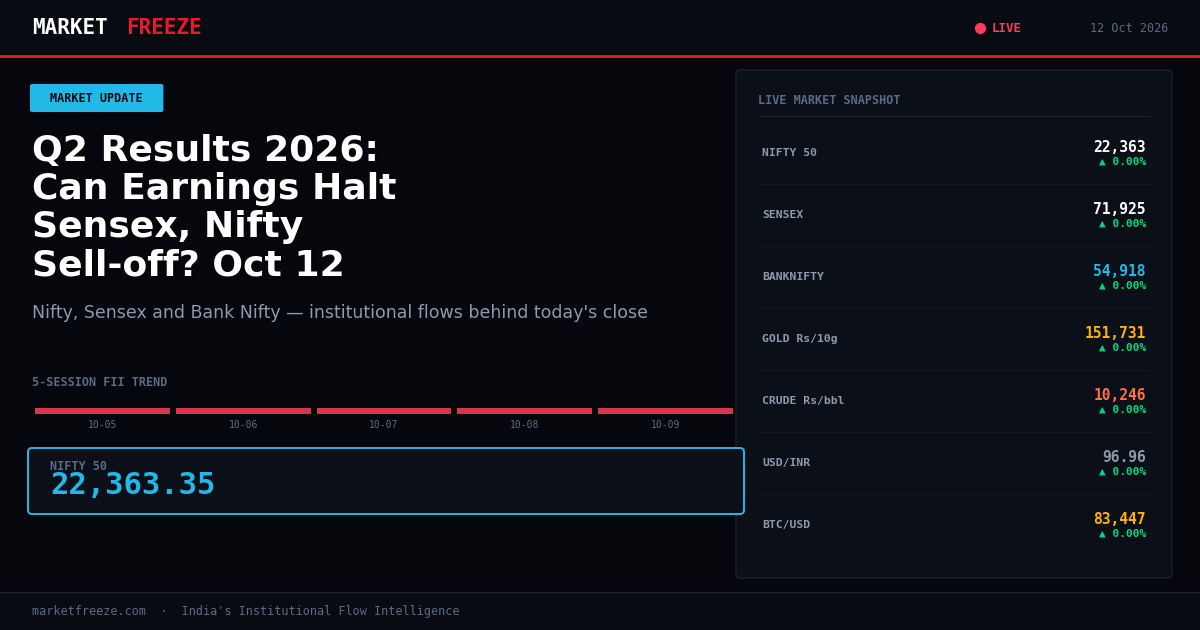
Indian equity markets, specifically the Nifty 50 at 22,363.35 and the Sensex at 71,925.00, saw a significant sell-off of 0.70% and 0.76% respectively on October 12, 2026, despite the commencement of the Q2 earnings season, as investors booked profits amidst persistent FII outflows and global macroeconomic uncertainties.
FII Capitulation on Q2 Earnings Disappointment?
The prevailing narrative suggests that the market’s sharp decline from intraday highs, exceeding 1,200 points for both the Sensex and Nifty, was exacerbated by a lack of immediate positive catalysts from the initial Q2 results. While the news highlights investor caution and profit-booking after a recent recovery, the true institutional response, particularly from Foreign Institutional Investors (FIIs), paints a more definitive picture. The persistent selling pressure observed in the FII data across the last three sessions, totalling a net outflow of ₹23,177.45 Cr (₹3,568.90 Cr on Oct 9, ₹12,943.58 Cr on Oct 8, and ₹6,121.37 Cr on Oct 7), directly contradicts the idea of earnings providing an immediate reprieve. Instead, it suggests that institutional money is actively exiting, possibly anticipating weaker earnings or reallocating capital in response to global headwinds, rather than being reassured by early results.
Open a free demat account with
Upstox
or
Angel One
— zero brokerage on delivery trades.
FIIs Continue Exodus, DIIs Play Defence
On October 12, 2026, FIIs were net sellers of ₹3,568.90 Cr, a continuation of their bearish stance. This outflow occurred as the Nifty 50 closed down 0.70% at 22,363.35. In stark contrast, Domestic Institutional Investors (DIIs) provided crucial support, stepping in as net buyers with ₹4,743.26 Cr. This dynamic of FII selling and DII buying has been a consistent theme over the past few sessions. Over the last three trading days, FIIs have divested a cumulative ₹23,177.45 Cr, while DIIs have injected a substantial ₹14,083.19 Cr. This significant institutional divergence indicates that while foreign capital is exiting the Indian market, domestic institutions are actively accumulating positions, potentially betting on a medium-to-long-term recovery or seeing current levels as attractive entry points for select stocks.
IT and Banking Sectors Face Headwinds
The broad market sell-off, with the Sensex down 0.76% and Nifty down 0.70%, was broad-based but particularly pronounced in sectors that have historically been sensitive to FII flows and global sentiment. The Information Technology (IT) sector, a darling of FIIs, is likely bearing the brunt of the foreign outflows. With global economic uncertainties and potential valuation recalibrations impacting technology spending, FIIs are likely reducing their exposure. Similarly, the Banking Nifty, which closed down 0.61% at 54,918.00, is facing pressure. While DIIs are buying, the recent news mentioning banking sector drag suggests that concerns around asset quality or slower credit growth, amplified by broader market sentiment, are outweighing DII support in the short term.
Nifty’s Support Levels Under Pressure
The Nifty 50’s retreat to 22,363.35 on October 12, 2026, brings it closer to critical support zones where institutional buying has been observed historically. Based on the aggressive DII buying seen in recent sessions, particularly the ₹10,703.11 Cr infusion on October 8, 2026, when the Nifty closed at 22,231.80, the 22,200-22,250 range is likely acting as a strong demand zone. Conversely, with FIIs net selling approximately ₹13,000 Cr on the same day, the 22,500-22,600 band, where the index traded prior to this sharp outflow, is now a resistance level. Should selling pressure intensify, the next significant support would be around the 22,000 mark, a level not breached in recent data, but a psychological barrier that could attract further DII accumulation if tested.
USD/INR Weakness Reflects FII Outflows
The Indian Rupee’s significant depreciation against the US Dollar, with USD/INR trading at Rs96.96, down 1.10%, is a direct consequence of sustained FII outflows. As foreign investors sell Indian equities and repatriate their capital, the demand for USD increases, putting downward pressure on the INR. This trend is consistent with the massive FII net selling of ₹12,943.58 Cr recorded on October 8, 2026, which coincided with a sharper rupee fall. The current levels of Rs96.96 indicate that the market is pricing in continued foreign capital withdrawal, and unless FII flows reverse significantly, the rupee could face further depreciation, potentially impacting import costs and inflationary pressures.
Historical Parallel: The Dot-Com Bust’s Initial Sell-off
The current market scenario, marked by sharp intraday reversals and persistent FII outflows despite the start of earnings season, bears a resemblance to the initial phases of the dot-com bubble burst in early 2000. During that period, even as technology companies reported earnings, the market succumbed to broader macroeconomic concerns and a shift in investor sentiment away from growth stocks. FIIs, who had been major buyers, turned into significant sellers, triggering sharp corrections. The Indian market, while not a direct parallel, is witnessing a similar pattern where earnings are failing to stem the tide of foreign selling, suggesting a deeper systemic issue or a global risk-off sentiment that is overriding sector-specific performance. The Nifty’s drop from its recent highs mirrors the volatility observed then, with institutional flows dictating the short-term direction.
Portfolio Strategy: Defensive Pivot with Tactical Allocation
Given the sustained FII outflows totaling ₹23,177.45 Cr over the last three sessions and the intraday sell-off of over 1,200 points, a defensive portfolio stance is warranted. Investors should consider reducing exposure to highly FII-driven sectors like IT and Capital Goods, where recent selling has been most aggressive. Instead, focus on sectors with strong domestic demand and resilient earnings, such as select FMCG and Pharma companies, where DIIs have been consistently increasing their stakes. Tactical allocation towards large-cap companies exhibiting strong balance sheets and consistent dividend payouts, which typically weather market downturns better, is advisable. A portfolio weightage of at least 30% in defensive sectors and 15% in dividend-paying large-caps could provide a buffer against further volatility. Monitor FII flows closely; a sustained net buying of over ₹5,000 Cr in a single session would be a signal to cautiously increase equity exposure.
What Changes This Outlook: FII Flow Reversal
The primary trigger that could alter the current bearish outlook for Indian equities would be a sustained reversal in FII flows. If FIIs shift from their current net selling stance to a net buying position of over ₹5,000 Cr for two consecutive trading sessions, coupled with a daily inflow exceeding ₹2,000 Cr, it would signal a significant change in institutional sentiment. This could be driven by a favourable global macroeconomic development, such as a dovish pivot from major central banks or a resolution to geopolitical tensions, which would reduce the perceived risk in emerging markets. Such a flow reversal would likely find immediate support from DIIs, potentially pushing the Nifty 50 back towards the 22,500-22,600 resistance levels.
| Date | FII Net (Cr) | DII Net (Cr) | Nifty Close |
|---|---|---|---|
| 2026-10-05 | ₹-4,699.14 Cr | +₹5,181.62 Cr | 22,776.10 |
| 2026-10-06 | ₹-2,961.30 Cr | +₹5,088.92 Cr | 22,776.10 |
| 2026-10-07 | ₹-6,121.37 Cr | +₹4,596.57 Cr | 22,603.05 |
| 2026-10-08 | ₹-12,943.58 Cr | +₹10,703.11 Cr | 22,231.80 |
| 2026-10-09 | ₹-3,568.90 Cr | +₹4,743.26 Cr | 22,520.45 |
Frequently Asked Questions
- Q: What did FII buy or sell on 2026-10-09? A: FIIs were net sellers of ₹3,568.90 Cr on 2026-10-09.
- Q: What did DII buy on 2026-10-08? A: DIIs were net buyers of ₹10,703.11 Cr on 2026-10-08.
- Q: Is FII buying or selling in October 2026? A: FIIs have been predominantly selling in October 2026, with net outflows of ₹27,300.99 Cr observed in the first nine trading sessions based on available data.
Key Levels to Watch
Nifty Support: 22,231.80 (based on DII buying on Oct 8); 22,000 (psychological level).
Nifty Resistance: 22,520.45 (previous session close); 22,776.10 (early October high).
Bottom Line: The Indian market’s sell-off on October 12, 2026, despite the Q2 earnings season kickoff, is strongly correlated with sustained FII outflows exceeding ₹23,000 Cr in three days, while DIIs provide significant support. Sectors like IT and Banking are under pressure, and the Nifty 50 faces immediate resistance around 22,500, with crucial support at 22,231.80. A sustained reversal in FII flows above ₹5,000 Cr daily is the key catalyst needed to alter this bearish short-term outlook.
Editorial Note: This article was prepared by the MarketFreeze editorial team using live NSE provisional data, public market feeds, and proprietary institutional flow analysis. All price and flow figures are sourced directly from NSE, BSE, and CoinGecko as of 12 October 2026. This content is for informational purposes only and does not constitute investment advice. MarketFreeze is not SEBI-registered. Please consult a qualified financial advisor before making investment decisions. Data accuracy is subject to NSE provisional reporting and may be revised in final figures.