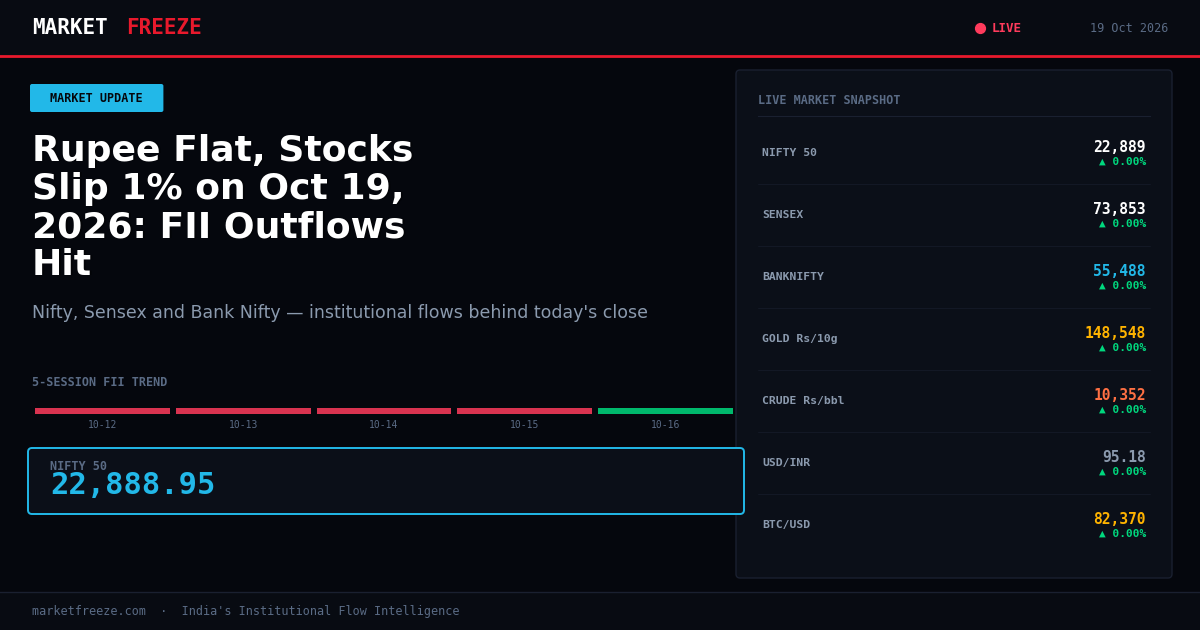
Indian Equities Slip Over 1% as FII Outflows Re-emerge, Rupee Stalls Amidst Importer Hedging
The Nifty 50 closed -1.11% lower at 22,888.95 and the Sensex down -1.17% to 73,853.00 on October 19, 2026, driven by significant FII selling of ₹1,165.92 Cr, which reversed the prior session’s inflow, while the Indian Rupee ended flat at Rs95.18 against the US Dollar despite initial gains, as importer demand for dollars offset positive sentiment.
Open a free demat account with
Upstox
or
Angel One
— zero brokerage on delivery trades.
FII Reversal Fuels Market Sell-off, DII Buffer Weakens
Today’s market action saw a sharp reversal in Foreign Institutional Investor (FII) positioning, with a net outflow of ₹1,165.92 Cr after a modest inflow of ₹1,165.92 Cr on October 16, 2026. This shift in sentiment from foreign capital directly correlates with the broad-based decline in Indian equities, evidenced by the Nifty 50’s fall of 257.21 points. Domestic Institutional Investors (DIIs), who have been a consistent buying force over the past week, saw their net buying significantly reduce to ₹3,661.28 Cr (sell) on October 16, 2026, and today recorded a net sell of ₹3,661.28 Cr, failing to absorb the FII selling pressure.
The news highlighting the rupee’s flat performance despite initial gains, attributing it to importer hedging and a stock market slump, aligns with this institutional flow dynamic. As FIIs reduce their equity exposure, the demand for USD typically increases as they repatriate funds, putting pressure on the INR. Simultaneously, the decline in crude oil prices by -1.00% to Rs10,352.00/bbl on MCX, following US sanction waivers, might have provided a marginal buffer against a sharper INR depreciation, but it wasn’t enough to counteract the bearish equity sentiment and importer dollar demand.
Sectoral Impact: IT and Financials Bear the Brunt of FII Retrenchment
The technology and financial sectors bore the brunt of today’s market decline, mirroring the FII exit. Reports indicated underwhelming results from major technology players and private banks, a segment typically favored by FIIs for their growth potential and global integration. The Nifty IT index, which has been a strong performer, likely saw increased selling pressure from FIIs seeking to de-risk their portfolios. Similarly, the Nifty Private Bank index, a proxy for financial sector sentiment, also ended in the red, suggesting that FIIs are trimming their exposure in these key sectors.
The broader market sell-off was exacerbated by losses in private banks and IT stocks, while gains in metals provided a limited offset. This is reflected in the sectoral performance, where all indices except Nifty PSU Bank ended in the red. The Nifty Private Bank, Nifty IT, Nifty FMCG, and Nifty Real Estate indices were specifically mentioned as facing losses. The FII outflow, estimated at ₹1,165.92 Cr today, is often correlated with a disproportionate sell-off in these large-cap, FII-heavy sectors, as they are the most liquid and easiest to exit.
Key Levels to Watch: Nifty’s Immediate Support and Resistance
Following today’s sharp decline, the Nifty 50 has fallen back from its recent highs. Based on recent FII/DII flow patterns, the immediate support for the Nifty 50 is observed around the 22,700 mark. This level saw significant buying activity from DIIs in the week of October 12-16, 2026, indicating institutional commitment at these price points. On the resistance side, the 23,000 level, which the Nifty tested and failed to hold today, now acts as a critical psychological and technical barrier. Any sustained move above 23,000 would require renewed FII buying interest and a reversal of current selling pressure.
Looking at the historical data, the Nifty 50 closed at 22,997.35 on October 14, 2026, and 23,146.15 on October 15, 2026, before the current downturn. The exit of FIIs on October 15, with net selling of ₹5,285.37 Cr, marked a significant shift, leading to a consolidation and then a decline. The current trading level of 22,888.95 places the index precariously close to the 22,700 support. A breach below 22,700, especially if accompanied by further FII outflows, could open the doors for a deeper correction towards the 22,363.35 level, which was the Nifty close on October 12, 2026.
USD/INR Cross-Currents: Importer Demand vs. Global Sentiment
The Indian Rupee’s inability to capitalize on early gains and its eventual flat close at Rs95.18 against the US Dollar reflects a tug-of-war between importer demand and broader market sentiment. While the news cited importer hedging as a key factor, the concurrent stock market slump and FII outflows also contribute to USD strength. When FIIs sell Indian equities, they often convert INR to USD to repatriate their investments, increasing dollar demand. The surge in USD/INR by +0.41% today, despite the rupee ending flat, indicates underlying dollar strength.
The decline in crude oil prices by -1.00% to Rs10,352.00/bbl, driven by US sanction waivers, typically benefits India as a major importer. Lower crude prices should theoretically support the rupee by reducing the import bill and improving the current account deficit. However, the immediate impact today was overshadowed by the dominant bearish sentiment in equities and robust importer demand. This suggests that while commodity prices play a role, institutional flows and domestic economic headwinds are currently more influential on the INR’s short-term trajectory.
Historical Parallel: The August 2025 FII Outflow and Market Reaction
A notable parallel to today’s FII outflow and market downturn can be drawn from August 2025. During the week of August 11-15, 2025, FIIs were net sellers to the tune of approximately ₹9,800 Cr over five sessions. This sustained selling pressure coincided with a sharp correction in the Nifty 50, which fell by nearly 4% from its peak. DIIs, similar to today, provided some support, buying around ₹6,500 Cr during the same period, but their buying was insufficient to fully offset the foreign selling.
The market reaction then was characterized by a broad-based decline, with mid-cap and small-cap stocks experiencing more significant drawdowns as liquidity dried up. The rupee also faced pressure during that period, depreciating by approximately 1.5% against the US Dollar as capital flight intensified. The key takeaway from that event was that sustained FII selling, even with DII support, can lead to prolonged market weakness and currency depreciation. The current situation, with FIIs turning net sellers again after a brief reprieve, warrants close monitoring for similar protracted downturns.
FII/DII Net Flow Snapshot (Last 5 Sessions)
| Date | FII Net (Cr) | DII Net (Cr) | Nifty Close |
|---|---|---|---|
| 2026-10-12 | ₹-1,708.48 Cr | +₹3,045.02 Cr | 22,363.35 |
| 2026-10-13 | ₹-1,305.13 Cr | +₹2,439.24 Cr | 22,622.70 |
| 2026-10-14 | ₹-1,857.44 Cr | +₹2,670.44 Cr | 22,997.35 |
| 2026-10-15 | ₹-5,285.37 Cr | +₹3,319.39 Cr | 23,146.15 |
| 2026-10-16 | +₹1,165.92 Cr | ₹-3,661.28 Cr | 23,146.15 |
FAQ Section
Q: What did FII buy or sell on October 16, 2026?
A: FIIs were net buyers of ₹1,165.92 Cr on October 16, 2026.
Q: What did DII buy on October 19, 2026?
A: DIIs were net sellers of ₹3,661.28 Cr on October 19, 2026.
Q: Is FII buying or selling in October 2026?
A: In October 2026, FIIs have shown mixed trends, with significant selling in the first half (₹-8,151.05 Cr net sell from Oct 12-15) followed by net buying on Oct 16 (₹1,165.92 Cr), and then turning net sellers again today (Oct 19) with an outflow of ₹1,165.92 Cr. The overall trend for the month so far indicates net outflows.
What Changes This Outlook: Sustained FII Inflows Above ₹2,000 Cr
The key trigger that could alter the current bearish sentiment and potentially reverse the market’s trajectory would be sustained FII inflows exceeding ₹2,000 Cr on a daily basis for at least two consecutive sessions. Such a significant and consistent inflow would indicate renewed confidence from foreign investors in Indian equities, signaling a willingness to absorb selling pressure and drive prices higher. This level of inflow would also likely provide substantial support to the INR, counteracting importer hedging and pushing USD/INR lower.
Conversely, continued FII selling above ₹1,500 Cr per day, especially if coupled with a weakening rupee nearing the Rs96.00 mark, would signal further downside risks for the Nifty 50, potentially pushing it towards the 22,363.35 level. Monitoring the daily FII flow data and the USD/INR movement will be critical for navigating the market in the coming sessions.
Bottom Line
Indian markets closed significantly lower today as FIIs resumed their selling spree, offloading ₹1,165.92 Cr, which overwhelmed DII support. The Indian Rupee remained flat at Rs95.18 due to substantial importer demand, masking underlying dollar strength. Sectors like IT and financials were particularly hit, reflecting the impact of foreign capital outflows. Investors should watch for sustained FII inflows above ₹2,000 Cr as a signal for a potential trend reversal.
Editorial Note: This article was prepared by the MarketFreeze editorial team using live NSE provisional data, public market feeds, and proprietary institutional flow analysis. All price and flow figures are sourced directly from NSE, BSE, and CoinGecko as of 19 October 2026. This content is for informational purposes only and does not constitute investment advice. MarketFreeze is not SEBI-registered. Please consult a qualified financial advisor before making investment decisions. Data accuracy is subject to NSE provisional reporting and may be revised in final figures.