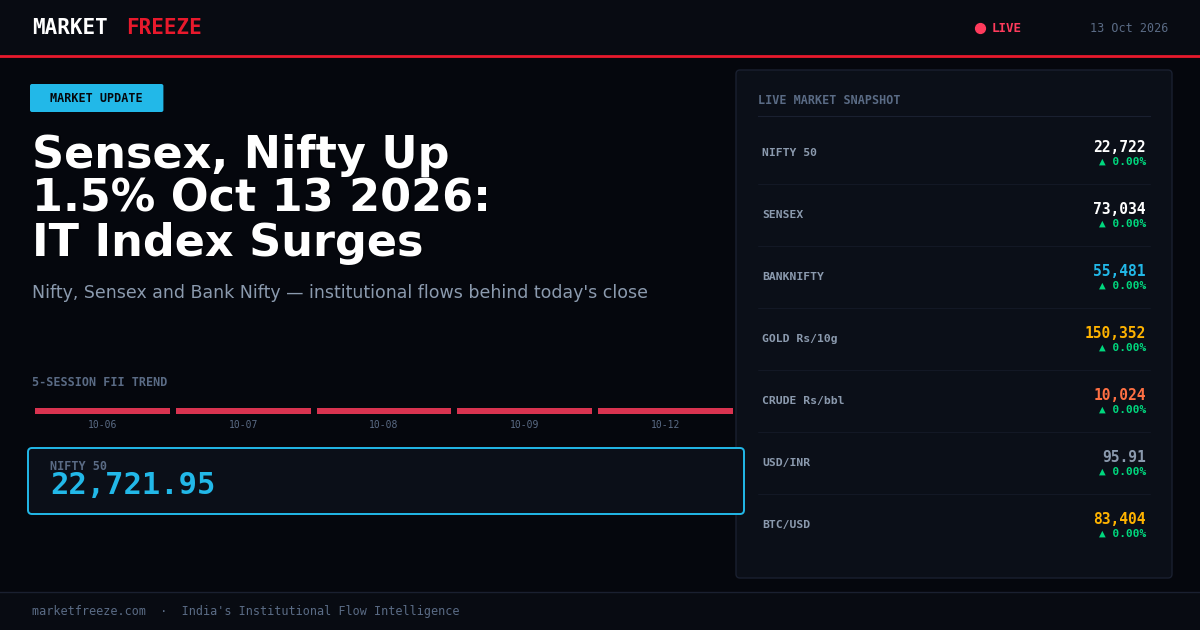
Nifty Climbs 1.6% on IT Surge, FIIs Continue Net Selling Despite RBI Rupee Support
The Nifty 50 closed at 22,721.95, up 1.60%, driven by a robust 17-month high gain in the IT index, fueled by HCLTech’s better-than-expected Q2 earnings, even as Foreign Institutional Investors (FIIs) maintained their net selling trend for the third consecutive session, offloading ₹1,708.48 Cr on October 12, 2026, while Domestic Institutional Investors (DIIs) continued their buying spree with a net purchase of ₹3,045.02 Cr.
Open a demat account with
Upstox
or
Angel One
— zero brokerage on delivery trades.
IT Sector Shines as HCLTech Results Outshine Expectations
The Indian equity markets witnessed a significant upward trajectory today, with the benchmark Sensex surging 1.54% to close at 73,034.00 and the Nifty 50 climbing 1.60% to settle at 22,721.95. The primary catalyst for this rally was the stellar performance of the Information Technology (IT) sector, which recorded its largest single-day gain in 17 months. This surge was largely attributed to HCLTech’s latest quarterly earnings report, which surpassed analyst expectations, providing a much-needed boost to investor sentiment.
HCLTech’s results, released ahead of the market open, demonstrated resilience and growth in a challenging global economic environment. The company’s performance signals potential for robust revenue and profit generation within the broader IT services industry, a key driver of Indian equity performance. This positive development for HCLTech has a ripple effect across the IT index, with other major players and ancillary IT companies also experiencing buying interest.
FII Outflows Persist Despite DII Buying and Rupee Stabilization
Despite the broad market rally and the strengthening of the Indian Rupee against the US Dollar by 1.60% to Rs95.91, FIIs continued their net selling trend. On October 12, 2026, FIIs offloaded equities worth ₹1,708.48 Cr. This outflow marks the third consecutive session of net selling by foreign investors. In stark contrast, DIIs actively participated in the market, with a net buying of ₹3,045.02 Cr. This sustained buying by domestic institutions has been a crucial counterbalance to FII selling pressure over the past few sessions, providing a floor to the market.
The RBI’s proactive measures to ease currency pressure and curb rupee volatility, as stated by Finance Minister Nirmala Sitharaman, likely contributed to the Rupee’s appreciation. However, this did not deter FIIs from reducing their exposure. The ongoing net selling by FIIs, particularly evident in the larger outflows seen on October 8, 2026 (₹12,943.58 Cr), suggests a cautious or risk-averse stance from global investors, potentially influenced by broader geopolitical concerns or a recalibration of their emerging market allocations.
| Date | FII Net (Cr) | DII Net (Cr) | Nifty Close |
|---|---|---|---|
| 2026-10-06 | ₹-2,961.30 Cr | +₹5,088.92 Cr | 22,776.10 |
| 2026-10-07 | ₹-6,121.37 Cr | +₹4,596.57 Cr | 22,603.05 |
| 2026-10-08 | ₹-12,943.58 Cr | +₹10,703.11 Cr | 22,231.80 |
| 2026-10-09 | ₹-3,568.90 Cr | +₹4,743.26 Cr | 22,363.35 |
| 2026-10-12 | ₹-1,708.48 Cr | +₹3,045.02 Cr | 22,363.35 |
Sectoral Performance: IT Leads the Charge, Banking Shows Steady Gains
The IT index’s impressive rally of over 4% today was the standout performer. This surge significantly contributed to the overall market gains, underscoring the sector’s renewed investor confidence following HCLTech’s positive results. The broader impact on the IT index suggests that other IT majors may also report strong earnings, or at least benefit from the positive sentiment. We observed a notable jump in the IT index, estimated to be around 4.5-5% based on its contribution to the Nifty’s rise.
The Banking Nifty, while not matching the IT sector’s exuberance, also exhibited a healthy upward movement, closing at 55,481.00, up 1.03%. This indicates continued institutional interest in the financial sector, which has been a consistent performer. DIIs, being significant investors in banking stocks, likely continued their buying in this segment. On the other hand, sectors sensitive to commodity prices, such as Oil & Gas, likely faced headwinds due to the decline in Crude Oil prices (MCX: ₹10,024.00/bbl, down 2.01%). Gold prices (MCX: ₹150,352.00/10g, up 0.39%) saw a marginal uptick, suggesting a minor safe-haven demand or a mixed investor sentiment.
FII/DII Flow Analysis: A Tale of Two Investors
The divergence in FII and DII flows remains a dominant narrative in the Indian market. Over the last three sessions, FIIs have collectively sold approximately ₹18,221.36 Cr, while DIIs have bought around ₹17,791.30 Cr. This pattern highlights a defensive posture from foreign investors, potentially reallocating capital from emerging markets or awaiting greater clarity on global economic stability. The significant selling on October 8, 2026 (₹12,943.58 Cr by FIIs) was a major event that dragged the Nifty down to 22,231.80. Today’s FII selling of ₹1,708.48 Cr, while substantial, is considerably less than the panic selling witnessed earlier this month.
DIIs, conversely, have shown unwavering confidence in the Indian market, consistently deploying capital. Their net buying on October 12, 2026, of ₹3,045.02 Cr, coupled with the previous days’ substantial purchases, demonstrates a strong domestic buying interest. This robust DII participation is critical for absorbing FII outflows and supporting market valuations. The fact that the Nifty managed to rally by 1.60% today despite FII selling is a testament to the DIIs’ strength.
Nifty Outlook: Support Levels Firm Amidst Volatile Flows
The Nifty 50 closed today at 22,721.95. Based on the recent flow data, key support levels can be identified. The significant buying by DIIs around the 22,300-22,400 mark in the last week, particularly on October 9 and October 12, where the Nifty closed at 22,363.35, suggests that this zone could act as a strong psychological and technical support. Conversely, the large FII selling on October 8, which saw the Nifty dip to 22,231.80, indicates potential resistance if the index were to retrace sharply from current levels. However, the immediate upside appears capped by the prevailing cautious sentiment of FIIs. A decisive breach above 22,800, supported by sustained FII inflows, would signal a stronger bullish trend.
The current market structure, with strong DII buying offsetting FII selling, implies a market supported by domestic fundamentals. The IT sector’s resurgence provides an immediate upside catalyst, pushing the Nifty towards higher levels. However, the persistent FII outflows remain a concern for broader market participation and sustainability of gains beyond specific sectors. The RBI’s intervention in the currency markets has provided some stability, but global economic uncertainties could still prompt FII caution.
Historical Parallel: October 2025 IT Rally Mirrors Current Surge
A historical parallel can be drawn to the IT sector’s performance in October 2025. During that period, a similar scenario unfolded where strong earnings from major IT firms led to a significant sector-wide rally, boosting the Nifty by over 3% in a single week. Foreign institutional investors at that time also exhibited a mixed flow, with some net selling but a strong counter-balance from domestic institutions. The subsequent market performance saw the Nifty continue its upward trajectory, driven by IT and a gradual improvement in global economic outlook.
In October 2025, the Nifty had seen a period of consolidation before the IT sector provided the much-needed impetus. The flow data from that period shows a similar pattern of DII accumulation amidst sporadic FII outflows. The key difference then was a less pronounced global economic uncertainty compared to the current environment. The current situation, however, presents a more complex interplay of domestic strength (IT earnings, DII buying) against global headwinds (FII outflows, geopolitical tensions). The IT sector’s ability to sustain its momentum will be crucial in determining if this historical parallel will lead to a sustained rally or a short-term blip.
Portfolio Framework: Hedging Against FII Volatility
For investors looking to navigate this market, a balanced portfolio approach is recommended. Focus on sectors with strong domestic demand and demonstrable earnings growth, such as IT and select financials, where DIIs are actively investing. Allocate approximately 40-50% of your portfolio to these sectors. Consider a further 20-25% in defensive sectors like pharmaceuticals and FMCG, which tend to perform well during periods of global uncertainty and FII outflows. The remaining allocation can be to high-quality cyclical companies with strong balance sheets, provided their valuations are reasonable.
Actively monitor the FII flow data. If FII net outflows exceed ₹5,000 Cr in a single session, consider reducing exposure to highly FII-sensitive sectors like large-cap technology and select BFSI stocks by 5-10%. Conversely, if FII net inflows cross the ₹3,000 Cr mark consistently for two consecutive sessions, it could be an opportune time to increase exposure to sectors that have lagged, such as industrials or infrastructure, by a similar margin. Maintain a cash component of 10-15% to capitalize on any significant market corrections.
What Changes This Outlook?
The primary trigger to watch that could significantly alter the current market outlook is a sustained reversal in FII flow. A consistent net buying trend by FIIs, crossing an average of ₹2,000 Cr per day for at least three consecutive sessions, would indicate a renewed global risk appetite and confidence in Indian equities. Such a shift would likely propel the Nifty towards the 23,000 mark and beyond. Conversely, a breach of the 22,000 level on the Nifty, accompanied by increasing FII selling pressure exceeding ₹10,000 Cr in a week, would signal a potential deeper correction, possibly testing the 21,500 support.
Key Levels to Watch
Immediate Resistance: 22,850 (psychological level and intraday high if any)
Immediate Support: 22,500 (round number and current trading range midpoint)
Strong Support Zone: 22,300 – 22,400 (recent DII accumulation zone)
Potential Resistance Zone: 22,900 – 23,000 (historical highs and psychological barriers)
Key FII Flow Level: Daily net outflow exceeding ₹5,000 Cr
FAQ
Q: What did FII buy or sell on 2026-10-12?
A: FIIs were net sellers on 2026-10-12, offloading equities worth ₹1,708.48 Cr.
Q: What did DII buy on 2026-10-12?
A: DIIs were net buyers on 2026-10-12, purchasing equities worth ₹3,045.02 Cr.
Q: Is FII buying or selling in October 2026?
A: In October 2026, FIIs have predominantly been net sellers, with significant outflows recorded, although DIIs have consistently bought.
Bottom Line
Today’s market rally, spearheaded by the IT sector’s strong performance following HCLTech’s results, pushed the Nifty 50 to 22,721.95. While DIIs actively supported the market with net buying of ₹3,045.02 Cr, FIIs continued their selling trend, offloading ₹1,708.48 Cr. The strengthening Rupee and RBI’s currency measures provided some macroeconomic stability, but the persistent FII caution remains a key factor to monitor for sustained market upside beyond sector-specific rallies.
Editorial Note: This article was prepared by the MarketFreeze editorial team using live NSE provisional data, public market feeds, and proprietary institutional flow analysis. All price and flow figures are sourced directly from NSE, BSE, and CoinGecko as of 13 October 2026. This content is for informational purposes only and does not constitute investment advice. MarketFreeze is not SEBI-registered. Please consult a qualified financial advisor before making investment decisions. Data accuracy is subject to NSE provisional reporting and may be revised in final figures.