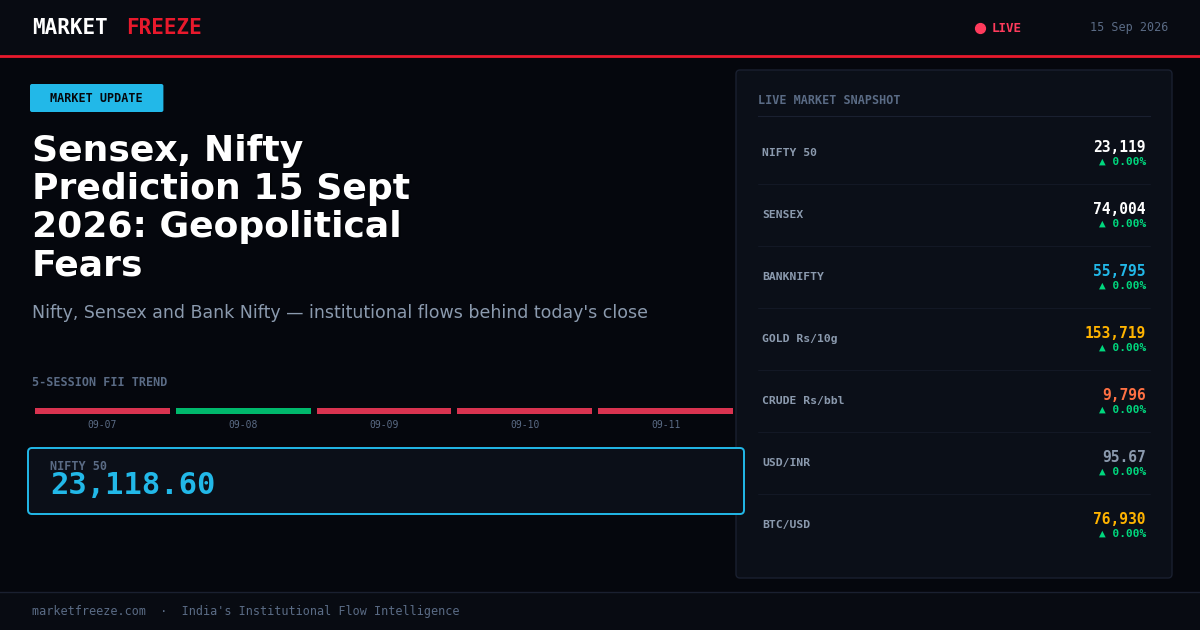
The Nifty 50 closed down 1.19% at 23,118.60 and the Sensex fell 1.04% to 74,004.00 on September 15, 2026, as escalating Middle East tensions drove crude oil prices up 3.11% to Rs9,796.00/bbl, igniting inflation fears and prompting a significant net sell of ₹930.90 Cr by Foreign Institutional Investors (FIIs).
FIIs Liquidate ₹930.90 Cr as Geopolitical Fears Dominate
On September 15, 2026, Foreign Institutional Investors (FIIs) offloaded a net ₹930.90 Cr from Indian equities, a stark reversal from their net buying trend observed in the preceding two sessions. This significant outflow coincided with a sharp 1.19% drop in the Nifty 50 to 23,118.60 and a 1.04% decline in the Sensex to 74,004.00. The primary catalyst appears to be the heightened geopolitical tensions in the Middle East, which sent crude oil prices surging by 3.11% to Rs9,796.00/bbl. This surge in oil prices, a key inflation indicator, stoked fears of a central bank rate hike, a narrative that typically prompts FIIs to reduce their exposure to emerging markets like India. Despite the broad market sell-off, Domestic Institutional Investors (DIIs) continued their buying spree, albeit at a slightly moderated pace compared to previous days, with a net buy of ₹1,968.17 Cr. This sustained DII buying, however, was insufficient to offset the substantial FII outflows, leading to the day’s downturn.
Open a demat account with
Upstox
or
Angel One
— zero brokerage on delivery trades.
Institutional Flow Snapshot: A Tale of Two Investors
The divergence in institutional investor behavior on September 15, 2026, was a defining feature of the trading session. FIIs turned net sellers to the tune of ₹930.90 Cr, marking the largest single-day outflow in the last three sessions. This comes after net sales of ₹582.99 Cr on September 10 and ₹123.19 Cr on September 9. Conversely, DIIs demonstrated consistent accumulation, buying ₹1,968.17 Cr worth of equities. This represents a marginal decrease from their ₹1,968.17 Cr purchase on September 11 and ₹1,509.04 Cr on September 10. The sustained buying by DIIs, despite FII outflows, indicates domestic institutions are potentially viewing the market dips as buying opportunities, possibly driven by a longer-term investment horizon or a belief in the resilience of the Indian economy. The contrasting flows highlight a potential tug-of-war between foreign and domestic institutional sentiment, with foreign capital showing heightened sensitivity to global macroeconomic headwinds.
IT Sector Shines Amidst Broader Market Gloom
While the broader market indices, Nifty 50 and Sensex, succumbed to selling pressure, the Information Technology (IT) sector emerged as a notable outlier, gaining 2.32%. This resilience in the IT sector can be attributed to a hopeful development on the global Artificial Intelligence (AI) front. Reports suggest that leading AI companies are now advocating for a more measured pace of AI development. This call for a slower trajectory could alleviate concerns about rapid technological obsolescence for IT services companies, which are heavily involved in providing IT support and development for legacy systems. The shift in narrative might also indicate a renewed focus on the practical implementation and integration of AI, where Indian IT firms hold significant expertise. This news, combined with the general market downturn, could have led to a rotation of funds into defensible IT counters as investors sought relative safety and potential growth drivers independent of immediate inflation and interest rate concerns. While today’s flow data doesn’t specifically break down sector-wise FII/DII purchases, the sharp outperformance of the IT index suggests that at least some institutional money, likely DIIs taking advantage of the dip, flowed into this sector.
Nifty Levels: Key Support and Resistance Zones Based on Recent Flow
Analyzing the recent flow data, we can infer potential support and resistance levels for the Nifty 50. The Nifty closed at 23,118.60 today, down from 23,398.10 on September 11. The significant FII selling on September 15, coupled with a broader market decline, suggests downward pressure. However, DII buying has provided some cushion. Based on the recent trend, a key support level to watch is around the 23,000 mark. This psychological level, if breached decisively, could trigger further selling pressure, potentially drawing FIIs to reduce their holdings further. On the upside, immediate resistance is likely to be encountered around the 23,300-23,400 zone, where the Nifty traded in the preceding sessions. A sustained move above 23,400 would require a reversal in FII sentiment and a de-escalation of geopolitical tensions.
Currency and Commodity Crossover: USD/INR’s Ascent Amidst Global Uncertainty
The Indian Rupee continued its weakening trend against the US Dollar, with USD/INR rising 0.97% to Rs95.67 on September 15, 2026. This depreciation of the Rupee is a direct consequence of the global risk-off sentiment driven by Middle East tensions. As global investors seek safe-haven assets, the US Dollar typically strengthens. Furthermore, rising crude oil prices, as seen today with MCX Crude up 3.11%, directly impact India’s import bill, widening the current account deficit and putting downward pressure on the Rupee. The combination of FII outflows and a strengthening dollar often leads to a weaker INR. This currency movement is crucial for institutional investors as it impacts the cost of their investments and the repatriation of profits. A sustained rise in USD/INR above Rs96.00 could further dampen investor sentiment and necessitate a reassessment of currency hedging strategies by foreign investors.
Historical Parallel: The 2022 Inflation Scare and FII Exodus
The current market scenario, characterized by rising oil prices, inflation fears, and the potential for central bank rate hikes, bears a resemblance to the market conditions experienced in mid-2022. During that period, global inflationary pressures, exacerbated by geopolitical events and supply chain disruptions, led to a significant sell-off by FIIs in Indian equities. Between May and June 2022, FIIs were net sellers of over ₹40,000 Cr as the Nifty 50 corrected by approximately 15% from its all-time highs. In that instance, the Reserve Bank of India (RBI) also initiated a series of rate hikes to combat inflation, which further pressured equity valuations. The DIIs, however, played a crucial role in cushioning the fall, buying substantial amounts during the downturn. While the magnitude of today’s FII outflow (₹930.90 Cr) is not comparable to the 2022 exodus, the underlying drivers of inflation and rate hike expectations are similar. If geopolitical tensions persist and crude prices remain elevated, we could witness a sustained period of FII outflows, mirroring the pattern observed in 2022.
Portfolio Framework: Hedging Against Inflationary Shocks
For investors looking to navigate the current market environment, a robust portfolio framework focusing on inflation hedging and defensive sectors is recommended. Specifically, consider allocating at least 15-20% of your portfolio to sectors like IT and Pharmaceuticals, which have demonstrated resilience and potential for independent growth drivers. Ensure that your fixed-income allocation is tilted towards shorter-duration instruments to mitigate interest rate risk, especially if the RBI signals further rate hikes. Furthermore, consider a modest allocation to commodities like Gold, which has historically acted as a hedge against inflation and geopolitical uncertainty. If Gold MCX prices consistently trade above Rs155,000/10g, it could signal escalating inflationary concerns that warrant increased portfolio defensiveness. Conversely, a sustained decline in crude oil prices below Rs9,000/bbl might ease inflation fears and allow for a potential shift back towards growth-oriented assets.
What Changes This Outlook: The US Fed’s Stance on Interest Rates
The single most critical factor that could alter the current market outlook is the US Federal Reserve’s monetary policy stance. Today’s news highlights that a sell-off in US Treasuries strengthened the case for a US Federal Reserve rate hike. If the Fed signals a more aggressive rate hike cycle than currently anticipated, it would likely lead to further FII outflows from emerging markets, including India, and put additional downward pressure on the Nifty 50. Conversely, any indication from the Fed that they are nearing the end of their rate hike cycle, or that they are willing to pause, could provide significant relief to global markets and potentially reverse the current FII selling trend. Monitoring the US Federal Reserve meeting minutes and statements from Fed officials is paramount for gauging future market direction. A clear signal of a pause in rate hikes from the Fed, particularly if accompanied by a stabilization in crude oil prices below Rs9,500/bbl, would be a key trigger for a potential market recovery.
Historical FII/DII Flow Data (Last 5 Sessions)
| Date | FII Net (Cr) | DII Net (Cr) | Nifty Close |
|---|---|---|---|
| 2026-09-07 | ₹-3,111.94 Cr | +₹8,930.12 Cr | 23,779.15 |
| 2026-09-08 | +₹280.13 Cr | +₹566.76 Cr | 23,635.10 |
| 2026-09-09 | ₹-123.19 Cr | +₹1,349.64 Cr | 23,431.50 |
| 2026-09-10 | ₹-582.99 Cr | +₹1,509.04 Cr | 23,477.80 |
| 2026-09-11 | ₹-930.90 Cr | +₹1,968.17 Cr | 23,398.10 |
Frequently Asked Questions
Q: What did FII buy or sell on September 15, 2026?
A: On September 15, 2026, FIIs were net sellers of ₹930.90 Cr.
Q: What did DII buy on September 15, 2026?
A: On September 15, 2026, DIIs were net buyers of ₹1,968.17 Cr.
Q: Is FII buying or selling in September 2026?
A: In September 2026, FIIs have largely been net sellers, with significant outflows observed on September 7 (₹3,111.94 Cr) and September 15 (₹930.90 Cr), interspersed with smaller net sales and one day of net buying on September 8 (₹280.13 Cr).
Key Levels to Watch for Nifty
Support: Immediate support for the Nifty 50 is seen around the 23,000 level. A decisive breach below this could lead to further declines. Extended support would be around the 22,800 mark, a level not tested recently but could come into play if selling pressure intensifies.
Resistance: The immediate resistance for the Nifty 50 lies in the 23,300-23,400 band. Breaking decisively above 23,500 would indicate a potential shift in sentiment and a move towards higher levels.
Bottom Line
The Indian equity markets experienced a significant downturn on September 15, 2026, driven by global geopolitical concerns and rising oil prices, leading to a substantial ₹930.90 Cr outflow from FIIs. Despite this, DIIs continued their robust buying, accumulating ₹1,968.17 Cr, providing a degree of stability. The IT sector bucked the trend with a 2.32% gain, signaling potential rotation into defensible growth areas. Investors should closely monitor crude oil prices and US Federal Reserve policy for future market direction, with key Nifty support at 23,000 and resistance at 23,400.
Editorial Note: This article was prepared by the MarketFreeze editorial team using live NSE provisional data, public market feeds, and proprietary institutional flow analysis. All price and flow figures are sourced directly from NSE, BSE, and CoinGecko as of 15 September 2026. This content is for informational purposes only and does not constitute investment advice. MarketFreeze is not SEBI-registered. Please consult a qualified financial advisor before making investment decisions. Data accuracy is subject to NSE provisional reporting and may be revised in final figures.