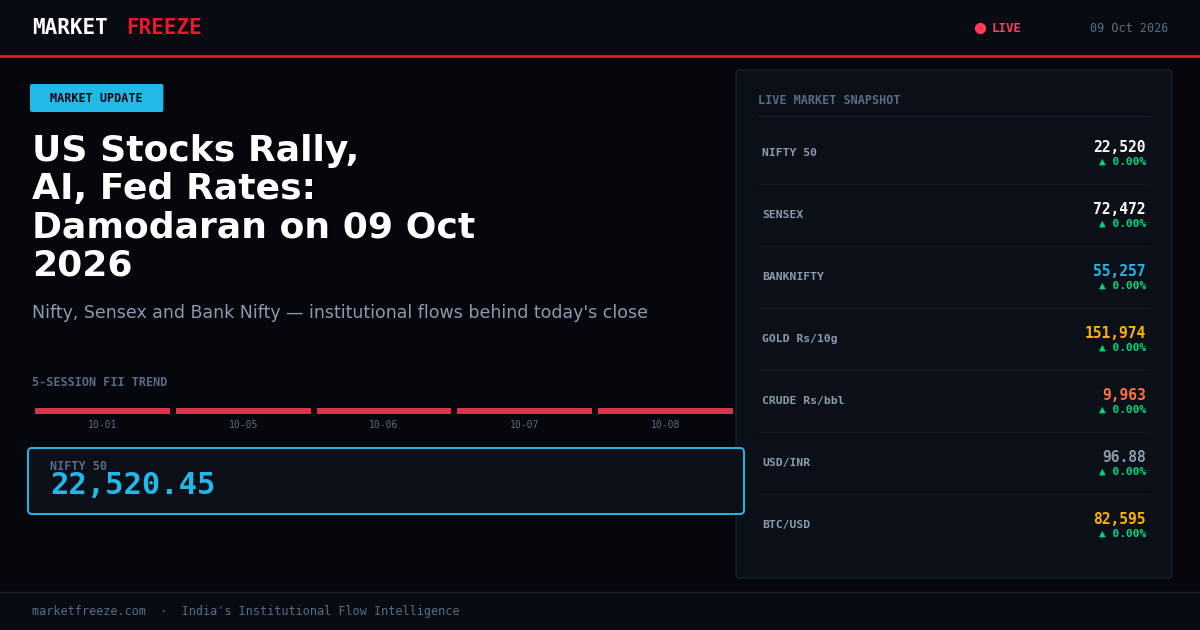
Indian equities staged a strong rebound today, with the Nifty 50 closing 1.30% higher at 22,520.45 and the Sensex up 1.23% at 72,472.00, defying global headwinds and driven by robust domestic institutional buying that more than offset persistent Foreign Institutional Investor (FII) selling, as global markets grapple with AI-driven growth narratives against rising US Treasury yields.
AI Rally’s Double-Edged Sword: FIIs Net Sell ₹12,943 Cr as DIIs Counter with ₹10,703 Cr Buy
While global markets, as highlighted by valuation expert Aswath Damodaran, are rallying on the back of AI-led earnings growth despite a hawkish US Federal Reserve stance and rising Treasury yields, the Indian market today presented a nuanced picture. The narrative of AI-driven optimism, which is propping up US equities, appears to be leading to a divergence in institutional flows within India. Today, Foreign Institutional Investors (FIIs) continued their selling spree, offloading a substantial ₹12,943.58 Cr net on October 8th, an acceleration from the previous sessions’ sell-offs of ₹6,121.37 Cr (October 7th) and ₹2,961.30 Cr (October 6th). Conversely, Domestic Institutional Investors (DIIs) displayed unwavering confidence, stepping in as significant buyers with a net purchase of ₹10,703.11 Cr on October 8th, following their consistent buying of ₹4,596.57 Cr (October 7th) and ₹5,088.92 Cr (October 6th). This substantial DII buying cushion was instrumental in absorbing FII selling pressure and propelling the Nifty 50 to close at 22,520.45, up 1.30%. The disconnect suggests that while global AI optimism influences broad market sentiment, FIIs are perhaps reassessing their India allocation in light of valuation concerns or seeking to rebalance portfolios, while DIIs are capitalizing on perceived undervalues or their mandate to support the domestic market.
Open a free demat account with
Upstox
or
Angel One
— zero brokerage on delivery trades.
IT Sector Gains Ahead of Earnings Amidst Global AI Hype, But FIIs Remain Cautious
The global narrative around AI-driven earnings growth, as articulated by Aswath Damodaran, has a direct implication for India’s Information Technology (IT) sector. HCL Technologies, for instance, saw its shares rise 2.57% today, anticipating its Q2 FY27 results announcement on October 12th. This specific sector rally, occurring amidst a broader market upswing, is likely a reflection of investors positioning for strong earnings from IT majors, potentially fueled by increased spending on AI-related services and digital transformation by global clients. However, the persistent FII selling, even as the IT sector shows buoyancy, raises a crucial question: are these FII outflows a sector-specific rebalancing, or a broader risk-off sentiment impacting growth stocks irrespective of their thematic appeal? If FIIs are indeed trimming their IT exposure, it could signal a concern about the sustainability of AI-led growth at current valuations, a sentiment echoed by Damodaran’s warning about equity risk premiums falling below 4% and the potential for a sharp market correction if AI investments fail to meet expectations. The DIIs’ continued buying in such an environment suggests they might be accumulating IT stocks at current levels, viewing the FII sell-off as an opportunity rather than a sign of fundamental weakness, particularly given the robust order books and digital spending trends.
Divergent Flows: FIIs Exit ₹12,943 Cr, DIIs Inject ₹10,703 Cr on Oct 8th
On October 8th, 2026, the Indian equity market witnessed a stark contrast in institutional investor behavior. FIIs were net sellers to the tune of ₹12,943.58 Cr, marking a significant outflow. This selling pressure was substantially absorbed by DIIs, who were net buyers with an inflow of ₹10,703.11 Cr. This dynamic played out as the Nifty 50 gained 1.30%, closing at 22,520.45. The scale of DII buying indicates strong domestic conviction, possibly driven by a belief in the long-term growth prospects of Indian companies or tactical asset allocation adjustments. The FII outflow, while concerning, did not derail the market’s upward momentum today, underscoring the growing influence of domestic capital in supporting Indian equities. The previous sessions also showed a similar trend: on October 7th, FIIs sold ₹6,121.37 Cr while DIIs bought ₹4,596.57 Cr, and on October 6th, FIIs sold ₹2,961.30 Cr against DII buying of ₹5,088.92 Cr. This sustained DII buying pattern provides a strong support base for the market, even in the face of significant FII outflows.
FII/DII Net Flows (Last 5 Sessions):
| Date | FII Net (Cr) | DII Net (Cr) | Nifty Close |
|---|---|---|---|
| 2026-10-01 | ₹-9,484.22 Cr | +₹10,041.84 Cr | 22,555.75 |
| 2026-10-05 | ₹-4,699.14 Cr | +₹5,181.62 Cr | 22,776.10 |
| 2026-10-06 | ₹-2,961.30 Cr | +₹5,088.92 Cr | 22,776.10 |
| 2026-10-07 | ₹-6,121.37 Cr | +₹4,596.57 Cr | 22,603.05 |
| 2026-10-08 | ₹-12,943.58 Cr | +₹10,703.11 Cr | 22,231.80 |
Banking and Financials Benefit from DII Accumulation Amidst Broader Market Gains
While the AI narrative primarily impacts the IT sector, today’s broad-based rally saw all sectoral indices trading higher. However, the sheer quantum of DII buying, amounting to ₹10,703.11 Cr on October 8th, likely found its way significantly into Banking and Financial Services stocks. DIIs, often having a longer-term investment horizon and a mandate to support domestic markets, are typically heavy investors in these stable, large-cap sectors. The Bank Nifty closed up 1.36% at 55,257.00, indicating strong demand. This is occurring even as FIIs net sold ₹12,943.58 Cr, suggesting that DIIs are actively counterbalancing FII outflows, potentially using the market dips, influenced by FII selling, to accumulate quality financial assets. The resilience of the banking sector, which forms a significant portion of benchmark indices, is crucial for overall market stability. The positive sentiment, coupled with DII’s consistent accumulation, is likely underpinning the banking sector’s performance, making it a key beneficiary of domestic institutional flow today.
Key Levels to Watch: Nifty Finds Support Near 22,200, Resistance at 22,600
Based on the recent flow dynamics and today’s price action, key levels for the Nifty 50 can be identified. The significant DII buying activity, particularly on October 8th when they bought ₹10,703.11 Cr, suggests strong absorption of selling pressure. The Nifty closed today at 22,520.45. The sustained DII inflows indicate a floor is being established. Historically, the Nifty has shown resilience when DIIs are actively buying, even amid FII outflows. A crucial support level appears to be forming around the 22,200-22,300 zone, where the market seemed to find a bottom on October 8th before the rebound. Should FII selling intensify or DII buying falter, a breach of this support could trigger further downside. On the upside, the immediate resistance would be the day’s high and then the psychological level of 22,600, which the index tested in previous sessions. A decisive move above 22,600, supported by continued DII buying and potentially a moderation in FII selling, could signal a continuation of the upward trend. Conversely, a sustained FII selling of over ₹10,000 Cr for consecutive days, without commensurate DII buying, would be a significant red flag, potentially pushing the Nifty back towards the 22,000 mark.
USD/INR Edges Lower as DII Inflows Offer Rupee Support
The Indian Rupee (USD/INR) traded marginally lower today, closing at Rs96.88, down 0.03%. This stability, despite potential global currency volatility, can be partly attributed to the substantial DII inflows of ₹10,703.11 Cr observed on October 8th. Such significant domestic buying in equities translates into demand for Indian Rupees, helping to support the currency against the US Dollar. While FIIs continued to be net sellers, the sheer volume of DII inflows appears to be more than enough to offset any potential weakening pressure on the Rupee stemming from FII outflows. This suggests that domestic capital remains a dominant force in influencing currency stability in the short term. The global context of rising US Treasury yields, which typically strengthens the dollar, is being counteracted by strong domestic demand for the Rupee, indicating a localized bullish sentiment driven by institutional flows.
Historical Parallel: October 2022’s FII Sell-off Met by DII Resilience
Looking back for a historical parallel to today’s FII selling coupled with DII buying, the situation in October 2022 offers a comparable scenario. During that period, FIIs were net sellers for several consecutive weeks, driven by global monetary tightening and recession fears. However, DIIs consistently stepped in, absorbing a significant portion of the selling pressure and preventing a sharper market decline. For instance, in the week of October 17-21, 2022, FIIs were net sellers of over ₹15,000 Cr, while DIIs were net buyers of nearly ₹12,000 Cr. This dynamic eventually led to a market consolidation followed by a gradual recovery as domestic demand proved resilient. Today’s pattern of substantial FII outflows (₹12,943.58 Cr on Oct 8th) met by equally robust DII inflows (₹10,703.11 Cr on Oct 8th) mirrors this historical resilience. In 2022, this domestic support eventually paved the way for a market rally. Whether a similar outcome awaits this time hinges on the sustainability of DII buying and the trajectory of FII flows. The current market is trading around Nifty 22,520.45, which is significantly higher than the levels seen in October 2022, indicating that while the flow dynamic might be similar, the valuation context is different.
Portfolio Framework: Accumulate on DII-led Dips Above 22,000, Trim if FII Outflows Exceed ₹15,000 Cr
For investors seeking to navigate this market influenced by divergent institutional flows, a clear framework is essential. Given today’s scenario, where DIIs are actively buying to counter FII selling, a strategy of “accumulate on dips” appears prudent, provided the Nifty remains above the crucial 22,000 level. Specifically, if the Nifty corrects by 1-1.5% within a trading session, and DII buying volume remains healthy (exceeding ₹5,000 Cr net), consider adding to high-quality fundamentally sound stocks, particularly in the banking and IT sectors, where DIIs are showing strong conviction. However, a clear trigger for caution would be if FII net selling consistently exceeds ₹15,000 Cr for two consecutive sessions, without a proportionate increase in DII buying. In such a scenario, it would be advisable to reduce exposure to highly leveraged or mid-cap growth stocks and increase allocation to defensives or value plays. The current equity risk premium, as flagged by Damodaran, also warrants a selective approach, favouring companies with demonstrable earnings visibility over speculative bets.
FAQ Section
Q: What did FII buy or sell on 08 October 2026?
A: On 08 October 2026, FIIs were net sellers with an outflow of ₹12,943.58 Cr.
Q: What did DII buy on 08 October 2026?
A: On 08 October 2026, DIIs were net buyers with an inflow of ₹10,703.11 Cr.
Q: Is FII buying or selling in October 2026?
A: In October 2026, FIIs have shown a consistent trend of net selling, with outflows recorded on October 1st (₹9,484.22 Cr), October 5th (₹4,699.14 Cr), October 6th (₹2,961.30 Cr), October 7th (₹6,121.37 Cr), and October 8th (₹12,943.58 Cr).
Bottom Line
Today’s market performance was a testament to the strength of domestic institutional investors, who successfully countered significant FII selling and propelled the Nifty 50 to close higher at 22,520.45. While global optimism around AI-driven growth persists, FIIs continued their cautious stance with substantial outflows, a trend that warrants close monitoring. DIIs’ robust buying, particularly in banking and financial services, provided a crucial support base, highlighting their increasing influence on market direction. Investors should remain vigilant, using DII-led dips above the 22,000 mark for accumulation, while being prepared to trim positions if FII selling crosses critical thresholds.
Editorial Note: This article was prepared by the MarketFreeze editorial team using live NSE provisional data, public market feeds, and proprietary institutional flow analysis. All price and flow figures are sourced directly from NSE, BSE, and CoinGecko as of 09 October 2026. This content is for informational purposes only and does not constitute investment advice. MarketFreeze is not SEBI-registered. Please consult a qualified financial advisor before making investment decisions. Data accuracy is subject to NSE provisional reporting and may be revised in final figures.