Bitcoin is trading at $78,685 USD or ₹7,538,023 INR, down 0.39% in the last 24 hours. The cryptocurrency market is exhibiting a mixed performance today, with Ethereum seeing a more significant dip of 1.88% to $2,459 USD (₹235,572 INR). This comes as European crypto regulation, MiCA, is reshaping the landscape, with Poland experiencing the impact, as highlighted by Mateusz Kara, founder and CEO of Morphic Financial Group. While the broader market shows some weakness, Solana is bucking the trend, up 0.96% to $96.98 USD (₹9,290 INR).
Open a free demat account with
Upstox
or
Angel One
— zero brokerage on delivery trades.
Bitcoin Holds Steady Amidst Broader Crypto Softness, European Regulatory Winds Blow
Bitcoin’s resilience is notable today, trading at $78,685 USD (₹7,538,023 INR), down a marginal 0.39% over the past 24 hours. This relative stability contrasts with Ethereum’s sharper decline of 1.88%, pushing its price to $2,459 USD (₹235,572 INR). The global crypto regulatory environment continues to evolve, with the implementation of MiCA in Europe reportedly causing significant shifts. Reports from Poland suggest a period of adjustment and recalibration following the regulatory overhaul, underscoring the complex interplay between innovation and oversight in the digital asset space. While specific impacts on Bitcoin’s price are not directly cited in these developments, the overarching regulatory clarity provided by MiCA can influence institutional adoption trends, which in turn, can affect major assets like Bitcoin.
The Weakening Rupee’s Impact on Indian Crypto Investor Returns
The USD/INR exchange rate stands at ₹95.8 today. For Indian investors holding cryptocurrencies priced in USD, a weakening rupee translates to higher INR returns, assuming the crypto asset’s USD price remains constant. Conversely, if the crypto asset’s USD price falls, the impact of the weakening rupee can cushion some of the losses. For instance, if an Indian investor holds Bitcoin, which is down 0.39% in USD terms, the INR value of their holdings would be affected by both the crypto’s price movement and the USD/INR rate. A slight depreciation in INR would mitigate the INR-denominated loss from Bitcoin’s USD price fall. This dynamic is crucial for Indian retail investors to consider when evaluating their overall portfolio performance, as currency fluctuations can significantly alter the net returns on their crypto investments.
Ethereum’s Underperformance and the ETH/BTC Ratio
Ethereum is experiencing a notable downturn today, down 1.88% to $2,459 USD (₹235,572 INR). The ETH/BTC ratio currently stands at 0.0313, indicating that Bitcoin is outperforming Ethereum on a relative basis. This divergence can be attributed to various factors, including shifts in developer activity, upcoming network upgrades, or changing institutional interest. Today’s news mentioning a 3% token move triggering $36 million in Ethereum DeFi liquidations suggests underlying fragility or specific market mechanics within the Ethereum ecosystem that could be contributing to its current weakness. Such events, even if isolated, can create broader sentiment shifts affecting the asset’s price relative to Bitcoin.
Solana’s Upward Momentum in a Mixed Altcoin Landscape
While Bitcoin and Ethereum show some weakness, Solana is demonstrating strength, trading up 0.96% to $96.98 USD (₹9,290 INR). This upward movement for Solana occurs within a generally mixed altcoin market, where other assets may be experiencing different price dynamics. The cryptocurrency space is diverse, and individual project developments, technological advancements, or specific narrative shifts can drive performance independent of the broader market leaders. Investors closely monitoring the altcoin segment will be looking for continued momentum in assets like Solana, which suggest potential leadership in emerging trends.
“Greed” Dominates Investor Sentiment, Hinting at Potential Pullbacks
The Fear & Greed Index is currently at 74/100, firmly in the “Greed” territory. Historically, readings above 60 have often preceded short-term market corrections ranging from 5% to 15% within a 2-4 week timeframe. While periods of sustained greed, such as seen in 2020-2021 when it remained above 75 for months, can extend bull cycles, current elevated levels warrant caution. This high greed reading suggests that market participants might be overly optimistic, potentially overlooking underlying risks. For Indian retail investors, this signals a time to re-evaluate portfolio allocations and consider taking some profits, especially if their holdings are skewed towards assets that have seen significant recent gains.
FII Inflows Support Indian Equities Amidst Crypto Fluctuations
Foreign Institutional Investors (FIIs) were net buyers in Indian equities today, injecting ₹1,182 Cr into the market. This positive flow from FIIs provides a supportive backdrop for the Indian stock market, with the Nifty currently trading at 24334.55. The sustained buying interest from foreign institutions suggests confidence in the Indian economic outlook. While not a direct correlation, strong FII inflows into equities can sometimes be seen as an alternative destination for capital that might otherwise flow into riskier assets like cryptocurrencies, or vice versa. The current robust FII activity indicates that traditional markets are attracting significant institutional attention.
Navigating Crypto Tax: A Hypothetical Scenario with Today’s Bitcoin Price
Understanding the tax implications of cryptocurrency transactions is crucial for Indian investors. Let’s consider a hypothetical scenario: an investor purchased 0.5 BTC when it was priced at $75,000 USD (₹7,200,000 INR) and decides to sell it today at $78,685 USD (₹7,538,023 INR). The profit on this sale would be approximately $3,685 USD per BTC, or ₹338,023 INR per BTC. For the 0.5 BTC sold, this amounts to a profit of roughly $1,842.5 USD (₹169,011.5 INR). Under India’s current crypto tax laws, this profit would be taxed at a flat rate of 30%, plus applicable surcharges and cess. Therefore, the tax liability on this specific transaction would be approximately ₹50,703.45 INR (30% of ₹169,011.5 INR), excluding any other charges. It is essential for investors to maintain detailed records of all their crypto transactions to accurately calculate their tax liabilities.
Key Levels to Watch for Nifty Based on Today’s FII Flows
Given the strong net buying of ₹1,182 Cr by FIIs today, and their consistent presence as net buyers over the last few sessions, we can infer a bullish bias from institutional foreign investors towards Indian equities. This suggests that immediate downside in the Nifty might be supported. Key support levels for the Nifty can be anticipated around the 24,200 mark, a level it has tested and consolidated around in recent days. A sustained push above the current trading levels, potentially towards the 24,500–24,600 range, could be a sign of further upside momentum. However, any significant reversal in FII flows or a sudden sell-off in global markets could quickly shift these levels, making the 24,000 psychological level a critical point to monitor for potential breakdowns.
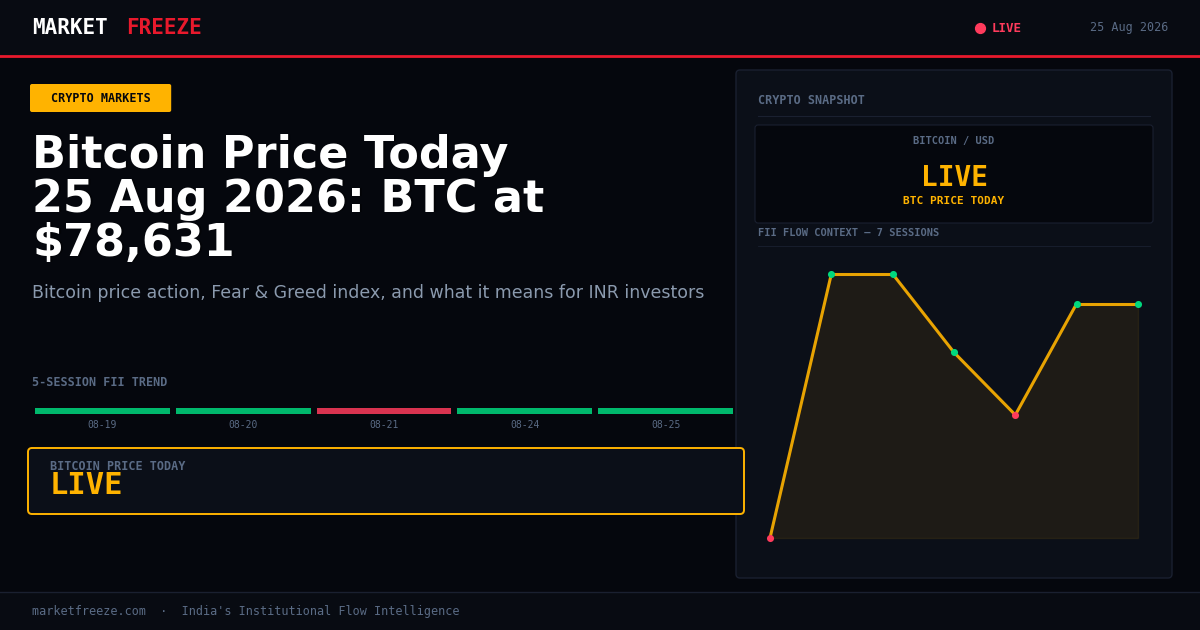
MarketFreeze Institutional Flow Data: Last 5 Sessions
| Date | FII Net (Cr) | DII Net (Cr) | Nifty Close |
|---|---|---|---|
| 2026-08-19 | +₹1,651.53 Cr | +₹2,579.31 Cr | 24,078.30 |
| 2026-08-20 | +₹407.99 Cr | +₹3,973.72 Cr | 24,231.85 |
| 2026-08-21 | ₹-583.36 Cr | +₹3,537.71 Cr | 24,252.00 |
| 2026-08-24 | +₹1,181.66 Cr | +₹2,493.41 Cr | 24,219.05 |
| 2026-08-25 | +₹1,181.66 Cr | +₹2,493.41 Cr | 24,334.55 |
FAQ: Your Crypto and Market Questions Answered
Q: What did FII buy or sell on 2026-08-21?
A: FIIs were net sellers on 2026-08-21, with a net outflow of ₹-583.36 Cr.
Q: What did DII buy on 2026-08-20?
A: Domestic Institutional Investors (DIIs) were significant net buyers on 2026-08-20, with a net inflow of +₹3,973.72 Cr.
Q: Is FII buying or selling in August 2026?
A: In August 2026, FIIs have shown a general trend of net buying, with inflows recorded on most trading days, indicating a positive stance towards Indian equities for the month so far.
Actionable Framework: Navigating “Greed” and FII Strength
Scenario: FIIs continue their buying spree, and the Fear & Greed Index remains elevated.
- FII Flow Confirmation: Monitor FII net flows closely. If today’s ₹1,182 Cr inflow is sustained or increases in the next 1-2 sessions, it reinforces the bullish institutional sentiment.
- Greed Index Deceleration: Look for the Fear & Greed Index to either stabilize below 75 or begin a gradual decline from the current 74. A rapid fall from these levels would signal increased caution.
- Nifty Pivot Points: If FII flows remain strong and Greed moderates, the Nifty could aim for new highs. A break above 24,400 with increasing volumes would be a bullish signal. Conversely, if FII flows turn negative or Greed spikes higher, the Nifty support at 24,200 becomes critical.
- Crypto Rebalancing Consideration: With high “Greed” in crypto, consider rebalancing crypto portfolios towards stablecoins or taking partial profits on assets that have seen substantial recent gains, especially if your crypto allocation exceeds your risk tolerance.
Bottom Line
Today’s market sees Bitcoin holding steady while Ethereum dips, amidst evolving global crypto regulations. The Indian equity market, bolstered by strong FII inflows of ₹1,182 Cr, shows resilience. The prevailing “Greed” sentiment in the crypto market, indicated by a 74/100 Fear & Greed Index reading, suggests a potential for short-term corrections. Indian investors should remain mindful of the USD/INR rate’s impact on their crypto returns and the ongoing institutional activity in domestic equities.
Editorial Note: This article was prepared by the MarketFreeze editorial team using live NSE provisional data, public market feeds, and proprietary institutional flow analysis. All price and flow figures are sourced directly from NSE, BSE, and CoinGecko as of 25 August 2026. This content is for informational purposes only and does not constitute investment advice. MarketFreeze is not SEBI-registered. Please consult a qualified financial advisor before making investment decisions. Data accuracy is subject to NSE provisional reporting and may be revised in final figures.