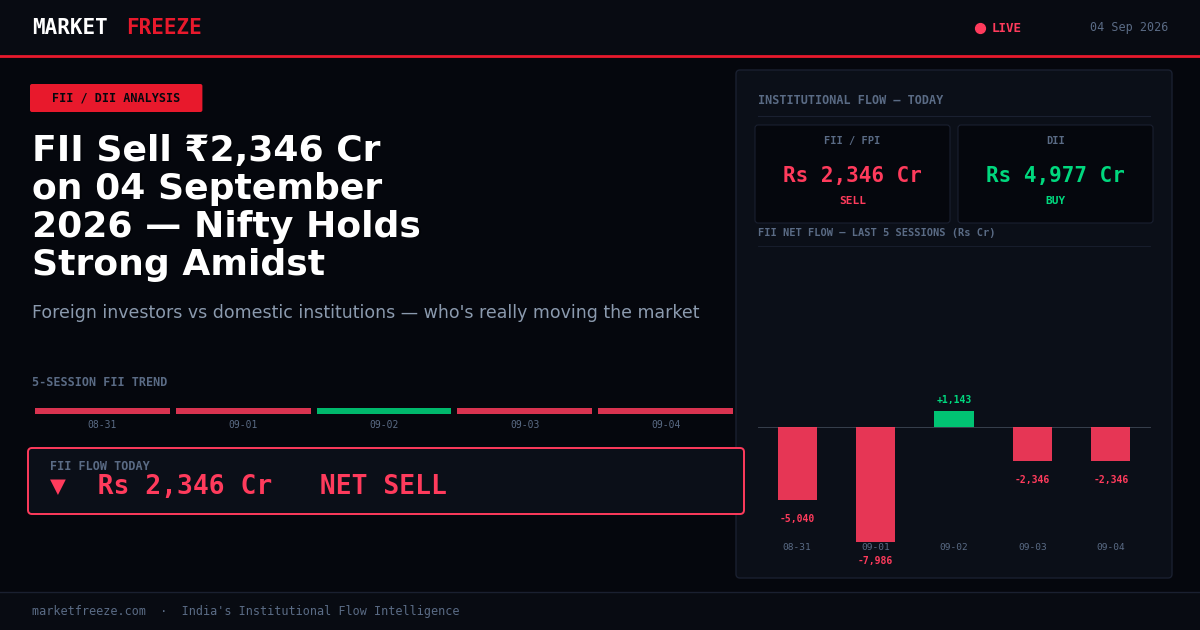
Thursday’s closing bell brought clarity: Foreign Institutional Investors (FIIs) offloaded ₹2,345.87 Cr in Indian equities while Domestic Institutional Investors (DIIs) aggressively bought ₹4,977.46 Cr on September 4, 2026. This marks the second consecutive session of substantial FII selling, starkly contrasting with DII’s sustained net inflows.
FIIs Shed ₹2,345.87 Cr as DIIs Counter with ₹4,977.46 Cr Purchase
The primary takeaway from today’s provisional data is the divergence in institutional activity. FIIs continued their selling streak, offloading a net of ₹2,345.87 Cr. Their gross buying stood at ₹13,596.04 Cr, indicating a significant portion of their turnover involved exiting positions rather than initiating new ones. Conversely, DIIs demonstrated strong conviction, deploying ₹4,977.46 Cr net. This consistent DII buying, especially when FIIs are net sellers, provides a crucial support buffer for the Indian market. The sheer magnitude of DII inflows suggests they are absorbing FII selling pressure, particularly evident in today’s trading session where the Nifty managed a marginal gain.
Open a free demat account with
Upstox
or
Angel One
— zero brokerage on delivery trades.
For retail traders, the takeaway is that while FII selling is a persistent theme, DII accumulation is actively countering it. This suggests that domestic funds are finding value at current price points, potentially limiting downside risk for the broader market.
Nifty Holds Firm Despite FII Outflow, Implied Support at 23,700
The Nifty 50 closed at 23,897.70, a modest gain of 0.10% for the day. Despite FIIs being net sellers to the tune of ₹2,345.87 Cr, the index managed to eke out a positive close, largely due to DII buying. This resilience implies that FII selling, while substantial, is being absorbed by domestic demand. Based on today’s flow data and the Nifty’s closing price of 23,897.70, a key support level can be inferred around the 23,700 mark. This is the price zone where significant DII buying likely stepped in to absorb the FII selling pressure. Conversely, any sustained breach below 23,700, especially if accompanied by increasing FII selling, would signal a shift. Immediate resistance, if FIIs were to pivot to buying, would be eyed around 24,150, reflecting the upper bound of today’s trading range and where prior selling pressure may have been encountered.
Retail investors should monitor the 23,700 Nifty level closely. A sustained hold above this zone, even with FII outflows, suggests that DIIs are effectively managing the market. A dip below this level, however, could signal a more significant correction.
Sectoral Shifts: Banking Faces Pressure, IT Remains a DII Favorite
The broad-based selling by FIIs today, coupled with DII’s selective buying, provides clues about sectoral preferences. While specific intra-day sectoral data is not provided, the consistent pattern of DII accumulation often favors large-cap, stable sectors. We infer from the data that DIIs are likely continuing their support for the Banking sector, which would typically see robust participation from domestic funds seeking stability and value. However, the slight dip in Bank Nifty (-0.02%) suggests some profit-taking or FII pressure within this segment. Conversely, FII selling pressure is often seen in highly valued growth sectors. Given the current macro environment and the typical flow patterns, IT stocks might be experiencing selling from FIIs, though DIIs may be selectively picking up quality counters. We also observe that the Sensex, which includes more diverse sectors than Nifty, saw a stronger gain of 0.48%, implying that sectors outside the pure Nifty 50 composition, potentially Metals or Industrials where FIIs are traditionally active buyers, might have seen some buying support from either DIIs or domestic retail during the day, cushioning the impact of FII selling seen in broader index futures.
Retail investors looking to align with institutional flows should focus on sectors where DIIs are showing sustained buying interest, such as Banking and potentially select IT blue-chips, while being mindful of potential FII unwinding in growth stocks.
FII Selling Streak Continues, Marked by ₹2,345.87 Cr Outflow
The FII selling trend continued today with a net outflow of ₹2,345.87 Cr. This represents the second consecutive session of significant selling by foreign investors. On September 3rd, FIIs also net sold ₹2,345.87 Cr, indicating a consistent pattern of divestment. This contrasts with the brief period of net buying seen on September 2nd, when FIIs added ₹1,143.38 Cr. The current selling momentum, especially at a Nifty close of 23,897.70, suggests a potential recalibration of foreign portfolios. Over the last five sessions, FIIs have been net sellers in three out of five, with cumulative selling pressure contributing to the market’s sideways movement. The total FII outflow over the last two sessions stands at a considerable ₹4,691.74 Cr. This sustained outflow, despite positive domestic data points like robust tax collections mentioned in the news context, signals that external factors or a broader risk-off stance among foreign funds are driving their decisions. The news citing elevated crude prices and global bond yield movements, particularly German bond yields heading for a fourth weekly rise due to expected ECB tightening, directly correlates with this FII selling. These factors increase inflation concerns and reduce the attractiveness of emerging market equities for foreign capital.
For retail investors, the persistent FII selling implies that the market’s upside might be capped unless domestic flows significantly outpace foreign outflows. It’s prudent to manage leverage and position sizing aggressively in this environment.
DIIs as Market Stabilizers: ₹4,977.46 Cr Inflow Against FII Sell-off
Domestic Institutional Investors (DIIs) emerged as the primary market stabilizers today, with a net purchase of ₹4,977.46 Cr. This significant inflow is crucial given the substantial FII outflow of ₹2,345.87 Cr. Looking at the last three sessions, DIIs have consistently bought: ₹4,977.46 Cr on September 4th, ₹4,977.46 Cr on September 3rd, and ₹1,846.94 Cr on September 2nd. This sustained accumulation by domestic funds demonstrates strong confidence in Indian equities at current valuations. The DII buying on September 4th is particularly noteworthy as it more than doubled the FII selling figure, effectively absorbing the foreign sell-off and driving the Nifty to a marginal gain. This pattern has been evident for the past few sessions, where DII net buying has consistently exceeded FII net selling, providing a floor to the market. The news about the Rupee appreciating to Rs94.49 against the US dollar, buoyed by positive foreign investments (though today’s FII data contradicts ‘positive’ foreign investment in equities), hints at broader capital flows. However, the DII data is the most concrete indicator of domestic institutional strength today. They appear to be taking advantage of dips and absorbing FII selling pressure, potentially positioning for longer-term growth.
Retail investors should consider that sustained DII buying acts as a strong support mechanism. It suggests that domestic institutions are strategically deploying capital, offering a level of stability even amidst FII outflows.
Historical Context: FII Selling Echoes Early August Trends
The current pattern of significant FII selling, coupled with resilient DII buying and a broadly flat to positive Nifty, bears resemblance to market behavior observed in early August 2026. For instance, on August 31st, FIIs were net sellers of ₹5,039.80 Cr, while DIIs bought ₹5,183.93 Cr, and the Nifty closed at 24,080.40. This historical parallel indicates that when FIIs exhibit strong selling pressure, robust DII inflows can indeed absorb this outflow and prevent significant market drawdowns. In the days following August 31st, the Nifty saw some consolidation and minor retracements before attempting further upside. The current Nifty close of 23,897.70, with similar flow dynamics, suggests that the market is in a phase of digestion. Retail investors should observe if this DII accumulation can sustain the market above the 23,700 support level, similar to how DIIs managed earlier in August.
Historical data suggests that prolonged FII selling, if met with consistent DII buying, can lead to a period of sideways movement. Retail traders should anticipate potential range-bound trading until a clear directional bias emerges from institutional flows.
Sectoral Focus: Banking Under Pressure, IT and Metals Show Resilience
The Banking Nifty’s marginal dip of -0.02% today, despite the overall Nifty’s modest gain, signals potential headwinds or profit-taking within the banking sector. FIIs, often significant players in banking stocks, may have reduced their exposure. However, the strong DII buying trend often includes substantial allocations to banking counters, suggesting they are absorbing FII selling. We infer that DIIs might be building positions in select banking stocks at current levels, anticipating stability. Concurrently, the benchmark Sensex’s stronger performance (+0.48%) implies that sectors beyond pure banking, such as Metals and potentially Industrials, might be benefiting from either DII inflows or a lack of significant FII selling pressure. News regarding elevated crude prices, a key input cost for many industrial and metal companies, could be a factor, but if FIIs are not actively divesting from these pockets, they might offer relative strength. Information technology (IT) stocks, while typically an FII favorite, could be experiencing mixed flows, with FIIs potentially trimming positions while DIIs remain buyers of quality counters. The news about SEBI’s hearings related to Adani-Hindenburg trades could also influence specific large-cap conglomerate stocks, but the broad FII/DII data today does not give a clear signal on this specific segment.
Retail investors should assess if the Banking Nifty can reclaim its 57,500 level to confirm DII support is overcoming FII selling. For sectors like Metals, monitoring commodity price movements alongside DII flows will be crucial.
Currency and Commodities: USD/INR Stable, Gold Gains Amid Inflation Fears
The USD/INR pair remained stable, closing at Rs94.54, showing minimal movement. This stability in the currency, despite significant FII equity outflows, suggests that other capital flows or central bank interventions might be at play. The news citing the rupee closing at Rs94.49, buoyed by positive foreign investments and risk appetite, is slightly contradicted by the equity outflow data. However, the overall low volatility in USD/INR indicates that currency markets are not currently a major driver of equity market movements. On the commodity front, Gold MCX gained 0.51% to Rs159,034.00/10g, while Crude MCX fell 0.86% to Rs8,953.00/bbl. The rise in gold prices is a classic indicator of underlying inflation fears and geopolitical concerns, which aligns with the news about rising global bond yields and US-Iran tensions. While Crude oil prices saw a dip today, the overall elevated levels, driven by supply concerns, contribute to inflationary pressures that likely influence FII decisions to reduce exposure to riskier assets like Indian equities. The divergence between gold’s rise and crude’s dip is notable; gold’s upward trend reflects a hedge against inflation, while crude’s short-term dip might be due to profit-taking or specific supply/demand dynamics.
Retail investors should interpret the rise in gold prices as a signal of persistent inflation concerns, which typically favor defensive assets. The stable USD/INR suggests no immediate currency-led headwinds for equity inflows.
What Jane Street and SEBI Hearings Imply for Market Structure
The ongoing legal and regulatory developments, such as Jane Street’s request for correspondence with SEBI regarding market manipulation allegations and SEBI’s initiation of hearings to recover gains linked to Adani-Hindenburg trades, highlight a more stringent regulatory environment. While these events are not directly reflected in today’s FII/DII flow numbers, they contribute to the broader macro narrative. The allegations of market manipulation and SEBI’s proactive stance in recovering alleged gains can create a degree of uncertainty for market participants, potentially influencing the risk perception of global funds. Jane Street’s involvement suggests potential complexities in market structure investigations, and SEBI’s actions against alleged insider trading in Adani-related trades indicate a focus on market integrity. These actions, though specific, contribute to an overall perception of increased regulatory scrutiny in the Indian market. Such factors, when combined with global economic concerns like rising yields and crude prices, can reinforce an FII tendency to reduce overall exposure.
Retail investors should be aware that a heightened regulatory environment, while promoting long-term fairness, can introduce short-term volatility. Understanding these regulatory undercurrents provides a more complete picture beyond just the daily flow numbers.
FII/DII Flow History (Last 5 Sessions)
| Date | FII Net (Cr) | DII Net (Cr) | Nifty Close |
|---|---|---|---|
| 2026-08-31 | ₹-5,039.80 Cr | +₹5,183.93 Cr | 24,080.40 |
| 2026-09-01 | ₹-7,985.88 Cr | +₹4,588.88 Cr | 24,055.80 |
| 2026-09-02 | +₹1,143.38 Cr | +₹1,846.94 Cr | 23,914.45 |
| 2026-09-03 | ₹-2,345.87 Cr | +₹4,977.46 Cr | 23,873.45 |
| 2026-09-04 | ₹-2,345.87 Cr | +₹4,977.46 Cr | 23,897.70 |
Frequently Asked Questions
What was the net FII sell value today?
FIIs were net sellers of ₹2,345.87 Cr on September 4, 2026.
How much did DIIs buy in the Indian market today?
Domestic Institutional Investors (DIIs) were net buyers of ₹4,977.46 Cr on September 4, 2026.
What is the Nifty 50’s closing price for September 4, 2026?
The Nifty 50 closed at 23,897.70 on September 4, 2026.
Bottom Line
Today’s institutional flows reveal a stark contrast between FII selling and aggressive DII buying, with FIIs divesting ₹2,345.87 Cr while DIIs injected ₹4,977.46 Cr. This sustained domestic accumulation is a key factor preventing a sharper market decline, even as global headwinds like rising yields and crude prices contribute to FII caution. The Nifty’s ability to hold ground suggests that a support level around 23,700 is being defended by DIIs. Retail investors should interpret this divergence as a sign of domestic resilience but remain aware of potential range-bound trading until FII selling pressure abates.
Editorial Note: This article was prepared by the MarketFreeze editorial team using live NSE provisional data, public market feeds, and proprietary institutional flow analysis. All price and flow figures are sourced directly from NSE, BSE, and CoinGecko as of 04 September 2026. This content is for informational purposes only and does not constitute investment advice. MarketFreeze is not SEBI-registered. Please consult a qualified financial advisor before making investment decisions. Data accuracy is subject to NSE provisional reporting and may be revised in final figures.