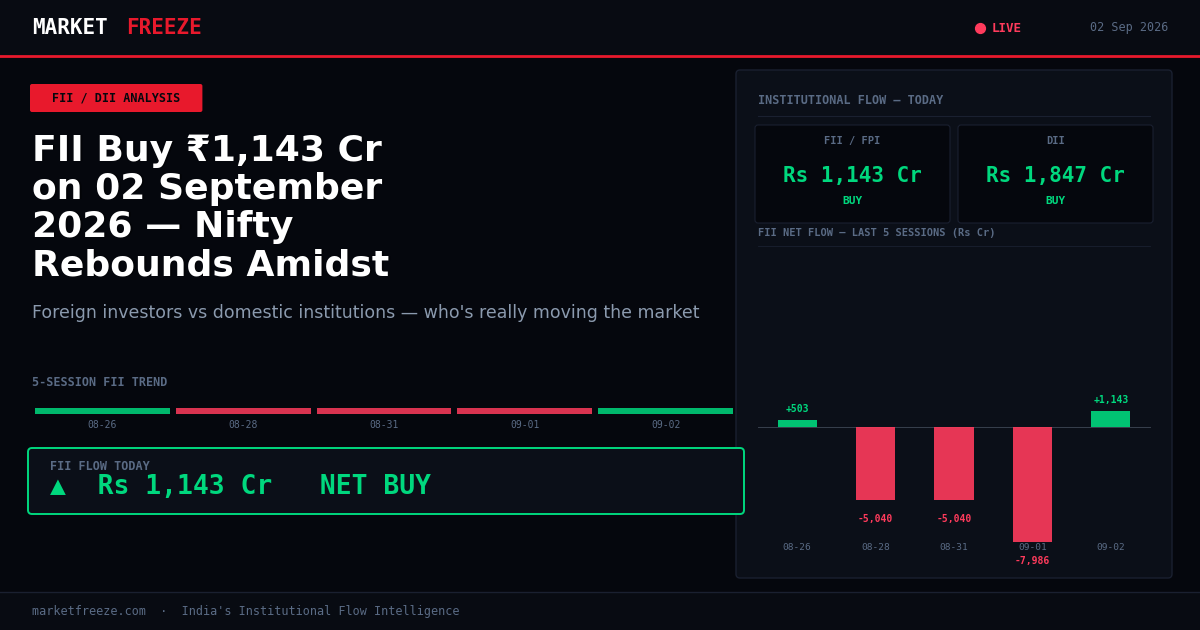
Parsing today’s institutional tape: FIIs registered a net buy of ₹1,143.38 Cr in Indian equities on 02 September 2026, marking a significant reversal after two consecutive sessions of substantial selling. DIIs also contributed positively with a net buy of ₹1,846.94 Cr, providing a cumulative institutional influx of ₹2,990.32 Cr despite the Nifty 50 closing down 0.59% at 23,914.45.
FII Reversal After ₹13,000 Cr Outflow: What it Signals
Today’s FII net buy of ₹1,143.38 Cr directly contrasts with the combined ₹13,025.68 Cr net sell observed over the previous two sessions (₹7,985.88 Cr on September 1st and ₹5,039.80 Cr on August 31st). This immediate shift from aggressive selling to buying suggests institutions are either covering short positions or initiating fresh long exposures at current levels. The gross FII buy value for the day stood at ₹17,807.53 Cr, indicating substantial activity and a willingness to deploy capital despite the broader market decline. For the retail investor, this signals a potential attempt by foreign institutions to establish a floor following the recent downturn, especially as the Nifty 50 dipped below the 24,000 mark as noted in today’s market highlights.
Open a free demat account with
Upstox
or
Angel One
— zero brokerage on delivery trades.
DII Buying Moderates as Nifty Dips Below 24,000
Domestic Institutional Investors (DIIs) sustained their buying streak, with a net purchase of ₹1,846.94 Cr. However, this figure is notably lower than the ₹4,588.88 Cr and ₹5,183.93 Cr DII buying observed on September 1st and August 31st, respectively. While DIIs have been consistent buyers, their reduced net contribution today, combined with the Nifty falling to 23,914.45, suggests a more selective approach or perhaps a slight reduction in conviction at these slightly lower levels. This moderating DII buying, alongside FII re-entry, indicates that domestic institutions might be awaiting further clarity before deploying larger sums, especially with ongoing concerns about oil prices and US Treasury yields impacting bond markets.
Nifty Support Re-Established: Targeting 23,800-24,100 Range
Given the combined institutional net buy of ₹2,990.32 Cr today, a potential support zone for the Nifty 50 can be identified around 23,800. This level is approximately 0.48% below today’s close of 23,914.45 and represents a plausible area where institutions initiated fresh buying interest after the index dipped below 24,000. Conversely, the immediate resistance lies around 24,100, roughly 0.77% above today’s close. This range reflects the recent consolidation and the struggle to maintain momentum above the psychological 24,000 level. Retail participants should observe if the Nifty can hold 23,800 on any further dips, as a sustained breach could lead to testing lower supports around 23,500.
Sectoral Implications of Today’s Institutional Flow
While specific sector data is not yet disclosed, the FII buying reversal, occurring alongside a decline in indices like the Bank Nifty (down 0.41% at 57,172.00), suggests a potential focus on defensive sectors or a selective re-entry into beaten-down segments. Given the prevailing concerns about inflation driven by crude oil prices (Crude MCX down 0.51% at ₹8,946.00/bbl), sectors like FMCG might attract DII buying for stability, while FIIs could be bottom-fishing in capital goods or specific banking names that have seen recent corrections. Conversely, the decline in HDFC Bank, as highlighted in the market news, indicates continued pressure on some large-cap financial stocks. Retail investors should monitor individual stock movements within these sectors for confirmation of institutional preference.
USD/INR Stability Despite Macro Headwinds: RBI Intervention Confirmed
The USD/INR pair remained relatively stable today, closing at Rs95.0, down 0.16%, despite the ongoing global debt selloff and rising US Treasury yields. This stability directly reflects the Reserve Bank of India’s (RBI) active intervention, as noted in the news context, which blunted importer dollar demand. The RBI’s backstop appears to be a critical factor in preventing a sharper depreciation of the rupee, even with elevated oil prices that typically pressure the currency due to India’s import dependence. For retail investors, this managed stability in the rupee reduces the immediate currency risk associated with international investments or imports, but continued vigilance on oil prices and US FOMC outcomes is warranted for future direction.
Comparison to August Trend: FIIs Still Net Sellers Month-to-Date
Despite today’s FII net buy, the broader trend for the start of September shows FIIs as net sellers when considering the past three sessions. The cumulative FII flow for September 1st and 2nd stands at a net sell of ₹6,842.50 Cr (₹7,985.88 Cr sell + ₹1,143.38 Cr buy). This indicates that today’s buying is a single-session event and has not yet offset the significant outflows from earlier in the week. The Nifty 50 has also continued its downward trajectory over these sessions, falling from 24,055.80 on September 1st to 23,914.45 today. Retail investors should interpret today’s FII buying as a short-term tactical move rather than a definitive change in the broader negative FII trend for the month so far.
Historical Flow Data: Last 5 Trading Sessions
| Date | FII Net (Cr) | DII Net (Cr) | Nifty Close |
|---|---|---|---|
| 2026-08-26 | +₹502.63 Cr | +₹6,425.16 Cr | 24,207.75 |
| 2026-08-28 | ₹-5,039.80 Cr | +₹5,183.93 Cr | 24,175.65 |
| 2026-08-31 | ₹-5,039.80 Cr | +₹5,183.93 Cr | 24,080.40 |
| 2026-09-01 | ₹-7,985.88 Cr | +₹4,588.88 Cr | 24,055.80 |
| 2026-09-02 | +₹1,143.38 Cr | +₹1,846.94 Cr | 23,914.45 |
Retail Positioning and Sentiment Shift: A Cautious Optimism
The contrasting movements between FIIs and DIIs, coupled with the Nifty’s dip below 24,000, paints an interesting picture of market sentiment. While FIIs show a decisive re-entry after substantial selling, their overall net position for the early part of September remains negative, as indicated by the cumulative outflow of ₹6,842.50 Cr over the first two trading days. This suggests that today’s buying might be a tactical play by foreign funds to capture perceived value rather than a wholesale shift in their global allocation strategies. Meanwhile, DIIs, though still net buyers, have moderated their pace from earlier in the week. This could imply that domestic institutions, while supporting the market, are also adopting a more cautious stance, perhaps waiting for clearer signals on inflation and interest rate trajectories. Retail investors, often seen as the ‘dumb money’ in market parlance, might be the ones absorbing some of the selling pressure from the previous days, or conversely, could be using this dip to initiate long positions, especially if they perceive the FII reversal as a positive omen. Observing the volume data on the day of FII net buying, which stood at ₹17,807.53 Cr, will be crucial to understanding whether this was broad-based buying or concentrated in specific large-cap stocks.
Crude Oil Volatility and its Ripple Effect on Sector Bets
The contemporary macro-economic landscape continues to be dominated by the volatility in crude oil prices, with Crude MCX trading at ₹8,946.00/bbl. Even a marginal dip of 0.51% today cannot mask the underlying inflationary pressures that elevated oil prices exert on the Indian economy. This persistent concern directly influences sectoral preferences. While FMCG stocks often benefit from their defensive nature and stable demand, making them a favoured playground for DIIs seeking stability, the capital goods sector could be a beneficiary of any sustained FII re-entry if they anticipate government spending or infrastructure growth. However, the recent slide in HDFC Bank, a bellwether for the financial sector, highlights ongoing sector-specific challenges. The potential for a rebound in banking stocks, especially if interest rate expectations begin to stabilize globally, remains a key watchpoint. Retail investors might find it prudent to align their sector choices with the perceived risk appetite of the larger institutions, favouring defensive or value-oriented plays amidst current uncertainties.
USD/INR Stability: A Temporary Respite or RBI’s Firm Grip?
The relative calm in the USD/INR pair, closing at Rs95.0, a mere 0.16% down, amidst global financial jitters, is a testament to the RBI’s proactive intervention. This stability is particularly noteworthy given the backdrop of rising US Treasury yields, which typically attract capital away from emerging markets and weaken currencies like the rupee. The RBI’s continuous efforts to manage dollar demand, especially from importers grappling with higher oil costs, have effectively cushioned the currency from sharper depreciations. For Indian retail investors, this managed currency stability is a double-edged sword. On one hand, it reduces the immediate risk associated with foreign investments and import costs. On the other, it might mask underlying economic vulnerabilities that could resurface if global pressures intensify or if the RBI’s intervention capacity is tested further. The continued reliance on imported energy, with crude at ₹8,946.00/bbl, means that any significant spike in global oil prices could still put pressure on the rupee, irrespective of RBI’s actions, and this is a critical factor to monitor for any forward-looking investment decisions.
Bottom Line
Today saw FIIs net buying ₹1,143.38 Cr and DIIs net buying ₹1,846.94 Cr, injecting over ₹2,990 Cr into the market despite the Nifty 50 declining to 23,914.45. This FII reversal follows two sessions of significant outflows, suggesting a tactical re-entry or short covering. The Nifty now finds immediate support around 23,800 and resistance at 24,100, with institutional activity potentially consolidating around these levels as broader macro concerns persist.
Frequently Asked Questions
What did FIIs do in the Indian stock market today, September 2, 2026?
FIIs were net buyers in the Indian stock market today, September 2, 2026, with a net purchase of ₹1,143.38 Cr.
How much did DIIs invest in Indian equities on September 2, 2026?
DIIs invested a net amount of ₹1,846.94 Cr in Indian equities on September 2, 2026.
What was the Nifty 50 close today and how did institutional flows impact it?
The Nifty 50 closed at 23,914.45, down 0.59%. Despite the FII net buy of ₹1,143.38 Cr and DII net buy of ₹1,846.94 Cr, the index declined, indicating that the institutional buying was either selective or offset by retail/hedging activity, potentially establishing a support around 23,800.
Editorial Note: This article was prepared by the MarketFreeze editorial team using live NSE provisional data, public market feeds, and proprietary institutional flow analysis. All price and flow figures are sourced directly from NSE, BSE, and CoinGecko as of 02 September 2026. This content is for informational purposes only and does not constitute investment advice. MarketFreeze is not SEBI-registered. Please consult a qualified financial advisor before making investment decisions. Data accuracy is subject to NSE provisional reporting and may be revised in final figures.