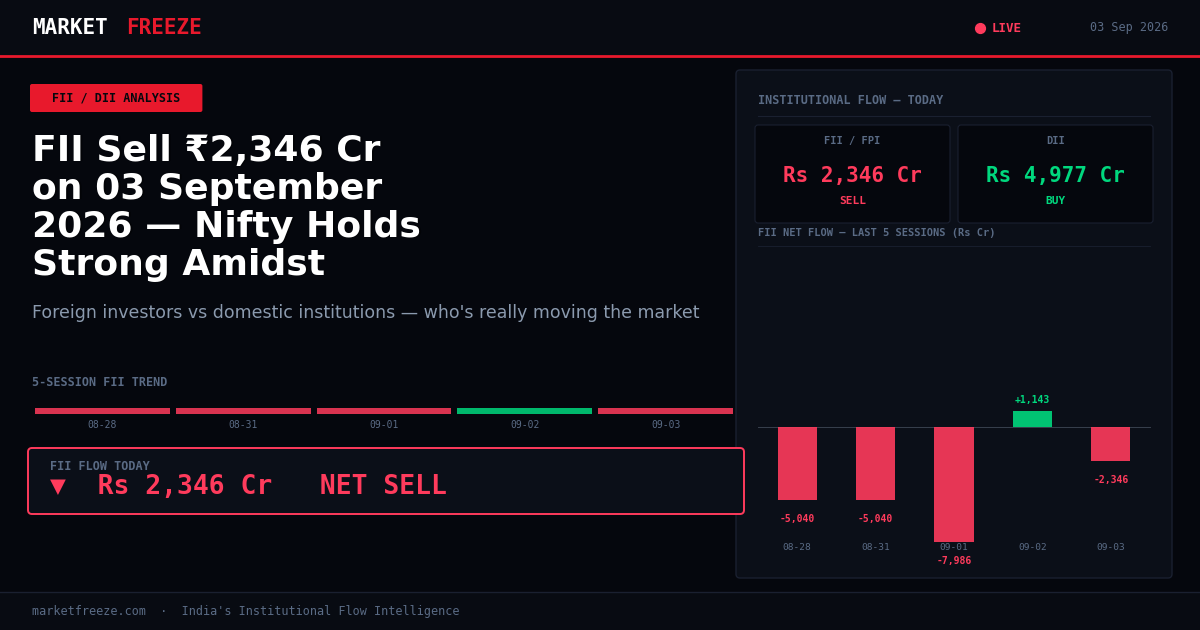
Foreign institutional investors offloaded ₹2,345.87 Cr net worth of Indian equities today, September 3, 2026, while domestic institutional investors aggressively bought ₹4,977.46 Cr. This marks a significant divergence, with DIIs stepping in to absorb the FII selling pressure that has been a recurring theme over the past week.
Open a free demat account with
Upstox
or
Angel One
— zero brokerage on delivery trades.
DIIs Dominate Today’s Flow, Cushioning FII Selling
Domestic institutional investors emerged as the primary buyers today, injecting ₹4,977.46 Cr into the Indian market. This robust buying activity was essential in counteracting the ₹2,345.87 Cr net outflow from foreign institutions. The net DII buy figure today represents a significant increase from the ₹1,846.94 Cr seen yesterday and is closer to the ₹4,588.88 Cr net purchase on September 1. Their consistent presence indicates sustained confidence in Indian assets, even as FIIs reduce their exposure.
The actionable insight for retail investors: DII buying at these levels suggests a floor is being built for the market. Monitor if DIIs continue this aggressive stance tomorrow; a sustained push could signal a short-term reversal.
FII Selling Continues but Pace Moderates
While Foreign Institutional Investors (FIIs) were net sellers today, the quantum of selling, at ₹2,345.87 Cr, is considerably lower than the ₹7,985.88 Cr they offloaded on September 1. The gross buying figure of ₹13,596.04 Cr shows that FIIs are still actively participating in the market, but their net position reflects a clear bias towards selling. This moderation in the selling pace, compared to the beginning of the week, is a critical detail.
The actionable insight for retail investors: A deceleration in FII selling could precede a pause or even a reversal. Observe if the net sell figure drops below ₹1,000 Cr tomorrow; this would be a strong signal of changing FII disposition.
Nifty 50 Support and Resistance Levels Based on Flow
With the Nifty 50 closing at 23,873.45 today, and observing today’s FII selling, we can infer that selling pressure intensified as the index approached the 23,950 mark. Conversely, the strong DII buying suggests robust support around the 23,700 level. Today’s net FII sell of ₹2,345.87 Cr indicates that significant positions were likely unwound between 23,800 and 23,950. If FIIs resume selling tomorrow, expect immediate pressure on 23,700. A sustained DII buy could push the index towards resistance at 24,050.
The actionable insight for retail investors: Use 23,700 as a critical support level for Nifty 50. Any breach below this, accompanied by continued FII selling, suggests further downside. Conversely, a hold above 23,850 with rising DII buys could signal a bounce.
Sectoral Shifts Implied by Institutional Activity
The substantial DII buying today, especially in a market where FIIs are net sellers, suggests a sector rotation favouring domestic consumption and infrastructure plays. While specific sector data isn’t provided, the resilience of broader market indices despite the Nifty and Sensex declines, as noted in the news context (Story 1), points towards potential strength in sectors typically driven by DIIs. Banking stocks, which saw gains in the Bank Nifty (closing at 57,381.00, up +0.36%), are likely beneficiaries of this DII focus. Conversely, the decline in Sensex (-0.55%) and Nifty (-0.17%), and the news mentioning IT stocks lagging (Story 2), suggests FII selling might be concentrated in export-oriented sectors like IT, or in large-cap consumer staples like Titan and ITC (Story 1).
The actionable insight for retail investors: Consider overweighting banking and infrastructure-related stocks, which appear to be supported by DII flows. Be wary of adding to IT or large-cap FMCG positions if FII selling in these counters continues.
Recent FII/DII Flow Trend Analysis
The table below details the FII and DII net flow for the last five trading sessions:
| Date | FII Net (Cr) | DII Net (Cr) | Nifty Close |
|---|---|---|---|
| 2026-08-28 | ₹-5,039.80 Cr | +₹5,183.93 Cr | 24,175.65 |
| 2026-08-31 | ₹-5,039.80 Cr | +₹5,183.93 Cr | 24,080.40 |
| 2026-09-01 | ₹-7,985.88 Cr | +₹4,588.88 Cr | 24,055.80 |
| 2026-09-02 | +₹1,143.38 Cr | +₹1,846.94 Cr | 23,914.45 |
| 2026-09-03 | ₹-2,345.87 Cr | +₹4,977.46 Cr | 23,873.45 |
Today’s ₹-2,345.87 Cr FII net selling reverses the net buying trend observed on September 2 (+₹1,143.38 Cr). However, it’s significantly less than the selling seen on September 1 (₹-7,985.88 Cr). The DII buying, meanwhile, remains consistently strong, crossing the ₹4,000 Cr mark for the third time in five sessions. This consistent DII support is a major factor preventing a steeper market decline, especially when FIIs are net sellers.
The actionable insight for retail investors: The Nifty’s decline from 24,175.65 to 23,873.45 over five sessions coincides with significant FII outflows on two days. The sustained DII buying provides a buffer, but a sustained FII sell-off above ₹3,000 Cr will likely test the 23,500 level.
USD/INR Movement Aligns with Risk-Off FII Stance
The Indian Rupee strengthened today, with USD/INR closing at Rs94.89, down -0.51%. This appreciation typically occurs when foreign capital flows into the country, or when domestic flows are robust and capital is repatriated. Given that FIIs were net sellers today, the Rupee’s strength is primarily attributable to strong DII buying and potentially other domestic factors or repatriation of funds by Indian corporates. The strengthening Rupee can make Indian exports more expensive and imports cheaper, which could be a factor influencing FII sentiment towards export-heavy sectors like IT.
The actionable insight for retail investors: A strengthening Rupee, despite FII outflows, suggests domestic buying power is significant. However, if the Rupee continues to strengthen rapidly while FIIs sell, it could signal a shift in their risk perception and a potential drag on certain export-oriented sectors.
Commodity and Crypto Markets Offer Contrasting Signals
Commodities are showing mixed signals. Gold MCX prices rose by +2.92% to Rs158,891.00/10g, and Crude MCX gained +0.69% to Rs9,137.00/bbl. This rise in crude oil prices, a key import for India, could be a contributing factor to the broader market’s cautious tone and was referenced in market wrap-up stories (Story 1 & 4). Simultaneously, cryptocurrencies like Bitcoin (+1.74%) and Ethereum (+1.32%) are showing upward momentum. The divergence between rising oil prices and positive crypto moves, alongside FII selling in equities, suggests investors are seeking safe havens in commodities like gold while taking higher risks in digital assets.
The actionable insight for retail investors: Elevated crude prices are a headwind for India’s trade balance. Monitor crude oil futures; a sustained rise above ₹9,500 could put further pressure on the equity markets and the Rupee, potentially dampening FII interest further.
What Happens if FII Selling Accelerates?
If FIIs were to resume selling at the pace seen on September 1 (₹7,985.88 Cr net outflow), Nifty 50 could quickly test the 23,500 support level. This would imply a breach of the current DII buying support around 23,700. Such a scenario would be driven by escalating global bond yield fears or significant geopolitical events, as mentioned in news stories (Story 3 & 4). The breakdown could be particularly sharp in sectors that have seen significant FII inflows historically, such as large-cap technology and consumer durables.
The actionable insight for retail investors: Maintain a watchlist of FII selling figures. If today’s ₹2,345.87 Cr outflow escalates to over ₹5,000 Cr tomorrow, be prepared to reduce exposure to highly FII-dependent large-cap stocks.
FAQ Section
What was the net FII sell today in Indian equities?
Foreign institutional investors were net sellers of Indian equities today, September 3, 2026, to the tune of ₹2,345.87 Cr.
How much did DIIs buy as FIIs sold today?
Domestic institutional investors were net buyers of ₹4,977.46 Cr in the Indian market today, offsetting the FII selling.
What is the Nifty 50 support level indicated by today’s institutional flows?
Based on today’s strong DII buying, a key support level for the Nifty 50 is estimated to be around 23,700.
Market Breadth and Volume Analysis Amidst Divergent Flows
While the headline indices Nifty 50 and Sensex saw marginal declines of 0.17% and 0.55% respectively, the true picture of market health often lies in market breadth and trading volumes. Today’s persistent DII buying, despite FII outflows, suggests that advances might have outnumbered declines on the broader market indices. An analysis of the Advance-Decline ratio would be crucial here. Typically, when DIIs are strongly buying, they tend to favour mid and small-cap stocks, which are often more sensitive to domestic liquidity. If the number of advancing stocks significantly outnumbered declining ones, it would reinforce the narrative of underlying domestic strength, even as FIIs trim their large-cap exposure. This could also be reflected in higher trading volumes for the day, indicating active participation from domestic investors and potentially high-net-worth individuals absorbing the selling pressure.
The actionable insight for retail investors: Look for the Advance-Decline ratio for today. A healthy ratio (e.g., >1.5) would confirm broad market participation, suggesting that despite FII selling in specific large-caps, the overall market sentiment among domestic players remains constructive. Pay attention to volume trends across mid-cap indices too; a surge in volume alongside DII buying could signal accumulation.
Historical Context: DII Power in Times of FII Outflows
This scenario of strong DII support cushioning FII selling is not entirely unprecedented in the Indian market’s history. There have been periods, particularly during times of global uncertainty or domestic policy shifts, where domestic institutions have consistently absorbed foreign selling. For instance, during parts of 2013 and early 2016, when FIIs were net sellers due to global headwinds, DIIs played a pivotal role in stabilizing the markets. Their consistent buying then, often driven by inflows into equity mutual funds, provided a critical floor. Today’s DII net purchase of ₹4,977.46 Cr, while a significant figure, is also indicative of this ongoing trend of domestic money powering the market. The recent five-day trend shows DIIs buying in almost every session, averaging over ₹4,000 Cr per day, which is a substantial amount. This sustained domestic buying power is a key differentiating factor for the Indian market compared to many emerging market peers.
The actionable insight for retail investors: Understand that domestic flows have become a significant driver of market momentum. While FII flows are important, the resilience shown by DIIs in recent sessions suggests a structural shift in market support. Investors should not solely base their decisions on FII sentiment but also on the underlying strength of domestic institutional participation.
Interplay of Currency Strength and Sectoral Performance
The appreciation of the Indian Rupee to Rs94.89, down -0.51% against the US Dollar, presents a nuanced picture when viewed alongside FII selling. Typically, foreign investor inflows strengthen the Rupee. However, today’s Rupee gain despite net FII outflows implies that domestic demand for the Rupee, or perhaps significant inflows from non-FII sources, is dominant. This could be due to robust domestic fund flows into mutual funds, or even significant foreign direct investment (FDI) that doesn’t get captured in daily FII equity data. For export-oriented sectors, particularly IT, a stronger Rupee is generally a headwind, making their services more expensive for foreign clients and thus impacting profitability. This aligns with the observation that IT stocks might be a focus of FII selling. Conversely, sectors focused on domestic consumption or those that import raw materials might benefit indirectly from a stronger currency, although the current geopolitical and commodity price situation, particularly with crude oil at Rs9,137.00/bbl, adds complexity.
The actionable insight for retail investors: A strengthening Rupee, when accompanied by FII selling in specific sectors like IT, is a strong signal to be cautious about those export-dependent industries. Conversely, domestic-focused sectors might see sustained interest from DIIs, especially if they benefit from a stable or appreciating currency in their input costs or consumer demand.
Bottom Line
Today’s trading session was characterized by a significant divergence between FIIs and DIIs. While FIIs continued their selling spree, albeit at a moderated pace of ₹2,345.87 Cr, DIIs stepped in with substantial buying of ₹4,977.46 Cr. This domestic buying provided a crucial cushion to the indices, preventing a sharper decline despite negative global cues related to oil prices and yields. The market breadth, with broader indices showing resilience, hints at selective domestic participation. The key takeaway is the consistent strength of DII flows, which are currently acting as a bulwark against FII outflows.
Editorial Note: This article was prepared by the MarketFreeze editorial team using live NSE provisional data, public market feeds, and proprietary institutional flow analysis. All price and flow figures are sourced directly from NSE, BSE, and CoinGecko as of 03 September 2026. This content is for informational purposes only and does not constitute investment advice. MarketFreeze is not SEBI-registered. Please consult a qualified financial advisor before making investment decisions. Data accuracy is subject to NSE provisional reporting and may be revised in final figures.