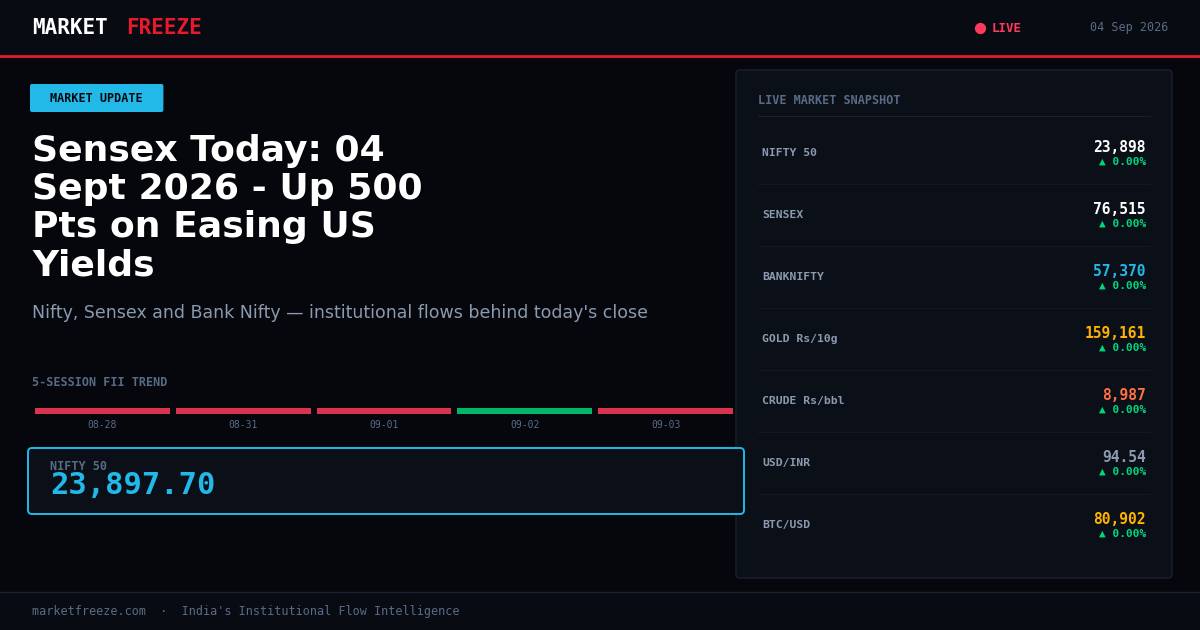
Sensex Gains 493 Points Driven by Easing US Yields, But FIIs Remain Cautious
The Indian equity market, as of 16:00 IST on September 4, 2026, witnessed a mixed but positive sentiment, with the Sensex closing up 0.48% at 76,515.00, while the Nifty 50 managed a marginal gain of 0.10% to settle at 23,897.70. The Bank Nifty, however, saw a slight dip of 0.02% to 57,370.00. This divergence was underpinned by a narrative of easing US Treasury yields, which typically fuels risk-on sentiment, yet Foreign Institutional Investors (FIIs) continued their net selling for the third consecutive session, offloading ₹2,345.87 Cr on September 3rd, a stark contrast to the robust DII buying of ₹4,977.46 Cr on the same day. This flow data suggests institutional money managers are selectively rebalancing, with domestic funds providing a crucial support buffer against foreign outflows.
Open a free demat account with
Upstox
or
Angel One
— zero brokerage on delivery trades.
Global Cues & Domestic Flows: A Tale of Two Narratives
The reported gains in benchmark indices were attributed to positive global cues, specifically the easing of US Treasury yields, which typically signals a lower risk-free rate and potentially higher valuations for equities. Jefferies’ commentary on a potential structural bear market in US bonds, while a long-term concern, may have created short-term volatility that is now abating, leading to some buying interest. However, the persistent net selling by FIIs, amounting to ₹7,985.88 Cr on September 1st and ₹2,345.87 Cr on September 3rd, contradicts a broad risk-on sentiment from foreign capital. Conversely, Domestic Institutional Investors (DIIs) have been consistent net buyers, with ₹4,588.88 Cr on September 1st, ₹1,846.94 Cr on September 2nd, and a substantial ₹4,977.46 Cr on September 3rd, indicating strong domestic conviction. This dichotomy suggests that while global macro factors are providing a tailwind, FIIs are deploying a more cautious strategy, possibly de-risking or reallocating within their India portfolios, while DIIs are actively absorbing selling pressure and identifying value.
Sectoral Rotation: Financials and Energy Exhibit Resilience
Selective buying was noted in financial and energy stocks, aligning with the narrative of market resilience. The financial sector, a significant component of both the Sensex and Nifty, often benefits from a stable or rising interest rate environment, and any perceived stabilization in global yields could attract renewed interest. DIIs, being major participants in the Indian financial markets, are likely increasing their exposure here, given their consistent buying. The energy sector’s performance, coupled with the MCX Crude oil price trading at ₹8,986.00/bbl (down 0.49% today), suggests that while crude prices are softening, the sector might be seen as a defensive play or benefiting from specific domestic demand drivers that FIIs are not currently capitalizing on. The Banking Nifty’s slight underperformance at -0.02% could indicate profit-taking or a pause in the rally, despite the positive sector news. Conversely, the positive momentum in Bitcoin (+4.19%) and Ethereum (+5.17%) signals a broader risk appetite in alternative assets, which could eventually spill over into equities if sustained.
Nifty’s Technical Crossroads: Flow Data Suggests Key Support Zones
The Nifty 50, currently trading at 23,897.70, shows a pattern of consolidation following significant selling pressure earlier in the month. The recent FII selling on September 1st (₹7,985.88 Cr) and September 3rd (₹2,345.87 Cr) coincided with declines in the Nifty, which closed at 24,055.80 and 23,873.45 respectively. The subsequent rebound, supported by DII buying, suggests that the levels around 23,800 have acted as a near-term support. On the resistance front, the Nifty struggled to decisively break above the 24,000 mark on September 4th, closing at 23,897.70. The strong DII buying on September 3rd, when the Nifty closed at 23,873.45, indicates that domestic institutions are accumulating positions. Therefore, a key support for the Nifty is identified around the 23,800-23,850 zone, where DIIs have demonstrated strong buying conviction. A sustained breach below this could trigger further unwinding, potentially bringing the 23,500 level into play. On the upside, a decisive move above 24,000, backed by renewed FII inflows, would be a strong bullish signal, with the next psychological resistance around 24,200.
USD/INR Stability Masks Underlying Dollar Strength
The USD/INR pair remained stable at Rs94.54, showing a 0.00% change on September 4th. This stability in the rupee, despite significant FII outflows, suggests that the Reserve Bank of India (RBI) might be actively managing the currency, or that other demand-supply factors are balancing out. The easing US Treasury yields, while generally bearish for the dollar, have not translated into significant rupee appreciation. This could imply that global risk sentiment, while improving, is not yet robust enough to draw substantial dollar outflows from developed markets into emerging market currencies like the INR. The persistent strength of the US dollar in broader trade, despite yield moderation, is a factor that FIIs likely consider when deploying capital, contributing to their cautious approach.
Historical Snapshot: Navigating FII Reversals
Looking back at the last five trading sessions, a clear pattern emerges. The significant FII sell-off on September 1st (₹7,985.88 Cr) saw the Nifty decline from 24,175.65 on August 28th (which had consistent FII net sell of ₹5,039.80 Cr and DII net buy of ₹5,183.93 Cr) to 23,873.45 on September 3rd. The period between August 31st and September 3rd shows a consistent trend of FII selling and DII buying, with the Nifty oscillating within a range. Notably, the brief period of FII net buying on September 2nd (₹1,143.38 Cr) coincided with a Nifty uptick to 23,914.45, but this was not sustained, as evidenced by the renewed FII selling on September 3rd. This historical data reinforces the observation that while global factors can influence intraday movements, the underlying trend is heavily influenced by institutional flow dynamics, with DIIs acting as a bulwark against FII outflows.
Portfolio Strategy: Conditional Allocation Based on Flow Reversals
For investors looking to navigate this environment, a conditional allocation strategy is advised. Given the persistent FII selling, a defensive posture is warranted until there’s a clear reversal in foreign flows.
- Equities: Allocate 50-60% to large-cap stocks with strong DII holding and consistent earnings. Focus on sectors like financials and select energy companies exhibiting resilience. Avoid highly leveraged or speculative small-cap stocks.
- Debt: Consider short-to-medium duration debt instruments, given the uncertainty around US Treasury yields and potential for inflation. A 20-30% allocation can provide stability.
- Gold: With Gold MCX at ₹159,168.00/10g, a 10-15% allocation to gold as a hedge against geopolitical risks and potential currency depreciation remains prudent.
- Cash: Maintain a 10% cash reserve for opportunistic buying should significant market corrections occur or FII flows turn positive.
This framework prioritizes capital preservation while allowing for participation in select growth areas, contingent on institutional money movement.
The Jane Street Allegation and Market Integrity
The news regarding Jane Street seeking correspondence with SEBI-NSE in a market manipulation case, alleging the role of a UAE-based hedge fund, introduces an element of caution regarding market integrity. Such allegations, if proven, can lead to increased regulatory scrutiny and potentially impact investor sentiment, especially for foreign participants. While the direct impact on today’s market action is not immediately evident from the FII/DII flows, sustained concerns about market manipulation could deter future foreign investment, reinforcing the cautious stance of FIIs observed in recent sessions. The outcome of this investigation will be crucial for maintaining confidence in India’s capital markets.
Key Levels to Watch
The Nifty 50 is currently trading at 23,897.70. Based on recent institutional flows, key levels to watch are:
- Support: The 23,800-23,850 zone, where DII buying has been observed. A breach below this could signal further downside towards 23,500.
- Resistance: The 24,000-24,050 level, which has acted as a psychological and technical barrier. A sustained move above this, ideally supported by FII inflows, would open the path towards 24,200.
FII/DII Flow Snapshot (Last 5 Sessions)
| Date | FII Net (Cr) | DII Net (Cr) | Nifty Close |
|---|---|---|---|
| 2026-08-28 | ₹-5,039.80 Cr | +₹5,183.93 Cr | 24,175.65 |
| 2026-08-31 | ₹-5,039.80 Cr | +₹5,183.93 Cr | 24,080.40 |
| 2026-09-01 | ₹-7,985.88 Cr | +₹4,588.88 Cr | 24,055.80 |
| 2026-09-02 | +₹1,143.38 Cr | +₹1,846.94 Cr | 23,914.45 |
| 2026-09-03 | ₹-2,345.87 Cr | +₹4,977.46 Cr | 23,873.45 |
Frequently Asked Questions
- Q: What did FII buy or sell on 2026-09-03? A: FIIs were net sellers of ₹2,345.87 Cr on 2026-09-03.
- Q: What did DII buy on 2026-09-03? A: DIIs were net buyers of ₹4,977.46 Cr on 2026-09-03.
- Q: Is FII buying or selling in September 2026? A: In September 2026, FIIs have predominantly been net sellers, with net sales of ₹7,985.88 Cr on Sept 1st and ₹2,345.87 Cr on Sept 3rd, interspersed with a small net buy of ₹1,143.38 Cr on Sept 2nd.
Bottom Line
The Indian equity market on September 4, 2026, showed resilience led by domestic institutional buying, despite continued foreign outflows, as easing US Treasury yields provided a positive global backdrop. The Sensex closed higher by 0.48% while the Nifty 50 edged up 0.10%. The persistent FII selling, totaling over ₹10,000 Cr in the past three sessions, highlights caution from foreign investors, contrasting with robust DII accumulation. Investors should monitor the 23,800-23,850 Nifty support level and watch for any signs of a sustained FII inflow reversal.
Stay ahead of the market. Subscribe to MarketFreeze for daily institutional flow intelligence and in-depth analysis.
Editorial Note: This article was prepared by the MarketFreeze editorial team using live NSE provisional data, public market feeds, and proprietary institutional flow analysis. All price and flow figures are sourced directly from NSE, BSE, and CoinGecko as of 04 September 2026. This content is for informational purposes only and does not constitute investment advice. MarketFreeze is not SEBI-registered. Please consult a qualified financial advisor before making investment decisions. Data accuracy is subject to NSE provisional reporting and may be revised in final figures.