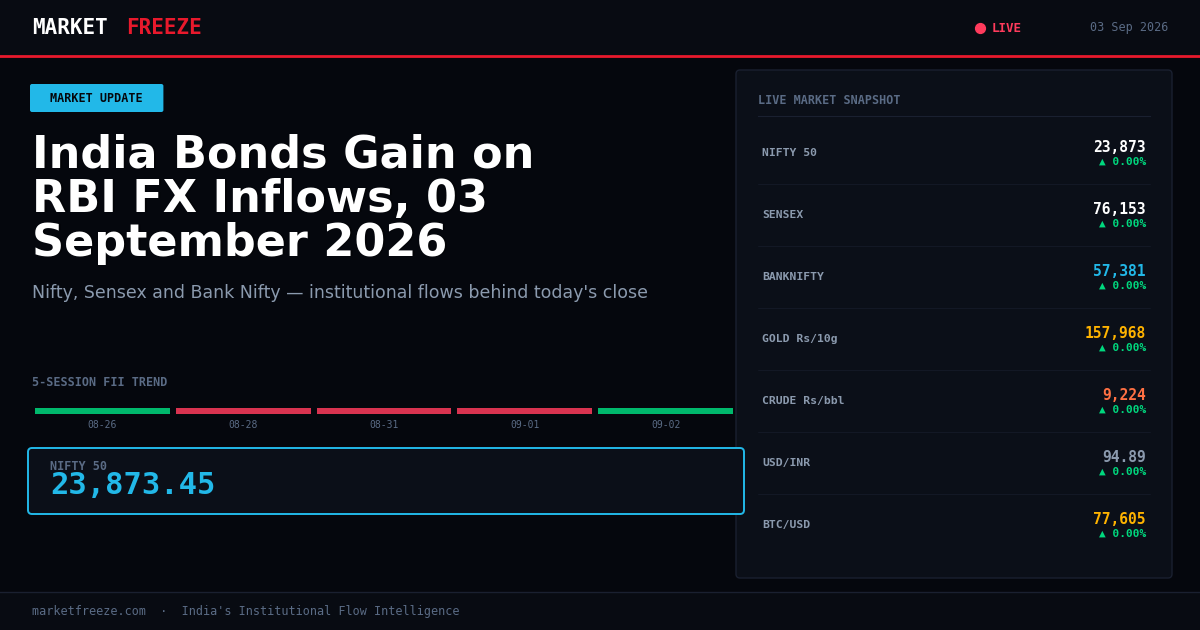
Indian government bonds gained today, driven by short-term debt instruments, as the Reserve Bank of India’s foreign exchange inflows boosted rupee liquidity, a move that saw mixed signals from institutional flows with FIIs net selling ₹1,143.38 Cr and DIIs net buying ₹1,846.94 Cr, according to MarketFreeze data.
RBI FX Inflows Boost Bond Liquidity, Amidst Mixed Institutional Activity
The Indian bond market displayed strength early Thursday, with shorter-dated government securities leading the gains. This positive sentiment was primarily fueled by substantial dollar inflows orchestrated by the Reserve Bank of India (RBI), which effectively enhanced liquidity within the rupee market. Banks’ significant foreign currency borrowings also contributed to this liquidity surge, bolstering the domestic financial system’s capacity to support the rupee and local markets. However, this inflow-driven liquidity enhancement was juxtaposed against institutional trading patterns, where Foreign Institutional Investors (FIIs) recorded net selling of ₹1,143.38 Cr, while Domestic Institutional Investors (DIIs) actively bought net ₹1,846.94 Cr. This divergence suggests that while the overall liquidity environment is supportive, foreign capital remains cautious, potentially due to external factors like elevated oil prices and rising US Treasury yields which continue to put pressure on longer-dated bonds.
Open a free demat account with
Upstox
or
Angel One
— zero brokerage on delivery trades.
FIIs Divest, DIIs Accumulate as Bond Inflows Infuse Liquidity
Today’s trading session on September 3, 2026, presented a nuanced picture of institutional participation. FIIs turned net sellers, offloading equities worth ₹1,143.38 Cr. This outflow contrasts with the preceding two sessions where FIIs had been net sellers, with outflows of ₹7,985.88 Cr on September 1 and ₹5,039.80 Cr on August 31, before a brief period of net buying on September 2. Conversely, DIIs continued their buying spree, adding to their portfolios with net purchases of ₹1,846.94 Cr. This sustained DII accumulation, evident through their consistent net buying in the last three sessions (₹1,846.94 Cr on Sep 2, ₹4,588.88 Cr on Sep 1, and ₹5,183.93 Cr on Aug 31), indicates a strong domestic institutional confidence in the Indian market, potentially capitalizing on dips or anticipating future growth. The RBI’s FX inflows, while improving overall liquidity and supporting bonds, did not directly translate into broad-based FII equity buying today.
Sectoral Ripples from Bond Inflows and Mixed Flows
The confluence of positive liquidity from RBI’s FX inflows and the mixed FII/DII flows today has distinct sectoral implications. Banking stocks, particularly those sensitive to interest rate movements and liquidity conditions, are likely to be beneficiaries. The increased rupee liquidity and enhanced ability to support the rupee suggests a stable operating environment for banks. DIIs’ consistent buying also often favors financial services. Conversely, sectors heavily reliant on FII capital or those sensitive to global yield movements might face headwinds. Given the persistent rise in US Treasury yields mentioned in supporting stories, interest-rate sensitive sectors like Information Technology (IT), which typically benefits from a weaker rupee, could see subdued sentiment. The strength in shorter-term bonds might also attract some capital away from equity markets, especially from more risk-averse investors, potentially impacting defensive sectors like Fast-Moving Consumer Goods (FMCG) if they were expecting broader FII inflows.
Nifty’s Tight Range Reflects Underlying Caution
The Nifty 50 closed at 23,873.45, down 0.17%, while the Sensex ended at 76,153.00, down 0.55%. The Bank Nifty, however, bucked the trend, closing higher at 57,381.00, up 0.36%. This divergence highlights the market’s current internal dynamics. The Nifty’s proximity to recent support levels suggests a battle between positive liquidity factors and cautious foreign investor sentiment. Based on recent flow data, significant buying interest for DIIs was observed around the 23,900-24,000 levels in the past few sessions. The Nifty trading at 23,873.45, is currently testing these immediate support zones. A sustained move below 23,800, especially on increased FII selling, could signal a retest of lower levels around 23,500, which saw some institutional activity in late August. Resistance is likely to be encountered around 24,100, a level that has acted as a pivot in recent trading.
Currency and Commodity Crossovers: USD/INR Weakens Amidst FX Inflows
The Indian Rupee strengthened against the US Dollar, with USD/INR closing at Rs94.89, down 0.51%. This appreciation is a direct consequence of the large dollar inflows reported by the RBI, which increases the supply of foreign currency in the domestic market, thereby driving up the rupee’s value. This is positive for importers and could help in controlling inflation. Concurrently, Gold prices on MCX surged by 2.33% to Rs157,986.00/10g, and Crude oil prices on MCX climbed 1.61% to Rs9,220.00/bbl. The rise in gold, often seen as a safe-haven asset, could be a reaction to global uncertainties and rising US Treasury yields, which are also mentioned as a risk to Wall Street’s rally. The elevated crude prices, however, are a concern for India’s import bill and inflation, even as the rupee’s strength might offer some mitigation.
Historical Parallel: End of August Sell-off and Early September Rebound
The institutional flows of the past week offer a historical parallel to current dynamics. The period from August 28 to September 1 saw significant FII net selling, amounting to ₹5,039.80 Cr and ₹7,985.88 Cr respectively, coinciding with a decline in the Nifty from 24,175.65 to 24,055.80. During this time, DIIs remained strong net buyers, accumulating ₹5,183.93 Cr and ₹4,588.88 Cr. The subsequent session on September 2 saw a reversal in FII flows to net buying of ₹1,143.38 Cr, with DIIs continuing their purchases at ₹1,846.94 Cr, as the Nifty closed at 23,914.45. This pattern suggests that periods of intense FII outflows can be absorbed by robust DII buying, leading to a stabilization or modest rebound, as was partially observed today. The current situation, where RBI’s FX inflows are adding liquidity, could further support this stabilization, provided FII selling pressure does not re-intensify significantly.
Portfolio Framework: Hedging Against Rising Global Yields
For investors looking to navigate the current market conditions characterized by rising global yields and mixed institutional flows, a balanced portfolio approach is advisable. Allocate 60% to domestic-focused, quality companies with strong balance sheets and pricing power, particularly in sectors like banking and select manufacturing, which are likely to benefit from increased domestic liquidity and government spending. Allocate 25% to defensive assets such as gold and potentially shorter-duration debt instruments, given the rising global risk aversion and the continued upward pressure on US Treasury yields. The remaining 15% can be kept in cash or highly liquid short-term instruments to take advantage of potential market dislocations or to re-enter sectors at more attractive valuations, especially if FII outflows accelerate past ₹3,000 Cr in a single session.
Key Levels to Watch
The Nifty 50, currently trading at 23,873.45, is positioned near crucial support levels. Immediate support lies around the 23,800 mark, which has seen DII accumulation in recent weeks. A decisive break below this level, especially with a notable increase in FII selling, could trigger a slide towards the 23,500 level. On the upside, the index faces resistance around 24,000-24,100, a zone where selling pressure has emerged previously. Sustained buying by DIIs and a halt in FII outflows beyond 23,800 would be a positive indicator. Conversely, a breach of 23,700 on significant volume, accompanied by renewed FII selling exceeding ₹2,000 Cr in a day, would signal a bearish turn.
| Date | FII Net (Cr) | DII Net (Cr) | Nifty Close |
|---|---|---|---|
| 2026-08-26 | +₹502.63 Cr | +₹6,425.16 Cr | 24,207.75 |
| 2026-08-28 | ₹-5,039.80 Cr | +₹5,183.93 Cr | 24,175.65 |
| 2026-08-31 | ₹-5,039.80 Cr | +₹5,183.93 Cr | 24,080.40 |
| 2026-09-01 | ₹-7,985.88 Cr | +₹4,588.88 Cr | 24,055.80 |
| 2026-09-02 | +₹1,143.38 Cr | +₹1,846.94 Cr | 23,914.45 |
FAQ Section
- Q: What did FII buy or sell on September 2, 2026? A: FIIs were net buyers of ₹1,143.38 Cr on September 2, 2026.
- Q: What did DII buy on September 3, 2026? A: DIIs were net buyers of ₹1,846.94 Cr on September 3, 2026.
- Q: Is FII buying or selling in September 2026? A: In early September 2026, FIIs have shown a mixed trend, with significant selling on September 1 and 2, followed by net buying on September 2, and net selling again on September 3.
Bottom Line
Today’s market saw Indian bonds rally on enhanced liquidity from RBI’s FX inflows, yet equity markets experienced mixed institutional flows with FIIs net selling ₹1,143.38 Cr and DIIs net buying ₹1,846.94 Cr. While DIIs continue to show strong conviction, FII caution, potentially driven by global yield concerns, capped broader market gains, reflected in the Nifty’s flat close. Investors should monitor FII flows closely as a key indicator of foreign sentiment amidst supportive domestic liquidity.
Stay ahead of the market with MarketFreeze.com’s institutional flow intelligence. Subscribe for daily insights connecting real money movements to market events.
Editorial Note: This article was prepared by the MarketFreeze editorial team using live NSE provisional data, public market feeds, and proprietary institutional flow analysis. All price and flow figures are sourced directly from NSE, BSE, and CoinGecko as of 03 September 2026. This content is for informational purposes only and does not constitute investment advice. MarketFreeze is not SEBI-registered. Please consult a qualified financial advisor before making investment decisions. Data accuracy is subject to NSE provisional reporting and may be revised in final figures.