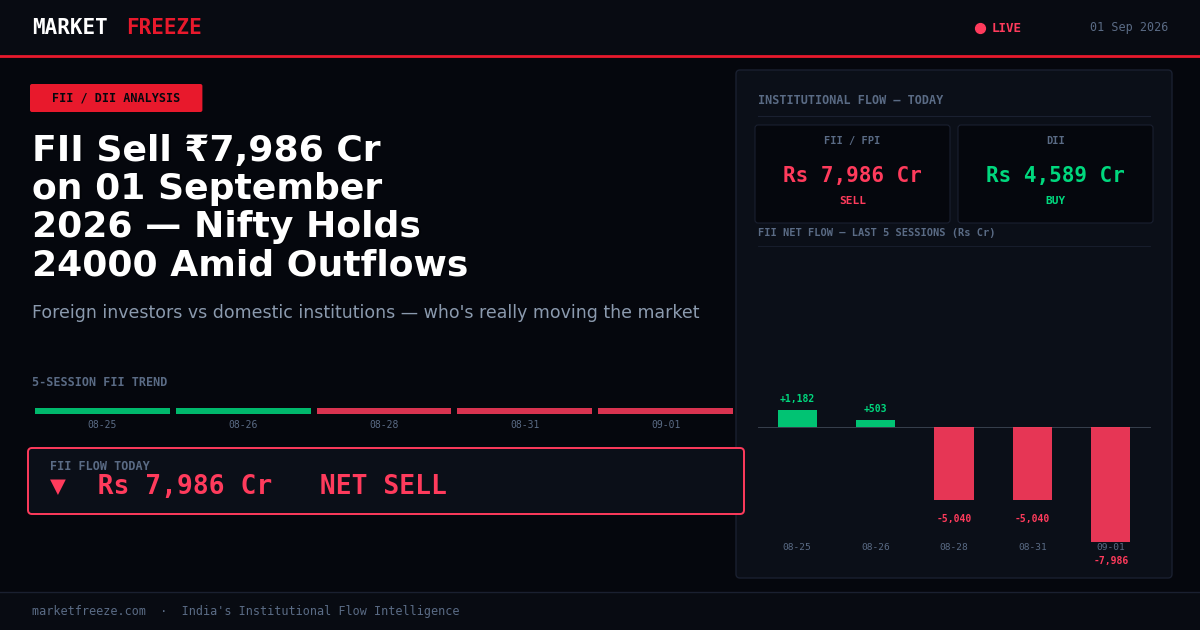
Institutional flow data released after market close shows Foreign Institutional Investors (FIIs) offloaded a net of ₹7,985.88 Cr in Indian equities today, 01 September 2026. This marks the most aggressive daily selling by FIIs in the last five sessions. Domestic Institutional Investors (DIIs) provided a partial buffer, buying a net of ₹4,588.88 Cr.
FII Selling Accelerates Amid Global Headwinds
The significant FII outflow of ₹7,985.88 Cr today is a stark acceleration compared to the preceding two sessions where net selling stood at ₹5,039.80 Cr each. This sharp increase in selling pressure aligns with global market developments. European shares remained flat as surging bond yields, driven by inflation concerns, dampened investor enthusiasm, as reported by MarketFreeze (Story 1). Similarly, UK 10-year gilt yields hit their highest since 2008, fueled by rising oil prices and reignited inflation fears (Story 5). The elevated yields, coupled with hawkish US Federal Reserve policies and rising crude oil prices, are straining global liquidity, posing a challenge to Indian equities despite robust domestic GDP growth (Story 4).
Open a free demat account with
Upstox
or
Angel One
— zero brokerage on delivery trades.
For retail investors, this amplified FII selling suggests that overseas funds are actively reducing their India exposure. Monitor any further escalation in FII outflows to assess potential downside risk.
DII Buying Fails to Offset FII Sell-off
While DIIs actively bought ₹4,588.88 Cr today, their net purchases were insufficient to counter the substantial FII selling. This divergence highlights a defensive stance from domestic institutions, stepping in to absorb some of the selling pressure. However, the net DII buy today is also lower than the ₹5,183.93 Cr they purchased in the previous two sessions. This slight dip in DII buying momentum, even as FII selling intensified, is a critical signal.
Nifty Faces Downside Pressure, Support at 23,800
The Nifty 50 closed at 24,055.80, down 0.10% on the day. The aggressive FII selling today points to immediate downside risk. Based on historical flow patterns and today’s selling volume, immediate support for the Nifty is established around the 23,800 mark. Resistance is likely to be encountered around 24,300. Should FII selling accelerate past ₹10,000 Cr in a single session, expect a swift test of the lower support. Conversely, a sustained DII buying spree exceeding ₹7,000 Cr daily could offer a temporary reprieve.
Retail investors should consider tightening their stop-losses on long positions, especially if the Nifty breaches 24,000 on sustained selling volume.
Sectoral Implications: Banks and Autos Under FII Scrutiny
The sharp FII sell-off today, particularly when considering the performance of the Bank Nifty which closed down 1.06% at 57,410.00, suggests that financials are likely a primary target for FII divestment. Heavyweight banks reversed Monday’s gains, indicating selling pressure at higher levels (Story 2). Auto stocks also experienced losses, aligning with potential FII unwinding. Conversely, sectors typically favored by DIIs, such as consumer staples or select manufacturing, might show relative resilience. The energy sector, however, benefited from rising crude prices (Story 1, Story 2), though its FII flow data is not granular enough to confirm net buying.
Retail investors should be wary of initiating fresh positions in banking and auto sectors until FII selling subsides. Focus on sectors showing DII accumulation or defensive characteristics.
Rupee Strength Curtailed by Global Factors
The Indian Rupee (USD/INR) appreciated to Rs95.2, down 0.46% against the dollar today. This strength was attributed to decisive Reserve Bank of India interventions and dollar inflows from foreign banks, bolstered by positive domestic growth indicators (Story 3). However, the upward pressure on global bond yields and rising crude oil prices (Rs8,787.00/bbl, up 2.00%) acted as significant constraints on further rupee appreciation. The FII selling today indicates that these currency-positive factors are being outweighed by broader global risk aversion. Any sustained FII outflow will likely put renewed pressure on the rupee, pushing it towards Rs96.0.
Retail traders should avoid aggressive long dollar positions against the rupee for now, but remain alert for a potential reversal if FII outflows persist and global risk sentiment worsens.
Historical Flow Comparison: A Pattern of Caution
Today’s FII selling of ₹7,985.88 Cr is the largest in the provided five-session window. The previous instances of significant FII selling, such as on August 28th and August 31st (₹5,039.80 Cr each), were followed by continued, albeit less intense, FII selling and subdued Nifty movements. The Nifty closed at 24,055.80 today, a decline from 24,080.40 on August 31st and 24,175.65 on August 28th. This suggests a trend of escalating caution among foreign funds.
Retail investors should note that prolonged FII selling periods have historically correlated with elevated market volatility and potential downside. Expect similar choppy market conditions until FIIs turn net buyers consistently.
FII/DII Net Flows: Last 5 Sessions
| Date | FII Net (Cr) | DII Net (Cr) | Nifty Close |
|---|---|---|---|
| 2026-08-25 | +₹1,181.66 Cr | +₹2,493.41 Cr | 24,334.55 |
| 2026-08-26 | +₹502.63 Cr | +₹6,425.16 Cr | 24,207.75 |
| 2026-08-28 | ₹-5,039.80 Cr | +₹5,183.93 Cr | 24,175.65 |
| 2026-08-31 | ₹-5,039.80 Cr | +₹5,183.93 Cr | 24,080.40 |
| 2026-09-01 | ₹-7,985.88 Cr | +₹4,588.88 Cr | 24,055.80 |
FAQ Section
Why did FIIs sell so much today?
FIIs sold a net of ₹7,985.88 Cr today, primarily driven by rising global bond yields and inflation fears, similar to trends observed in European markets and the UK. These global headwinds are causing foreign investors to reduce their exposure to emerging markets like India.
What does the DII buying mean for the market?
DIIs bought ₹4,588.88 Cr, providing some support against FII selling. However, their buying volume was lower than in previous sessions, indicating domestic institutions are not fully compensating for foreign outflows. This suggests a more cautious approach even from DIIs.
What is the immediate support level for Nifty after today’s flows?
Following today’s substantial FII selling, the Nifty 50 faces immediate downside pressure. Based on institutional flow patterns, support is now seen around the 23,800 level.
The current market sentiment, heavily influenced by aggressive FII outflows, could prompt a deeper analysis of the typical retail investor reaction during such periods. Historically, when foreign institutions withdraw significant capital, often in excess of ₹5,000 Cr in a single session, retail participation tends to bifurcate. A segment may panic and exit their positions, leading to increased selling pressure on mid and small-cap stocks which are often perceived as riskier. Conversely, a more informed retail investor base might view the dip as a buying opportunity, particularly in fundamentally strong companies that have been oversold due to broad FII selling rather than company-specific issues. The sustained DII buying, even at a slightly reduced pace, suggests that domestic money managers remain optimistic about India’s long-term prospects, potentially creating a floor for the market and signaling selective buying opportunities for retail participants willing to weather short-term volatility.
Cross-Asset Correlations: Crude, Currency, and Equities
Today’s market action provides a compelling case study for cross-asset correlations. The surge in crude oil prices to Rs8,787.00/bbl, up by 2.00%, directly correlates with rising inflation expectations globally. This, in turn, fuels the hawkish stance of central banks like the US Federal Reserve, leading to higher bond yields. For India, a net importer of crude oil, higher prices exacerbate inflationary pressures and widen the current account deficit, indirectly weakening the rupee. The fact that the rupee only appreciated slightly to Rs95.2, down 0.46% against the dollar, despite significant RBI intervention, underscores the overwhelming pressure from global factors and FII outflows. This disconnect highlights that while domestic fundamentals might be strong, external financial flows and commodity prices can exert a dominant influence on equity markets. Retail investors might find it prudent to observe this triad – crude prices, currency movements, and FII flows – as a leading indicator of broad market direction.
Sector Rotation Insights: Shifting Preferences
The pronounced selling in the banking sector, evidenced by the Bank Nifty’s decline of 1.06%, coupled with the broad FII outflow of ₹7,985.88 Cr, strongly suggests a rotation away from rate-sensitive and potentially higher-valuation sectors. Banks are often vulnerable to rising interest rate environments and tightening liquidity, which are direct consequences of the global headwinds mentioned. Similarly, auto stocks, which can be cyclical and sensitive to consumer spending, may also be on the FII exit list. This implies a potential shift towards defensive sectors or those less impacted by global liquidity conditions. While not explicitly detailed in today’s flow data, sectors like FMCG or pharmaceuticals, typically favored by DIIs for their stable earnings, could see increased relative strength. Retail investors should consider monitoring sector performance against FII/DII flows to identify potential beneficiaries of this ongoing rotation, rather than reacting solely to broad market movements.
A Glimpse into Historical Outflow Patterns
To contextualize today’s aggressive FII selling of ₹7,985.88 Cr, it is useful to recall similar periods of substantial foreign outflows. For instance, the market experienced significant selling pressure around the Brexit referendum in 2016, where FIIs withdrew billions in a short span. While the drivers were different, the market reaction – increased volatility, sharp corrections in specific sectors, and a temporary weakening of the rupee – bore resemblance. The key difference today is the concurrent strength in domestic GDP growth, which provides a more resilient base compared to the global uncertainty of 2016. However, the scale of today’s outflow, which eclipses the ₹5,039.80 Cr seen on August 28th and 31st, signals that global macroeconomic concerns are temporarily trumping India’s positive domestic narrative for foreign investors. This suggests that while a major crash might be averted by DII support, sustained recovery will likely hinge on a reversal of these global yield and inflation pressures, and consequently, FII sentiment.
Bottom Line
Today’s institutional flows reveal a pronounced increase in FII selling, amounting to ₹7,985.88 Cr. This outflow, driven by global inflation and yield concerns, is pressuring Indian equities, with the Nifty closing below 24,100. DIIs offered partial support with ₹4,588.88 Cr in net buying, but their activity did not fully offset foreign divestment. Sectors like Banking and Auto appear to be under particular FII selling pressure. Retail investors should anticipate continued volatility and monitor FII flow direction for potential market shifts.
Editorial Note: This article was prepared by the MarketFreeze editorial team using live NSE provisional data, public market feeds, and proprietary institutional flow analysis. All price and flow figures are sourced directly from NSE, BSE, and CoinGecko as of 01 September 2026. This content is for informational purposes only and does not constitute investment advice. MarketFreeze is not SEBI-registered. Please consult a qualified financial advisor before making investment decisions. Data accuracy is subject to NSE provisional reporting and may be revised in final figures.