Bitcoin is trading at $77,973 USD or ₹7,440,963 INR today, down 0.84% in the last 24 hours. The Dallas Fed’s warning that tokenized deposits could strip as much as $700 billion from U.S. banks’ lending capacity due to programmable deposits and AI agents enabling instantaneous bank switching for higher yields, thereby increasing bank funding costs, provides a critical backdrop for understanding potential shifts in capital flows and investor behavior, which can indirectly influence digital asset markets.
Open a free demat account with
Upstox
or
Angel One
— zero brokerage on delivery trades.
Assessing the Impact of a Weakening Rupee on Indian Crypto Investors
The Indian Rupee is currently trading at ₹95.43 against the US Dollar. For Indian retail investors holding cryptocurrencies denominated in USD, such as Bitcoin ($77,973 USD | ₹7,440,963 INR) and Ethereum ($2,442 USD | ₹233,040 INR), a depreciating Rupee generally translates into higher INR returns on their investments, assuming the crypto asset’s USD price remains stable or appreciates. Conversely, if the Rupee were to strengthen, the INR value of their holdings would decrease, all else being equal. Today’s slight weakness in the Rupee offers a modest tailwind to the INR value of Indian crypto holdings, mitigating some of the downside seen in USD terms for assets like Solana ($95.96 USD | ₹9,157 INR), which is down 0.97%.
The Euro’s Stance on Digital Currency Privacy and Its Ripple Effects
The European Central Bank’s assertion that its planned digital Euro will offer the ‘maximum level of privacy’ is a significant development in the global digital currency landscape. While ECB board member Piero Cipollone stated that the Eurosystem would be structurally unable to link users to purchases, the caveat that banks handling these transactions could still do so raises questions about true anonymity. This tension between central bank control and user privacy in digital currencies mirrors the ongoing debates within the crypto space regarding decentralization and censorship resistance. While not directly impacting today’s Bitcoin ($77,973 USD | ₹7,440,963 INR) or Ethereum ($2,442 USD | ₹233,040 INR) prices, such regulatory pronouncements from major financial institutions can shape long-term investor sentiment towards digital assets.
Ethereum’s Performance Relative to Bitcoin Amidst Shifting Altcoin Dynamics
The ETH/BTC ratio stands at 0.0313, indicating that Bitcoin ($77,973 USD | ₹7,440,963 INR) is currently holding steadier than Ethereum ($2,442 USD | ₹233,040 INR) over the past 24 hours. Ethereum has seen a 0.62% decrease, while Bitcoin has fallen by 0.84%. This dynamic suggests a mild preference for Bitcoin’s relative stability within the top-tier digital assets. Solana, often a bellwether for altcoin performance, is down 0.97% ($95.96 USD | ₹9,157 INR), underscoring a general downward trend across major cryptocurrencies today. The limited notable movement in the ETH/BTC ratio means that significant shifts in capital allocation between these two flagship assets are not a dominant theme today.
Interpreting Today’s ‘Greed’ Signal in the Crypto Market Context
The Crypto Fear & Greed Index is currently at 65/100, firmly in the ‘Greed’ territory. Historically, readings above 60 have often preceded short-term market corrections, typically in the range of 5-15%, within a 2-4 week timeframe. While periods of strong bull markets, such as 2020-2021, saw greed readings sustain above 75 for extended durations, the current level suggests a heightened sense of optimism that could be vulnerable to a pullback. Investors should remain cognizant of this historical pattern as they navigate their positions in assets like Bitcoin ($77,973 USD | ₹7,440,963 INR) and Ethereum ($2,442 USD | ₹233,040 INR).
Foreign Institutional Investor Flows and Their Potential Connection to Digital Asset Capital
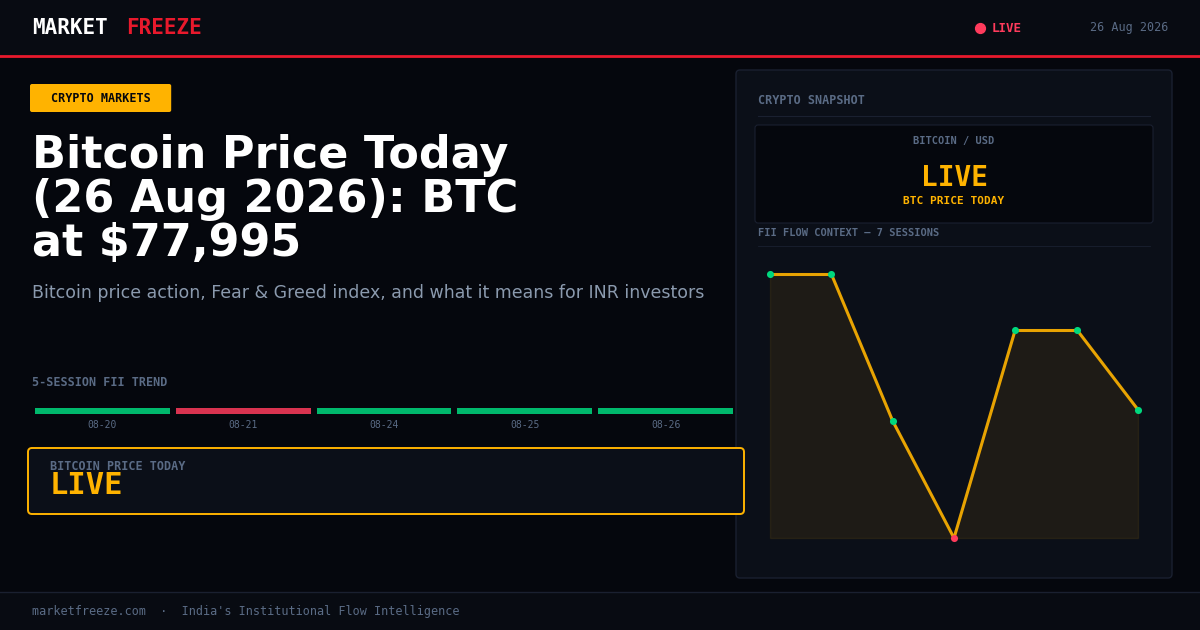
Foreign Institutional Investors (FIIs) were net buyers in Indian equities today, with a net inflow of ₹503 Cr. This follows a pattern of FII inflows observed over the past few sessions. The accompanying table details these flows and their correlation with Nifty movements:
| Date | FII Net (Cr) | DII Net (Cr) | Nifty Close |
|---|---|---|---|
| 2026-08-20 | +₹407.99 Cr | +₹3,973.72 Cr | 24,231.85 |
| 2026-08-21 | ₹-583.36 Cr | +₹3,537.71 Cr | 24,252.00 |
| 2026-08-24 | +₹1,181.66 Cr | +₹2,493.41 Cr | 24,219.05 |
| 2026-08-25 | +₹1,181.66 Cr | +₹2,493.41 Cr | 24,334.55 |
| 2026-08-26 | +₹502.63 Cr | +₹6,425.16 Cr | 24,207.75 |
While direct capital flow from FIIs into Indian crypto markets is not publicly tracked, the consistent inflow into Indian equities suggests a broader risk-on sentiment among institutional players. If this sentiment were to extend to digital assets, it could potentially support prices of major cryptocurrencies like Bitcoin ($77,973 USD | ₹7,440,963 INR) and Ethereum ($2,442 USD | ₹233,040 INR) in the longer term. However, today’s slight dip in crypto prices, despite FII buying in equities, indicates that the correlation is not immediate or direct.
Navigating Crypto Taxation: An Illustration with Bitcoin’s Current Price
Consider an Indian investor who purchased 0.1 Bitcoin (BTC) on August 20, 2026, at a price of approximately ₹7,400,000 INR per BTC (assuming a USD price of ~$77,800). Today, August 26, 2026, this 0.1 BTC is valued at ₹7,440,963 INR. If this investor were to sell their entire holding today, they would realize a profit of approximately ₹40,963 INR. Under India’s current crypto tax laws, this profit would be subject to a 30% tax, resulting in a tax liability of approximately ₹12,288.90 INR. No tax deduction would be allowed for the cost of acquisition, and losses from one crypto asset cannot be set off against gains from another. This example highlights the implications of even modest price appreciation for Indian crypto investors under the prevailing tax regime.
Key Levels to Watch for Nifty Based on Institutional Flow Trends
Given the sustained FII buying over the last five sessions, with a notable jump in DII activity today (+₹6,425.16 Cr), the immediate support for the Nifty appears to be around today’s closing level of 24,207.75. Any sustained weakness below this level could signal a shift in institutional sentiment. Conversely, if FII and DII flows continue to be robust, Nifty resistance could be tested around the recent highs seen on August 25th (24,334.55). While crypto prices like Bitcoin ($77,973 USD | ₹7,440,963 INR) are not directly dictated by Nifty levels, broader market trends influenced by institutional flows can indirectly impact overall investor risk appetite.
Understanding the Revolut EURR Stablecoin Launch
Revolut’s launch of its Euro-pegged EURR stablecoin for select customers in Denmark, Poland, and Portugal, with reserves held by a Stripe subsidiary, is a notable event in the stablecoin ecosystem. This move signifies increasing institutional adoption and integration of stablecoins into traditional financial services. While not directly impacting Bitcoin ($77,973 USD | ₹7,440,963 INR) or Ethereum ($2,442 USD | ₹233,040 INR) prices today, it reflects a growing trend towards regulated and fiat-backed digital currencies, which could influence the broader digital asset landscape in the medium to long term.
Actionable Framework: Navigating Potential Short-Term Crypto Pullbacks
Based on today’s ‘Greed’ reading (65/100) and historical precedents, Indian investors in cryptocurrencies should consider the following framework:
- Monitor for Weakness: If Bitcoin ($77,973 USD | ₹7,440,963 INR) breaks below ₹7,300,000 INR (approximately $76,500 USD), it could signal the start of a short-term correction.
- Ethereum’s Role: A sustained drop in the ETH/BTC ratio below 0.0310 might indicate a rotation out of altcoins towards Bitcoin’s relative safety.
- Solana as an Indicator: If Solana ($95.96 USD | ₹9,157 INR) falls below ₹9,000 INR (approximately $94.30 USD), it could signal broader altcoin weakness.
- Rebalancing Consideration: For investors who entered at lower levels and are experiencing significant paper gains, consider taking partial profits to de-risk, especially if they are within the 2-4 week window following a ‘Greed’ reading above 60.
Frequently Asked Questions
Q: What did FII buy or sell on August 25, 2026?
A: FIIs were net buyers of equities on August 25, 2026, with net inflows of +₹1,181.66 Cr.
Q: What did DII buy on August 26, 2026?
A: Domestic Institutional Investors (DIIs) were strong net buyers on August 26, 2026, with net inflows of +₹6,425.16 Cr.
Q: Is FII buying or selling in August 2026?
A: In August 2026, FIIs have shown a predominantly buying trend, with net inflows in most of the analyzed sessions, indicating a generally positive stance towards Indian equities.
The introduction of a 30% tax on Virtual Digital Assets (VDAs) in India, as previously illustrated, presents a significant consideration for domestic investors. This flat tax rate applies regardless of the holding period, meaning short-term speculative gains and long-term investments are treated identically from a tax perspective. Furthermore, the inability to offset losses from one VDA against gains from another, coupled with the prohibition of deducting acquisition costs, amplifies the tax burden. For instance, if an investor sold 0.1 BTC today for a profit of ₹40,963 INR, they would owe approximately ₹12,288.90 INR in taxes. This regime encourages a more cautious approach to trading and holding digital assets, as every profitable transaction directly incurs a substantial tax liability.
Understanding the Nuances of the Digital Personal Data Protection Act, 2023
The recently enacted Digital Personal Data Protection Act, 2023 (DPDP Act) in India, while not directly related to cryptocurrency pricing, establishes a framework for data privacy that could indirectly influence the adoption and regulation of digital assets. The Act imposes obligations on entities processing personal data, including requirements for consent, data security, and breach notifications. For crypto exchanges and platforms operating in India, compliance with the DPDP Act will be paramount. This includes ensuring robust security measures to protect user data, which could include sensitive financial information and transaction histories. Enhanced data protection may foster greater trust among users, potentially encouraging wider adoption of digital assets and related services, though it also introduces compliance costs and operational considerations for businesses in the sector.
Exploring the Correlation Between Gold Prices and Bitcoin’s Trajectory
Gold, often considered a traditional safe-haven asset, is currently trading around $2,330 USD per ounce. Historically, Bitcoin has been touted as “digital gold,” with proponents suggesting it could serve as an inflation hedge and a store of value similar to precious metals. However, the correlation between gold and Bitcoin has been inconsistent. While both assets can attract capital during times of economic uncertainty, their price movements are driven by different factors. Bitcoin’s volatility, regulatory landscape, and technological advancements play a more significant role in its price discovery than gold. Currently, despite a stable gold price, Bitcoin ($77,973 USD | ₹7,440,963 INR) is experiencing a slight dip, underscoring that a direct, immediate correlation is not always present.
Assessing the Impact of Global Interest Rate Hikes on Crypto Markets
Major central banks globally continue to navigate inflationary pressures, with some maintaining higher interest rates. Elevated interest rates in traditional economies can make fixed-income investments more attractive, potentially drawing capital away from riskier assets like cryptocurrencies. Investors might shift funds from assets such as Bitcoin ($77,973 USD | ₹7,440,963 INR) or Ethereum ($2,442 USD | ₹233,040 INR) to government bonds or high-yield savings accounts that offer guaranteed returns. While the immediate impact on today’s crypto prices is subtle, sustained high interest rates could exert downward pressure on digital asset valuations by increasing the opportunity cost of holding non-yielding or volatile assets.
Bottom Line
Today’s crypto market shows minor declines, with Bitcoin at $77,973 USD | ₹7,440,963 INR and Ethereum at $2,442 USD | ₹233,040 INR. The ‘Greed’ indicator at 65/100 suggests caution is warranted, as historical patterns point to potential short-term corrections. While FIIs remain net buyers in Indian equities, this has not immediately translated into a crypto rally. Investors should monitor key price levels and consider profit-taking strategies given the current market sentiment.
Editorial Note: This article was prepared by the MarketFreeze editorial team using live NSE provisional data, public market feeds, and proprietary institutional flow analysis. All price and flow figures are sourced directly from NSE, BSE, and CoinGecko as of 26 August 2026. This content is for informational purposes only and does not constitute investment advice. MarketFreeze is not SEBI-registered. Please consult a qualified financial advisor before making investment decisions. Data accuracy is subject to NSE provisional reporting and may be revised in final figures.