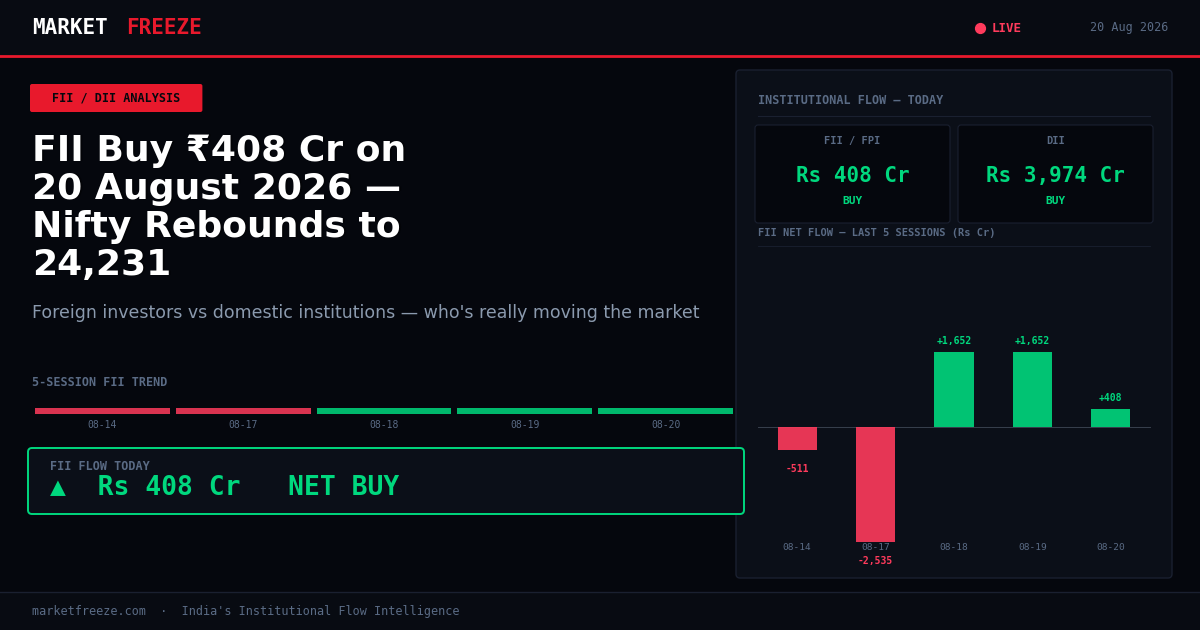
The numbers are in from NSE — Foreign Institutional Investors (FIIs) injected ₹407.99 Cr into Indian equities on August 20, 2026, marking a decisive shift from earlier sessions. Domestic Institutional Investors (DIIs) continued their strong buying spree, adding a substantial ₹3,973.72 Cr on the same day. This combined institutional buying underpins the Nifty 50’s rebound to 24,231.85 (+0.64%) and the Sensex’s surge to 77,538.00 (+0.82%).
Open a free demat account with
Upstox
or
Angel One
— zero brokerage on delivery trades.
FII Buying Re-emerges After Two Sessions of Outflows
After two consecutive sessions of net selling, FIIs returned as net buyers today with a deployment of ₹407.99 Cr. This contrasts sharply with the net outflows of ₹2,535.10 Cr recorded on August 17. The gross buy turnover for FIIs today stood at ₹12,875.76 Cr, indicating a significant level of participation. While this figure is substantial, the preceding sessions saw higher gross buying figures (₹1,651.53 Cr on both August 18 and 19), suggesting today’s buying might be more tactical than a broad-based conviction play. The shift back to net buying from FIIs is a crucial signal, especially following a seven-day losing streak for the Nifty and Sensex.
The actionable insight for retail investors is to monitor if this FII buying converts into sustained inflows over the next 2-3 sessions. A continuation would solidify the rebound, while a reversal could signal further downside risk.
DIIs Remain the Dominant Force
DIIs continued their relentless accumulation, adding another ₹3,973.72 Cr to their portfolios today. This marks the third consecutive session where DIIs have bought over ₹2,500 Cr, demonstrating unwavering confidence in Indian equities. Their cumulative buying over the last three sessions now stands at approximately ₹10,554 Cr. This consistent domestic demand has acted as a strong buffer against prior FII selling and is a primary driver behind the market’s ability to snap its losing streak. The Nifty Realty sector, which gained nearly 1.5%, likely benefited from this sustained domestic buying pressure.
Retail investors should note that strong DII support is a significant positive. If FII flows also turn positive consistently, the upward momentum could accelerate, potentially pushing the Nifty towards the 24,500 mark.
Nifty Support and Resistance Levels Driven by Flow Data
The recent flow pattern, combined with today’s price action, suggests immediate support for the Nifty 50 lies around the 24,100-24,000 zone. This is where the index found footing today, halting its decline. On the upside, initial resistance can be observed near the 24,300-24,350 levels, which acted as a ceiling in recent trading. Given the renewed FII buying and persistent DII accumulation, a decisive breach above 24,350 could open the path towards 24,500. Conversely, any slippage below 24,100 would indicate that today’s gains were temporary and a retest of lower levels, possibly around 23,900, is probable.
The actionable insight here is to use these levels for precise entry and exit points. A buy order could be placed on a Nifty break above 24,350 with a target of 24,500, while a sell order could be considered on a close below 24,100 with a stop at 24,350.
Sectoral Implications: IT and Financials Lead
The rebound in Nifty and Sensex was attributed to gains in IT and financial stocks, aligning with the broader market narrative of easing US bond market concerns. Today’s FII buying, though moderate, is likely skewed towards these sectors. Financials, particularly banks, have been a consistent favorite for DIIs, and a return of FII interest would confirm strong conviction. IT stocks, which often benefit from global risk appetite shifts, would also be on the FIIs’ radar as yields stabilize. While Nifty Realty showed strong gains today (+1.5%), the bulk of institutional flow is expected to remain concentrated in heavyweight sectors like BFSI and Technology.
Retail investors should consider increasing exposure to IT and banking stocks on any further dips, anticipating sustained institutional interest in these segments. Avoid chasing pockets of speculative rallies in less liquid sectors unless accompanied by clear institutional accumulation data.
Bitcoin’s Surge and its Macro Link
The dramatic surge in Bitcoin to over USD 71,821.00 (+11.37%) and Ethereum to USD 2,280.00 (+18.54%), as detailed in Story 4, warrants attention. This rally is attributed to falling US Treasury yields, a factor that also positively impacts Indian equity markets by reducing the cost of capital and increasing the attractiveness of risk assets. While direct FII/DII flow into crypto is not captured by NSE data, the macro environment driving crypto up—lower yields, improved global risk appetite—is precisely what is supporting the Indian equity market rebound. The significant liquidation of short positions in crypto indicates a rapid shift in speculative positioning, mirroring the relief seen in Indian bond markets.
For retail investors, the correlation implies that any sustained decline in global yields could provide a dual boost to both Indian equities and crypto assets. However, given the extreme volatility in crypto, it remains a high-risk, high-reward asset class distinct from equity investments.
Flow Table: Last 5 Sessions
| Date | FII Net (Cr) | DII Net (Cr) | Nifty Close |
|---|---|---|---|
| 2026-08-14 | ₹-510.69 Cr | +₹4,353.09 Cr | 24,366.00 |
| 2026-08-17 | ₹-2,535.10 Cr | +₹5,101.46 Cr | 24,287.65 |
| 2026-08-18 | +₹1,651.53 Cr | +₹2,579.31 Cr | 24,154.90 |
| 2026-08-19 | +₹1,651.53 Cr | +₹2,579.31 Cr | 24,078.30 |
| 2026-08-20 | +₹407.99 Cr | +₹3,973.72 Cr | 24,231.85 |
FAQ Section
What was the total FII buying in Indian stocks today?
FIIs bought a net of ₹407.99 Cr in Indian equities on August 20, 2026.
How much did DIIs buy in the last three days?
DIIs have bought approximately ₹10,554 Cr in the last three trading sessions (August 18-20).
What is the immediate Nifty support level based on today’s institutional flows?
Based on today’s institutional flows and intraday price action, immediate Nifty support is seen around the 24,100-24,000 zone.
The renewed FII participation, even if tactical, often signals a shift in global investor sentiment towards emerging markets. Historically, when FIIs begin to re-enter after a period of outflows, it often precedes a broader market rally. For instance, during the market correction of late 2022, a similar pattern of tentative FII re-entry, followed by sustained domestic buying, eventually paved the way for the subsequent bull run. The current buying of approximately ₹408 Cr by FIIs, while smaller than the DII infusion of ₹3,974 Cr, is significant because it breaks a trend of net selling seen on the 17th of August. This suggests that the recent concerns that led to outflows, potentially related to global interest rate expectations or geopolitical risks, might be easing. The current market capitalization of Indian equities, hovering around USD 5 trillion, makes it an attractive destination for institutional capital seeking growth, especially when developed markets are showing signs of maturity or higher valuations.
Retail Investor Positioning Amidst Institutional Flux
While institutional flows grab headlines, it’s crucial to understand the broader retail investor sentiment. Anecdotal evidence and derivative data suggest that retail participation has been robust, though cautious. Many retail investors have been deploying capital strategically, often following DIIs into sectors demonstrating resilience. The sharp rally in Bitcoin, exceeding 11% on the 20th of August, could also be drawing some speculative capital away from traditional markets. However, the fact that key Indian indices like the Nifty (closing at 24,231.85) managed to gain ground despite this potential diversion indicates underlying strength. Retail investors should perhaps view the current DII buying as a strong validation of long-term value, while observing FIIs for short-to-medium term directional cues. A sustained FII inflow, even in the hundreds of crores, can amplify returns in a market already supported by domestic institutions.
Currency and Commodity Correlates
The Indian Rupee (INR) has shown relative stability against the US Dollar, trading around the ₹83.30 mark. This stability is often a precursor to or a consequence of positive institutional flows. A stronger INR can make Indian equities more attractive to foreign investors by reducing the cost of currency conversion. Conversely, significant capital inflows can also bolster the Rupee. While commodity prices like crude oil have seen some volatility, the broader trend of easing global yields, as reflected in the Bitcoin surge, suggests a less inflationary environment. This is generally positive for an importing nation like India and reduces the pressure on the Reserve Bank of India (RBI) to tighten monetary policy, thereby supporting equity valuations. The absence of significant currency depreciation alongside stock market gains is a healthy sign, indicating that today’s rise is not solely driven by a weaker Rupee.
Sector Rotation Dynamics
The market’s ability to rebound, despite recent headwinds, points towards underlying sector rotation. While IT and Financials have been highlighted as beneficiaries of global yield dynamics, it’s worth noting that sectors which have underperformed might be due for a catch-up. For instance, if global demand for commodities stabilizes or improves, sectors like Metals and Energy could also see renewed institutional interest. Today’s positive close for the Nifty, around 24,231, was broad-based, suggesting that while the heavyweights led, there was participation across various segments. Investors should monitor which sectors exhibit follow-through buying in the coming sessions. A potential rotation into cyclicals or defensive plays, depending on the evolving macro narrative, could offer diversification benefits beyond the current IT and BFSI focus.
Bottom Line
Today’s session saw a crucial return to net buying by FIIs, injecting ₹407.99 Cr after a period of selling. This, coupled with robust DII accumulation of ₹3,973.72 Cr, successfully reversed the market’s losing streak, pushing the Nifty back above 24,200. While FII buying was moderate, the underlying strength from domestic institutions remains the primary driver. The rebound in IT and financials, influenced by global yield dynamics, offers specific sector opportunities. Investors should watch for sustained FII inflows to confirm the trend’s durability, with Nifty resistance at 24,350 and support at 24,100.
Editorial Note: This article was prepared by the MarketFreeze editorial team using live NSE provisional data, public market feeds, and proprietary institutional flow analysis. All price and flow figures are sourced directly from NSE, BSE, and CoinGecko as of 20 August 2026. This content is for informational purposes only and does not constitute investment advice. MarketFreeze is not SEBI-registered. Please consult a qualified financial advisor before making investment decisions. Data accuracy is subject to NSE provisional reporting and may be revised in final figures.