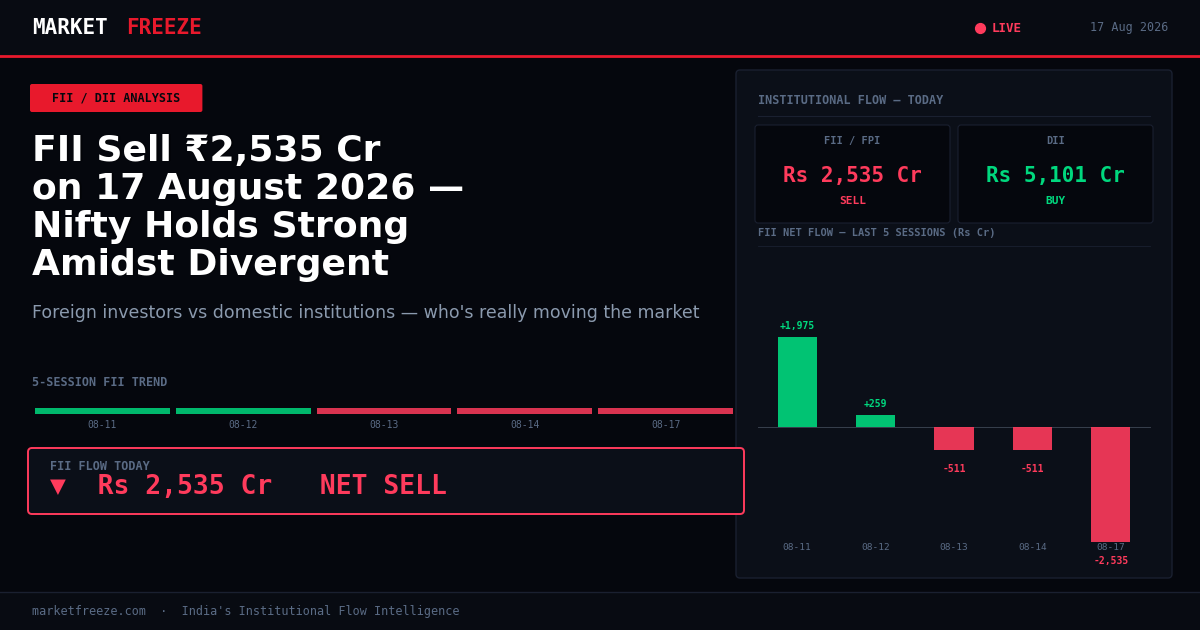
FIIs Unleash ₹2,535 Cr Selloff as DIIs Counter with ₹5,101 Cr Buy
India’s equity markets absorbed a significant institutional churn today, 17 August 2026, with Foreign Institutional Investors (FIIs) offloading a net ₹2,535.10 Cr in equities. This outflow was substantially counterbalanced by Domestic Institutional Investors (DIIs), who deployed a net ₹5,101.46 Cr, creating a pronounced divergence in flow direction between the two key investor classes.
Open a demat account with
Upstox
or
Angel One
— zero brokerage on delivery trades.
FII Selling Accelerates Beyond Recent Trend
Today’s FII net sell figure of ₹2,535.10 Cr marks a sharp acceleration in selling pressure compared to the preceding two sessions. On 14 August and 13 August, FIIs sold ₹510.69 Cr net each day. This indicates a decisive increase in the pace of foreign outflows, moving from a moderate divestment to a more aggressive exit over the past trading day. The total sell value for FIIs today stood at ₹11,546.16 Cr, against a buy value of ₹9,011.06 Cr (calculated from net sell and total sell), signifying substantial gross turnover and conviction in the selling activity.
An actionable insight for retail traders: The sharp increase in FII selling today, breaking the pattern of the prior two sessions, suggests a potential unwinding of positions that could exert downward pressure on select market segments in the near term.
DII Buying Strength Outpaces FII Outflow
Domestic institutions provided a robust buffer against foreign selling today, stepping in with a net purchase of ₹5,101.46 Cr. This DII buying significantly exceeds their activity over the last three sessions, where they bought ₹4,353.09 Cr (14 Aug & 13 Aug) and ₹1,290.29 Cr (11 Aug). The substantial deployment by DIIs today, more than double the net inflow seen on the previous two days, demonstrates strong domestic conviction and a willingness to absorb foreign sell orders, particularly in the face of broader market declines.
An actionable insight for retail traders: The aggressive DII buying today, particularly when contrasted with FII selling, suggests pockets of domestic institutional demand may offer support to specific stocks or sectors that DIIs are accumulating.
Nifty Edges Lower Amid Divergent Flows
The benchmark Nifty 50 closed down 0.32% at 24,287.65, mirroring the broader market trend of a 280-point decline in the Sensex. This marginal dip occurred despite the significant DII buying offsetting the larger FII selling. The underlying pressure from foreign outflows, coupled with global headwinds, appears to have capped any upside potential. The Bank Nifty, however, showed resilience, closing marginally up by 0.01% at 57,498.00, indicating strength within financials that DIIs may be favouring.
Derived from today’s flow data and Nifty’s closing price: With FIIs actively selling, immediate support for the Nifty 50 is seen around 24,150. A breach below this level could expose the index to 23,900. Conversely, sustained DII buying and a reversal in FII flows could test resistance at 24,550, with a stronger push towards 24,800.
An actionable insight for retail traders: While the headline index declined, the divergence suggests sector-specific performance. Monitor banking stocks closely, as DII accumulation might offer a protective cushion.
Sectoral Implications: IT Faces Headwinds, Banking Shows Resilience
The substantial FII sell-off today, amounting to ₹2,535.10 Cr net, likely targeted sectors where foreign investors have significant exposure. Information Technology (IT) and potentially FMCG stocks are often primary destinations for FII capital and could be areas of FII liquidation. The sharp decline in IT stocks like Infosys and HCL Tech, as noted in market highlights, aligns with this expectation. Conversely, the resilience of the Bank Nifty indicates that DIIs might be increasing their allocations to the banking sector, potentially viewing current valuations as attractive or anticipating sustained credit growth.
An actionable insight for retail traders: Given the FII selling trend, consider reducing exposure or adopting a cautious approach towards IT stocks. Monitor banking sector performance as a potential area of DII support.
Global Inflation Fears and Rupee Weakness Weigh on Markets
Today’s market action was influenced by external factors, including rising crude oil prices and geopolitical tensions in West Asia, as highlighted by news reports. Story 2 directly links the Sensex and Nifty declines to rising crude oil prices and geopolitical tensions. Furthermore, Story 1 notes that Euro zone bond yields are near 15-year highs due to Middle East war-driven energy inflation, raising expectations of further rate hikes. This global inflationary pressure indirectly impacts Indian markets by increasing the cost of capital and potentially influencing foreign investor decisions. The Indian Rupee also weakened against the US Dollar, closing at Rs95.61 (+0.20%), exacerbated by the RBI’s move to shorten its forex swap timeframe (Story 3), adding another layer of concern for importers and potentially contributing to the overall negative flow.
An actionable insight for retail traders: The interconnectedness of global inflation, energy prices, and currency movements suggests a challenging environment. Be mindful of how these macro factors could impact domestic corporate earnings and FII flow patterns.
Historical Flow Comparison: A Significant Turnaround in One Day
The last five trading sessions paint a picture of fluctuating institutional activity. After net inflows from both FIIs and DIIs on 11 and 12 August, the last three days have seen a clear divergence. Specifically, the period from 13 August to 17 August shows consistent FII selling (₹510.69 Cr on 13 Aug and 14 Aug, and ₹2,535.10 Cr today) juxtaposed with robust DII buying (₹4,353.09 Cr on 13 Aug and 14 Aug, and ₹5,101.46 Cr today). Today’s FII outflow is the largest in this 5-session window, indicating a significant shift in foreign investor positioning compared to the earlier part of the week. The Nifty’s closing price has also trended downwards over these five sessions, from 24,471.70 on 11 August to 24,287.65 today.
| Date | FII Net (Cr) | DII Net (Cr) | Nifty Close |
|---|---|---|---|
| 2026-08-11 | +₹1,974.76 Cr | –₹1,290.29 Cr | 24,471.70 |
| 2026-08-12 | +₹258.55 Cr | +₹24.77 Cr | 24,435.95 |
| 2026-08-13 | –₹510.69 Cr | +₹4,353.09 Cr | 24,395.85 |
| 2026-08-14 | –₹510.69 Cr | +₹4,353.09 Cr | 24,366.00 |
| 2026-08-17 | –₹2,535.10 Cr | +₹5,101.46 Cr | 24,287.65 |
An actionable insight for retail traders: The marked increase in FII selling today, coupled with the consecutive decline in Nifty, warrants close observation. If DII buying falters or FII selling accelerates further, the downward trend could persist.
FAQ Section
Why did FIIs sell so much today?
FIIs net sold ₹2,535.10 Cr in equities today, a significant increase from their selling in previous sessions. This sharp outflow is likely influenced by global inflationary pressures stemming from Middle East conflicts, driving up energy prices and potentially leading to higher interest rates globally, as well as the weakening Indian Rupee.
How much did DIIs buy to offset the FII selling?
DIIs were net buyers of ₹5,101.46 Cr today, providing a substantial counter-balance to the FII outflow. This is their highest net buy figure in the last three sessions.
What is the immediate support level for Nifty based on today’s flows?
Based on today’s divergent institutional flows and the Nifty 50’s closing price of 24,287.65, immediate support is estimated around 24,150.
Retail Investor Sentiment Amidst Institutional Flux
While institutional flows dominate the headlines, understanding retail investor behaviour provides a more complete market picture. Today’s sharp FII sell-off, amounting to a net outflow of over ₹2,500 Cr, could potentially trigger caution among retail participants. Historically, significant foreign selling often precedes a period of market consolidation or correction, leading retail investors to reduce their exposure or adopt a wait-and-watch approach. However, the strong DII buying, exceeding ₹5,100 Cr net, might offer a degree of reassurance. This domestic accumulation could signal underlying strength in specific sectors, potentially encouraging retail investors to selectively participate, especially in areas supported by DIIs, such as banking.
An actionable insight for retail traders: Observe retail trading volumes and sentiment indicators in conjunction with institutional flows. If retail participation remains subdued or turns negative despite DII strength, it could indicate a broader loss of confidence that could eventually pressure the market, even with domestic institutional support.
Potential Sector Rotation Dynamics
The pronounced divergence between FII selling and DII buying suggests a potential shift in sector allocation within the Indian equity landscape. Foreign investors, often heavily weighted in growth-oriented sectors like Information Technology, may be trimming positions due to global economic uncertainties and rising interest rate expectations. The reported sell-off in IT stocks aligns with this hypothesis. Conversely, DIIs, with a more domestic-centric mandate, might be reallocating capital towards sectors perceived as defensive or offering better value. The banking sector’s resilience, as evidenced by the Bank Nifty’s flat close, points towards significant DII accumulation in financials, possibly driven by expectations of stable earnings and credit growth in the Indian economy. Other sectors that are less export-oriented and more domestically driven could also be beneficiaries of this DII inflow.
An actionable insight for retail traders: Monitor the performance of IT and banking stocks closely. A sustained trend of FIIs exiting IT while DIIs enter banking could signal a significant sector rotation play that retail investors can leverage.
Currency and Commodity Crossover: A Double Whammy
The dual pressure of a weakening Indian Rupee and rising global commodity prices, particularly crude oil, presents a complex challenge for Indian equities. The Rupee’s depreciation against the US Dollar, moving from a stronger position to around Rs95.61, increases the import bill for energy and raw materials, thereby impacting corporate profitability for many Indian businesses. Simultaneously, elevated crude oil prices, driven by geopolitical tensions, directly contribute to inflationary pressures both domestically and globally. Today’s FII selling might be partially attributed to foreign investors factoring in these adverse macro-economic conditions. For instance, a weaker Rupee makes imported technology more expensive for IT firms, while higher oil prices increase operational costs for transportation-heavy sectors.
An actionable insight for retail traders: Stay informed about global crude oil prices and the INR-USD exchange rate. Significant adverse movements in these indicators, especially when coinciding with large FII outflows, could signal increased market volatility and necessitate a more defensive portfolio stance.
Bottom Line
Today’s session was defined by aggressive FII selling of ₹2,535.10 Cr, starkly contrasted by strong DII buying of ₹5,101.46 Cr. This created a significant divergence, with FII outflows accelerating beyond recent trends and DII accumulation reaching new highs for the period. While the Nifty 50 closed lower at 24,287.65, the robust domestic buying provided a floor, particularly evident in the Bank Nifty’s resilience. Global inflation fears and a weaker rupee add macro headwinds, suggesting continued vigilance is necessary.
Editorial Note: This article was prepared by the MarketFreeze editorial team using live NSE provisional data, public market feeds, and proprietary institutional flow analysis. All price and flow figures are sourced directly from NSE, BSE, and CoinGecko as of 17 August 2026. This content is for informational purposes only and does not constitute investment advice. MarketFreeze is not SEBI-registered. Please consult a qualified financial advisor before making investment decisions. Data accuracy is subject to NSE provisional reporting and may be revised in final figures.