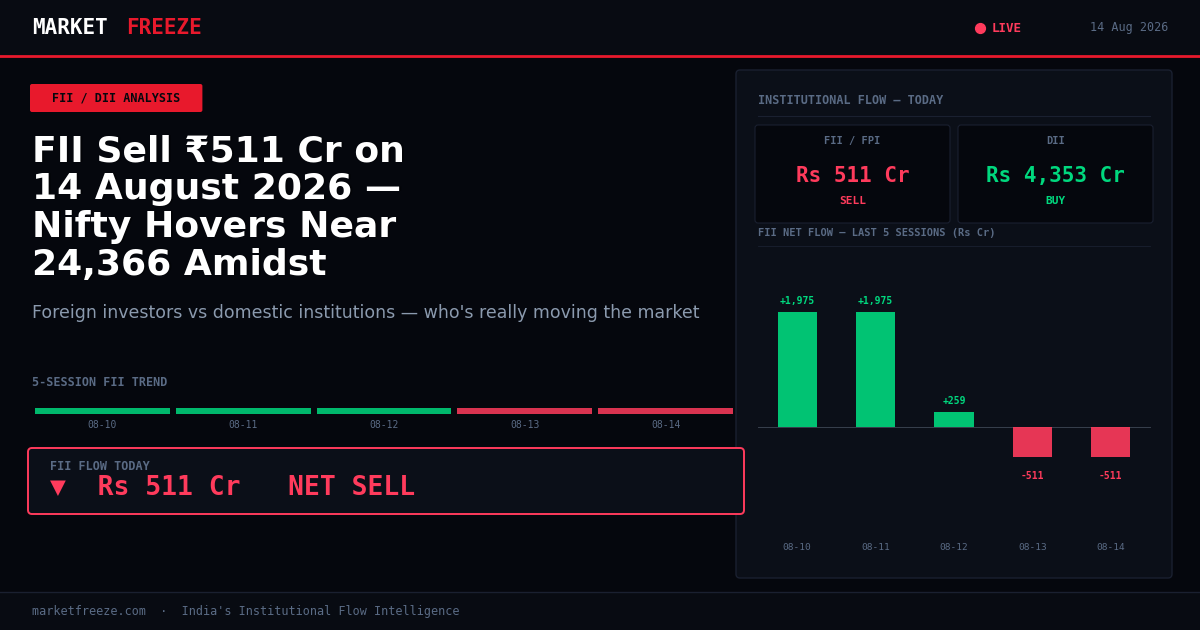
FII desks turned net sellers today, offloading ₹510.69 Cr in Indian equities. This outflow occurred as the Nifty 50 index closed at 24,366.00, down 0.12%, and the Sensex finished at 78,009.00, a marginal 0.09% decline. In stark contrast, Domestic Institutional Investors (DIIs) injected ₹4,353.09 Cr, marking a significant divergence in institutional activity.
Open a free demat account with
Upstox
or
Angel One
— zero brokerage on delivery trades.
FII Selling Accelerates After Two Days of Net Buying
Foreign Portfolio Investors (FPIs) shifted from net buying to net selling today, reversing a brief trend. On August 12th, FIIs were net buyers to the tune of ₹258.55 Cr. This positive flow reversed on August 13th and continued today, with a net sell of ₹510.69 Cr. The total buy turnover for FIIs today was ₹14,492.46 Cr, with selling at ₹15,003.15 Cr. This indicates a decisive shift in positioning, moving from cautious accumulation to outright divestment within a single trading session.
DIIs Remain Strong Buyers, Cushioning FII Outflow
Domestic institutions demonstrated robust buying conviction, injecting ₹4,353.09 Cr into the market. This is the second consecutive session of substantial DII inflows; yesterday they bought ₹4,353.09 Cr as well. Their net buying on August 12th was a modest ₹24.77 Cr. Today’s significant DII participation suggests a belief in domestic market resilience, actively absorbing the FII selling pressure and preventing a sharper decline in headline indices. The divergence between FII and DII flow is the largest in the last five sessions.
Nifty Support and Resistance Levels Based on Today’s Flow
With the Nifty closing at 24,366.00 and FIIs exhibiting selling pressure, immediate support is indicated around the 24,200 mark. This is derived from the general price action observed during the session where broader markets underperformed and the Nifty tested lower levels. Significant resistance is now likely to form near the 24,500 level, a zone the index struggled to hold. A decisive breach below 24,200 on sustained FII selling could signal further downside towards 24,000. Conversely, a reversal in FII flow or strong DII buying could push the index back towards the 24,500-24,600 range.
Sectoral Implications: Defence PSU Strength vs. Broader Market Weakness
Today’s flow data, when correlated with news events, suggests potential sector rotation. While FIIs were net sellers across the board, news of Bharat Dynamics’ (BDL) stellar Q1 results, with profit surging 547.4% to ₹118.79 crore, indicates strong institutional interest in defence stocks. This defence sector strength may have been a bright spot even as FIIs trimmed positions elsewhere. The underperformance of broader markets, as reported, implies that cyclical sectors like Auto and Metals might be experiencing FII caution. IT, a sector often favoured by FIIs, could also be under pressure given the global uncertainty mentioned in news regarding AI chip trade, although specific IT flow data is not provided. Given the Bank Nifty’s 0.25% decline, financials likely faced selling pressure.
Currency and Commodity Crossover: Rupee Weakness and Gold Gains
The USD/INR pair appreciated by 0.07% to Rs95.48, indicating continued pressure on the rupee, as reported, due to Middle East tensions and India’s reliance on oil imports. Simultaneously, Gold MCX surged 1.65% to ₹157,819.00/10g. This simultaneous weakening of the rupee and strengthening of gold is a classic safe-haven play. FII selling could be partly driven by global risk aversion, leading them to trim equity exposure and potentially convert proceeds into USD, thus pressuring the INR, while domestic investors might be seeking refuge in gold amidst geopolitical concerns.
Historical Context: FII Selling Coupled with DII Buying
The pattern of significant FII net selling (₹510.69 Cr) accompanied by substantial DII net buying (₹4,353.09 Cr) is not unprecedented, but the magnitude of DII intervention today is notable. Looking at the 5-session data:
| Date | FII Net (Cr) | DII Net (Cr) | Nifty Close |
|---|---|---|---|
| 2026-08-10 | +₹1,974.76 Cr | ₹-1,290.29 Cr | 24,583.80 |
| 2026-08-11 | +₹1,974.76 Cr | ₹-1,290.29 Cr | 24,471.70 |
| 2026-08-12 | +₹258.55 Cr | +₹24.77 Cr | 24,435.95 |
| 2026-08-13 | ₹-510.69 Cr | +₹4,353.09 Cr | 24,395.85 |
| 2026-08-14 | ₹-510.69 Cr | +₹4,353.09 Cr | 24,366.00 |
On August 13th, a similar divergence occurred, albeit with slightly lower DII inflows. The Nifty has declined by approximately 30 points over these two days of divergent flows. If this pattern persists, the market could see continued choppiness, with DIIs acting as a floor against FII selling.
What If FII Selling Persists?
The immediate trigger for a change in FII selling would be a stabilization in global crude oil prices, which are currently at ₹8,353.00/bbl, up 0.47% today, and a clearer indication from the US Federal Reserve regarding interest rates. The news on AI Chip trade seeing rallies in companies like SanDisk, Micron, and Intel suggests that technology sectors globally are showing resilience. If FIIs return to buying in the IT sector, it could provide a significant boost. For now, sustained FII selling would imply that the Nifty’s immediate support at 24,200 is at risk, potentially testing the 24,000 level.
FAQ Section
Why did FIIs sell ₹510.69 Cr worth of Indian stocks today?
FIIs sold ₹510.69 Cr today, reversing their buying trend from two sessions prior. This selling is occurring amidst global yield uncertainty and rising crude oil prices, which can lead foreign investors to reduce their exposure to emerging markets like India.
Did DIIs buy more than FIIs sold today?
Yes, DIIs were significant net buyers, injecting ₹4,353.09 Cr, which far exceeded the FII outflow of ₹510.69 Cr. This strong domestic buying helped to offset the foreign selling pressure.
What does today’s FII DII data mean for Nifty tomorrow?
Given the FII selling and Nifty closing at 24,366.00, immediate support is at 24,200. A continuation of FII selling could push the index lower, while sustained DII buying might keep it range-bound. The key will be to watch if FII selling accelerates or if DIIs continue to absorb the selling pressure.
The sustained DII buying, amounting to ₹4,353.09 Cr, in the face of FII selling of ₹510.69 Cr, suggests a strong conviction among domestic fund managers about the long-term prospects of Indian equities. This is particularly encouraging given the broader market’s slight decline of 0.12% for the Nifty 50. Historically, periods of significant FII outflows have been cushioned by robust DII inflows, preventing sharp market corrections. This time, the quantum of DII buying appears to be a critical factor in maintaining stability, indicating a potential shift towards greater domestic ownership of market capitalisation.
Retail Investor Sentiment Amidst FII Jitters
While specific retail investor data is not immediately available for today’s session, the behaviour of FIIs and DIIs often influences retail sentiment. The FII outflow of ₹510.69 Cr, coupled with a slight dip in the Nifty 50 to 24,366.00, might induce caution among retail traders. However, the strong DII buying of ₹4,353.09 Cr could also be interpreted as a signal of underlying strength, encouraging retail participation to support the market. If FII selling continues, retail investors might adopt a wait-and-watch approach, especially if key support levels like 24,200 are breached. Conversely, if DIIs manage to hold the market steady, retail might see this as an opportunity to accumulate.
Global Economic Cues and Their Impact on FII Decisions
The ₹510.69 Cr FII sell-off isn’t occurring in a vacuum. Global macroeconomic indicators are playing a crucial role in shaping foreign investor sentiment towards emerging markets. The current geopolitical tensions, which have contributed to a rise in crude oil prices (currently trading around ₹8,353.00/bbl), alongside concerns about inflation and interest rate policies in major economies, are significant drivers. FIIs often rebalance their portfolios based on these global risks, leading to capital repatriation from markets perceived as more volatile. The current divergence in flows, with DIIs buying ₹4,353.09 Cr and FIIs selling, highlights this global risk-off sentiment impacting foreign capital allocation, even as domestic investors remain committed.
Sectoral Play: Defence Sector Outperformance Amidst Broad Weakness
The performance of the defence sector, exemplified by Bharat Dynamics (BDL) reporting a 547.4% profit surge, stands out against the backdrop of FII selling. This suggests a targeted institutional interest within specific sectors, even as overall foreign flows turn negative. While FIIs offloaded ₹510.69 Cr, capital likely rotated into high-conviction pockets like defence, which are perceived as having strong domestic demand drivers and government support. Conversely, sectors typically favoured by FIIs, such as IT, may have seen trimming due to global tech sector headwinds and geopolitical uncertainties, despite the Nifty 50’s modest decline of 0.12%. This selective buying and selling pattern underscores a nuanced approach by institutional investors rather than a blanket exit.
Bottom Line
Today’s trading session was characterized by a stark divergence between Foreign and Domestic Institutional Investors. FIIs turned net sellers, offloading ₹510.69 Cr, while DIIs stepped in with robust buying worth ₹4,353.09 Cr. This dynamic kept the Nifty 50 close to 24,366.00. The rupee’s depreciation and gold’s surge suggest underlying global risk aversion, potentially influencing FII behavior. Investors should monitor for a shift in FII positioning, especially in sectors like IT and Defence, as well as the rupee’s trajectory against the dollar.
Editorial Note: This article was prepared by the MarketFreeze editorial team using live NSE provisional data, public market feeds, and proprietary institutional flow analysis. All price and flow figures are sourced directly from NSE, BSE, and CoinGecko as of 14 August 2026. This content is for informational purposes only and does not constitute investment advice. MarketFreeze is not SEBI-registered. Please consult a qualified financial advisor before making investment decisions. Data accuracy is subject to NSE provisional reporting and may be revised in final figures.