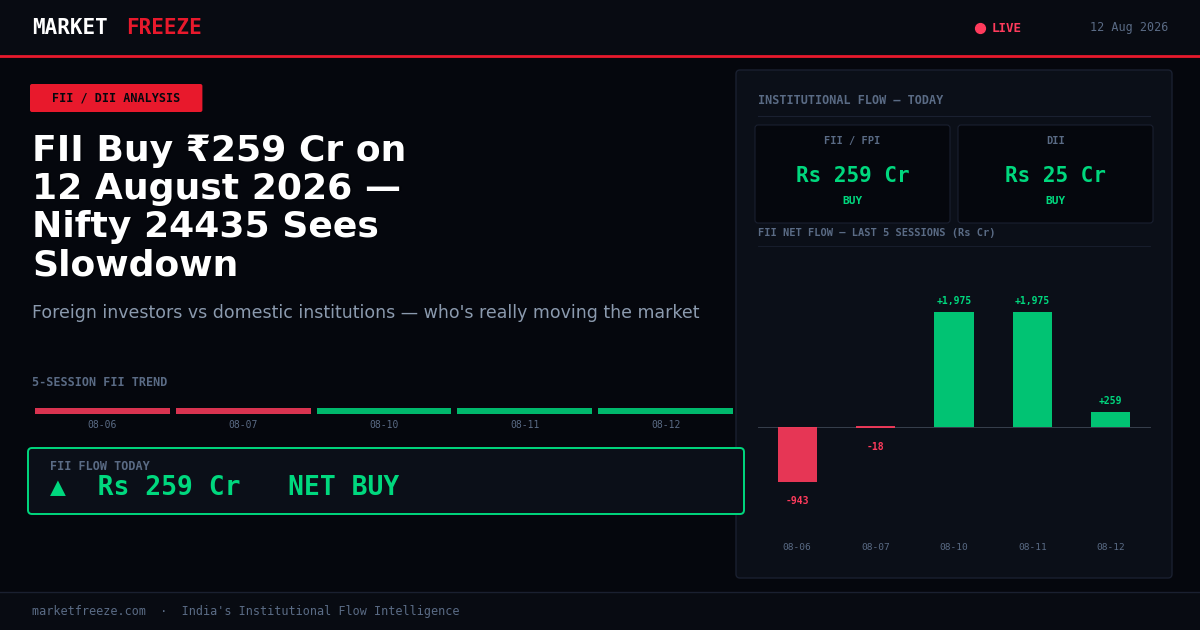
The numbers are in from NSE — FIIs deployed ₹258.55 Cr into Indian equities today, a stark slowdown from their aggressive buying in the preceding two sessions, while DIIs flipped to a net buy of ₹24.77 Cr after significant selling yesterday.
FII Buying Decelerates Sharply After Two-Day Surge
Foreign Institutional Investors (FIIs) net purchased ₹258.55 Cr today, a dramatic shift from the substantial inflows of ₹1,974.76 Cr seen on both August 10th and August 11th. Today’s buy figure represents a mere 13% of the average net buy over the previous two sessions. The gross purchase value today stood at ₹14,628.47 Cr against a selling value of ₹14,369.92 Cr. This significant drop in net FII activity suggests reduced conviction or a pause in their bullish stance, especially when contrasted with their strong deployment in the prior two days. The market closed lower with the Nifty at 24,435.95 and Sensex at 77,966.00, indicating that this reduced FII participation did not prevent a minor dip.
Open a free demat account with
Upstox
or
Angel One
— zero brokerage on delivery trades.
Actionable Insight: Retail investors should monitor if FII inflows remain subdued tomorrow. A continued low inflow could signal a shift in institutional sentiment, prompting a review of long positions.
DIIs Turn Net Buyers, Offsetting Previous Selling
Domestic Institutional Investors (DIIs) recorded a net buy of ₹24.77 Cr today, a sharp reversal from their net selling of ₹1,290.29 Cr on both August 10th and August 11th. This shift from significant selling to a marginal buy indicates a potential stabilization or a re-evaluation of their positions. While FII buying significantly decelerated, DIIs’ modest return as net buyers provided some counterbalance to the overall institutional flow picture, preventing a sharper decline in the indices.
Actionable Insight: The flip in DII positioning from heavy selling to marginal buying is a subtle signal. Retail traders might consider increasing their allocation to sectors where DIIs have historically shown strong participation, provided FII flows also align.
Nifty Faces Resistance at 24,550 Amid Flow Slowdown
With the Nifty closing at 24,435.95 today, the significant slowdown in FII net buying, coupled with the overall market decline (Sensex down 0.24%, Nifty down 0.15%), suggests immediate resistance. Based on today’s flow pattern and market close, the immediate upside resistance for the Nifty is at 24,550. Any sustained buying exceeding today’s ₹258.55 Cr FII net figure would be required to breach this level. Conversely, a break below 24,300 would suggest further selling pressure, potentially indicating a retest of lower support levels around 24,200, which aligns with the lower end of the Nifty’s trading range over the last few sessions.
Actionable Insight: Traders should view 24,550 as a critical resistance point for the Nifty. A failure to break above this level on increased volumes could lead to short-term traders reducing exposure.
Sectoral Clues: Banking Gains, IT Under Pressure
Today’s market wrap indicates that PSU Banks outperformed while IT stocks remained weak, consistent with the broader market narrative of extended losses. While specific sector-level FII/DII data is not provided, the general market trend and news context suggest continued FII preference for Banking stocks, likely driven by their defensive characteristics and potential for rate sensitivity. The weakness in IT, as highlighted in the market wrap referencing TCS and M&M as top losers, indicates FII caution or profit-taking in the sector. Gold prices on MCX saw a significant jump of +1.87% to Rs158,824.00, a move that often correlates with heightened geopolitical risks and could be drawing some capital away from equities, a theme referenced in the news regarding Middle East tensions impacting crude prices.
Actionable Insight: Given the outperformance of PSU Banks and weakness in IT, retail investors might consider tilting their portfolios towards banking counters for short-term gains, while remaining underweight on IT stocks until FII flows reverse.
Historical Context: FII Inflows Drying Up
Looking at the historical FII/DII flow data for the last five sessions:
| Date | FII Net (Cr) | DII Net (Cr) | Nifty Close |
|---|---|---|---|
| 2026-08-06 | ₹-943.42 Cr | +₹2,883.17 Cr | 24,636.00 |
| 2026-08-07 | ₹-17.86 Cr | +₹4,013.60 Cr | 24,570.65 |
| 2026-08-10 | +₹1,974.76 Cr | ₹-1,290.29 Cr | 24,583.80 |
| 2026-08-11 | +₹1,974.76 Cr | ₹-1,290.29 Cr | 24,471.70 |
| 2026-08-12 | +₹258.55 Cr | +₹24.77 Cr | 24,435.95 |
Today’s FII inflow of ₹258.55 Cr marks a significant departure from the sustained, high-volume buying seen on August 10th and 11th. This pattern is somewhat reminiscent of the earlier days in August (Aug 6-7) where FIIs were net sellers, but DIIs were strong buyers. The key difference now is the shift of DIIs from buyers to sellers and then back to marginal buyers, while FIIs have flipped from sellers to aggressive buyers, and now to cautious buyers. The market’s marginal decline today, despite the FII inflow, signals that the volume of buying was insufficient to overcome selling pressure, unlike the previous two days.
Actionable Insight: Retail investors should recognize that a sustained drop in FII inflow, especially below the ₹300 Cr mark, could indicate a broader trend reversal. Monitor the next 2-3 sessions for consistency.
Rupee Intervention Amid Geopolitical Tensions
The USD/INR closed at Rs95.46, down -0.08% today, reflecting marginal appreciation of the rupee. This movement occurred despite rising crude prices (MCX Crude at Rs8,515.00/bbl, up +0.33%) and ongoing Middle East tensions, as per Story 1. Continuous intervention by the RBI has provided support to the rupee. While FII flows today were positive, the overall market decline suggests that external factors like geopolitical risks and potential inflation data (as noted in Story 1 and 3) are weighing on sentiment. The rupee’s relative stability, despite these headwinds, is partly due to RBI’s actions.
Actionable Insight: A strengthening rupee can be a tailwind for Indian equities by reducing import costs and increasing purchasing power for foreign investors. However, today’s market dip suggests this factor is currently outweighed by broader geopolitical concerns.
FAQ Section
What was the net FII buying figure for August 12, 2026, and what does it signify?
On August 12, 2026, FIIs recorded a net buy of ₹258.55 Cr. This figure signifies a significant slowdown in their buying activity compared to the previous two sessions where they bought over ₹1,900 Cr each day.
How did DIIs trade on August 12, 2026, compared to the previous two days?
DIIs turned net buyers with ₹24.77 Cr on August 12, 2026, a reversal from their net selling of ₹1,290.29 Cr on August 10th and 11th.
What are the current Nifty support and resistance levels based on today’s institutional flows?
Based on today’s trading and institutional flow slowdown, immediate Nifty resistance is at 24,550, and support is around 24,300, with a firmer support at 24,200.
The subtle recalibration in institutional behaviour warrants a closer look at potential sector rotation. While the article touches upon PSU Banks outperforming and IT underperforming, this shift could be signaling a broader trend of capital moving from growth-oriented, often tech-heavy, sectors towards more value-driven or defensive plays. The slowdown in FII inflows, coupled with the marginal buy from DIIs, might indicate a market that is becoming more discerning, favoring sectors with tangible earnings and lower valuations over speculative growth narratives. This could persist if geopolitical uncertainties continue to loom, making defensives like FMCG or pharmaceuticals more attractive, even if not explicitly highlighted in today’s headlines.
Divergence in Flows and Market Sentiment
The divergence between the absolute amount of FII inflow today (just over ₹250 Cr) and the previous two sessions’ aggregate inflow (approaching ₹4,000 Cr) is critical. It suggests that while foreign capital hasn’t exited wholesale, the aggressive buying spree has paused. This pause, coinciding with a slight dip in the broader indices (Nifty down by approximately 0.15%), implies that the market’s underlying sentiment might be more fragile than previously assumed. DIIs, with their much smaller net buy of just over ₹20 Cr, were unable to provide significant counter-momentum. This lack of robust domestic buying support, when combined with reduced foreign appetite, creates a delicate equilibrium.
Actionable Insight: Retail investors should consider that the market’s ability to absorb selling pressure has diminished. A break below key support levels, even on moderate volumes, could be amplified in the absence of strong institutional buying.
Currency and Commodity Interplay: A Closer Look
The rupee’s movement (down by approximately 0.08%) against the dollar, despite positive crude price action (up by around 0.33%), presents an interesting dichotomy. Typically, a rising crude price, a significant import cost for India, would put pressure on the rupee. The fact that the rupee managed to appreciate suggests that RBI’s intervention efforts have been substantial, or perhaps that other dollar inflows, not captured in the FII equity data, are at play. The concurrent rise in gold prices (up by nearly 2%) to levels around ₹158,800 per unit, often seen as a safe-haven asset, further underscores the cautious global sentiment. This suggests that while equity markets are seeing some positive flows, the underlying risk aversion remains, potentially drawing capital away from riskier assets towards commodities and gold, even as FIIs put in a small net buy.
Actionable Insight: The interplay between a stable-to-strengthening rupee (due to intervention) and rising gold prices indicates a complex risk environment. Retail investors might consider hedging strategies or increasing allocations to gold if geopolitical risks escalate further.
Retail Investor Positioning: A Broader View
While not directly measured by today’s FII/DII data, the actions of retail investors often follow institutional trends with a lag. If FIIs are indeed pausing their aggressive buying, it could lead to a more cautious stance among retail participants as well, especially if market sentiment deteriorates. The sharp decline in FII inflows today, from nearly ₹2,000 Cr to just over ₹250 Cr, might be a precursor to retail investors trimming their positions, particularly in sectors that have seen rapid run-ups. This is especially relevant given the current market levels and the increased global uncertainty. The fact that the market closed lower despite some positive FII activity underscores this potential shift.
Bottom Line
Today’s institutional flows reveal a significant deceleration in FII buying after two days of aggressive deployment, accompanied by a shift in DIIs from sellers to marginal buyers. The Nifty closed lower at 24,435.95, indicating that the reduced FII participation was insufficient to counter selling pressure, potentially influenced by Middle East tensions and upcoming inflation data. Banking stocks appear to be favoured over IT. Retail investors should watch for a sustained drop in FII inflows below the ₹300 Cr mark as a potential signal for a trend reversal.
Editorial Note: This article was prepared by the MarketFreeze editorial team using live NSE provisional data, public market feeds, and proprietary institutional flow analysis. All price and flow figures are sourced directly from NSE, BSE, and CoinGecko as of 12 August 2026. This content is for informational purposes only and does not constitute investment advice. MarketFreeze is not SEBI-registered. Please consult a qualified financial advisor before making investment decisions. Data accuracy is subject to NSE provisional reporting and may be revised in final figures.