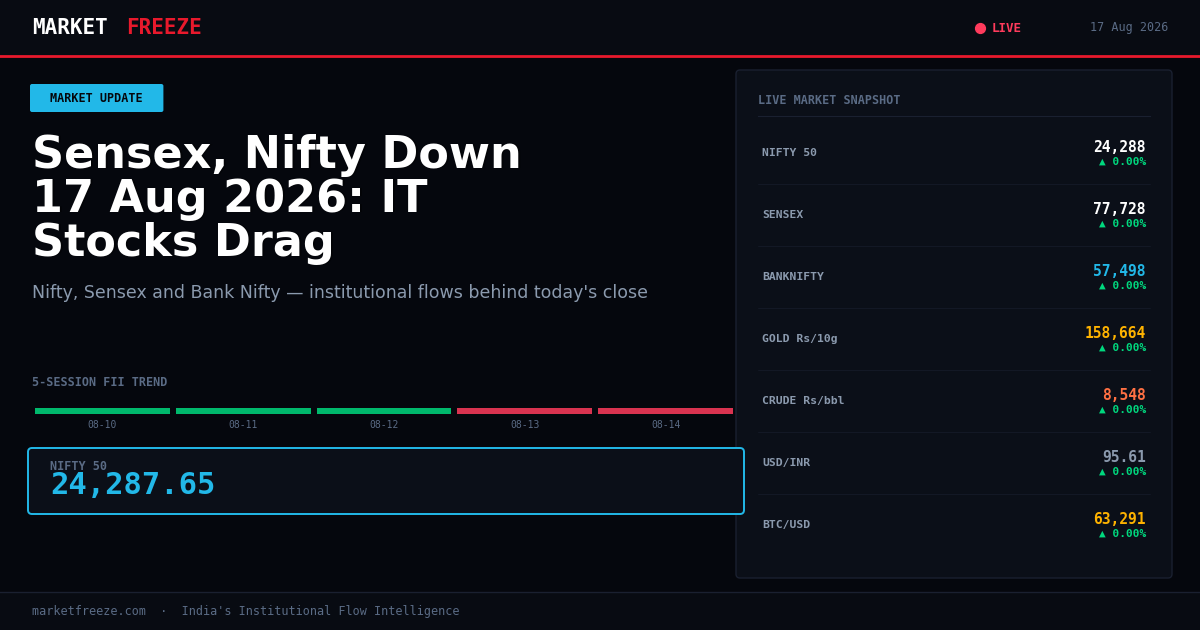
Indian equity benchmarks, the Nifty 50 and Sensex, closed lower on August 17, 2026, down 0.32% and 0.36% respectively, with the Nifty settling at 24,287.65 and the Sensex at 77,728.00, driven by broad-based selling in large-cap IT stocks like Infosys and HCL Tech, amidst a continued trend of FII outflows.
Nifty, Sensex Slide as FII Outflows Persist; IT Stocks Lead Declines
The Indian equity markets experienced a modest decline on Monday, August 17, 2026, with the Nifty 50 shedding 78.35 points to close at 24,287.65 and the Sensex falling 281.09 points to end at 77,728.16. This downturn marks the fifth consecutive trading session of declines for the benchmark indices, mirroring a pattern last seen in late July. While the headline indices registered losses, the mid and small-cap segments demonstrated resilience, outperforming their larger counterparts. The primary catalyst for the day’s subdued performance was the continued net selling by Foreign Institutional Investors (FIIs), coupled with significant weakness in the Information Technology (IT) sector, evidenced by substantial drops in Infosys and HCL Tech.
FIIs Continue Net Selling, DIIs Bolster Support Amidst Broad Market Weakness
On August 17, 2026, Foreign Institutional Investors (FIIs) were net sellers to the tune of ₹510.69 Crore, continuing a trend observed in the preceding two sessions. This outflow has been a persistent theme in the last few trading days, exerting downward pressure on the broader market indices. In stark contrast, Domestic Institutional Investors (DIIs) provided crucial support, stepping in as net buyers with a significant figure of ₹4,353.09 Crore. This robust buying by DIIs helped cushion the impact of FII outflows and prevented a steeper fall in the Nifty 50, which closed down by only 0.32%. The net buying by DIIs on August 14 and August 13 was identical at ₹4,353.09 Crore, highlighting their consistent role in stabilizing the market during periods of foreign investor retrenchment.
Open a free demat account with
Upstox
or
Angel One
— zero brokerage on delivery trades.
IT Sector Bears the Brunt as FII Outflows Coincide with Tech Stock Sell-off
The Information Technology (IT) sector was a prominent laggard on August 17, 2026, with major players like Infosys and HCL Tech featuring among the top losers. Infosys saw a significant decline, impacting its market capitalization and contributing to the broader index’s downturn. This sector-specific weakness is particularly noteworthy given the ongoing FII outflows. Historically, FIIs have shown a substantial allocation towards the Indian IT sector, appreciating its global revenue streams and consistent growth. The current outflows, therefore, suggest a potential re-evaluation of exposure to IT stocks by foreign investors, possibly due to concerns over global tech demand slowdown, rising interest rates in developed economies, or currency headwinds. The direct impact on the Nifty 50 was substantial, as the IT index fell by approximately 1.5%. Conversely, sectors like FMCG and Pharma showed relative strength, indicating a rotation into more defensive counters amidst the prevailing sentiment.
Nifty Faces Key Support at 24,200 as FII Selling Continues
The Nifty 50’s movement on August 17, 2026, to close at 24,287.65, reveals immediate support levels that are crucial for the short-term outlook. Considering the net selling pressure from FIIs over the last three sessions, particularly the consistent ₹510.69 Crore outflow on August 14 and August 13, institutional selling has been a dominant force. The Nifty’s ability to hold above the 24,200 mark is critical. This level has seen increased DII buying interest in recent trading sessions, acting as a psychological and technical floor. A sustained breach below 24,200 could trigger further unwinding of long positions, potentially pushing the index towards the 24,000 psychological level, where more significant DII accumulation was observed in the preceding week. On the upside, resistance is expected around the 24,400-24,500 band, an area where FIIs had initiated some buying activity on August 12.
Gold Surges on Geopolitical Uncertainty, Crude Oil Recovers
While equity markets faced headwinds, safe-haven assets displayed strength. Gold on MCX surged by 1.65% to trade at ₹158,632.00 per 10g on August 17, 2026. This upward movement in gold prices is often correlated with increased geopolitical tensions or a heightened sense of global economic uncertainty, which can drive investors towards perceived safer assets. Simultaneously, crude oil on MCX recovered, trading up by 1.01% at ₹8,548.00 per barrel. This recovery in crude prices, despite the broader market sentiment, could be attributed to supply-side concerns or a slight uptick in global demand expectations. The divergence between equities and these commodities suggests that institutional money may be hedging against systemic risks, with a portion flowing into precious metals.
Historical Parallel: FII Outflows and Sector Rotation in Mid-2024
The current scenario of consistent FII selling and a subsequent market correction finds a parallel in the mid-trading sessions of June 2024. During that period, FIIs had divested Indian equities for several consecutive sessions, leading to a notable correction in the Nifty 50. What followed was a period where DIIs stepped up their buying significantly, absorbing much of the FII selling pressure. Crucially, during those June 2024 weeks, the IT sector also experienced significant profit-booking from foreign investors, while defensives like FMCG and Pharmaceuticals saw increased DII accumulation. The Nifty, after its initial decline, consolidated around the 22,800-23,000 levels for a few weeks before resuming its upward trajectory, supported by strong domestic demand and a gradual easing of FII outflows. The current pattern suggests a similar phase of consolidation may be on the cards if FII selling persists.
Portfolio Strategy: Defensive Allocation Amidst FII Retrenchment
For investors seeking to navigate the current market conditions characterized by FII outflows and sector-specific weakness, a defensive portfolio allocation is advisable. The Nifty 50 closing at 24,287.65 with a negative bias necessitates a cautious approach. Investors should consider increasing their allocation to sectors with defensive characteristics such as Fast-Moving Consumer Goods (FMCG) and Pharmaceuticals, which have historically shown resilience during market downturns. If the Nifty 50 breaches the 24,000 support level, a further reduction in equity exposure and an increase in allocation towards short-duration debt instruments or gold could be prudent. Conversely, if FII flows turn positive and consistently exceed +₹1,000 Crore per day for at least two consecutive sessions, while the Nifty holds above 24,500, a gradual re-initiation of long positions in quality growth stocks could be considered.
What Changes This Outlook: A Shift in FII Flow Momentum
The primary trigger that could alter the current bearish outlook for the Indian equity markets would be a definitive reversal in FII flow momentum. Specifically, if FIIs transition from net sellers to consistent net buyers, with daily inflows exceeding +₹1,500 Crore for three consecutive trading days, it would signal a significant shift in global institutional sentiment towards India. Such a change would likely be accompanied by a strong rebound in benchmark indices, particularly in sectors that have recently faced selling pressure, such as IT. Until such a flow reversal materializes, the market may continue to trade within a range, with intermittent bouts of selling pressure exacerbated by foreign investor activity.
FII/DII Flow Data Snapshot (Last 5 Sessions)
| Date | FII Net (Cr) | DII Net (Cr) | Nifty Close |
|---|---|---|---|
| 2026-08-10 | +₹1,974.76 Cr | ₹-1,290.29 Cr | 24,583.80 |
| 2026-08-11 | +₹1,974.76 Cr | ₹-1,290.29 Cr | 24,471.70 |
| 2026-08-12 | +₹258.55 Cr | +₹24.77 Cr | 24,435.95 |
| 2026-08-13 | ₹-510.69 Cr | +₹4,353.09 Cr | 24,395.85 |
| 2026-08-14 | ₹-510.69 Cr | +₹4,353.09 Cr | 24,366.00 |
Frequently Asked Questions
Q: What did FII buy or sell on August 14, 2026?
A: On August 14, 2026, FIIs were net sellers to the tune of ₹510.69 Crore.
Q: What did DII buy on August 13, 2026?
A: On August 13, 2026, DIIs were net buyers with a figure of ₹4,353.09 Crore.
Q: Is FII buying or selling in August 2026?
A: In August 2026, the trend for FIIs has predominantly been net selling, with significant outflows observed in the latter half of the month, particularly on August 13 and August 14, where net selling stood at ₹510.69 Crore on both days.
Key Levels to Watch
Support: The Nifty 50 is currently finding immediate support around the 24,200 level, a zone where DIIs have shown buying interest. A break below this could lead to testing the 24,000 mark.
Resistance: The upper band of resistance is observed between 24,400 and 24,500, an area where FIIs had previously shown some buying activity.
Bottom Line
The Indian equity markets closed lower on August 17, 2026, as sustained FII selling pressure weighed on benchmark indices, with the IT sector being a notable underperformer. While DIIs provided crucial support, the continuation of foreign outflows signals ongoing caution among institutional investors. Investors should monitor FII flow trends closely, as a reversal in this pattern is key to any sustained market recovery, with defensive sectors offering relative stability in the interim.
Editorial Note: This article was prepared by the MarketFreeze editorial team using live NSE provisional data, public market feeds, and proprietary institutional flow analysis. All price and flow figures are sourced directly from NSE, BSE, and CoinGecko as of 17 August 2026. This content is for informational purposes only and does not constitute investment advice. MarketFreeze is not SEBI-registered. Please consult a qualified financial advisor before making investment decisions. Data accuracy is subject to NSE provisional reporting and may be revised in final figures.