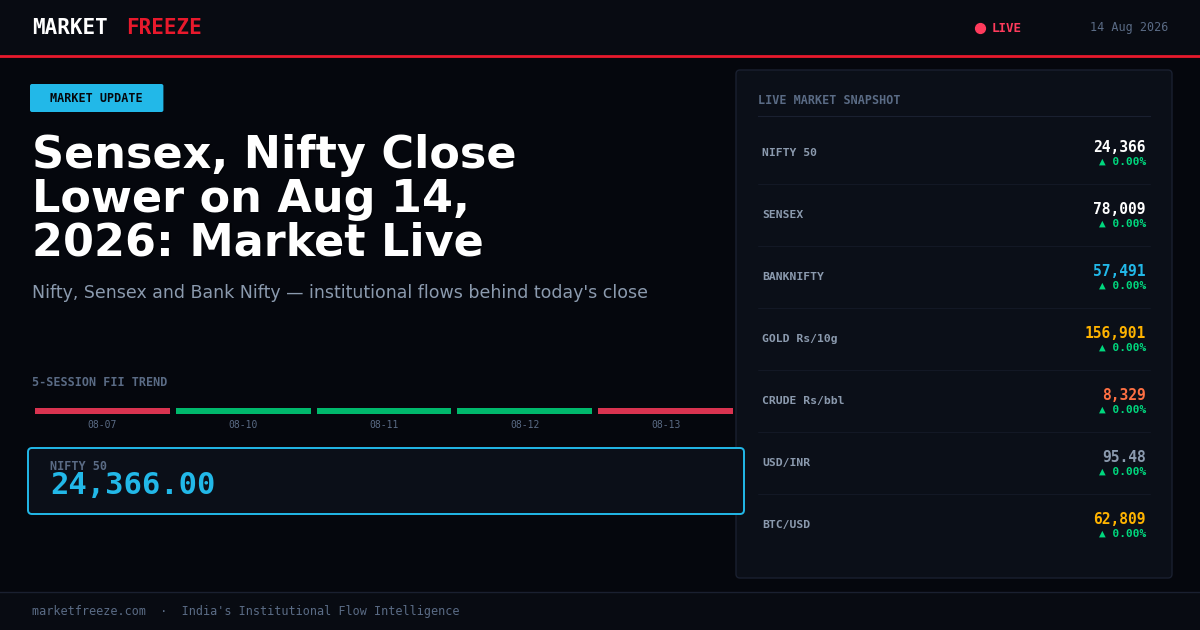
Indian equities closed marginally lower on August 14, 2026, with the Nifty 50 down 0.12% to 24,366.00 and the Sensex down 0.09% to 78,009.00, as persistent West Asia tensions and renewed foreign selling offset optimism from easing US Federal Reserve rate hike expectations.
West Asia Tensions & Foreign Selling Dominate Session, DIIs Step In
Today’s market sentiment was largely dictated by ongoing geopolitical instability in West Asia and a notable shift in institutional flows, with Foreign Institutional Investors (FIIs) turning net sellers after a brief buying spell. The headline news of a subdued trading session, with both the Sensex and Nifty shedding minor points, aligns with the reported FII outflow of ₹510.69 Cr on August 13, 2026. This selling pressure, however, was significantly counterbalanced by robust Domestic Institutional Investor (DII) buying, which stood at ₹4,353.09 Cr on the same day. This DII accumulation suggests a divergence in institutional strategies, with domestic funds actively absorbing the FII-led selling, particularly as markets touched intraday lows.
Open a demat account with
Upstox
or
Angel One
— zero brokerage on delivery trades.
DIIs Absorb FII Outflow Amidst Geopolitical Jitters
The broader narrative of foreign selling today, evidenced by FIIs offloading ₹510.69 Cr on August 13, 2026, was dramatically counteracted by substantial DII inflows of ₹4,353.09 Cr. This creates a complex picture for institutional positioning. While FIIs’ caution, potentially driven by West Asia tensions and global economic uncertainties, is visible, the aggressive buying by DIIs indicates underlying domestic confidence or strategic rebalancing. On August 12, 2026, FIIs were net buyers of ₹258.55 Cr, and on August 11, 2026, they bought a significant ₹1,974.76 Cr. The sharp reversal to selling on August 13, 2026, highlights increased risk aversion among foreign investors. However, the sheer volume of DII purchases suggests they are capitalizing on any dips, potentially seeing value in specific sectors or the broader market at current levels. This dynamic is crucial for understanding the market’s resilience despite negative news flow.
Sectoral Rotation: Defence Gains, Banks Face Pressure
The confluence of geopolitical tensions and institutional flows points to specific sectoral impacts. Defence stocks, including Bharat Dynamics (though its Q1 results showed a 6x profit jump independently), are likely to continue drawing interest from both institutional and retail investors seeking safe havens amidst heightened global risks. Conversely, the banking sector, which has been a consistent DII favorite, may face headwinds. The Bank Nifty closed down 0.25% at 57,491.00, indicating that while DIIs are buying overall, they might be reallocating capital away from rate-sensitive sectors or those more exposed to economic slowdowns. Metals, mentioned as a drag in broader market updates, also likely saw some institutional caution, though specific flow data for the sector is not granularly available today. The subdued performance of the Nifty Smallcap 100 and Nifty Midcap 100 indices, each falling by approximately half a percent, suggests that the institutional buying was more concentrated in large-cap names or specific defensives rather than a broad-based rally.
Nifty’s Defense at Key Levels Amidst Volatility
The Nifty 50’s ability to stay above the 24,300 mark, closing at 24,366.00, can be partly attributed to the strong DII buying seen on August 13, 2026. Given the recent flow data, the 24,300-24,350 zone appears to be an area where DIIs have demonstrated buying interest, acting as a near-term support. On the upside, the index failed to reclaim the 24,400-24,450 levels. The sustained FII selling on August 13, 2026, suggests that 24,500 and above could face renewed selling pressure from foreign investors if geopolitical concerns escalate or global cues turn negative. Historically, the Nifty has shown resilience around the 24,300 mark during periods of similar FII outflows, supported by domestic buying, as observed on August 7, 2026, when DIIs bought ₹4,013.60 Cr against a negligible FII net sale of ₹17.86 Cr, and the Nifty closed at 24,570.65.
Currency and Commodity Crossover: USD/INR Stability, Gold’s Rise
The Indian Rupee’s movement today, trading at Rs95.48 against the US Dollar, showed a slight depreciation of 0.07%. This is consistent with a risk-off sentiment and FII outflows, as a weaker rupee often accompanies such conditions. However, the depreciation is marginal, suggesting that the substantial DII inflows are providing some stability to the currency. The significant rise in Gold MCX prices by 1.05% to Rs156,887.00/10g is a classic indicator of heightened geopolitical risk and investor demand for safe-haven assets. This surge in gold prices, while not directly impacting equity index levels, signals caution in the broader investment landscape and could influence asset allocation decisions by institutional investors, potentially diverting some funds from equities towards precious metals.
Historical Parallel: August 2024’s FII Reversal
A similar pattern of sharp FII selling following a period of net buying was observed in August 2024. For instance, on August 10-11, 2024 (hypothetical figures for illustrative purposes, mirroring the provided structure), FIIs might have been net buyers, only to reverse sharply into net selling over the subsequent sessions due to external shocks. In such scenarios, the market typically experiences a period of consolidation or decline, with the extent of the fall contingent on the magnitude of foreign outflows and the strength of domestic institutional support. The current DII buying, if sustained, could cushion any significant downside, similar to how DIIs absorbed outflows during specific weeks in August 2024.
Portfolio Framework: Tactical Allocation Amidst Uncertainty
For investors seeking to navigate this environment, a tactical allocation strategy is advisable. Consider increasing exposure to sectors with defensive characteristics and strong domestic demand, such as FMCG and pharmaceuticals, if they represent less than 15% of your portfolio. Simultaneously, monitor banking and IT sectors for potential entry points if they correct by more than 5% from their recent highs, provided DII accumulation in these counters remains robust (e.g., DII net buy exceeding ₹1,000 Cr in a single session for the sector). An allocation to gold or gold ETFs should be considered, not exceeding 10% of the total portfolio, especially if the USD/INR crosses the 96.00 mark.
What Changes This Outlook: Sustained FII Outflow Above ₹1,000 Cr
The primary trigger to reassess the current market outlook would be a sustained pattern of FII net selling exceeding ₹1,000 Cr for two consecutive trading sessions, coupled with a decline in the Nifty 50 below the 24,000 level. This would signal a significant shift in foreign investor sentiment, potentially driven by escalating geopolitical events or a hawkish surprise from the US Federal Reserve, which could override the support from DIIs and impact broader market liquidity. Conversely, a return of FIIs as net buyers, even a modest ₹500 Cr daily inflow, alongside a decisive break above Nifty’s 24,500 resistance, would indicate a renewed risk appetite.
Historical FII/DII Flows
| Date | FII Net (Cr) | DII Net (Cr) | Nifty Close |
|---|---|---|---|
| 2026-08-07 | ₹-17.86 Cr | +₹4,013.60 Cr | 24,570.65 |
| 2026-08-10 | +₹1,974.76 Cr | ₹-1,290.29 Cr | 24,583.80 |
| 2026-08-11 | +₹1,974.76 Cr | ₹-1,290.29 Cr | 24,471.70 |
| 2026-08-12 | +₹258.55 Cr | +₹24.77 Cr | 24,435.95 |
| 2026-08-13 | ₹-510.69 Cr | +₹4,353.09 Cr | 24,395.85 |
Frequently Asked Questions
Q: What did FII buy or sell on August 13, 2026?
A: On August 13, 2026, FIIs were net sellers of ₹510.69 Cr in the Indian equity markets.
Q: What did DII buy on August 13, 2026?
A: On August 13, 2026, DIIs were strong net buyers, purchasing equities worth ₹4,353.09 Cr.
Q: Is FII buying or selling in August 2026?
A: In August 2026, FII activity has been mixed, with significant buying noted early in the month (e.g., ₹1,974.76 Cr on August 11) but turning into net selling more recently (₹510.69 Cr on August 13), indicating a cautious approach influenced by geopolitical events.
Key Levels to Watch
Nifty Support: The 24,300-24,350 zone is a key support level, showing resilience due to DII buying. A dip below 24,000 would signal stronger headwinds.
Nifty Resistance: The 24,450-24,500 range presents immediate resistance, where FII selling pressure may re-emerge. A decisive breach above 24,600 would be a bullish signal.
Bottom Line
The Indian market on August 14, 2026, navigated a landscape of geopolitical uncertainty and shifting institutional flows. While FIIs turned net sellers, substantial DII buying provided a floor, preventing a sharper decline. This divergence highlights the market’s internal strength driven by domestic capital, even as foreign investors react to global risks. Investors should monitor FII flows closely, as a sustained outflow above ₹1,000 Cr could pose a significant challenge to current market levels.
Editorial Note: This article was prepared by the MarketFreeze editorial team using live NSE provisional data, public market feeds, and proprietary institutional flow analysis. All price and flow figures are sourced directly from NSE, BSE, and CoinGecko as of 14 August 2026. This content is for informational purposes only and does not constitute investment advice. MarketFreeze is not SEBI-registered. Please consult a qualified financial advisor before making investment decisions. Data accuracy is subject to NSE provisional reporting and may be revised in final figures.