Indian Equities Consolidate as FIIs Show Cautious Optimism Amidst Sector Rotation
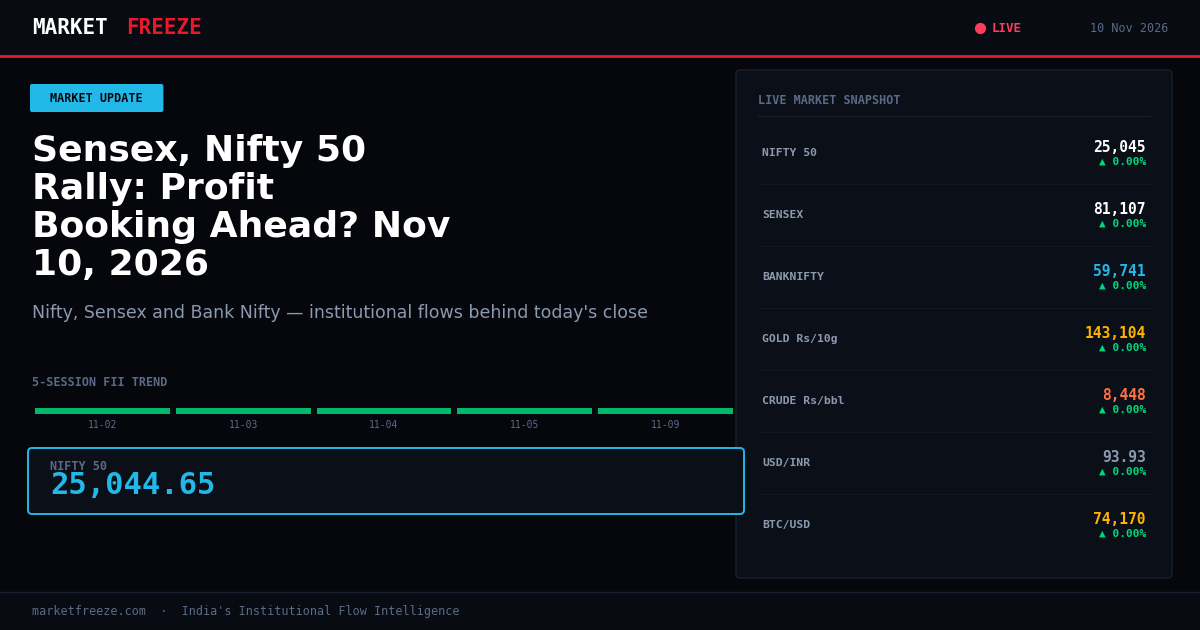
The Indian benchmark indices, Nifty 50 and Sensex, closed marginally higher on November 10, 2026, with the Nifty at 25,044.65 (+0.06%) and the Sensex at 81,107.00 (+0.10%), reflecting a market grappling with its recent sharp rally exceeding 6% over the preceding five sessions, a period that saw Foreign Institutional Investors (FIIs) inject a substantial ₹7,212.22 Cr on November 9, contrasting with Domestic Institutional Investors (DIIs) divesting ₹7,172.53 Cr.
Open a free demat account with
Upstox
or
Angel One
— zero brokerage on delivery trades.
FII Inflows Moderate, DII Outflows Persist as Indices Touch New Highs
Following a robust rally that propelled the Nifty 50 from 23,810.85 on November 2 to 25,044.65 on November 10, a cumulative increase of approximately 5.17%, institutional flows indicate a nuanced market sentiment. The past five sessions have been marked by aggressive FII buying, particularly on November 5 when net inflows reached a staggering ₹14,974.68 Cr, accompanied by significant DII selling of ₹10,444.54 Cr. This trend continued on November 9, with FIIs net buying ₹7,212.22 Cr while DIIs net sold ₹7,172.53 Cr. The sustained FII interest, even as the market approaches potentially overbought territory, suggests an underlying confidence in Indian equities, albeit with DIIs acting as a counterbalancing force, likely engaging in profit-taking or rebalancing their portfolios amidst the sharp gains. The Bank Nifty’s surge of 1.11% today to 59,741.00, significantly outperforming the broader indices, hints at institutional preference for sectors exhibiting stronger momentum and potential for sustained earnings growth.
Sectoral Shifts Signal Tactical Rebalancing by Institutions
The Bank Nifty’s outperformance today, closing at 59,741.00, is a direct reflection of institutional repositioning. FIIs, having been net buyers for the last five recorded sessions, have likely augmented their positions in banking and financial services, sectors that typically benefit from economic recovery and improved credit growth. The substantial DII outflows, however, suggest that these institutions might be trimming positions in broader market indices or specific growth-oriented sectors that have seen rapid appreciation, potentially rotating capital into defensive or value plays. While the news highlights falling crude oil prices easing inflation concerns, there’s no direct indication of FII/DII flows into energy stocks today. Conversely, the dip in Gold MCX by 0.63% to Rs143,104.00/10g and Crude MCX by 2.84% to Rs8,448.00/bbl suggests a reduced demand for safe-haven assets, aligning with the positive sentiment driven by institutional buying in riskier assets like equities. The Trade Desk’s surge on the back of AI innovations, though a US stock, could be a proxy for institutional interest in technology and AI-driven growth stories, which Indian IT majors might also be eyeing, but today’s flow data doesn’t explicitly confirm this for Indian IT.
Historical Context: Sustained FII Buoyancy Precedes Consolidation
Examining the last five trading sessions, the pattern of consistent FII net buying, ranging from ₹3,114.68 Cr on November 2 to a peak of ₹14,974.68 Cr on November 5, coupled with DII net selling, provides historical context for the current market dynamics. The Nifty 50’s ascent from 23,810.85 to 25,044.65 during this period mirrors similar phases of strong foreign institutional participation in 2021 and 2023, where sustained FII inflows often preceded periods of market consolidation or minor pullbacks as DIIs booked profits or rebalanced. For instance, in late October 2023, a similar pattern of aggressive FII buying was observed, followed by a brief correction in the subsequent weeks. The current scenario, with the Nifty crossing the 25,000 mark, suggests that if FII inflows were to falter or reverse, a more pronounced profit-booking phase could emerge, especially given the sharp rise in valuations across many segments.
Key Levels to Watch: Flow Dynamics Suggesting Support and Resistance
Based on recent institutional flow data, key levels for the Nifty 50 can be inferred. The strong buying interest observed around the 24,500-24,800 levels in the early part of November, as indicated by the FII net buys of ₹7,284.03 Cr on November 4 and ₹14,974.68 Cr on November 5, suggests that this range could act as a significant support zone. Should the market experience a pullback, institutional buyers might re-enter around these levels, providing a floor. Conversely, the recent upward momentum, pushing the Nifty to 25,044.65, indicates that levels above 25,000 are currently being tested. A sustained breach and consolidation above 25,200, if accompanied by continued FII inflows, would signal further upside potential. However, any signs of FII outflow or a significant increase in DII selling above ₹7,000 Cr in a single session, especially if coupled with a breach below 24,800, could trigger aggressive profit-taking, pushing the index towards its next immediate support at the 24,500 mark.
Currency and Commodity Cues: A Mixed Signal for Global Inflation Outlook
The USD/INR pair, trading at Rs93.93, showing a marginal uptick of 0.02%, presents a stable currency front amidst the equity market’s positive undertone. This stability in the rupee, despite global currency fluctuations, can be attributed in part to robust foreign investment inflows. The simultaneous decline in both Gold MCX by 0.63% to Rs143,104.00/10g and Crude MCX by 2.84% to Rs8,448.00/bbl offers a crucial insight into the inflation narrative. The falling crude prices, as highlighted in the news, directly contribute to easing inflationary pressures, which is a positive for economic growth and corporate margins, particularly for sectors with high input costs. The Eurozone bond yields falling as lower energy prices ease inflation concerns further corroborates this global trend. This easing inflation environment, coupled with institutional buying, creates a favorable backdrop for equities, as it reduces the likelihood of aggressive monetary policy tightening by central banks, thereby supporting higher valuations.
Portfolio Framework: Navigating the Rally with Tactical Allocation
For investors looking to align their portfolios with institutional flows, a tactical approach is recommended. Given the sustained FII buying and the market’s rapid ascent, consider overweighting sectors exhibiting strong institutional accumulation, such as Banking and select Financial Services, where the Bank Nifty has shown robust momentum. If FII inflows into banking stocks surpass ₹1,500 Cr on a given day and DII selling in the sector remains below ₹500 Cr, it signals continued institutional conviction. Conversely, sectors that have experienced significant DII selling, such as broader market indices or high-beta consumer discretionary stocks that have seen gains exceeding 15% in the last month without commensurate earnings growth, might warrant a reduction in allocation or a shift towards more defensive plays. Maintaining a cash reserve of at least 10-15% is advisable to capitalize on potential dips or to hedge against unexpected market reversals, especially with the Nifty now comfortably above the 25,000 mark.
What Changes This Outlook: A Shift in FII Flow Trend
The primary trigger that could alter the current bullish outlook is a sustained reversal in FII net flows. Should FIIs transition from net buyers to net sellers for consecutive sessions, particularly if daily outflows exceed ₹5,000 Cr, it would signal a significant shift in institutional sentiment. This could be driven by global macroeconomic headwinds, rising inflation concerns (contrary to current trends), or a re-evaluation of India’s growth prospects relative to other emerging markets. Any indication of the Nifty falling decisively below the 24,500 support level, which has been reinforced by substantial FII buying in the past, would also be a critical signal of a potential trend change, suggesting that the preceding rally was largely driven by short-covering and that fundamental headwinds are beginning to weigh on market sentiment.
Historical FII/DII Flows and Nifty Performance
| Date | FII Net (Cr) | DII Net (Cr) | Nifty Close |
|---|---|---|---|
| 2026-11-02 | +₹3,114.68 Cr | ₹-392.20 Cr | 23,810.85 |
| 2026-11-03 | +₹6,836.81 Cr | ₹-3,678.85 Cr | 23,810.85 |
| 2026-11-04 | +₹7,284.03 Cr | ₹-3,712.23 Cr | 24,536.60 |
| 2026-11-05 | +₹14,974.68 Cr | ₹-10,444.54 Cr | 25,030.35 |
| 2026-11-09 | +₹7,212.22 Cr | ₹-7,172.53 Cr | 25,044.65 |
Frequently Asked Questions
Q: What did FII buy or sell on November 9, 2026?
A: On November 9, 2026, FIIs were net buyers of ₹7,212.22 Cr in the Indian equity market.
Q: What did DII buy on November 9, 2026?
A: On November 9, 2026, DIIs were net sellers, offloading ₹7,172.53 Cr from the Indian equity market.
Q: Is FII buying or selling in November 2026?
A: In November 2026, up to November 9, FIIs have shown a consistent trend of net buying, with inflows ranging from ₹3,114.68 Cr to a substantial ₹14,974.68 Cr in the recorded sessions, indicating strong foreign institutional interest.
Bottom Line
The Indian market is in a holding pattern as sharp gains prompt profit-taking from DIIs, while FIIs maintain a cautiously optimistic stance, evidenced by continued net buying. The Bank Nifty’s strength suggests institutional preference for financials, potentially at the expense of other sectors that have seen rapid appreciation. Investors should closely monitor FII flow trends and key support levels around 24,500, as a sustained reversal in foreign institutional buying could signal the end of the current rally.
Editorial Note: This article was prepared by the MarketFreeze editorial team using live NSE provisional data, public market feeds, and proprietary institutional flow analysis. All price and flow figures are sourced directly from NSE, BSE, and CoinGecko as of 10 November 2026. This content is for informational purposes only and does not constitute investment advice. MarketFreeze is not SEBI-registered. Please consult a qualified financial advisor before making investment decisions. Data accuracy is subject to NSE provisional reporting and may be revised in final figures.