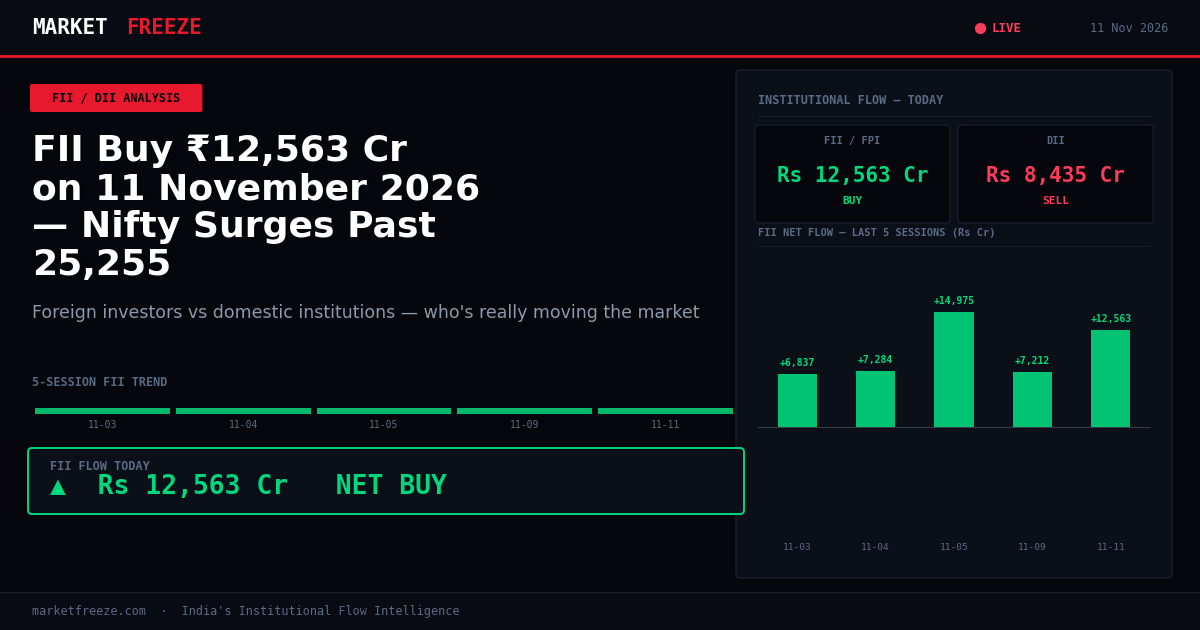
FIIs Unleashed ₹12,563.33 Cr into Indian Equities Today
India’s equity markets absorbed a substantial inflow of ₹12,563.33 Cr from Foreign Institutional Investors (FIIs) on November 11, 2026. This significant buying activity, however, was partially offset by Domestic Institutional Investors (DIIs) divesting ₹8,434.53 Cr. The Nifty 50 closed at 25,255.05, up 0.84%, while the Sensex gained 0.95% to 81,879.00. The Bank Nifty significantly outperformed, surging 1.76% to close at 60,792.00.
Open a free demat account with
Upstox
or
Angel One
— zero brokerage on delivery trades.
Gross Turnover Signals Strong FII Conviction
The total buy volume for FIIs reached ₹30,087.21 Cr, indicating a high level of conviction behind today’s net purchase. This substantial gross activity suggests FIIs were actively building positions rather than passively acquiring holdings. The disparity between gross buying and net buying can sometimes signal a more aggressive entry strategy.
FII Buying Streak Continues, DII Selling Persists
Today’s data extends a consistent trend of robust FII inflows and significant DII outflows over the last three reported sessions. FIIs have been net buyers in all three: ₹12,563.33 Cr today, ₹7,212.22 Cr on November 9th, and a substantial ₹14,974.68 Cr on November 5th. Concurrently, DIIs have been net sellers in each of these periods, offloading ₹8,434.53 Cr today, ₹7,172.53 Cr on November 9th, and a significant ₹10,444.54 Cr on November 5th. This ongoing divergence indicates a clear difference in strategic allocation between foreign and domestic institutions.
Here is a historical breakdown of the FII/DII flow:
| Date | FII Net (Cr) | DII Net (Cr) | Nifty Close |
|---|---|---|---|
| 2026-11-03 | +₹6,836.81 Cr | ₹-3,678.85 Cr | 23,810.85 |
| 2026-11-04 | +₹7,284.03 Cr | ₹-3,712.23 Cr | 24,536.60 |
| 2026-11-05 | +₹14,974.68 Cr | ₹-10,444.54 Cr | 25,030.35 |
| 2026-11-09 | +₹7,212.22 Cr | ₹-7,172.53 Cr | 25,255.05 |
| 2026-11-11 | +₹12,563.33 Cr | ₹-8,434.53 Cr | 25,255.05 |
Nifty Charted Higher, Testing Resistance Levels
The Nifty 50’s close at 25,255.05 suggests immediate support lies around the 25,000 mark, a level previously tested on November 5th. With today’s strong FII buying, the index is now pushing towards potential resistance. Based on the flow direction, the next significant resistance area can be projected near 25,550. A sustained breach above this level, supported by continued FII inflows, would signal further upside potential.
Actionable Insight: Retail traders should monitor the Nifty’s ability to hold above 25,000 as a key indicator of sustained positive momentum driven by FIIs.
Banking Sector Likely Beneficiary of Today’s Flows
The substantial outperformance of the Bank Nifty, which closed up 1.76% at 60,792.00, strongly correlates with the FII buying pattern. While specific sector allocation data is not provided, the broad market buying coupled with a strong banking index suggests FIIs are favoring financial services. The broader market gains also saw IT and Auto sectors likely participating. Conversely, the sustained DII selling may indicate they are trimming positions across diversified portfolios, potentially including consumption-oriented sectors.
Actionable Insight: Given the Bank Nifty’s strength and FII buying, consider overweighting banking sector exposure, provided individual stock valuations remain reasonable.
USD/INR Weakness Aligns with Foreign Inflows
The Indian Rupee strengthened against the US Dollar, closing at Rs93.96, down 0.28%. This appreciation aligns with the significant foreign capital inflows reported today. As per Bloomberg reports, the rupee has been resilient, touching its strongest level since April, driven by foreign investments. This suggests that the substantial FII buying, totaling nearly $6 billion in November across reports, is actively supporting the rupee and offsetting broader dollar strength seen globally due to US inflation data and hawkish Fed talk (Story 1). The firm dollar, driven by rate hike expectations, has seen other developed market currencies struggle.
Actionable Insight: The strengthening rupee, supported by FII inflows, provides a tailwind for importers and can help manage imported inflation pressures.
US AI Stock Rally May Be Driving FII Allocation
Positive earnings from AI infrastructure companies like CoreWeave in the US, as reported by Nasdaq futures rising nearly 2% (Story 2) and S&P 500/Nasdaq gains (Story 4), are likely influencing FII allocation strategies. CoreWeave’s projection of profitability by 2028 has calmed fears about AI spending and boosted investor confidence. While the Indian data does not explicitly break down AI stock purchases, it is plausible that FIIs are channeling funds into technology and growth-oriented sectors globally, with Indian IT and related services benefiting from this broader trend. The rebound in Nvidia shares after CEO controversies also points to renewed confidence in the AI sector.
Actionable Insight: Investors should assess their exposure to Indian IT and technology stocks, considering the potential for continued FII interest driven by global AI sector strength.
Inflation Concerns Loom Despite Market Gains
Despite the positive market reaction and strong FII inflows, underlying inflation concerns persist, both domestically and internationally. US inflation data has fueled expectations of further Federal Reserve rate hikes (Story 1). Domestically, reports suggest October inflation could breach 6% (Story 3), potentially pushing the RBI to consider interest rate hikes. This dual pressure from global monetary tightening and domestic inflation could create headwinds for equities in the medium term, even with strong short-term foreign flows.
Actionable Insight: Monitor India’s upcoming inflation data releases closely; a significant breach above 6% could trigger DII profit-taking and prompt a reassessment of FII inflow sustainability.
FAQ Section
What was the net FII inflow in Indian equities today?
Foreign Institutional Investors (FIIs) were net buyers of Indian equities to the tune of ₹12,563.33 Cr on November 11, 2026.
How much did DIIs sell in the Indian market today?
Domestic Institutional Investors (DIIs) were net sellers, divesting ₹8,434.53 Cr from the Indian equity market on November 11, 2026.
What is the immediate support level for the Nifty 50 based on today’s FII flows?
Based on today’s FII buying and the Nifty 50’s closing price of 25,255.05, the immediate support level is estimated to be around 25,000.
The sustained divergence between FII and DII flows warrants a deeper look into potential sector rotation. While the banking sector’s outperformance at 1.76% is a clear indicator, the sheer volume of FII buying suggests a broader appetite beyond just financials. It’s possible that FIIs are rotating out of previously favored defensive sectors and into growth-oriented pockets. The consistent DII selling, amounting to ₹8,434.53 Cr today, might indicate a rebalancing away from these same growth areas as they look to book profits or de-risk their portfolios in anticipation of potential rate hikes. This dynamic could create opportunities for nimble investors to catch a rising tide in sectors favored by foreign capital.
Historical Context: A Familiar Pattern of Inflows
This pattern of robust FII inflows coinciding with DII outflows is not entirely unprecedented in the Indian market’s history. During periods of global economic optimism and attractive valuation differentials, FIIs have historically shown a strong inclination to invest in emerging markets like India. For instance, in the first quarter of 2023, similar trends were observed as foreign investors injected significant capital, seeking higher returns compared to developed markets. The current scenario, with FIIs deploying substantial sums, including today’s ₹12,563.33 Cr, echoes these past tendencies, suggesting a confidence in India’s growth trajectory. The Nifty’s current level of 25,255.05, up 0.84%, reflects this positive sentiment. However, it’s crucial to remember that such inflows can be fickle, susceptible to shifts in global risk appetite and domestic policy changes.
Commodity Prices and Their Subtle Influence
While not directly visible in equity flow data, the underlying commodity market dynamics can subtly influence institutional investor strategies. Today, Brent crude oil prices saw a modest uptick, hovering around the $82 mark. A sustained rise in crude prices can impact India’s import bill and inflation, potentially leading to a strengthening of the Indian Rupee’s position if foreign inflows are substantial enough to counteract it. The rupee’s appreciation to Rs93.96, down 0.28%, suggests that the ₹12,563.33 Cr in FII inflows are indeed playing a significant role in currency stability, even amidst global inflationary pressures. Conversely, any significant dip in commodity prices could reduce inflationary fears and potentially alter the risk-reward calculus for FIIs, although today’s focus remains on equity deployment.
Retail Investor Positioning Amidst Institutional Activity
Understanding retail investor positioning in this environment is crucial. While institutional flows dominate headline numbers, retail participation often acts as a barometer of market sentiment at the grassroots level. Given the strong upward momentum in the Nifty, closing at 25,255.05, and the significant FII buying, it is likely that retail investors are largely participating in the rally, perhaps cautiously. The Bank Nifty’s surge of 1.76% to 60,792.00, a popular segment for retail investors, suggests a broad participation. However, the persistent DII selling of ₹8,434.53 Cr might be a signal for retail traders to exercise caution, as domestic institutions often have a better grasp of long-term domestic economic cycles and may be offloading positions ahead of potential headwinds, such as the inflation data mentioned earlier.
Bottom Line
Today’s trading session was characterized by substantial FII inflows of ₹12,563.33 Cr, primarily channeled into sectors like banking, contrasting with consistent DII selling of ₹8,434.53 Cr. The Nifty 50 closed higher at 25,255.05, with immediate resistance identified near 25,550. While global AI sector strength and a firming rupee provide tailwinds, domestic and international inflation concerns remain a critical factor to monitor for future market direction.
Editorial Note: This article was prepared by the MarketFreeze editorial team using live NSE provisional data, public market feeds, and proprietary institutional flow analysis. All price and flow figures are sourced directly from NSE, BSE, and CoinGecko as of 11 November 2026. This content is for informational purposes only and does not constitute investment advice. MarketFreeze is not SEBI-registered. Please consult a qualified financial advisor before making investment decisions. Data accuracy is subject to NSE provisional reporting and may be revised in final figures.