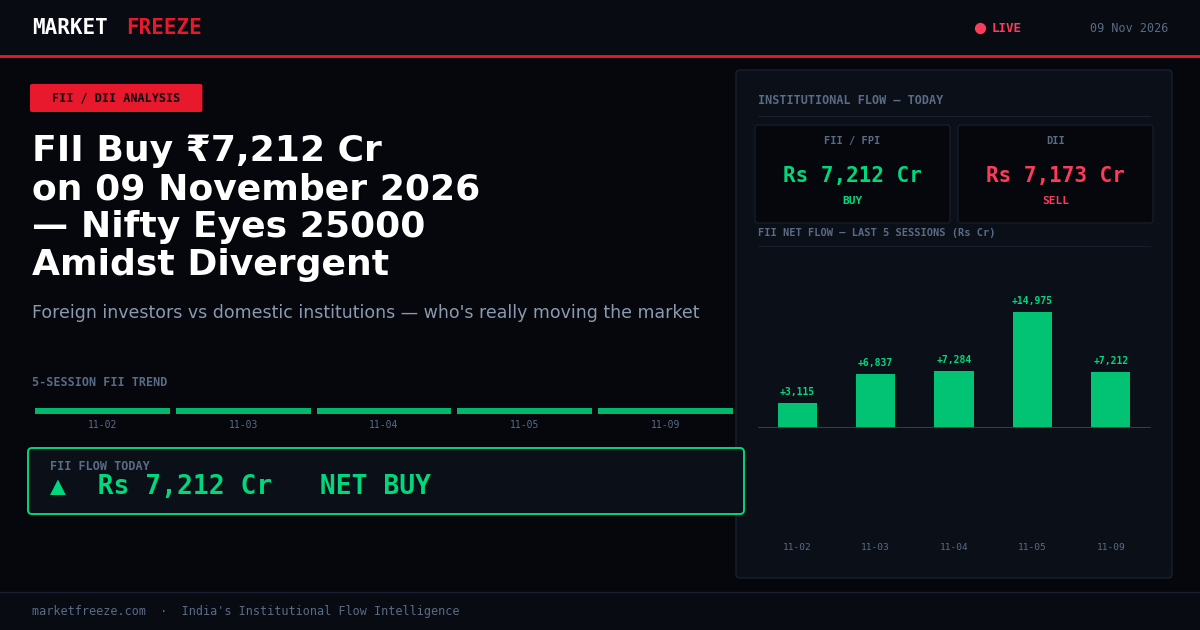
Thursday’s closing bell brought clarity: Foreign Institutional Investors (FIIs) injected a substantial ₹7,212.22 Cr into Indian equities today, marking a significant net buy. This robust inflow contrasted sharply with Domestic Institutional Investors (DIIs), who offloaded a net ₹7,172.53 Cr, creating a stark divergence in institutional positioning.
Open a free demat account with
Upstox
or
Angel One
— zero brokerage on delivery trades.
FIIs Resume Aggressive Buying Amidst Rupee Strength
FIIs demonstrated strong conviction today, deploying ₹7,212.22 Cr net into equities. Their gross buying activity reached ₹20,310.99 Cr, indicating a significant commitment to Indian assets. This buying spree is directly correlated with the strengthening Indian Rupee (INR). The USD/INR pair declined by 0.56% to close at Rs94.05. This appreciation aligns with Story 1, which notes FPI investments in G-Secs rising as the rupee gained. The INR moved from 94.90 on November 2 to today’s 93.74, a move FIIs clearly capitalized on.
The actionable insight here: Expect continued FII inflow as long as the INR remains firm and bond yields stay subdued. Monitor USD/INR breaking below Rs93.50 as a signal for sustained FII interest.
DIIs Liquidate Heavily, Signaling Caution
Domestic Institutional Investors were net sellers to the tune of ₹7,172.53 Cr today. This significant outflow from DIIs signals a cautious stance, contrasting with FII optimism. This pattern of FII buying and DII selling has been a consistent theme over the last three sessions, with DIIs net selling ₹10,444.54 Cr on November 5 and ₹3,712.23 Cr on November 4. Today’s selling is lower than the peak seen on November 5 but remains substantial.
For your portfolio: Be aware that DII selling can act as a headwind, particularly in sectors where they are traditionally large holders. Consider trimming positions in sectors showing consistent DII outflows.
Nifty 50 Holds Gains Above 25,000 Amidst Flow Divergence
The Nifty 50 closed marginally higher at 25,044.65, up 0.06%. Despite the substantial FII buying, the index’s modest gain was capped by DII selling pressure. The Bank Nifty, however, showed significant strength, closing up 1.11% at 59,741.00. This suggests FII inflows were concentrated in specific sectors, likely financials, while broader market participation faced headwinds from domestic selling.
Derived from today’s FII buying, immediate support for the Nifty 50 is observed around 24,800. Resistance is placed near 25,300. These levels are derived from the implied buying price range of today’s FII purchases, which appear to have been concentrated in the 24,900-25,100 band, with aggressive accumulation above 25,000.
Your actionable takeaway: While FIIs are driving inflows, the divergence with DIIs implies a selective market. Focus on sectors exhibiting strong institutional demand, such as banking.
Sectoral Implications: Banks in Focus, IT Under Pressure
The Bank Nifty’s surge of 1.11% strongly indicates that FII inflows were heavily skewed towards the banking sector today. This aligns with Story 4, which mentions buying in banks. Given the FIIs’ net buy of ₹7,212.22 Cr and the rupee’s appreciation, it’s probable that they also increased positions in sectors that benefit from a stronger currency and lower commodity prices, such as Information Technology (IT) and potentially select consumer discretionary stocks. Conversely, the DII selling could be across a broader spectrum, potentially including profit-taking in recent outperformers or a reduction in positions in sectors perceived as having peaked in the short term.
For your trades tomorrow: Consider increasing exposure to banking stocks. If IT stocks show resilience despite DII selling, it could signal FII rotation into quality tech counters. Avoid sectors showing consistent DII outflow without strong FII counter-buying.
Bond Yields Ease, Supporting Equity Inflows
The easing of bond yields, with the 10-year benchmark government security falling to 7.178% from 7.315% on November 2 (Story 1), provides a fertile ground for equity inflows. This yield compression, driven partly by falling crude oil prices (as noted in Story 3), makes Indian equities relatively more attractive compared to fixed income. The easing crude oil prices (down 3.51% today to Rs8,923.00/bbl on MCX) also reduce imported inflation pressures, a positive macroeconomic signal that analysts like Citi Research are factoring into bullish forecasts (Story 5).
The actionable strategy: Bond yield movements are a key indicator of risk appetite for FIIs. A sustained drop in yields below 7.15% could trigger further FII inflows into equities. Keep an eye on Indian inflation data, which will be crucial for future yield direction.
Rupee’s Potential Capped Despite FII Inflows
While today’s FII inflows and rupee appreciation are positive, Story 2 highlights a potential ceiling on INR gains. The Reserve Bank of India’s significant net short position of USD 239 billion in the forward market suggests the central bank may intervene to prevent excessive rupee strengthening. This could mean that despite strong FII buying, the USD/INR might struggle to break decisively below the Rs93.00 mark in the near term.
Your trading decision: While the rupee is strengthening, be mindful of potential RBI intervention. This suggests that currency-hedged equity strategies might not be as critical as they would be if the rupee were allowed to strengthen unimpeded. Focus on the underlying equity fundamentals.
Historical Context: FII Buying Streaks and Market Performance
Today’s FII net buy of ₹7,212.22 Cr follows substantial inflows on November 5 (₹14,974.68 Cr) and November 4 (₹7,284.03 Cr). This marks a three-session streak of strong FII buying. The Nifty’s performance during these periods shows a clear positive correlation. On November 5, Nifty closed at 25,030.35, and today it closed at 25,044.65. This sustained buying pressure, even with DII selling, has helped the Nifty maintain its gains above the 25,000 psychological level.
For your portfolio: Historical data suggests that sustained FII buying typically leads to upward price momentum. The current FII flow trend indicates the Nifty could target 25,500 if this buying continues and DII selling moderates.
FAQ Section
What was the net FII buying figure today, November 9, 2026?
FIIs were net buyers of Indian equities today, November 9, 2026, to the tune of ₹7,212.22 Cr.
How much did DIIs sell on November 9, 2026?
Domestic Institutional Investors (DIIs) were net sellers of ₹7,172.53 Cr on November 9, 2026.
What was the Nifty 50 closing price on November 9, 2026?
The Nifty 50 closed at 25,044.65 on November 9, 2026.
FII/DII Flow History (Last 5 Sessions)
| Date | FII Net (Cr) | DII Net (Cr) | Nifty Close |
|---|---|---|---|
| 2026-11-02 | +₹3,114.68 Cr | ₹-392.20 Cr | 23,810.85 |
| 2026-11-03 | +₹6,836.81 Cr | ₹-3,678.85 Cr | 23,810.85 |
| 2026-11-04 | +₹7,284.03 Cr | ₹-3,712.23 Cr | 24,536.60 |
| 2026-11-05 | +₹14,974.68 Cr | ₹-10,444.54 Cr | 25,030.35 |
| 2026-11-09 | +₹7,212.22 Cr | ₹-7,172.53 Cr | 25,044.65 |
The interplay between currency movements and commodity prices presents another layer of analysis for today’s trading session. The rupee’s strength against the dollar, closing at Rs94.05, directly benefits importers and sectors heavily reliant on imported raw materials. Concurrently, the fall in crude oil prices to Rs8,923.00/bbl on MCX is a significant tailwind, reducing input costs for many industries and potentially boosting corporate margins. FIIs are likely factoring in this dual benefit. For instance, a stronger rupee makes imports cheaper, which can lead to lower cost of goods sold for companies that import components, thereby enhancing their profitability. This is particularly relevant for sectors like manufacturing and consumer durables. The decline in crude oil, a major inflation driver, also reduces the pressure on the Reserve Bank of India to hike interest rates, further supporting a positive sentiment for equities.
Retail Investor Positioning Amidst Institutional Divergence
While the focus has been on FII and DII flows, understanding retail investor positioning provides a more holistic market picture. Typically, retail investors tend to follow broader market trends, often entering when markets show sustained upward momentum and exiting during periods of uncertainty. Today’s significant DII selling, amounting to ₹7,172.53 Cr, might be an attempt by domestic fund managers to lock in profits or rebalance portfolios in anticipation of a market correction, or perhaps reallocate capital to sectors they perceive as more defensive. This could create an opportunity for retail investors to enter specific segments if they believe the FII-driven rally has legs. However, without direct data on retail flows for today, it’s prudent to assume they might be cautiously optimistic, observing the institutional battle. Their actions in the coming days, particularly in response to any dips, will be crucial.
Historical Echoes: FII Buying and Sectoral Rotation
Looking back at periods of similar FII buying intensity, such as the inflow of over ₹14,974.68 Cr recorded on November 5, provides valuable context. During that surge, the Nifty 50 experienced a notable upward move, closing at 25,030.35. The current pattern, with FIIs deploying substantial capital for three consecutive sessions, suggests a strategic allocation rather than a one-off event. While banking has clearly benefited from today’s inflows, evidenced by the Bank Nifty’s rise of 1.11%, it’s worth examining if other sectors, perhaps those that have been underperforming, are now on FIIs’ radar. Historically, sustained FII interest can lead to broad-based rallies, but initially, it often concentrates in market leaders or perceived safe havens before spilling over. The IT sector, which often benefits from a stronger rupee, might see renewed interest, especially if valuations become attractive following any potential DII-driven selling pressure in that space.
Currency Hedging Strategies and RBI’s Role
The Reserve Bank of India’s forward market position, holding a significant net short of USD 239 billion, is a critical factor that investors must consider. This stance suggests a deliberate policy to manage excessive currency volatility. While FII inflows are currently supporting the rupee, pushing it towards levels like Rs93.50, the RBI’s intervention capability means that a rapid appreciation beyond a certain point might be met with countermeasures. This intervention is not necessarily to weaken the rupee, but to ensure orderly movements. For portfolio managers, this implies that while the rupee’s current strength is a positive for importers and potentially IT stocks, a drastic move downwards in USD/INR might be limited. Therefore, the cost-benefit analysis of currency hedging for foreign portfolios might lean towards caution, prioritizing fundamental stock selection over currency plays, especially when the rupee is in the 93-94 band.
Bottom Line
Today’s session was defined by a significant divergence: FIIs aggressively bought Indian equities to the tune of ₹7,212.22 Cr, driven by a strengthening rupee and easing bond yields. This contrasts with substantial DII selling of ₹7,172.53 Cr, indicating domestic caution. The Nifty 50 held its ground above 25,000, largely supported by FII inflows concentrated in the banking sector. While FII buying provides a bullish bias, DII selling and potential RBI intervention in currency markets warrant selective positioning.
Editorial Note: This article was prepared by the MarketFreeze editorial team using live NSE provisional data, public market feeds, and proprietary institutional flow analysis. All price and flow figures are sourced directly from NSE, BSE, and CoinGecko as of 09 November 2026. This content is for informational purposes only and does not constitute investment advice. MarketFreeze is not SEBI-registered. Please consult a qualified financial advisor before making investment decisions. Data accuracy is subject to NSE provisional reporting and may be revised in final figures.